Help needed please!! I know it's not answer C (in a direction perpendicular to the line)....
Help needed please!! I know it's not answer C (in a direction perpendicular to the line). I'm torn between B (in the Y dimension) or D (all of the above).
1. In predicting Y from X, the regression line is laid down so
that the squared discrepancies between points and the line are
minimized
(a) in the X dimension
(b) in the Y dimension
(c) in a direction perpendicular to the line
(d) in all of the above dimensions
Homework Answers
The standard error of estimate measures variability of -
A. obtained scores around the regression. line
Add Answer to:
Help needed please!! I know it's not answer C (in a direction
perpendicular to the line)....
Definition 1 Denote by Lra the straight line that is perpendicular to the direction [cos(a), sin(a)] and at distanc...
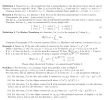 Definition 1 Denote by Lra the straight line that is perpendicular to the direction [cos(a), sin(a)] and at distance r from the origin 0 (0,0). Thus (r, y) is on the line Lr,a if and only if r cos(a) +y sin(a) - Common choices are r E R and 0<a< T. Another potential choice might be r 2 0 and -<aT =r. Remark 2 The line Lr,a is a distance r from (0,0) in the direction perpendicular to [cos(a), sin(a)]....
Definition 1 Denote by Lra the straight line that is perpendicular to the direction [cos(a), sin(a)] and at distanc...
 Definition 1 Denote by Lra the straight line that is perpendicular to the direction [cos(a), sin(a)] and at distance r from the origin 0 (0, 0). Thus (r, y) is on the line Lr.a if and only if r cos (a) y sin(a) = Common choices are r E R and 0 a<T. Another potential choice might be r 2 0 and -T < a < T. Remark 2 The line Lra is a distance r from (0,0) in the...
Definition 1 Denote by Lra the straight line that is perpendicular to the direction [cos(a), sin(a) and at distance...
 Definition 1 Denote by Lra the straight line that is perpendicular to the direction [cos(a), sin(a) and at distance r from the origin 0= (0,0). Thus (z, y) is on the line Lra if and only if r cos(a)+y sin(a) r Common choices are r E R and 0 a<. Another potential choice might be r2 0 and -T<asT. Remark 2 The line Lra is a distance r from (0,0) in the direction perpendicular to [cos(a), sin(a)] Consequently, the point...
Definition 1 Denote by Lra the straight line that is perpendicular to the direction [cos(a), sin(a) and at distance...
 Definition 1 Denote by Lra the straight line that is perpendicular to the direction [cos(a), sin(a) and at distance r from the origin 0= (0,0). Thus (z, y) is on the line Lra if and only if r cos(a)+y sin(a) r Common choices are r E R and 0 a<. Another potential choice might be r2 0 and -T<asT. Remark 2 The line Lra is a distance r from (0,0) in the direction perpendicular to [cos(a), sin(a)] Consequently, the point...
Question 2 (5%). Let L be a line in 3D such that it is perpendicular to...
 Question 2 (5%). Let L be a line in 3D such that it is perpendicular to the plane X - Y - z = 1. Choose the correct answer for vectors which are perpendicular to L. (A) All normal vectors of the plane X – Y – z = 10. (B) All normal vectors of the plane x + 2y + 3z = 3. (C) All vectors parallel to the line (-1,-1,1) ++(-1,-1,1). (D) All vectors parallel to the line...
Please help me to solve part b and c . and please dont copy my answer in part a and then post it ...
 please help me to solve part b and c .
and please dont copy my answer in part a and then post it as
an answer.
thanks
Consider two separate linear regression models and For concreteness, assume that the vector yi contains observations on the wealth ofn randomly selected individuals in Australia and y2 contains observations on the wealth of n randomly selected individuals in New Zealand. The matrix Xi contains n observations on ki explanatory variables which are believed...
please help me to solve part b and c .
and please dont copy my answer in part a and then post it as
an answer.
thanks
Consider two separate linear regression models and For concreteness, assume that the vector yi contains observations on the wealth ofn randomly selected individuals in Australia and y2 contains observations on the wealth of n randomly selected individuals in New Zealand. The matrix Xi contains n observations on ki explanatory variables which are believed...
There are greater errors in predicting Y from X when A. None of the above. B....
There are greater errors in predicting Y from X when A. None of the above. B. All of the above. C. The slope of the regression line is closer to 0. D. The correlation coefficient is closer to 0. E. There is greater spread of Y scores around the regression line.
3. Use the data table below to answer the following questions: (a) The least absolute deviation line for the data i...
 3. Use the data table below to answer the following questions: (a) The least absolute deviation line for the data in the table is y - 1.5x +17. What is the sum of the absolute deviations? (b) Find the median-median regression line for the data in the table. (c) Using the equations for the least absolute deviation line and the median-median regression line determine which model does a better job of predicting the y-value for x 11.* 21 20 38...
I know it's a long question but if you could answer all parts of it that'd...
 I know it's a long question but if you could answer all
parts of it that'd be awesome!!
5) So far in class we have examined the force exerted by a dipole. Now what about the force exerted on a dipole? qc Let's model a dipole as a negative (qA) and a positive (qB) charge linked by a solid bar of length 2L that won't stretch or compress. There is a nearby negative charge (qc) that is a distance d...
I know it's a long question but if you could answer all
parts of it that'd be awesome!!
5) So far in class we have examined the force exerted by a dipole. Now what about the force exerted on a dipole? qc Let's model a dipole as a negative (qA) and a positive (qB) charge linked by a solid bar of length 2L that won't stretch or compress. There is a nearby negative charge (qc) that is a distance d...
The least squares regression line minimizes the sum of theA. Sum of Differences between actual and...
The least squares regression line minimizes the sum of theA. Sum of Differences between actual and predicted Y valuesB. Sum of Squared differences between actual and predicted X valuesC. Sum of Absolute deviations between actual and predicted X valuesD. Sum of Absolute deviations between actual and predicted Y valuesE. Sum of Squared differences between actual and predicted Y values
 Definition 1 Denote by Lra the straight line that is perpendicular to the direction [cos(a), sin(a)] and at distance r from the origin 0 (0,0). Thus (r, y) is on the line Lr,a if and only if r cos(a) +y sin(a) - Common choices are r E R and 0<a< T. Another potential choice might be r 2 0 and -<aT =r. Remark 2 The line Lr,a is a distance r from (0,0) in the direction perpendicular to [cos(a), sin(a)]....
 Definition 1 Denote by Lra the straight line that is perpendicular to the direction [cos(a), sin(a)] and at distance r from the origin 0 (0, 0). Thus (r, y) is on the line Lr.a if and only if r cos (a) y sin(a) = Common choices are r E R and 0 a<T. Another potential choice might be r 2 0 and -T < a < T. Remark 2 The line Lra is a distance r from (0,0) in the...
 Definition 1 Denote by Lra the straight line that is perpendicular to the direction [cos(a), sin(a) and at distance r from the origin 0= (0,0). Thus (z, y) is on the line Lra if and only if r cos(a)+y sin(a) r Common choices are r E R and 0 a<. Another potential choice might be r2 0 and -T<asT. Remark 2 The line Lra is a distance r from (0,0) in the direction perpendicular to [cos(a), sin(a)] Consequently, the point...
 Definition 1 Denote by Lra the straight line that is perpendicular to the direction [cos(a), sin(a) and at distance r from the origin 0= (0,0). Thus (z, y) is on the line Lra if and only if r cos(a)+y sin(a) r Common choices are r E R and 0 a<. Another potential choice might be r2 0 and -T<asT. Remark 2 The line Lra is a distance r from (0,0) in the direction perpendicular to [cos(a), sin(a)] Consequently, the point...
 Question 2 (5%). Let L be a line in 3D such that it is perpendicular to the plane X - Y - z = 1. Choose the correct answer for vectors which are perpendicular to L. (A) All normal vectors of the plane X – Y – z = 10. (B) All normal vectors of the plane x + 2y + 3z = 3. (C) All vectors parallel to the line (-1,-1,1) ++(-1,-1,1). (D) All vectors parallel to the line...
 please help me to solve part b and c .
and please dont copy my answer in part a and then post it as
an answer.
thanks
Consider two separate linear regression models and For concreteness, assume that the vector yi contains observations on the wealth ofn randomly selected individuals in Australia and y2 contains observations on the wealth of n randomly selected individuals in New Zealand. The matrix Xi contains n observations on ki explanatory variables which are believed...
please help me to solve part b and c .
and please dont copy my answer in part a and then post it as
an answer.
thanks
Consider two separate linear regression models and For concreteness, assume that the vector yi contains observations on the wealth ofn randomly selected individuals in Australia and y2 contains observations on the wealth of n randomly selected individuals in New Zealand. The matrix Xi contains n observations on ki explanatory variables which are believed...
 3. Use the data table below to answer the following questions: (a) The least absolute deviation line for the data in the table is y - 1.5x +17. What is the sum of the absolute deviations? (b) Find the median-median regression line for the data in the table. (c) Using the equations for the least absolute deviation line and the median-median regression line determine which model does a better job of predicting the y-value for x 11.* 21 20 38...
 I know it's a long question but if you could answer all
parts of it that'd be awesome!!
5) So far in class we have examined the force exerted by a dipole. Now what about the force exerted on a dipole? qc Let's model a dipole as a negative (qA) and a positive (qB) charge linked by a solid bar of length 2L that won't stretch or compress. There is a nearby negative charge (qc) that is a distance d...
I know it's a long question but if you could answer all
parts of it that'd be awesome!!
5) So far in class we have examined the force exerted by a dipole. Now what about the force exerted on a dipole? qc Let's model a dipole as a negative (qA) and a positive (qB) charge linked by a solid bar of length 2L that won't stretch or compress. There is a nearby negative charge (qc) that is a distance d...
Most questions answered within 3 hours.
-
Where is the error in this code sequence?
String s1 = "Hello";
String s2 = "ello";...
asked 10 months ago -
Financial data for Joel de Paris, Inc., for last year
follow:
Joel de Paris, Inc.
Balance...
asked 10 months ago -
Consider this reaction:
Al2(SO4)3 (aq)+ BaCl3
(aq) Al2Cl6 (aq)- +
3BaSO4(s) . What is the...
asked 10 months ago -
Suppose that Savneet is considering increasing her
recent random sample from 20 car rentals to 40...
asked 10 months ago -
Trucks arrive at an unloading terminal at an average rate of 120
per hour.
Trucks arrive...
asked 10 months ago -
Why are methanol and ethanol completely soluble in water while
octanol is not very little soluble....
asked 10 months ago -
A facilities manager at a university reads in a research report
that the mean amount of...
asked 10 months ago -
When the CuSO4 is rehydrated by adding water to the anhydrous
compound, is this an endothermic...
asked 10 months ago -
A ray of sunlight is passing from diamond into crown glass; the
angle of incidence is...
asked 10 months ago -
A block of mass 0.249 kg is placed on top of a light, vertical
spring of...
asked 10 months ago -
how do the kidneys compensate in the presences of acidosis
a) trigger hyperventilate
b) reserve acid...
asked 10 months ago -
Question 501 pts
The rental rate of capital to the firm increases. Which of the
following...
asked 10 months ago