Symphony no. 5 in C Minor, op. 67 – movement 1: Allegro con brio by Ludwig...
Symphony no. 5 in C Minor, op. 67 – movement 1: Allegro con brio by Ludwig van Beethoven
Homework Answers
Ludwig van Beethoven
Symphony No. 5 in C minor, Op. 67- I. Allegro con brio
It is one of the most popular and recognizable symphonies in the world, Ludwig van Beethoven's SymphonyNo. 5was written between 1804-1808. The four well-known dramatic notes of the opening motif unify the symphony as a whole. Beethoven wrote No. 5, despite grappling with rapidly increasing hearing loss during this time
Add Answer to:
Symphony no. 5 in C Minor, op. 67 – movement 1:
Allegro con brio by Ludwig...
minimize and form TF Problem 1 C(s) 6 2 5 5 1+6 4 5 67
 minimize and form TF
Problem 1 C(s) 6 2 5 5 1+6 4 5 67
minimize and form TF
Problem 1 C(s) 6 2 5 5 1+6 4 5 67
(1) 07.76 c : Minor ONLY (2) 07.76 e: Minor ONLY (3) 07.76 f: Major and...
 (1) 07.76 c : Minor ONLY
(2) 07.76 e: Minor ONLY
(3) 07.76 f: Major and Minor
(4) 07.76 h: Minor ONLY
(5) 07.76 i: Minor ONLY
(6) 07.76 j: Minor ONLY
Practice Problem 07.76c Identify the major and minor product(s) of the following reaction: Br i NaOEt Norden ? If there is more than one minor product, be sure to draw all of them. Practice Problem 07.76e Identify the major and minor product(s) of the following reaction: ohan NaOEt...
(1) 07.76 c : Minor ONLY
(2) 07.76 e: Minor ONLY
(3) 07.76 f: Major and Minor
(4) 07.76 h: Minor ONLY
(5) 07.76 i: Minor ONLY
(6) 07.76 j: Minor ONLY
Practice Problem 07.76c Identify the major and minor product(s) of the following reaction: Br i NaOEt Norden ? If there is more than one minor product, be sure to draw all of them. Practice Problem 07.76e Identify the major and minor product(s) of the following reaction: ohan NaOEt...
Ch 5 Analysis of Ideal Op Amp Circuits 1 of 11> Part B Ideal op amp...
 Ch 5 Analysis of Ideal Op Amp Circuits 1 of 11> Part B Ideal op amp circuits with a voltage source: part 2 Learning Goal: For the circuit shown (Figure 1), determine the range (i.e., maximum and minimum values) of V so that the op amp operates in the linear region. Assume that R1-5 ? . R2-1 kN. R3-60 ? , and V,-15 V To analyze circuits that contain op amps using the ideal op amp assumptions. Express your answer...
PROBLEM 5. Reaction Mechanism 1. Propose products (major/minor) and provide a detaile reaction mechanism to account...
 PROBLEM 5. Reaction Mechanism 1. Propose products (major/minor) and provide a detaile reaction mechanism to account for the formation of the major product. Use curved arrow notation to indicate electron flow. Also, draw a structure of the transition state that accounts for the formation of the major product HЕr он 0° C major minor transition state corresponding to the major product of 20 points
Kritik Assignment 5 Chem 267 1) A. Draw the mechanism that produces the major and minor...
 Kritik Assignment 5 Chem 267 1) A. Draw the mechanism that produces the major and minor products Make sure you add all arrows!!! And watch out for charges on atoms. B. For any step that involves an acid/base or nucleophile/electrophile reaction label the acid/base or nucleophile/electrophile pairs. C. Label the elimination step (E1cb). NaOH/H30 major and minor heat 2) A. Draw the mechanism for the following Claisen Condensation reaction. B. For any step that involves an acid/base or nucleophile/electrophile reaction...
I need help with 1-5 on electrolyte type, major species, and minor species 17-7 Part II....
 I need help with 1-5 on electrolyte type, major species, and
minor species
17-7 Part II. Acids and Bases in Aqueous Solution Sample Conductivity Electrolyte Type Major Species in Solution Minor Species in Solution (if applicable) 1. HC2H2O2(aq) weak 2. HCl(aq) strong 3. NaOH(aq) strong 4. NH3(aq) Week 5. HC2H2O2(aq) + NH3(aq) strong Part III. Reactions in Aqueous Solution Reactants Na2CO3(aq). H2SO4(aq) NaOH(aq) NH3(aq) Pb(CH3O2)(aq) Fe(NO3)3(aq) NH,C,H,O2(aq) H2SO4(aq)
I need help with 1-5 on electrolyte type, major species, and
minor species
17-7 Part II. Acids and Bases in Aqueous Solution Sample Conductivity Electrolyte Type Major Species in Solution Minor Species in Solution (if applicable) 1. HC2H2O2(aq) weak 2. HCl(aq) strong 3. NaOH(aq) strong 4. NH3(aq) Week 5. HC2H2O2(aq) + NH3(aq) strong Part III. Reactions in Aqueous Solution Reactants Na2CO3(aq). H2SO4(aq) NaOH(aq) NH3(aq) Pb(CH3O2)(aq) Fe(NO3)3(aq) NH,C,H,O2(aq) H2SO4(aq)
1. When attempting to develop power and strength for a dynamic movement (throwing. kicking. punch...
 1. When attempting to develop power and strength for a dynamic movement (throwing. kicking. punching), the preferred method of training would be to perform strength development exercises isotonic isokinetic isometric isolateral 2. Which of the following muscles will contract to produce the trunk rotation to the right that is necessary for a left hand throw? 1) right external oblique 2) left external oblique 3) right internal oblique 4) left internal oblique a.1, 3 b.2, 4 c.2, 3 d.1, 4 3....
11 O-I-1 6 2 3 4. LetA=(1 2 3 4) 5 67 8 15 in Nul)?...
 11 O-I-1 6 2 3 4. LetA=(1 2 3 4) 5 67 8 15 in Nul)? Explain. a. Is 14 -23 in Nul(A)? Explain. b. Is in Col(A)? Explain. c. Is 10 5. Let A =(2 2 a. Find the characteristic polynomial of A.
Question 4 (1 point) For the op-amp circuit shown below 20 Ω, CI :: 5 μF,...
 Question 4 (1 point) For the op-amp circuit shown below 20 Ω, CI :: 5 μF, C2 :: 25 nF The circuit is excited by a Triangular wave taveform t4in Table 5.4) with A·5 V, and To. 1 ms. Provide the following (a) An expression for H(w) -V.(w)/V,(w) b) Derive the Fourier series representation of the output v(t c) Calculate the first five terms of volt)
1. Consider the following equilibrium: Cr OP(aq)+H20(1) 5 2Cro2 (aq) + 2H'(aq) a. Predict the shift in system at eq...
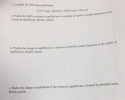 1. Consider the following equilibrium: Cr OP(aq)+H20(1) 5 2Cro2 (aq) + 2H'(aq) a. Predict the shift in system at equilibrium if a solution of AgNO; is added dropwise to the system at equilibrium. Briefly explain. b. Predict the change in equilibrium if a solution of NaOH is added dropwise to the system at equilibrium. Briefly explain. c. Predict the change in equilibrium if the system at equilibrium is diluted by distilled water. Briefly explain.
 minimize and form TF
Problem 1 C(s) 6 2 5 5 1+6 4 5 67
minimize and form TF
Problem 1 C(s) 6 2 5 5 1+6 4 5 67
 (1) 07.76 c : Minor ONLY
(2) 07.76 e: Minor ONLY
(3) 07.76 f: Major and Minor
(4) 07.76 h: Minor ONLY
(5) 07.76 i: Minor ONLY
(6) 07.76 j: Minor ONLY
Practice Problem 07.76c Identify the major and minor product(s) of the following reaction: Br i NaOEt Norden ? If there is more than one minor product, be sure to draw all of them. Practice Problem 07.76e Identify the major and minor product(s) of the following reaction: ohan NaOEt...
(1) 07.76 c : Minor ONLY
(2) 07.76 e: Minor ONLY
(3) 07.76 f: Major and Minor
(4) 07.76 h: Minor ONLY
(5) 07.76 i: Minor ONLY
(6) 07.76 j: Minor ONLY
Practice Problem 07.76c Identify the major and minor product(s) of the following reaction: Br i NaOEt Norden ? If there is more than one minor product, be sure to draw all of them. Practice Problem 07.76e Identify the major and minor product(s) of the following reaction: ohan NaOEt...
 Ch 5 Analysis of Ideal Op Amp Circuits 1 of 11> Part B Ideal op amp circuits with a voltage source: part 2 Learning Goal: For the circuit shown (Figure 1), determine the range (i.e., maximum and minimum values) of V so that the op amp operates in the linear region. Assume that R1-5 ? . R2-1 kN. R3-60 ? , and V,-15 V To analyze circuits that contain op amps using the ideal op amp assumptions. Express your answer...
 PROBLEM 5. Reaction Mechanism 1. Propose products (major/minor) and provide a detaile reaction mechanism to account for the formation of the major product. Use curved arrow notation to indicate electron flow. Also, draw a structure of the transition state that accounts for the formation of the major product HЕr он 0° C major minor transition state corresponding to the major product of 20 points
 Kritik Assignment 5 Chem 267 1) A. Draw the mechanism that produces the major and minor products Make sure you add all arrows!!! And watch out for charges on atoms. B. For any step that involves an acid/base or nucleophile/electrophile reaction label the acid/base or nucleophile/electrophile pairs. C. Label the elimination step (E1cb). NaOH/H30 major and minor heat 2) A. Draw the mechanism for the following Claisen Condensation reaction. B. For any step that involves an acid/base or nucleophile/electrophile reaction...
 I need help with 1-5 on electrolyte type, major species, and
minor species
17-7 Part II. Acids and Bases in Aqueous Solution Sample Conductivity Electrolyte Type Major Species in Solution Minor Species in Solution (if applicable) 1. HC2H2O2(aq) weak 2. HCl(aq) strong 3. NaOH(aq) strong 4. NH3(aq) Week 5. HC2H2O2(aq) + NH3(aq) strong Part III. Reactions in Aqueous Solution Reactants Na2CO3(aq). H2SO4(aq) NaOH(aq) NH3(aq) Pb(CH3O2)(aq) Fe(NO3)3(aq) NH,C,H,O2(aq) H2SO4(aq)
I need help with 1-5 on electrolyte type, major species, and
minor species
17-7 Part II. Acids and Bases in Aqueous Solution Sample Conductivity Electrolyte Type Major Species in Solution Minor Species in Solution (if applicable) 1. HC2H2O2(aq) weak 2. HCl(aq) strong 3. NaOH(aq) strong 4. NH3(aq) Week 5. HC2H2O2(aq) + NH3(aq) strong Part III. Reactions in Aqueous Solution Reactants Na2CO3(aq). H2SO4(aq) NaOH(aq) NH3(aq) Pb(CH3O2)(aq) Fe(NO3)3(aq) NH,C,H,O2(aq) H2SO4(aq)
 1. When attempting to develop power and strength for a dynamic movement (throwing. kicking. punching), the preferred method of training would be to perform strength development exercises isotonic isokinetic isometric isolateral 2. Which of the following muscles will contract to produce the trunk rotation to the right that is necessary for a left hand throw? 1) right external oblique 2) left external oblique 3) right internal oblique 4) left internal oblique a.1, 3 b.2, 4 c.2, 3 d.1, 4 3....
 11 O-I-1 6 2 3 4. LetA=(1 2 3 4) 5 67 8 15 in Nul)? Explain. a. Is 14 -23 in Nul(A)? Explain. b. Is in Col(A)? Explain. c. Is 10 5. Let A =(2 2 a. Find the characteristic polynomial of A.
 Question 4 (1 point) For the op-amp circuit shown below 20 Ω, CI :: 5 μF, C2 :: 25 nF The circuit is excited by a Triangular wave taveform t4in Table 5.4) with A·5 V, and To. 1 ms. Provide the following (a) An expression for H(w) -V.(w)/V,(w) b) Derive the Fourier series representation of the output v(t c) Calculate the first five terms of volt)
 1. Consider the following equilibrium: Cr OP(aq)+H20(1) 5 2Cro2 (aq) + 2H'(aq) a. Predict the shift in system at equilibrium if a solution of AgNO; is added dropwise to the system at equilibrium. Briefly explain. b. Predict the change in equilibrium if a solution of NaOH is added dropwise to the system at equilibrium. Briefly explain. c. Predict the change in equilibrium if the system at equilibrium is diluted by distilled water. Briefly explain.
Most questions answered within 3 hours.
-
Where is the error in this code sequence?
String s1 = "Hello";
String s2 = "ello";...
asked 11 months ago -
Financial data for Joel de Paris, Inc., for last year
follow:
Joel de Paris, Inc.
Balance...
asked 11 months ago -
Consider this reaction:
Al2(SO4)3 (aq)+ BaCl3
(aq) Al2Cl6 (aq)- +
3BaSO4(s) . What is the...
asked 11 months ago -
Suppose that Savneet is considering increasing her
recent random sample from 20 car rentals to 40...
asked 11 months ago -
Trucks arrive at an unloading terminal at an average rate of 120
per hour.
Trucks arrive...
asked 11 months ago -
Why are methanol and ethanol completely soluble in water while
octanol is not very little soluble....
asked 11 months ago -
A facilities manager at a university reads in a research report
that the mean amount of...
asked 11 months ago -
When the CuSO4 is rehydrated by adding water to the anhydrous
compound, is this an endothermic...
asked 11 months ago -
A ray of sunlight is passing from diamond into crown glass; the
angle of incidence is...
asked 11 months ago -
A block of mass 0.249 kg is placed on top of a light, vertical
spring of...
asked 11 months ago -
how do the kidneys compensate in the presences of acidosis
a) trigger hyperventilate
b) reserve acid...
asked 11 months ago -
Question 501 pts
The rental rate of capital to the firm increases. Which of the
following...
asked 11 months ago