14% of M&M are the brown ones that nobody wants. suppose that 7 M&M are selected...
14% of M&M are the brown ones that nobody wants. suppose that 7 M&M are selected at random, and let x be the number of M&M out of the 7 that are brown. use the binomial probability formula to find the probability that 2 of the M&M will be brown. Find p(x=2)
Homework Answers
Solution
Given that ,
p = 0.14
q = 1 - p = 1 - 0.14=0.86
n = 7
Using binomial probability formula ,
P(X = x) = (n C x) * p x * (1 - p)n - x
P(X = 2) = (7 C 2) * 0.142 * (0.86)7 -2
probability=0.1936
Add Answer to:
14% of M&M are the brown ones that nobody wants. suppose
that 7 M&M are selected...
The proportion of brown M&M’s in a milk chocolate packet is approximately 14% (Madison, 2013). Suppose...
The proportion of brown M&M’s in a milk chocolate packet is approximately 14% (Madison, 2013). Suppose a package of M&M’s typically contains 52 M&M’s. a.) State the random variable. b.) Argue that this is a binomial experiment Find the probability that c.) Six M&M’s are brown- d.) Twenty-five M&M’s are brown- e.) All of the M&M’s are brown. f.) Would it be unusual for a package to have only brown M&M’s? If this were to happen, what would you think...
3. Suppose a batch of 50 items contains 4 defective ones, and a sample of 5...
 3. Suppose a batch of 50 items contains 4 defective ones, and a sample of 5 items is selected at random from the batch. Let X denote the number of defective items in the sample. (a) What is the name of the distribution of X? (b) Find the probability mass function for X. You may write this as a function or as a chart. If you write it as a function, also give the set of X values where the...
Suppose a large class of 75 students is made up of 45 females and 30 males....
Suppose a large class of 75 students is made up of 45 females and 30 males. The teacher randomly selects 5 different students to present homework solutions in front of the class. let X = the number of females among the 5 selected. a) find the mean and variance of this random variable x. b) find P(X=2) show formula setup c) approximate P(X=2) by a binomial approximation (show setup)
Part Two. Can you help me with the binomial probability distribution? Please see instructions below. Please...
 Part Two. Can you help me with the binomial probability
distribution? Please see instructions below.
Please show all steps to understand better. Thank you in
advance.
5. Use the binomial distribution table to find the binomial probabilities for these cases: a) n=10, p=1, k= 3 b) n=14, p = 6, k = 7 c) n =25, p=5, k = 14 6. Consider a binomial experiment with n = 20 and p=0.70. Use the binomial formula to calculate: a) P(x =...
Part Two. Can you help me with the binomial probability
distribution? Please see instructions below.
Please show all steps to understand better. Thank you in
advance.
5. Use the binomial distribution table to find the binomial probabilities for these cases: a) n=10, p=1, k= 3 b) n=14, p = 6, k = 7 c) n =25, p=5, k = 14 6. Consider a binomial experiment with n = 20 and p=0.70. Use the binomial formula to calculate: a) P(x =...
Suppose a random variable, x, arises from a binomial experiment. If n = 14, and p...
Suppose a random variable, x, arises from a binomial experiment. If n = 14, and p = 0.13, find the following probabilities using the binomial formula. a.) P( x = 5) b.) P( x = 8) c.) P( x = 12) d.) P( x ≤ 4) e.) P( x ≥ 8) f.) P( x ≤12)
1. Suppose that random variables X and Y are independent and have the following properties: E(X)...
1. Suppose that random variables X and Y are independent and have the following properties: E(X) = 5, Var(X) = 2, E(Y ) = −2, E(Y 2) = 7. Compute the following. (a) E(X + Y ). (b) Var(2X − 3Y ) (c) E(X2 + 5) (d) The standard deviation of Y . 2. Consider the following data set: �x = {90, 88, 93, 87, 85, 95, 92} (a) Compute x¯. (b) Compute the standard deviation of this set. 3....
In one city, 20% of the population has a college education. Three people are selected at...
 In one city, 20% of the population has a college education. Three people are selected at random from the city. Find the probability distribution of X, the number among the three that have a college education. A. Identify then and the p for this distribution. p B. Let the random variable x be the possible number of people selected with a college degree. Develop a binomial distribution by finding P(x) when x = 0, 1, 2, and 3. XP(x) 0...
5. There are 7 red marbles and 3 blue ones in a jar. We randomly take...
 5. There are 7 red marbles and 3 blue ones in a jar. We randomly take out marbles from the jar without replacement, which means that we do not put any marbles back into the jar after they are taken out. MATH 32: Probability & Statistics Fall Semester 2019 (a) We take out 3 marbles. Let X be the number of red marbles among the three. Does X have a binomial distribution? Why or why not? (b) Let Y be...
Approximately 20% of the lightbulbs produced by a company are defective (and the rest are non-defective)....
Approximately 20% of the lightbulbs produced by a company are defective (and the rest are non-defective). Suppose 3 lightbulbs are selected randomly. Let Y be the random variable showing number of defective lightbulbs. a)Complete the following probability distribution given in the following table. (You can use binomial distribution formula) y p(y) 0 0.512 1 2 3 0.008 Find the mean and variance of the above probability distribution
Suppose that X is uniformly selected from the numbers 1, 2, 3 (that is, P(X =...
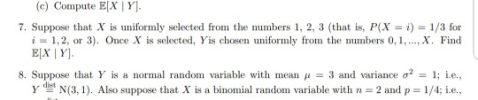 Suppose that X is uniformly selected from the numbers
1, 2, 3 (that is, P(X = i) = 1/3 for
i = 1, 2, or 3). Once X is selected, Y is chosen uniformly from the
numbers 0, 1, ..., X. Find
E[X | Y ].
(c) Compute EX Y 7. Suppose that X is uniformly selected from the numbers 1, 2, 3 (that is, P(X- i) 1/3 for ,X. Find i = 1,2, or 3). Once X is selected,...
Suppose that X is uniformly selected from the numbers
1, 2, 3 (that is, P(X = i) = 1/3 for
i = 1, 2, or 3). Once X is selected, Y is chosen uniformly from the
numbers 0, 1, ..., X. Find
E[X | Y ].
(c) Compute EX Y 7. Suppose that X is uniformly selected from the numbers 1, 2, 3 (that is, P(X- i) 1/3 for ,X. Find i = 1,2, or 3). Once X is selected,...
 3. Suppose a batch of 50 items contains 4 defective ones, and a sample of 5 items is selected at random from the batch. Let X denote the number of defective items in the sample. (a) What is the name of the distribution of X? (b) Find the probability mass function for X. You may write this as a function or as a chart. If you write it as a function, also give the set of X values where the...
 Part Two. Can you help me with the binomial probability
distribution? Please see instructions below.
Please show all steps to understand better. Thank you in
advance.
5. Use the binomial distribution table to find the binomial probabilities for these cases: a) n=10, p=1, k= 3 b) n=14, p = 6, k = 7 c) n =25, p=5, k = 14 6. Consider a binomial experiment with n = 20 and p=0.70. Use the binomial formula to calculate: a) P(x =...
Part Two. Can you help me with the binomial probability
distribution? Please see instructions below.
Please show all steps to understand better. Thank you in
advance.
5. Use the binomial distribution table to find the binomial probabilities for these cases: a) n=10, p=1, k= 3 b) n=14, p = 6, k = 7 c) n =25, p=5, k = 14 6. Consider a binomial experiment with n = 20 and p=0.70. Use the binomial formula to calculate: a) P(x =...
 In one city, 20% of the population has a college education. Three people are selected at random from the city. Find the probability distribution of X, the number among the three that have a college education. A. Identify then and the p for this distribution. p B. Let the random variable x be the possible number of people selected with a college degree. Develop a binomial distribution by finding P(x) when x = 0, 1, 2, and 3. XP(x) 0...
 5. There are 7 red marbles and 3 blue ones in a jar. We randomly take out marbles from the jar without replacement, which means that we do not put any marbles back into the jar after they are taken out. MATH 32: Probability & Statistics Fall Semester 2019 (a) We take out 3 marbles. Let X be the number of red marbles among the three. Does X have a binomial distribution? Why or why not? (b) Let Y be...
 Suppose that X is uniformly selected from the numbers
1, 2, 3 (that is, P(X = i) = 1/3 for
i = 1, 2, or 3). Once X is selected, Y is chosen uniformly from the
numbers 0, 1, ..., X. Find
E[X | Y ].
(c) Compute EX Y 7. Suppose that X is uniformly selected from the numbers 1, 2, 3 (that is, P(X- i) 1/3 for ,X. Find i = 1,2, or 3). Once X is selected,...
Suppose that X is uniformly selected from the numbers
1, 2, 3 (that is, P(X = i) = 1/3 for
i = 1, 2, or 3). Once X is selected, Y is chosen uniformly from the
numbers 0, 1, ..., X. Find
E[X | Y ].
(c) Compute EX Y 7. Suppose that X is uniformly selected from the numbers 1, 2, 3 (that is, P(X- i) 1/3 for ,X. Find i = 1,2, or 3). Once X is selected,...
Most questions answered within 3 hours.
-
Where is the error in this code sequence?
String s1 = "Hello";
String s2 = "ello";...
asked 11 months ago -
Financial data for Joel de Paris, Inc., for last year
follow:
Joel de Paris, Inc.
Balance...
asked 11 months ago -
Consider this reaction:
Al2(SO4)3 (aq)+ BaCl3
(aq) Al2Cl6 (aq)- +
3BaSO4(s) . What is the...
asked 11 months ago -
Suppose that Savneet is considering increasing her
recent random sample from 20 car rentals to 40...
asked 11 months ago -
Trucks arrive at an unloading terminal at an average rate of 120
per hour.
Trucks arrive...
asked 11 months ago -
Why are methanol and ethanol completely soluble in water while
octanol is not very little soluble....
asked 11 months ago -
A facilities manager at a university reads in a research report
that the mean amount of...
asked 11 months ago -
When the CuSO4 is rehydrated by adding water to the anhydrous
compound, is this an endothermic...
asked 11 months ago -
A ray of sunlight is passing from diamond into crown glass; the
angle of incidence is...
asked 11 months ago -
A block of mass 0.249 kg is placed on top of a light, vertical
spring of...
asked 11 months ago -
how do the kidneys compensate in the presences of acidosis
a) trigger hyperventilate
b) reserve acid...
asked 11 months ago -
Question 501 pts
The rental rate of capital to the firm increases. Which of the
following...
asked 11 months ago