Which of the following signaling components directly amplify the signal? (can select more than one) a....
Which of the following signaling components directly amplify the signal? (can select more than one)
a. protein kinases
b. receptor tyrosine kinases
c. first messengers
d. second messengers
e. signaling domains
Homework Answers
d. Second messengers:
An significant characteristic of the second messenger signaling scheme is that it is possible to couple second messengers downstream to multi-cyclic kinase cascades to significantly amplify the power of the initial first messenger. Example: RasGTP signals, connected to the MAPK cascade to amplify the allosteric activation of transcription elements like Myc and CREB.
b. Receptor Tyrosine Kinases:
RTK are basically receptors and they can also act as signal amplifiers. Example: As with GPCRs, GTP-binding proteins play an important part in signal transduction from the activated RTK into the cell. GPCR assigns proteins to particular subdomains of membranes where they engage in signaling when activated. Small G proteins that activate guanine nucleotide exchange factors like SOS1 are activated by activated RTKs in turn. These exchange variables can activate smaller G proteins once activated, thereby amplifying the original signal of the receptor.
Add Answer to:
Which of the following signaling components directly amplify the
signal? (can select more than one)
a....
Which of the following signaling pathways usually use G protein to transduce the signal? Select one:...
 Which of the following signaling pathways usually use G protein to transduce the signal? Select one: O a. Channel-linked receptor pathways O b. Receptor tyrosine kinase pathways O c. Steroid hormone receptor pathways
Which of the following statements accurately describe receptor tyrosine kinases (RTKs)? There is more than one...
Which of the following statements accurately describe receptor tyrosine kinases (RTKs)? There is more than one correct answer. Select all the true statements. A) A ligand binds to the extracellular domain. B) RTKs are usually (but not always) monomeric in the absence of ligand. C) Ligand binding is required for autophosphorylation (cross-phosphorylation). D) The intracellular domain has phosphatase domains. E) The alpha subunit contains seven alpha helices that span the membrane. F) The structure includes a transmembrane helix.
help with 7-10 Question 7 1 pts Phosphorylation of kinases in one location can result in activation, while phosphor...
 help
with 7-10
Question 7 1 pts Phosphorylation of kinases in one location can result in activation, while phosphorylation in another location on the same protein can result in deactivation of the enzyme. True False Question 8 2 pts Dephosphorylation, or removal of a phosphate group, is accomplished with the help of a both kinases and phosphatases neither kinases not phosphatases phosphatase kinase Question 9 1 pts Select all of the following that act as second messengers. D DAG CAMP...
help
with 7-10
Question 7 1 pts Phosphorylation of kinases in one location can result in activation, while phosphorylation in another location on the same protein can result in deactivation of the enzyme. True False Question 8 2 pts Dephosphorylation, or removal of a phosphate group, is accomplished with the help of a both kinases and phosphatases neither kinases not phosphatases phosphatase kinase Question 9 1 pts Select all of the following that act as second messengers. D DAG CAMP...
A. B. C. D. E. F. Thank you receptors induce activation of adenlyate cyclase, which creates...
 A. B. C. D. E. F. Thank you
receptors induce activation of adenlyate cyclase, which creates the second messenger(s) O G-Protein Coupled, CAMP O Tyrosine Kinase, CAMP OTyrosine Kinase, IP3 and DAG G-Protein Coupled, IP3 and DAG Which of the following is most likely to be activated by a small hydrophobic signal? OIntracellular receptor Receptor Tyrosine Kinase O G-Protein Coupled Receptor Ligand-Gated lon Channel Which of the following types of receptors require dimerization for activation? (Select any/all that apply) OLigand-gated...
A. B. C. D. E. F. Thank you
receptors induce activation of adenlyate cyclase, which creates the second messenger(s) O G-Protein Coupled, CAMP O Tyrosine Kinase, CAMP OTyrosine Kinase, IP3 and DAG G-Protein Coupled, IP3 and DAG Which of the following is most likely to be activated by a small hydrophobic signal? OIntracellular receptor Receptor Tyrosine Kinase O G-Protein Coupled Receptor Ligand-Gated lon Channel Which of the following types of receptors require dimerization for activation? (Select any/all that apply) OLigand-gated...
Signal amplification is an essential step in signal transduction. Which of the following steps of signal...
Signal amplification is an essential step in signal transduction. Which of the following steps of signal transduction amplify the signal (select all that apply)? Group of answer choices a) ligand binding to receptor b) release of GTP bound form of G protein from receptor c) binding of GTP bound form of G protein to target enzyme d) generation of second messenger by activated target enzyme e) activation of gene expression
2. The following is a description of a signaling pathway initiated by receptor tyrosine kinases. Ligand → RTK → Sos → Ras → Raf → MEK → ERK → Transcription factor → Cell growth A. (3pts) Which of the...
 2. The following is a description of a signaling pathway initiated by receptor tyrosine kinases. Ligand → RTK → Sos → Ras → Raf → MEK → ERK → Transcription factor → Cell growth A. (3pts) Which of these steps indicates the protein is activated after a GTP exchange step? B. (3pts) Which of these proteins can be deactivated by phosphatases? C. (4pts) Describe a mutation that would cause Ras to be permanently "on"? Would this mutation lead to high...
Although each class of extracellular receptors can respond to a wide variety of signals, certain types...
 Although each class of extracellular receptors can respond to a wide variety of signals, certain types of responses are more frequently elicited by the different classes Mutations in the downstream signalling cascade of which type of receptors are most likely to be associated with the development and progression of cancer? Enzyme-coupled receptors protein coupled receptors lon-channel coupled receptors You are the first scientist to study the signaling pathway regulating a particular cellular response, so very little is known about the...
Which of the following best describe Recombination Signal Sequence (RSS) events Select one or more: A....
Which of the following best describe Recombination Signal Sequence (RSS) events Select one or more: A. Always productive B. RAG1,2 C. External signal regulation D. IL-7 receptor E. T cell dependent F. Alters antigen specificity G. Alters biological specificity H. Signal joint I. Permanent loss of DNA J. Heavy cain constant domains K. Coding joint L. high likelihood of frame-shift M. AID
d is incorrect 30. Place the events that occur during GPCR signaling in order. Which step...
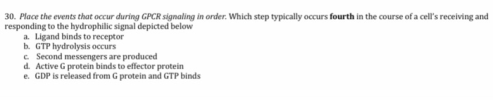 d
is incorrect
30. Place the events that occur during GPCR signaling in order. Which step typically occurs fourth in the course of a cell's receiving and responding to the hydrophilic signal depicted below a. Ligand binds to receptor b. GTP hydrolysis occurs c. Second messengers are produced d. Active G protein binds to effector protein e. GDP is released from G protein and GTP binds GP Cytoplasm C binding proti C
d
is incorrect
30. Place the events that occur during GPCR signaling in order. Which step typically occurs fourth in the course of a cell's receiving and responding to the hydrophilic signal depicted below a. Ligand binds to receptor b. GTP hydrolysis occurs c. Second messengers are produced d. Active G protein binds to effector protein e. GDP is released from G protein and GTP binds GP Cytoplasm C binding proti C
d is incorrect 30. Place the events that occur during GPCR signaling in order. Which step...
 d is incorrect
30. Place the events that occur during GPCR signaling in order. Which step typically occurs fourth in the course of a cell's receiving and responding to the hydrophilic signal depicted below a. Ligand binds to receptor b. GTP hydrolysis occurs c. Second messengers are produced d. Active G protein binds to effector protein e. GDP is released from G protein and GTP binds Cytoplasm C binding progin Call response
d is incorrect
30. Place the events that occur during GPCR signaling in order. Which step typically occurs fourth in the course of a cell's receiving and responding to the hydrophilic signal depicted below a. Ligand binds to receptor b. GTP hydrolysis occurs c. Second messengers are produced d. Active G protein binds to effector protein e. GDP is released from G protein and GTP binds Cytoplasm C binding progin Call response
 Which of the following signaling pathways usually use G protein to transduce the signal? Select one: O a. Channel-linked receptor pathways O b. Receptor tyrosine kinase pathways O c. Steroid hormone receptor pathways
 help
with 7-10
Question 7 1 pts Phosphorylation of kinases in one location can result in activation, while phosphorylation in another location on the same protein can result in deactivation of the enzyme. True False Question 8 2 pts Dephosphorylation, or removal of a phosphate group, is accomplished with the help of a both kinases and phosphatases neither kinases not phosphatases phosphatase kinase Question 9 1 pts Select all of the following that act as second messengers. D DAG CAMP...
help
with 7-10
Question 7 1 pts Phosphorylation of kinases in one location can result in activation, while phosphorylation in another location on the same protein can result in deactivation of the enzyme. True False Question 8 2 pts Dephosphorylation, or removal of a phosphate group, is accomplished with the help of a both kinases and phosphatases neither kinases not phosphatases phosphatase kinase Question 9 1 pts Select all of the following that act as second messengers. D DAG CAMP...
 A. B. C. D. E. F. Thank you
receptors induce activation of adenlyate cyclase, which creates the second messenger(s) O G-Protein Coupled, CAMP O Tyrosine Kinase, CAMP OTyrosine Kinase, IP3 and DAG G-Protein Coupled, IP3 and DAG Which of the following is most likely to be activated by a small hydrophobic signal? OIntracellular receptor Receptor Tyrosine Kinase O G-Protein Coupled Receptor Ligand-Gated lon Channel Which of the following types of receptors require dimerization for activation? (Select any/all that apply) OLigand-gated...
A. B. C. D. E. F. Thank you
receptors induce activation of adenlyate cyclase, which creates the second messenger(s) O G-Protein Coupled, CAMP O Tyrosine Kinase, CAMP OTyrosine Kinase, IP3 and DAG G-Protein Coupled, IP3 and DAG Which of the following is most likely to be activated by a small hydrophobic signal? OIntracellular receptor Receptor Tyrosine Kinase O G-Protein Coupled Receptor Ligand-Gated lon Channel Which of the following types of receptors require dimerization for activation? (Select any/all that apply) OLigand-gated...
 2. The following is a description of a signaling pathway initiated by receptor tyrosine kinases. Ligand → RTK → Sos → Ras → Raf → MEK → ERK → Transcription factor → Cell growth A. (3pts) Which of these steps indicates the protein is activated after a GTP exchange step? B. (3pts) Which of these proteins can be deactivated by phosphatases? C. (4pts) Describe a mutation that would cause Ras to be permanently "on"? Would this mutation lead to high...
 Although each class of extracellular receptors can respond to a wide variety of signals, certain types of responses are more frequently elicited by the different classes Mutations in the downstream signalling cascade of which type of receptors are most likely to be associated with the development and progression of cancer? Enzyme-coupled receptors protein coupled receptors lon-channel coupled receptors You are the first scientist to study the signaling pathway regulating a particular cellular response, so very little is known about the...
 d
is incorrect
30. Place the events that occur during GPCR signaling in order. Which step typically occurs fourth in the course of a cell's receiving and responding to the hydrophilic signal depicted below a. Ligand binds to receptor b. GTP hydrolysis occurs c. Second messengers are produced d. Active G protein binds to effector protein e. GDP is released from G protein and GTP binds GP Cytoplasm C binding proti C
d
is incorrect
30. Place the events that occur during GPCR signaling in order. Which step typically occurs fourth in the course of a cell's receiving and responding to the hydrophilic signal depicted below a. Ligand binds to receptor b. GTP hydrolysis occurs c. Second messengers are produced d. Active G protein binds to effector protein e. GDP is released from G protein and GTP binds GP Cytoplasm C binding proti C
 d is incorrect
30. Place the events that occur during GPCR signaling in order. Which step typically occurs fourth in the course of a cell's receiving and responding to the hydrophilic signal depicted below a. Ligand binds to receptor b. GTP hydrolysis occurs c. Second messengers are produced d. Active G protein binds to effector protein e. GDP is released from G protein and GTP binds Cytoplasm C binding progin Call response
d is incorrect
30. Place the events that occur during GPCR signaling in order. Which step typically occurs fourth in the course of a cell's receiving and responding to the hydrophilic signal depicted below a. Ligand binds to receptor b. GTP hydrolysis occurs c. Second messengers are produced d. Active G protein binds to effector protein e. GDP is released from G protein and GTP binds Cytoplasm C binding progin Call response
Most questions answered within 3 hours.
-
Where is the error in this code sequence?
String s1 = "Hello";
String s2 = "ello";...
asked 11 months ago -
Financial data for Joel de Paris, Inc., for last year
follow:
Joel de Paris, Inc.
Balance...
asked 11 months ago -
Consider this reaction:
Al2(SO4)3 (aq)+ BaCl3
(aq) Al2Cl6 (aq)- +
3BaSO4(s) . What is the...
asked 11 months ago -
Suppose that Savneet is considering increasing her
recent random sample from 20 car rentals to 40...
asked 11 months ago -
Trucks arrive at an unloading terminal at an average rate of 120
per hour.
Trucks arrive...
asked 11 months ago -
Why are methanol and ethanol completely soluble in water while
octanol is not very little soluble....
asked 11 months ago -
A facilities manager at a university reads in a research report
that the mean amount of...
asked 11 months ago -
When the CuSO4 is rehydrated by adding water to the anhydrous
compound, is this an endothermic...
asked 11 months ago -
A ray of sunlight is passing from diamond into crown glass; the
angle of incidence is...
asked 11 months ago -
A block of mass 0.249 kg is placed on top of a light, vertical
spring of...
asked 11 months ago -
how do the kidneys compensate in the presences of acidosis
a) trigger hyperventilate
b) reserve acid...
asked 11 months ago -
Question 501 pts
The rental rate of capital to the firm increases. Which of the
following...
asked 11 months ago