A spacecraft is moving in gravity-free space along a straight path when its pilot decides to...
A spacecraft is moving in gravity-free space along a straight path when its pilot decides to accelerate forward. He turns on the thrusters, and burned fuel is ejected at a constant rate of 3.0 × 10² kg/s, at a speed (relative to the rocket) of 2.0 × 10² m/s. The initial mass of the spacecraft and its unburned fuel is 3.0 × 10⁴ kg, the initial fuel mass is 104 kg, and the thrusters are on for 30 s. (a) What is the spacecrafts acceleration as a function of time? (b) What are the spacecraft’s 52 4.5 Exercises accelerations at t = 0, 15, 30, and 35 s? (c) What is the thrust (the force applied to the rocket by the ejected fuel) on the spacecraft?
Homework Answers
Derivation of acceleration formula in a general case is given in
the image: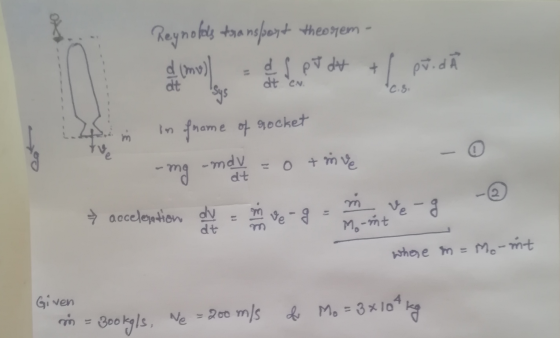
And because It is a gravity free space, ie. g=0
Thus acceleration = 
a) Putting the values acceleration as a time function
acceleration =  -Ans
-Ans
b)
at t=0 acceleration =  -Ans
-Ans
at t=15 acceleration =  -Ans
-Ans
at t=30 acceleration =  -Ans
-Ans
After t=30s the thrusters are turned off
thus at t=35 accleration =  -Ans
-Ans
c) Thrust by rocket is given by ejected burned fuel and is equal to right hand side of eq(1)
Ie Thrust =  -Ans
-Ans
Ps: If this answer was helpful, I would really appreciate your upvote. Thanks:)
Add Answer to:
A spacecraft is moving in gravity-free space along a straight
path when its pilot decides to...
A robotic spacecraft is flying in interstellar space on a straight line with a constant speed...
 A robotic spacecraft is flying in interstellar space on a straight line with a constant speed of 77.6 km/s. (See figure.) This speed is measured with respect to the space station the spacecraft was originally launched from. In interstellar space the gravitational pull from the stars is negligible, because the stars are extremely far. The spacecraft turns its main rocket engine on for a time period of 6.9 hours. The rocket engine provides a thrust of 936 N of force....
What are the Solutions to Part B of Chapter 2 of Tillery Physics 9th edition.......kinda pointless...
What are the Solutions to Part B of Chapter 2 of Tillery Physics 9th edition.......kinda pointless for you guys to only have the solutions that the book has already. 1. What was the average speed in km/h of a car that travels 400.0 km in 4.5 h? 2. What was the average speed in km/h of a boat that moves 15.0 km across a lake in 45 min? 3. How much would a 80.0 kg person weigh (a) on Mars,...
 A robotic spacecraft is flying in interstellar space on a straight line with a constant speed of 77.6 km/s. (See figure.) This speed is measured with respect to the space station the spacecraft was originally launched from. In interstellar space the gravitational pull from the stars is negligible, because the stars are extremely far. The spacecraft turns its main rocket engine on for a time period of 6.9 hours. The rocket engine provides a thrust of 936 N of force....
Most questions answered within 3 hours.
-
Where is the error in this code sequence?
String s1 = "Hello";
String s2 = "ello";...
asked 11 months ago -
Financial data for Joel de Paris, Inc., for last year
follow:
Joel de Paris, Inc.
Balance...
asked 11 months ago -
Consider this reaction:
Al2(SO4)3 (aq)+ BaCl3
(aq) Al2Cl6 (aq)- +
3BaSO4(s) . What is the...
asked 11 months ago -
Suppose that Savneet is considering increasing her
recent random sample from 20 car rentals to 40...
asked 11 months ago -
Trucks arrive at an unloading terminal at an average rate of 120
per hour.
Trucks arrive...
asked 11 months ago -
Why are methanol and ethanol completely soluble in water while
octanol is not very little soluble....
asked 11 months ago -
A facilities manager at a university reads in a research report
that the mean amount of...
asked 11 months ago -
When the CuSO4 is rehydrated by adding water to the anhydrous
compound, is this an endothermic...
asked 11 months ago -
A ray of sunlight is passing from diamond into crown glass; the
angle of incidence is...
asked 11 months ago -
A block of mass 0.249 kg is placed on top of a light, vertical
spring of...
asked 11 months ago -
how do the kidneys compensate in the presences of acidosis
a) trigger hyperventilate
b) reserve acid...
asked 11 months ago -
Question 501 pts
The rental rate of capital to the firm increases. Which of the
following...
asked 11 months ago