Question 1 (1 point) Saved Ultrasonic sound that travels at 1530 m/s in ocean water is...
Question 1 (1 point)
Saved
Ultrasonic sound that travels at 1530 m/s in ocean water is bounced off the ocean floor and returns to the ship above. If the round trip takes 3 s, the depth of the water is
Question 1 options:
|
2295 m. |
|
|
1530 m. |
|
|
3060 m. |
|
|
4590 m. |
Question 2 (1 point)
Saved
A bass fiddle is louder than a harp because of its
Question 2 options:
|
sounding board. |
|
|
thicker strings. |
|
|
lower pitch. |
|
|
all of the above |
|
|
none of the above |
Question 3 (1 point)
Saved
A 60 vibration per second wave travels 30 m in 1 s. Its frequency is
Question 3 options:
|
30 Hz and it travels at 60 m/s. |
|
|
60 Hz and it travels at 30 m/s. |
|
|
neither |
Question 4 (1 point)
Saved
Two tuning forks produce sounds of wavelengths 3.4 m and 3.3 m. What beat frequency is produced?
Question 4 options:
|
2.0 Hz |
|
|
1.0 Hz |
|
|
0.1 Hz |
|
|
4.0 Hz |
|
|
3.0 Hz |
Question 5 (1 point)
Saved
Resonance can be viewed as forced vibration with the
Question 5 options:
|
maximum amount of energy input. |
|
|
minimum beat frequency. |
|
|
matching of wave amplitudes. |
|
|
least amount of energy input. |
|
|
matching of constructive and destructive interference. |
Question 6 (1 point)
Saved
The explanation for all types of refraction involves a change in
Question 6 options:
|
speed. |
|
|
period. |
|
|
frequency. |
|
|
all of the above |
|
|
none of the above |
Question 7 (1 point)
Saved
A skipper on a boat notices wave crests passing the anchor chain every 5 s. The skipper estimates the distance between crests is 15 m. What is the speed of the water waves?
Question 7 options:
|
15 m/s |
|
|
3 m/s |
|
|
5 m/s |
|
|
not enough information |
Question 8 (1 point)
Saved
Sound travels fastest in
Question 8 options:
|
ice |
|
|
water vapor |
|
|
water |
Question 9 (1 point)
Saved
A compression is a squash and a rarefaction is a
Question 9 options:
|
reverse tension. |
|
|
crunch. |
|
|
stretch. |
Question 10 (1 point)
Saved
For light, a red shift indicates the light source moves
Question 10 options:
|
toward you. |
|
|
at right angles to you. |
|
|
away from you. |
|
|
all of the above |
|
|
none of the above |
Question 11 (1 point)
Saved
On days when the air nearest the ground is colder than air above, sound waves
Question 11 options:
|
tend to be refracted upward. |
|
|
travel without refraction. |
|
|
tend to be refracted downward. |
Question 12 (1 point)
Saved
Sound waves can interfere with one another so that no sound is produced.
Question 12 options:
|
True |
|
|
False |
Question 13 (1 point)
Saved
How many vibrations per second are associated with a 101-MHz radio wave?
Question 13 options:
|
more than 101,000,00 |
|
|
101,000,000 |
|
|
less than 101,000,000 |
Question 14 (1 point)
Saved
The pitch of a musical sound depends on the sound wave's
Question 14 options:
|
amplitude. |
|
|
frequency. |
|
|
wavelength. |
|
|
speed. |
|
|
all of the above |
Question 15 (1 point)
Saved
A standing wave occurs when
Question 15 options:
|
a wave reflects upon itself. |
|
|
the speed of the wave is zero or near zero. |
|
|
two waves overlap. |
|
|
the amplitude of a wave exceeds its wavelength. |
Question 16 (1 point)
Saved
A wiggle in time is a
Question 16 options:
|
wave. |
|
|
vibration. |
|
|
both |
|
|
neither |
Question 17 (1 point)
Saved
The loudness of a musical sound is a measure of the sound wave's
Question 17 options:
|
wavelength. |
|
|
amplitude. |
|
|
frequency. |
|
|
speed. |
|
|
all of the above |
Question 18 (1 point)
Saved
The vibrations of a transverse wave move in a direction
Question 18 options:
|
at right angles to the direction of wave travel. |
|
|
opposite to wave travel. |
|
|
along the direction of wave travel. |
Question 19 (1 point)
Saved
The Doppler effect is characteristic of
Question 19 options:
|
sound waves. |
|
|
light waves. |
|
|
water waves. |
|
|
all of the above |
|
|
none of the above |
Question 20 (1 point)
Saved
A wave travels an average distance of 1 m in 1 s with a frequency of 1 Hz. Its amplitude is
Question 20 options:
|
not enough information |
|
|
1 m. |
|
|
more than 1 m. |
|
|
less than |
Homework Answers
Q1)-
If we assume the distance between ship an d ocean floor = x than-
2x = 1530 * t where t =3 sec
2x = 1530 * 3
x = 2295 m
Q2)-
Sounding Board
Q3)- Frequency means vibration per second i.e 60 Hz
And Velocity of the wave will be 30m/s
Q4)- Beat Frq = |f2 - f1|
f2 = c /  =
3*108 / 3.3
=
3*108 / 3.3
f2 = 0.9090*108 hz
f1 = c / =
3*108 / 3.4
f1 = 0.88235 *108 Hz
Beat Freq = | f2 -f1|
= 0.02673 *108 Hz
Q5)-
matching of wave amplitudes.
Q6)-
The change of direction of light as it passes from one medium to another is associated with a change in velocity and wavelength.
Q7)-
s = vt
15 = v*5
V = 3 m/s
Now rest of the questions u have to ask in the another uploaded question set.
Thankyou !!! Have Fun
Please Rate High.
Add Answer to:
Question 1 (1 point)
Saved
Ultrasonic sound that travels at 1530 m/s in ocean water is...
Question 6 (1 point) Which of the following is a longitudinal wave? Question 6 options: none...
Question 6 (1 point) Which of the following is a longitudinal wave? Question 6 options: none of these wave in a guitar string electromagnetic wave sound wave in a gas all of these sub section Question 7 (1 point) On a day when the speed of sound in air is 340 m/s, what will be the wavelength of sound of frequency 510 Hz? Question 7 options: 0.67 m 1.5 m 0.33 m 3.0 m 510 m sub section Question 8...
a sound wave in air has a frequency of 262 Hz and travels with a speed...
a sound wave in air has a frequency of 262 Hz and travels with a speed of 343 m/s. how far apart are the wave crests? (compressions)
A sound wave in air has a frequency of 354 Hz and travels with a speed...
A sound wave in air has a frequency of 354 Hz and travels with a speed of 343 m/s. How far apart are the wave crests (compressions) in meters?
What is the wavelength of a 34 MHz ultrasonic sound wave? Question 29 options: 0.270 m...
What is the wavelength of a 34 MHz ultrasonic sound wave? Question 29 options: 0.270 m 10. m 0.00001 m 8.8 m View hint for Question 29 Question 30 (1 point) If you listento radio, you know stations have numbers like 92.3. The number refers to the frequency of the channel in megahertz, as in 92.3 MHz. What is the wavelength of the radio wave? Question 30 options: 3,300,000 m 3.7 m 0.0000037 m 3.3 m Question 31...
Question 35 (1 point) A sound wave has a length of 0.66 meters. If the frequency...
Question 35 (1 point) A sound wave has a length of 0.66 meters. If the frequency of the wave is 512 Hz (high C), what is the wave velocity? Question 35 options: 511 m/sec 776 m/s 0.00129 m/s 338 m/s Question 36 (1 point) A standing wave on a string has a velocity of 42 m/s and a period of 0.01 s. What is the frequency of the wave? Question 36 options: 10 sec 0.42 Hz 100 Hz 260...
Which is a longitudinal wave? Question 22 options: sound ocean x-ray light Question 23 (1 point)...
Which is a longitudinal wave? Question 22 options: sound ocean x-ray light Question 23 (1 point) We see frequency as Question 23 options: amplitude color speed brightness Question 24 (1 point) A wave pulse is transmitted down a slinky. What actually travels down the slinky? Question 24 options: period energy amplitude displacement Question 25 (1 point) The shift in observed frequency due to movement of the source is called ___. (i.e. The horn sound notes going up and...
Question 2 12 pts The speed of sound in air is 343 m/s, while the speed...
 Question 2 12 pts The speed of sound in air is 343 m/s, while the speed of sound in water is 1,446 m/s. a) If the frequency of a sound wave is 300 Hz while traveling in water, what is the wavelength of the sound wave? b) If the wave length of a sound wave traveling in air is 3 m, what is the frequency of the sound wave and is it audible to human beings? c) A sound wave...
the speed of sound in gelatin and fatty 5. The speed of sound in gelatin and fatty tissue is 1530 m/s. The graph sh...
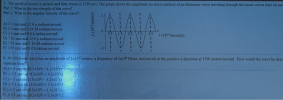 the speed of sound in gelatin and fatty
5. The speed of sound in gelatin and fatty tissue is 1530 m/s. The graph shows the amplitude (in micro meters) of an ultrasonic wave traveling through the tissue versus time (in mi Part 1: What is the wavelength of this wave? Part 2: What is the angular velocity of the wave? y (106 meters) A) 3.1 mm and 126 u radians/second B) 3.1 mm and 3.14 M radians/second C) 3.1 mm...
the speed of sound in gelatin and fatty
5. The speed of sound in gelatin and fatty tissue is 1530 m/s. The graph shows the amplitude (in micro meters) of an ultrasonic wave traveling through the tissue versus time (in mi Part 1: What is the wavelength of this wave? Part 2: What is the angular velocity of the wave? y (106 meters) A) 3.1 mm and 126 u radians/second B) 3.1 mm and 3.14 M radians/second C) 3.1 mm...
A depth sounding vessel surveys the ocean bottom with ultrasonic sound that travels 1523 m/s in...
A depth sounding vessel surveys the ocean bottom with ultrasonic sound that travels 1523 m/s in seawater. How deep is the water, if the time delay of the echo from the ocean floor is 6.2 s? The time delay is the time it takes the sound to travel from the sound source to the ocean floor and back to the source.
1-5 test prep please help Waves A fisherman notices that wave crests pass the bow of...
 1-5 test prep please help
Waves A fisherman notices that wave crests pass the bow of his anchored boat every 3.0 s. He measures the distance between two crests to be 6.5 m. How fast are the waves traveling? 2. A sound wave in air has a frequency of 262 Hz and travels with a speed of 343 m/s. How far apart are the wave crests (compressions)? io signals have frequencies between 550 kHz and 1600 kHz and travel with...
1-5 test prep please help
Waves A fisherman notices that wave crests pass the bow of his anchored boat every 3.0 s. He measures the distance between two crests to be 6.5 m. How fast are the waves traveling? 2. A sound wave in air has a frequency of 262 Hz and travels with a speed of 343 m/s. How far apart are the wave crests (compressions)? io signals have frequencies between 550 kHz and 1600 kHz and travel with...
 Question 2 12 pts The speed of sound in air is 343 m/s, while the speed of sound in water is 1,446 m/s. a) If the frequency of a sound wave is 300 Hz while traveling in water, what is the wavelength of the sound wave? b) If the wave length of a sound wave traveling in air is 3 m, what is the frequency of the sound wave and is it audible to human beings? c) A sound wave...
 the speed of sound in gelatin and fatty
5. The speed of sound in gelatin and fatty tissue is 1530 m/s. The graph shows the amplitude (in micro meters) of an ultrasonic wave traveling through the tissue versus time (in mi Part 1: What is the wavelength of this wave? Part 2: What is the angular velocity of the wave? y (106 meters) A) 3.1 mm and 126 u radians/second B) 3.1 mm and 3.14 M radians/second C) 3.1 mm...
the speed of sound in gelatin and fatty
5. The speed of sound in gelatin and fatty tissue is 1530 m/s. The graph shows the amplitude (in micro meters) of an ultrasonic wave traveling through the tissue versus time (in mi Part 1: What is the wavelength of this wave? Part 2: What is the angular velocity of the wave? y (106 meters) A) 3.1 mm and 126 u radians/second B) 3.1 mm and 3.14 M radians/second C) 3.1 mm...
 1-5 test prep please help
Waves A fisherman notices that wave crests pass the bow of his anchored boat every 3.0 s. He measures the distance between two crests to be 6.5 m. How fast are the waves traveling? 2. A sound wave in air has a frequency of 262 Hz and travels with a speed of 343 m/s. How far apart are the wave crests (compressions)? io signals have frequencies between 550 kHz and 1600 kHz and travel with...
1-5 test prep please help
Waves A fisherman notices that wave crests pass the bow of his anchored boat every 3.0 s. He measures the distance between two crests to be 6.5 m. How fast are the waves traveling? 2. A sound wave in air has a frequency of 262 Hz and travels with a speed of 343 m/s. How far apart are the wave crests (compressions)? io signals have frequencies between 550 kHz and 1600 kHz and travel with...
Most questions answered within 3 hours.
-
Where is the error in this code sequence?
String s1 = "Hello";
String s2 = "ello";...
asked 10 months ago -
Financial data for Joel de Paris, Inc., for last year
follow:
Joel de Paris, Inc.
Balance...
asked 10 months ago -
Consider this reaction:
Al2(SO4)3 (aq)+ BaCl3
(aq) Al2Cl6 (aq)- +
3BaSO4(s) . What is the...
asked 10 months ago -
Suppose that Savneet is considering increasing her
recent random sample from 20 car rentals to 40...
asked 10 months ago -
Trucks arrive at an unloading terminal at an average rate of 120
per hour.
Trucks arrive...
asked 10 months ago -
Why are methanol and ethanol completely soluble in water while
octanol is not very little soluble....
asked 10 months ago -
A facilities manager at a university reads in a research report
that the mean amount of...
asked 10 months ago -
When the CuSO4 is rehydrated by adding water to the anhydrous
compound, is this an endothermic...
asked 10 months ago -
A ray of sunlight is passing from diamond into crown glass; the
angle of incidence is...
asked 10 months ago -
A block of mass 0.249 kg is placed on top of a light, vertical
spring of...
asked 10 months ago -
how do the kidneys compensate in the presences of acidosis
a) trigger hyperventilate
b) reserve acid...
asked 10 months ago -
Question 501 pts
The rental rate of capital to the firm increases. Which of the
following...
asked 10 months ago