In game theory, the strategic form (or normal form) is a way of describing a competitive...
In game theory, the strategic form (or normal form) is a way of describing a competitive simultaneous game using a matrix. Suppose that there are two players (P1 and P2) who can each choose strategies A and B. The payoffs they will each receive for a given strategy is given by Pij, where i= 1,2 and j= A, B. As per class discussion, any two-player finite game can be represented by a matrix that encapsulates all the relevant information of the normal- form game.
-
Based on the problem statement described above, construct a generic 2-by-2 matrix representation of a two-player normal form game.
Homework Answers
From the given description, the matrix can be formed as follows. There are four possible strategies.
Screenshots are provided as the copy-paste is not available for such diagrams.
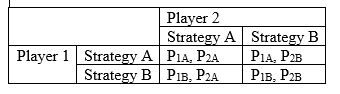
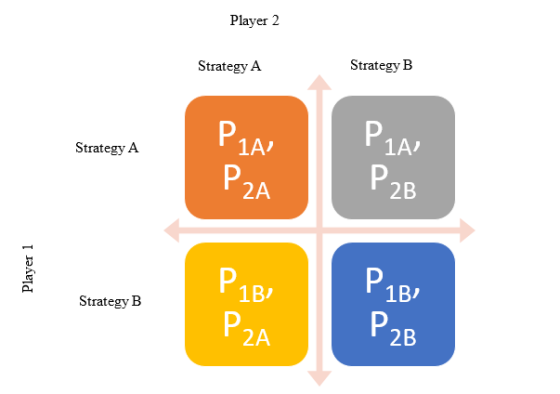
Here, P1A is the payoff of choosing strategy A by player 1. Similarly, P2A is the payoff of choosing strategy A by player 2.
Please upvote, if you find the answer helpful.
Add Answer to:
In game theory, the
strategic form (or normal form) is a way of
describing a competitive...
The normal form of a game uses a matrix to depict the strategic interactions of the...
The normal form of a game uses a matrix to depict the strategic interactions of the players. True/False
1 Consider the following normal-form game. P2 L CR P M (a) Does Pl (player 1)...
 1 Consider the following normal-form game. P2 L CR P M (a) Does Pl (player 1) have any dominated strategies? (b) Does P2 (player 2) have any dominated strategies? (c) Suppose l2 beleves that Pl is rational, should P2 believe P1 will ever play B? (d) Suppose player P2 rales out the possibility that Pl plays B, is there a dominated ECON 306 Page 2 of 12 2018 strategy for player P2? (e) Can yoa find any more eliminated strategies...
Froblem #5: Convert extensive-form to strategic-form, find Nash equilibria and subgame. perfect Nash equilibria (12...
 Froblem #5: Convert extensive-form to strategic-form, find Nash equilibria and subgame. perfect Nash equilibria (12pts) Consider the following extensive-form game: Veto Y Don't Veto In this game, Players 1 and 2 are deciding on a course of action, which may be X, Y, or Z Player 2 is the one who actually makes the choice, but first Player may choose to veto Y, which is the option Player 1 prefers the least. a) List all the strategies available to Player...
6. Consider a sequential game with 3 players. Player 1 can choose A or B. Player...
6. Consider a sequential game with 3 players. Player 1 can choose A or B. Player 2 can choose C, D, E, or F (depending on what player 1 chooses). Player 3 can choose G, H, I, J, K, L, M, or N (depending on what player 1 and 2 choose). Player 1 (P1) goes first, player 2 (P2) goes second, and player 3 (P3) goes third. Payoffs are written as the payoffs for P1, P2, and the for P3....
2. Consider the following sequential game. Player A can choose between two tasks, TI and T2....
 2. Consider the following sequential game. Player A can choose between two tasks, TI and T2. After having observed the choice of A, Player B chooses between two projects P1 or P2. The payoffs are as follows: If A chooses TI and B chooses Pl the payoffs are (12.8), where the first payoff is for A and the second for B; if A chooses TI and B opts for P2 the payoffs are (20,7); if A chooses T2 and B...
3. Consider the following game in normal form. Player 1 is the "row" player with strate-...
 3. Consider the following game in normal form. Player 1 is the "row" player with strate- gies a, b, c, d and Player 2 is the "column" player with strategies w, x, y, z. The game is presented in the following matrix: W Z X y a 3,3 2,1 0,2 2,1 b 1,1 1,2 1,0 1,4 0,0 1,0 3,2 1,1 d 0,0 0,5 0,2 3,1 с Find all the Nash equilibria in the game in pure strategies.
Player I and Player 2 compete in the simultaneous game illustrated by the normal form game...
 Player I and Player 2 compete in the simultaneous game illustrated by the normal form game below Playoffs listed (Player 1, Player 2). Player 2 Middle Right High Medium OW Player I 8. 2 2.8 3.6 16, 7 What strategy is Player 1 playing in this game's equilibrium? a. High b. Mediunm c. Low What strategy is Player 2 playing in this game's equilibrium? a. Left b. Middle c. Right True or False: There exists a non-equilibrium intersection of strategies...
2. Consider the following sequential game. Player A can choose between two tasks, Tl and T2....
 2. Consider the following sequential game. Player A can choose between two tasks, Tl and T2. After having observed the choice of A, Player B chooses between two projects Pl or P2. The payoffs are as follows: If A chooses TI and B chooses P1 the payoffs are (12, 8), where the first payoff is for A and the second for B; if A chooses T1 and B opts for P2 the payoffs are (20, 7); if A chooses T2...
(a) (5 points) Do the players have any strategies which are dominated? Any dominant strategies? (b)...
 (a) (5 points) Do the players have any
strategies which are dominated? Any dominant strategies?
(b) (2 points) Suppose you could create a new strategy (D) which
consisted of A x = 75% of the time and C 1 − x = 25% of the time.
If your payoff from this new strategy is the average of your
payoffs from A and C (given the percentages), what is the payoff of
D? Add it to the matrix.
(c) (3 points)...
(a) (5 points) Do the players have any
strategies which are dominated? Any dominant strategies?
(b) (2 points) Suppose you could create a new strategy (D) which
consisted of A x = 75% of the time and C 1 − x = 25% of the time.
If your payoff from this new strategy is the average of your
payoffs from A and C (given the percentages), what is the payoff of
D? Add it to the matrix.
(c) (3 points)...
1. Consider the following game in normal form. Player 1 is the "row" player with strate-...
 1. Consider the following game in normal form. Player 1 is the "row" player with strate- gies a, b, c, d and Player 2 is the "column" player with strategies w, x, y, 2. The game is presented in the following matrix: a b c d w 3,3 1,1 0,0 0,0 x 2,1 1,2 1,0 0,5 y 0,2 1,0 3, 2 0,2 z 2,1 1,4 1,1 3,1 (a) Find the set of rationalizable strategies. (b) Find the set of Nash...
 1 Consider the following normal-form game. P2 L CR P M (a) Does Pl (player 1) have any dominated strategies? (b) Does P2 (player 2) have any dominated strategies? (c) Suppose l2 beleves that Pl is rational, should P2 believe P1 will ever play B? (d) Suppose player P2 rales out the possibility that Pl plays B, is there a dominated ECON 306 Page 2 of 12 2018 strategy for player P2? (e) Can yoa find any more eliminated strategies...
 Froblem #5: Convert extensive-form to strategic-form, find Nash equilibria and subgame. perfect Nash equilibria (12pts) Consider the following extensive-form game: Veto Y Don't Veto In this game, Players 1 and 2 are deciding on a course of action, which may be X, Y, or Z Player 2 is the one who actually makes the choice, but first Player may choose to veto Y, which is the option Player 1 prefers the least. a) List all the strategies available to Player...
 2. Consider the following sequential game. Player A can choose between two tasks, TI and T2. After having observed the choice of A, Player B chooses between two projects P1 or P2. The payoffs are as follows: If A chooses TI and B chooses Pl the payoffs are (12.8), where the first payoff is for A and the second for B; if A chooses TI and B opts for P2 the payoffs are (20,7); if A chooses T2 and B...
 3. Consider the following game in normal form. Player 1 is the "row" player with strate- gies a, b, c, d and Player 2 is the "column" player with strategies w, x, y, z. The game is presented in the following matrix: W Z X y a 3,3 2,1 0,2 2,1 b 1,1 1,2 1,0 1,4 0,0 1,0 3,2 1,1 d 0,0 0,5 0,2 3,1 с Find all the Nash equilibria in the game in pure strategies.
 Player I and Player 2 compete in the simultaneous game illustrated by the normal form game below Playoffs listed (Player 1, Player 2). Player 2 Middle Right High Medium OW Player I 8. 2 2.8 3.6 16, 7 What strategy is Player 1 playing in this game's equilibrium? a. High b. Mediunm c. Low What strategy is Player 2 playing in this game's equilibrium? a. Left b. Middle c. Right True or False: There exists a non-equilibrium intersection of strategies...
 2. Consider the following sequential game. Player A can choose between two tasks, Tl and T2. After having observed the choice of A, Player B chooses between two projects Pl or P2. The payoffs are as follows: If A chooses TI and B chooses P1 the payoffs are (12, 8), where the first payoff is for A and the second for B; if A chooses T1 and B opts for P2 the payoffs are (20, 7); if A chooses T2...
 (a) (5 points) Do the players have any
strategies which are dominated? Any dominant strategies?
(b) (2 points) Suppose you could create a new strategy (D) which
consisted of A x = 75% of the time and C 1 − x = 25% of the time.
If your payoff from this new strategy is the average of your
payoffs from A and C (given the percentages), what is the payoff of
D? Add it to the matrix.
(c) (3 points)...
(a) (5 points) Do the players have any
strategies which are dominated? Any dominant strategies?
(b) (2 points) Suppose you could create a new strategy (D) which
consisted of A x = 75% of the time and C 1 − x = 25% of the time.
If your payoff from this new strategy is the average of your
payoffs from A and C (given the percentages), what is the payoff of
D? Add it to the matrix.
(c) (3 points)...
 1. Consider the following game in normal form. Player 1 is the "row" player with strate- gies a, b, c, d and Player 2 is the "column" player with strategies w, x, y, 2. The game is presented in the following matrix: a b c d w 3,3 1,1 0,0 0,0 x 2,1 1,2 1,0 0,5 y 0,2 1,0 3, 2 0,2 z 2,1 1,4 1,1 3,1 (a) Find the set of rationalizable strategies. (b) Find the set of Nash...
Most questions answered within 3 hours.
-
Where is the error in this code sequence?
String s1 = "Hello";
String s2 = "ello";...
asked 10 months ago -
Financial data for Joel de Paris, Inc., for last year
follow:
Joel de Paris, Inc.
Balance...
asked 10 months ago -
Consider this reaction:
Al2(SO4)3 (aq)+ BaCl3
(aq) Al2Cl6 (aq)- +
3BaSO4(s) . What is the...
asked 10 months ago -
Suppose that Savneet is considering increasing her
recent random sample from 20 car rentals to 40...
asked 10 months ago -
Trucks arrive at an unloading terminal at an average rate of 120
per hour.
Trucks arrive...
asked 10 months ago -
Why are methanol and ethanol completely soluble in water while
octanol is not very little soluble....
asked 10 months ago -
A facilities manager at a university reads in a research report
that the mean amount of...
asked 10 months ago -
When the CuSO4 is rehydrated by adding water to the anhydrous
compound, is this an endothermic...
asked 10 months ago -
A ray of sunlight is passing from diamond into crown glass; the
angle of incidence is...
asked 10 months ago -
A block of mass 0.249 kg is placed on top of a light, vertical
spring of...
asked 10 months ago -
how do the kidneys compensate in the presences of acidosis
a) trigger hyperventilate
b) reserve acid...
asked 10 months ago -
Question 501 pts
The rental rate of capital to the firm increases. Which of the
following...
asked 10 months ago