Oxaloacetic acid (2-ketosuccinic acid) is a very important intermediate in metabolism. The...
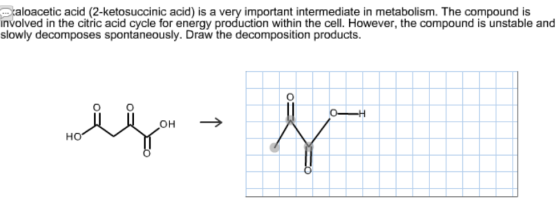
Oxaloacetic acid (2-ketosuccinic acid) is a very important intermediate in metabolism. The compound is involved in the citric acid cycle for energy production within the cell. However, the compound is unstable and slowly decomposes spontaneously. Draw the decomposition products.
Homework Answers

Add Answer to:
Oxaloacetic acid (2-ketosuccinic acid) is a very important intermediate in metabolism. The...
1-32 Oxaloacetic acid, an important intermediate in food metabolism, has the formula C4H40, and contains three...
 1-32 Oxaloacetic acid, an important intermediate in food metabolism, has the formula C4H40, and contains three C=0 bonds and two 0-H bonds. Propose two possible structures
MULTIPLE CHOICE. Choose the one alternative that best completes the statement or answers the question. Metabolism...
 MULTIPLE CHOICE. Choose the one alternative that best completes the statement or answers the question. Metabolism and Cellular Respiration Refer to Figure below as a guide to answer the folloaing questions Acetyt CoA Oxaloacetic acid CoA NADH Citric acid NAD Isocitric acid Malic acid Fumaric acid NAD co NADH -FADH FAD+ a-Ketoglutaric acid Succinic acid CO2NAD ATP Succinyl CoA ADP P NADH Figure above. Starting with citric acid and ending with oxaloacetic acid, how many ATP 6) Refer to molecules...
(35 pts) The overall objective of metabolism is to generate energy in the form of ATP by oxidizing carbon and reducing oxygen. (a) (2 pts) Write chemical reaction for the only oxidation step i...
 (35 pts) The overall objective of metabolism is to generate energy in the form of ATP by oxidizing carbon and reducing oxygen. (a) (2 pts) Write chemical reaction for the only oxidation step in glycolysis with full chemical structures of the reactant(s) and product(s), list the name(s) of the enzyme(s) and cofactor(s) involved in the equation. Indicate which carbons are oxidized in the chemical structures (b) (8 pts) Write the chemical reactions for all oxidation steps for citrate acid cycle...
Metabolism and Energetics Anatomy: Mention at least 3 structures, parts and/or organelles of the cell involved...
 Metabolism and Energetics Anatomy: Mention at least 3 structures, parts and/or organelles of the cell involved in metabolic processes. Physiology: Describe Glycolysis; Kreb Cycle/Citric Acid Cycle/Tri-Carboxylic Acid (TCA) Cycle; Electron Transport Chain • Fluid, Electrolyte & Acid-Base Balance Anatomy: What is the percentage distribution of fluids between males versus females? What is the percentage distribution of fluids between intracellular versus extracellular fluids? Mention the percentage distribution of the specific varied Cations and Anions within the intracellular versus extracellular fluids. Physiology:...
1. Where specifically within the cell does the citric acid cycle take place?__________________________________ 2. How many...
1. Where specifically within the cell does the citric acid cycle take place?__________________________________ 2. How many carbons from the original glucose molecule enter each round of the citric acid cycle?________ 3. How many carbons exit out of the citric acid cycle during each round, as a waste product?_________ Where did the carbons in this waste product originally come from (what molecule)? 4. The role of NAD+ in the citric acid cycle is the same as in glycolysis; namely, to taxi...
Which statement most accurately describes the citric acid cycle? a) It serves a catabolic role only,...
Which statement most accurately describes the citric acid cycle? a) It serves a catabolic role only, which is to generate ATP and reducing equivalents for cellular energy needs. b) It plays a central role in key metabolic processes in the cell, with many metabolic intermediates leaving and entering. c) It is an unregulated process, like an intersection without signal lights. d) It is the main center of ATP production during anaerobic metabolism.
Fatty Acid Metabolism. The reactions of the fatty acid spiral are shown below. Use the description...
 Fatty Acid Metabolism. The reactions of the fatty acid spiral are shown below. Use the description on the left side of the page to classify the reactions and fill in the boxes on the right side of the page Activation Step. The activation of the fatty acid begins by the addition of CoA which will carry the fatty acid from the cytosol into the mitochondria. The product, which is a fatty acid with a CoA attached, is known as a...
5. As indicated in the KEGG pathways for fatty acid degradation and biosynthesis which pathway does NOT use acetyl-CoA as a substrate? A. citric acid cycle B. butanoate metabolism C. fatty acid b...
 5. As indicated in the KEGG pathways for fatty acid degradation and biosynthesis which pathway does NOT use acetyl-CoA as a substrate? A. citric acid cycle B. butanoate metabolism C. fatty acid biosynthesis D. glycolysis 6. Which statement is consistent with the comparison of fatty acid biosynthesis in humans and in Helicobacter pylori 2017? A. Both organisms use the same multifunctional enzyme B. Humans use separate proteins to catalyze each step, while H. pylori 2017 uses one multifunctional enzyme to...
Which of the following statements best describes the difference between aerobic and anaerobic metabolism? Check all...
Which of the following statements best describes the difference between aerobic and anaerobic metabolism? Check all that apply. - Anaerobic metabolism produces more ATP than aerobic metabolism. - Anaerobic metabolism produces less ATP than aerobic metabolism. - Only aerobic metabolism can occur in the absence of oxygen. - Anaerobic metabolism does not produce lactate while aerobic metabolism does. - Both anaerobic and aerobic metabolism run through glycolysis, Krebs cycle, and the electron transport chain. - Only anaerobic metabolism can occur...
Study Guestions-TCA Cycle 1. A. Glucose 2 lactic acid Glucose + 602-구 c0g + H2O which of the rea...
 Please answer #1,2&3
Study Guestions-TCA Cycle 1. A. Glucose 2 lactic acid Glucose + 602-구 c0g + H2O which of the reactions above will provide the greatest amount of free energy for biological functions of an organism? what biochemical processes are involved in reaction A and reaction B? Provide a detailed answer. 2. Draw the structures of three tricarboxylic acids involved in the TCA cycle.What are the complete reactions, including nzymes that produce these compounds? . The molecules of con...
Please answer #1,2&3
Study Guestions-TCA Cycle 1. A. Glucose 2 lactic acid Glucose + 602-구 c0g + H2O which of the reactions above will provide the greatest amount of free energy for biological functions of an organism? what biochemical processes are involved in reaction A and reaction B? Provide a detailed answer. 2. Draw the structures of three tricarboxylic acids involved in the TCA cycle.What are the complete reactions, including nzymes that produce these compounds? . The molecules of con...
 1-32 Oxaloacetic acid, an important intermediate in food metabolism, has the formula C4H40, and contains three C=0 bonds and two 0-H bonds. Propose two possible structures
 MULTIPLE CHOICE. Choose the one alternative that best completes the statement or answers the question. Metabolism and Cellular Respiration Refer to Figure below as a guide to answer the folloaing questions Acetyt CoA Oxaloacetic acid CoA NADH Citric acid NAD Isocitric acid Malic acid Fumaric acid NAD co NADH -FADH FAD+ a-Ketoglutaric acid Succinic acid CO2NAD ATP Succinyl CoA ADP P NADH Figure above. Starting with citric acid and ending with oxaloacetic acid, how many ATP 6) Refer to molecules...
 (35 pts) The overall objective of metabolism is to generate energy in the form of ATP by oxidizing carbon and reducing oxygen. (a) (2 pts) Write chemical reaction for the only oxidation step in glycolysis with full chemical structures of the reactant(s) and product(s), list the name(s) of the enzyme(s) and cofactor(s) involved in the equation. Indicate which carbons are oxidized in the chemical structures (b) (8 pts) Write the chemical reactions for all oxidation steps for citrate acid cycle...
 Metabolism and Energetics Anatomy: Mention at least 3 structures, parts and/or organelles of the cell involved in metabolic processes. Physiology: Describe Glycolysis; Kreb Cycle/Citric Acid Cycle/Tri-Carboxylic Acid (TCA) Cycle; Electron Transport Chain • Fluid, Electrolyte & Acid-Base Balance Anatomy: What is the percentage distribution of fluids between males versus females? What is the percentage distribution of fluids between intracellular versus extracellular fluids? Mention the percentage distribution of the specific varied Cations and Anions within the intracellular versus extracellular fluids. Physiology:...
 Fatty Acid Metabolism. The reactions of the fatty acid spiral are shown below. Use the description on the left side of the page to classify the reactions and fill in the boxes on the right side of the page Activation Step. The activation of the fatty acid begins by the addition of CoA which will carry the fatty acid from the cytosol into the mitochondria. The product, which is a fatty acid with a CoA attached, is known as a...
 5. As indicated in the KEGG pathways for fatty acid degradation and biosynthesis which pathway does NOT use acetyl-CoA as a substrate? A. citric acid cycle B. butanoate metabolism C. fatty acid biosynthesis D. glycolysis 6. Which statement is consistent with the comparison of fatty acid biosynthesis in humans and in Helicobacter pylori 2017? A. Both organisms use the same multifunctional enzyme B. Humans use separate proteins to catalyze each step, while H. pylori 2017 uses one multifunctional enzyme to...
 Please answer #1,2&3
Study Guestions-TCA Cycle 1. A. Glucose 2 lactic acid Glucose + 602-구 c0g + H2O which of the reactions above will provide the greatest amount of free energy for biological functions of an organism? what biochemical processes are involved in reaction A and reaction B? Provide a detailed answer. 2. Draw the structures of three tricarboxylic acids involved in the TCA cycle.What are the complete reactions, including nzymes that produce these compounds? . The molecules of con...
Please answer #1,2&3
Study Guestions-TCA Cycle 1. A. Glucose 2 lactic acid Glucose + 602-구 c0g + H2O which of the reactions above will provide the greatest amount of free energy for biological functions of an organism? what biochemical processes are involved in reaction A and reaction B? Provide a detailed answer. 2. Draw the structures of three tricarboxylic acids involved in the TCA cycle.What are the complete reactions, including nzymes that produce these compounds? . The molecules of con...
Most questions answered within 3 hours.
-
Where is the error in this code sequence?
String s1 = "Hello";
String s2 = "ello";...
asked 11 months ago -
Financial data for Joel de Paris, Inc., for last year
follow:
Joel de Paris, Inc.
Balance...
asked 11 months ago -
Consider this reaction:
Al2(SO4)3 (aq)+ BaCl3
(aq) Al2Cl6 (aq)- +
3BaSO4(s) . What is the...
asked 11 months ago -
Suppose that Savneet is considering increasing her
recent random sample from 20 car rentals to 40...
asked 11 months ago -
Trucks arrive at an unloading terminal at an average rate of 120
per hour.
Trucks arrive...
asked 11 months ago -
Why are methanol and ethanol completely soluble in water while
octanol is not very little soluble....
asked 11 months ago -
A facilities manager at a university reads in a research report
that the mean amount of...
asked 11 months ago -
When the CuSO4 is rehydrated by adding water to the anhydrous
compound, is this an endothermic...
asked 11 months ago -
A ray of sunlight is passing from diamond into crown glass; the
angle of incidence is...
asked 11 months ago -
A block of mass 0.249 kg is placed on top of a light, vertical
spring of...
asked 11 months ago -
how do the kidneys compensate in the presences of acidosis
a) trigger hyperventilate
b) reserve acid...
asked 11 months ago -
Question 501 pts
The rental rate of capital to the firm increases. Which of the
following...
asked 11 months ago