Use the following steps to balance the redox reaction below: Mg + Au+ Mg2+ + Au a
Mg + Au+ Mg2+ + Au
a. Write the oxidation and reduction half-reactions. Make sure each half-reaction is balanced for number of atoms and charge.
b. Multiply each half-reaction by the correct number, in order to balance charges for the two half-reactions.
c. Add the equations and simplify to get a balanced equation.
Question 5: Stoichiometry
Use the balanced equation below to answer the following questions.
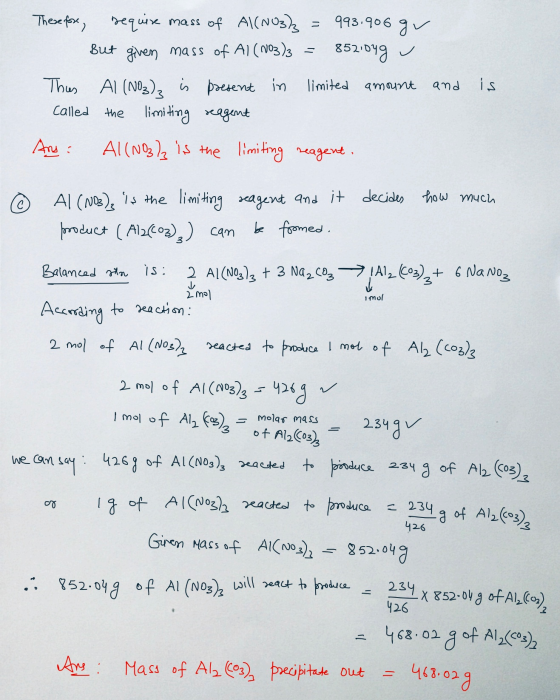
2Al(NO3)3 + 3Na2CO3 Al2(CO3)3(s) + 6NaNO3
a. What is the ratio of moles of Al(NO3)3 to moles Na2CO3?
b. If 852.04 g Al(NO3)3 reacted with the 741.93 g Na2CO3, which would be the limiting reagent? Show your work.
c. Use the limiting reagent to determine how many grams of Al2(CO3)3 should precipitate out in the reaction.
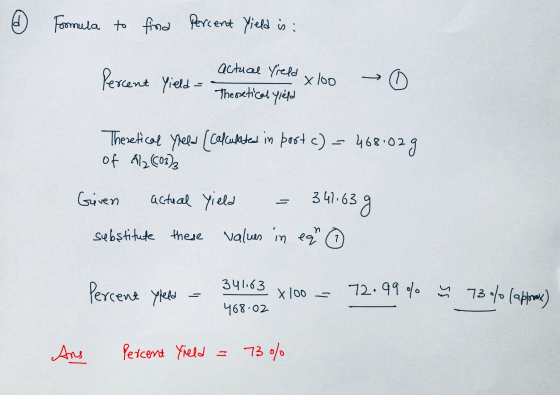
d. If only 341.63 g of Al2(CO3)3 precipitate were actually collected from the reaction, what would the percent yield be?
Homework Answers
 hope
this helps.. please rate if this is helpful.. thank you
hope
this helps.. please rate if this is helpful.. thank you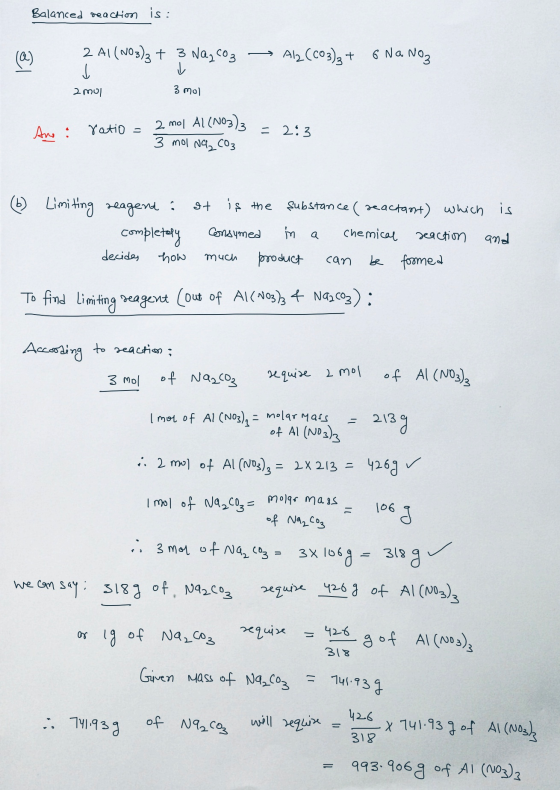
Add Answer to:
Use the following steps to balance the redox reaction below: Mg + Au+ Mg2+ + Au a
1. Balance the reaction between Mg and NO3- to form Mg2+ and HNO2 in acidic solution....
 1. Balance the reaction between Mg and
NO3- to form
Mg2+ and
HNO2 in acidic solution.
When you have balanced the equation using the smallest integers
possible, enter the coefficients of the species shown. Enter "1" if
the coefficient is "1."
Mg + NO3Mg2+
+ HNO2
Water appears in the balanced equation as a (reactant,
product, neither) with a coefficient of ______. (Enter 0 for
neither.)
How many electrons are transferred in this reaction? _______
.
.
2. Balance the following...
1. Balance the reaction between Mg and
NO3- to form
Mg2+ and
HNO2 in acidic solution.
When you have balanced the equation using the smallest integers
possible, enter the coefficients of the species shown. Enter "1" if
the coefficient is "1."
Mg + NO3Mg2+
+ HNO2
Water appears in the balanced equation as a (reactant,
product, neither) with a coefficient of ______. (Enter 0 for
neither.)
How many electrons are transferred in this reaction? _______
.
.
2. Balance the following...
Balance the following reaction using the oxidation number method. Ta205 + Mg + H+ Mg2+ +...
 Balance the following reaction using the oxidation number method. Ta205 + Mg + H+ Mg2+ + Ta + H2O In your response, include the following: i) labeled oxidation and reduction half reactions [2] iii) overall balanced equation [1]
Balance the following reaction using the oxidation number method. Ta205 + Mg + H+ Mg2+ +...
 Balance the following reaction using the oxidation number method. Ta205 + Mg + H+ Mg2+ + Ta + H2O In your response, include the following: i) labeled oxidation and reduction half reactions [2] iii) overall balanced equation [1]
Consider the following unbalanced reaction:  
Consider the following unbalanced reaction: Co3+(aq) + Cu(s) → Co2+(aq) + Cu2+(aq) The reduction potentials are as follows: Co3+/2+Eº = +1.92 V; Cu2+/0Eº = +0.34 V. Identify the OXIDANT Identify the REDUCTANT Co3+ Co3+ Cu Cu Write the individual half-reactions and show how they provide the redox equation above. Note that the stoichiometry will be different than above: make sure your equation is balanced. What is the ∆Gº of the reaction? What is ∆Eº of the reaction?
Please use the half-reaction method! 1. Balance the following redox reactions, using the rules on p....
 Please use the half-reaction method!
1. Balance the following redox reactions, using the rules on p. 97 or the half-reaction method, whichever makes more sense to you. a. PbO2() → Pb2+ + O2 b. FeS2(pyrite) + NO3 → N2(g) + FeOOH goethite) + SO42-
Please use the half-reaction method!
1. Balance the following redox reactions, using the rules on p. 97 or the half-reaction method, whichever makes more sense to you. a. PbO2() → Pb2+ + O2 b. FeS2(pyrite) + NO3 → N2(g) + FeOOH goethite) + SO42-
Part IV: Balancing Redox Reactions in Acidic and Basic Solution General rules for balancing redox reactions...
 Part IV: Balancing Redox Reactions in Acidic and Basic Solution General rules for balancing redox reactions in acidic or basic solution: 1. Divide the redox reaction into two half-reactions. One that contains the element that gets Oxidized and one that contains the element that gets reduced. 2. Focusing on one half-reaction at a time, balance all non-H and non-0 atoms. 3. Balance the O atoms by adding water molecules to the side with too few oxygens 4. Balance the H...
Write the overall reaction for the RedOx reaction (below) when it occurs in an acidic environment....
Write the overall reaction for the RedOx reaction (below) when it occurs in an acidic environment. 1A. Fe (s) + V2O3(aq) → Fe2O3(s) + VO (aq) B. NO2-(aq) + Al (s) → NH3(aq) + Al(OH)4- (aq) C. As2O3(aq) + NO3-(aq) → H3AsO4(aq) + NO (g) Steps for writing half-cell reactions and overall RedOx reactions: Balance atoms other than H and O by changing their coefficients Balance the O's by adding H2O Balance the H's by adding H+ Add electrons to...
19. a. Balance the following redox reaction if it occurs in acidic solution. How many electrons...
19. a. Balance the following redox reaction if it occurs in acidic solution. How many electrons are transferred, and what are the half reaction potentials? Fe 2+(aq) + MnO4 ?(aq) ? Fe 3+(aq) + Mn 2+(aq) b. What element is being oxidized, and what is the oxidizing agent in the given redox reaction? Mg2+(aq) + NH4 +(aq) ? Mg(s) + NO3 ?(aq)
Balance the following half-reaction: HONO→ NO3- 1. The first species to balance is the redox active...
 Balance the following half-reaction:
HONO→ NO3-
1. The first species to balance is the redox active species, the element that is changing oxidation state. In this reaction, the redox active species, N, is already balanced. 2. How many moles of H,O must there be on the reactant side of this half reaction? (Enter O if no moles of water are needed or enter #H2O where # moles of water are needed, e.g. if 4 moles of H20 are needed, type...
Balance the following half-reaction:
HONO→ NO3-
1. The first species to balance is the redox active species, the element that is changing oxidation state. In this reaction, the redox active species, N, is already balanced. 2. How many moles of H,O must there be on the reactant side of this half reaction? (Enter O if no moles of water are needed or enter #H2O where # moles of water are needed, e.g. if 4 moles of H20 are needed, type...
Use the provided reduction potentials to calculate the equilibrium constant (K) for the following balanced redox...
Use the provided reduction potentials to calculate the equilibrium constant (K) for the following balanced redox reaction at 25 °C: 2Al(s) + 3Mg2+(aq) → 2Al3+(aq) + 3Mg(s) E°(Al3+/Al) = -1.66 V and E°(Mg2+/Mg) = -2.37 V 1.0 × 1024 9.7 × 10-73 1.1 × 1072 4.6 × 1031 8.9 × 10-70
 1. Balance the reaction between Mg and
NO3- to form
Mg2+ and
HNO2 in acidic solution.
When you have balanced the equation using the smallest integers
possible, enter the coefficients of the species shown. Enter "1" if
the coefficient is "1."
Mg + NO3Mg2+
+ HNO2
Water appears in the balanced equation as a (reactant,
product, neither) with a coefficient of ______. (Enter 0 for
neither.)
How many electrons are transferred in this reaction? _______
.
.
2. Balance the following...
1. Balance the reaction between Mg and
NO3- to form
Mg2+ and
HNO2 in acidic solution.
When you have balanced the equation using the smallest integers
possible, enter the coefficients of the species shown. Enter "1" if
the coefficient is "1."
Mg + NO3Mg2+
+ HNO2
Water appears in the balanced equation as a (reactant,
product, neither) with a coefficient of ______. (Enter 0 for
neither.)
How many electrons are transferred in this reaction? _______
.
.
2. Balance the following...
 Balance the following reaction using the oxidation number method. Ta205 + Mg + H+ Mg2+ + Ta + H2O In your response, include the following: i) labeled oxidation and reduction half reactions [2] iii) overall balanced equation [1]
 Balance the following reaction using the oxidation number method. Ta205 + Mg + H+ Mg2+ + Ta + H2O In your response, include the following: i) labeled oxidation and reduction half reactions [2] iii) overall balanced equation [1]
 Please use the half-reaction method!
1. Balance the following redox reactions, using the rules on p. 97 or the half-reaction method, whichever makes more sense to you. a. PbO2() → Pb2+ + O2 b. FeS2(pyrite) + NO3 → N2(g) + FeOOH goethite) + SO42-
Please use the half-reaction method!
1. Balance the following redox reactions, using the rules on p. 97 or the half-reaction method, whichever makes more sense to you. a. PbO2() → Pb2+ + O2 b. FeS2(pyrite) + NO3 → N2(g) + FeOOH goethite) + SO42-
 Part IV: Balancing Redox Reactions in Acidic and Basic Solution General rules for balancing redox reactions in acidic or basic solution: 1. Divide the redox reaction into two half-reactions. One that contains the element that gets Oxidized and one that contains the element that gets reduced. 2. Focusing on one half-reaction at a time, balance all non-H and non-0 atoms. 3. Balance the O atoms by adding water molecules to the side with too few oxygens 4. Balance the H...
 Balance the following half-reaction:
HONO→ NO3-
1. The first species to balance is the redox active species, the element that is changing oxidation state. In this reaction, the redox active species, N, is already balanced. 2. How many moles of H,O must there be on the reactant side of this half reaction? (Enter O if no moles of water are needed or enter #H2O where # moles of water are needed, e.g. if 4 moles of H20 are needed, type...
Balance the following half-reaction:
HONO→ NO3-
1. The first species to balance is the redox active species, the element that is changing oxidation state. In this reaction, the redox active species, N, is already balanced. 2. How many moles of H,O must there be on the reactant side of this half reaction? (Enter O if no moles of water are needed or enter #H2O where # moles of water are needed, e.g. if 4 moles of H20 are needed, type...
Most questions answered within 3 hours.
-
Where is the error in this code sequence?
String s1 = "Hello";
String s2 = "ello";...
asked 10 months ago -
Financial data for Joel de Paris, Inc., for last year
follow:
Joel de Paris, Inc.
Balance...
asked 10 months ago -
Consider this reaction:
Al2(SO4)3 (aq)+ BaCl3
(aq) Al2Cl6 (aq)- +
3BaSO4(s) . What is the...
asked 10 months ago -
Suppose that Savneet is considering increasing her
recent random sample from 20 car rentals to 40...
asked 10 months ago -
Trucks arrive at an unloading terminal at an average rate of 120
per hour.
Trucks arrive...
asked 10 months ago -
Why are methanol and ethanol completely soluble in water while
octanol is not very little soluble....
asked 10 months ago -
A facilities manager at a university reads in a research report
that the mean amount of...
asked 10 months ago -
When the CuSO4 is rehydrated by adding water to the anhydrous
compound, is this an endothermic...
asked 10 months ago -
A ray of sunlight is passing from diamond into crown glass; the
angle of incidence is...
asked 10 months ago -
A block of mass 0.249 kg is placed on top of a light, vertical
spring of...
asked 10 months ago -
how do the kidneys compensate in the presences of acidosis
a) trigger hyperventilate
b) reserve acid...
asked 10 months ago -
Question 501 pts
The rental rate of capital to the firm increases. Which of the
following...
asked 10 months ago