Hi it's python I imported a data which are so many words in txt and I arranged and reshaped with alphabetically both rows and columns
I was successful with these steps but I am stuck with next step
below is my code and screenshot
import numpy as np
import pandas as pd
data=pd.read_csv("/Users/superman/Downloads/words_file2.txt",header=None)
df_input=pd.DataFrame(data)
df_output=pd.DataFrame(np.arange(676).reshape((26,26)),
index =
['a','b','c','d','e','f','g','h','i','j','k','l','m','n','o','p','q','r','s','t','u','v','w','x','y','z'],
columns =
['a','b','c','d','e','f','g','h','i','j','k','l','m','n','o','p','q','r','s','t','u','v','w','x','y','z'])
df_output.index.name="Start"
df_output.columns.name="End"
df_output
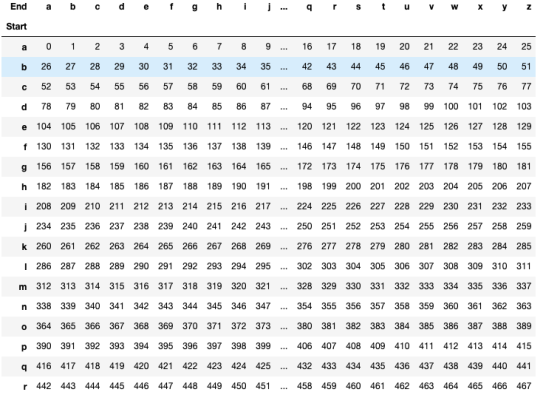
This below screen shot is what I have to find
I have to find each word from input data frame (which is txt file) which its start and end character and add the count into the output data frame.
So for example let's say there's adbkqa , it starts with a and ends a so it counts 1 between start a and a end, so add 1 to the current value. another example which starts a and end z is not into the txt so it counts 0 like below screenshot.
Maybe my first step might be wrong (one condition is all data initially in this data frame are zeros) <- I don't get it so
please help me to get a correct answer like below code please help!
the txt file is here
https://drive.google.com/open?id=1VXtEPNBJ6ypJZ62ypeeWtzS9TjcGhBp4

End a b cd e fg h .q rstuv wxy z Start a 2 0 10 7 48 1 2 2 0 0.. 0 3 11 15 0 0 01 11 0 b 00 1 2 4 0 0 6 0 0.. 0 0 4 0 0 00 1 0 c1 0 1 5 38 0 410 0...0 3 14 21 0 0 00 13 0 d 0 0 3 5 36 0 1 3 00..0 4 6 12 0010 6 0 e 0 0 5 3 24 0 0 110..0 3 3 16 0010 7 0
Homework Answers
CODE:
import numpy as np
import pandas as pd
data=pd.read_csv('words_file2.txt',header=None)
data.head()
df_output=pd.DataFrame(np.zeros(676,dtype=int).reshape((26,26)),
index =
['a','b','c','d','e','f','g','h','i','j','k','l','m','n','o','p','q','r','s','t','u','v','w','x','y','z'],
columns =
['a','b','c','d','e','f','g','h','i','j','k','l','m','n','o','p','q','r','s','t','u','v','w','x','y','z'])
df_output.index.name="Start"
df_output.columns.name="End"
df_output
#Here I have mentioned first i[-1] because in DataFrame first
index goes for column
#so we go for End as we mentioned the Row name
for i in data[0]:
df_output[i[-1]][i[0]]+=1
df_output
OUTPUT:
![In [15]: df output-pd.DataFrame (np.zeros (676,dtype-int).reshape( (26,26, index [a, b,c,d,e,f,g,h,i,j,k](http://img.homeworklib.com/images/f23458b1-a9a8-41d3-bb47-9c3749f6ea5d.png?x-oss-process=image/resize,w_560)
![In [24]: #Here I have mentioned first ǐ[-1] because in DataFrame first index goes for column #50 we go for End as we mentione](http://img.homeworklib.com/images/9174bc87-e333-498f-a275-500973196332.png?x-oss-process=image/resize,w_560)
#If you have any queries feel free to comment
Add Answer to:
Hi it's python I imported a data which are so many words in txt and I arranged and reshaped with ...
Hi it's my code for python I almost finished my project but only one thing left which is most con...
 Hi it's my code for python
I almost finished my project but only one thing left which is
most confusing part please help me
I have to find most occurring ending character from a to z
For instance, output should be like this I have to find a to
z.
Words starting with ‘a’ end mostly with ‘O’
Words starting with ‘b’ end mostly with ‘O’
......
No words start with ‘O’(If there's no word in the character from a...
Hi it's my code for python
I almost finished my project but only one thing left which is
most confusing part please help me
I have to find most occurring ending character from a to z
For instance, output should be like this I have to find a to
z.
Words starting with ‘a’ end mostly with ‘O’
Words starting with ‘b’ end mostly with ‘O’
......
No words start with ‘O’(If there's no word in the character from a...
why is this wrong for vectors vector<char> decrypt{ {'B', 'C', 'D', 'E', 'F', 'G', 'H', 'I',...
why is this wrong for vectors vector<char> decrypt{ {'B', 'C', 'D', 'E', 'F', 'G', 'H', 'I', 'J', 'K', 'L', 'M', 'N', 'O', 'P', 'Q', 'R', 'S', 'T', 'U', 'V', 'W', 'X', 'Y', 'Z', '1', '2', '3', '4', '5', '6', '7', '8', '9', 'A'}, {'C', 'D', 'E', 'F', 'G', 'H', 'I', 'J', 'K', 'L', 'M', 'N', 'O', 'P', 'Q', 'R', 'S', 'T', 'U', 'V', 'W', 'X', 'Y', 'Z', '1', '2', '3', '4', '5', '6', '7', '8', '9', 'A', 'B'}, }; for(int...
Write a program in Python to read the .txt file . Then to plot CO2_flux against...
 Write a program in Python to read the .txt file . Then to plot
CO2_flux against time for every half hour .
A H P DATAH DATAU DATA DATA DATA DATA 0 0 DATA DATA DATA DATA DATA DATA DATA DATA DATA DATA DATA DATA DATA DATA DATA DATA DATA DATA DATA DATA DATA DATA DATA DATA DATA DATA DATA DATA B C D E F G filename date t ime DOY daytime file_records used_record: Tau qc_Tau [yyyy-mm-de (HH:MM] [ddd.ddd]...
Write a program in Python to read the .txt file . Then to plot
CO2_flux against time for every half hour .
A H P DATAH DATAU DATA DATA DATA DATA 0 0 DATA DATA DATA DATA DATA DATA DATA DATA DATA DATA DATA DATA DATA DATA DATA DATA DATA DATA DATA DATA DATA DATA DATA DATA DATA DATA DATA DATA B C D E F G filename date t ime DOY daytime file_records used_record: Tau qc_Tau [yyyy-mm-de (HH:MM] [ddd.ddd]...
So I'm currently doing coding in Python. There's two parts and we're supposed to use loops...
 So I'm currently doing coding in Python. There's two parts and
we're supposed to use loops and nested loops to produce the
following outputs:
part A) 0 1 2 3 4 5 6 7 8 9
0 1 2 3 4 5 6 7 8 9
0 1 2 3 4 5 6 7 8 9
0 1 2 3 4 5 6 7 8 9 .... for ten times in total
part B) 0 0 0 0 0 0...
So I'm currently doing coding in Python. There's two parts and
we're supposed to use loops and nested loops to produce the
following outputs:
part A) 0 1 2 3 4 5 6 7 8 9
0 1 2 3 4 5 6 7 8 9
0 1 2 3 4 5 6 7 8 9
0 1 2 3 4 5 6 7 8 9 .... for ten times in total
part B) 0 0 0 0 0 0...
(B)(C)(D)(E)(G)(I)(J) 39 Write the Taylor expansion of function f order n at to given below. 1...
 (B)(C)(D)(E)(G)(I)(J)
39 Write the Taylor expansion of function f order n at to given below. 1 (a) (g)2+v1+ I, n 2,ro - 0 n = 7, xo = 0 1 -2-3 (b) sin z cos(2x), (c) z In(2+3z), VI+I n= 3, To = 0 1 +e-1/ (h) 2+x n =5,xo= +o0 n= 3, ro = 1 T (i) cos (2r), n 4, xo= 6 (d) n = 7,xo = 0 COSI i) V+-VI3-, n 4, 1o =+00 (e) In(1+ arcsin(2r)),...
(B)(C)(D)(E)(G)(I)(J)
39 Write the Taylor expansion of function f order n at to given below. 1 (a) (g)2+v1+ I, n 2,ro - 0 n = 7, xo = 0 1 -2-3 (b) sin z cos(2x), (c) z In(2+3z), VI+I n= 3, To = 0 1 +e-1/ (h) 2+x n =5,xo= +o0 n= 3, ro = 1 T (i) cos (2r), n 4, xo= 6 (d) n = 7,xo = 0 COSI i) V+-VI3-, n 4, 1o =+00 (e) In(1+ arcsin(2r)),...
Please Solove only (a)and (b) Please, Write so that I can recognize 4.20 Consider the system...
 Please Solove only (a)and (b)
Please, Write so that I can recognize
4.20 Consider the system depicted in Fig. P4.20(a). The of the input signal is depicted in Fig. P4.20(b). I FT FT z(t) Z(jw) and y(t) Z(ja) and Y(jo) for the following cases: -» Y(j»). Sket (a) w(t) cos(5 mt) and h(t) sin 6 (b) w(t) cos(5mt) and h(t) sin 5 (c) w(t) depicted in Fig. P4.20(c) and h(t) sin2r cos (5 rt X(jw) z(t) x)X hit) w(t) cos...
Please Solove only (a)and (b)
Please, Write so that I can recognize
4.20 Consider the system depicted in Fig. P4.20(a). The of the input signal is depicted in Fig. P4.20(b). I FT FT z(t) Z(jw) and y(t) Z(ja) and Y(jo) for the following cases: -» Y(j»). Sket (a) w(t) cos(5 mt) and h(t) sin 6 (b) w(t) cos(5mt) and h(t) sin 5 (c) w(t) depicted in Fig. P4.20(c) and h(t) sin2r cos (5 rt X(jw) z(t) x)X hit) w(t) cos...
Hello everyone. I have a bankers algorithm written in java that gets inputs from a .txt...
Hello everyone. I have a bankers algorithm written in java that gets inputs from a .txt file. The file has 7 processes and 5 resources however, when the program runs, it doesn't sum the resource columns correctly. The program runs correctly for smaller matricies (4 processes, 3 resources), not sure what the issue is and have been looking over the code for awhile so maybe another set of eyes would help...thanks BankersAlgorithm.java /** * This program implements Bankers algorithm which...
Create a graph in python for a given input series without using any libraries
I was asked this question:Given any input series a corresponding graph must be generated without the use of any libraries.After, trying my best, I arrived at this solution to which they replied it had a logical issue.# Create the matrix print("Enter the sequence with spaces: ") arr = list(map(int, input().split())) count = len(arr) rows = int(sum(arr)) cols = int(sum(arr) + 4) content = [[" "]*cols for _ in range(rows)] maxq = 0 maxp = 0 content[0][0] = "/" # Apply the positions in the matrix p = 0 q = arr[0] k = 0 for l in range(q): if (k != q): content[k][p] = "/" p = p + 1 k = k + 1 p = q flag = 1 i = 0 j = 0 k = 0 c = 0 temp = 0 r = 0 flag = 1 for i,j in enumerate(arr): c = c + 1 if c < count: k = arr[i+1] else: k = 0 if arr[i]: if flag == 1: content[q][p] = "/\\" if maxq < q: maxq = q maxp = p qori = q pori = p p = p + k temp = q - k...
i Data Table Table 2. INVENTORY RECORD DATA F G C Data Category Lot-sizing rule Lead...
 i Data Table Table 2. INVENTORY RECORD DATA F G C Data Category Lot-sizing rule Lead time Safety stock Scheduled receipts Beginning inventory L4L 3 weeks 0 150 (week 2) 125 D FOQ = 800 3 weeks 0 300 (week 2) 0 Item E FOQ = 600 4 weeks 0 600 (week 1) 255 L4L 2 weeks 70 None 670 L4L 1 week 0 1,200 (week 1) 0 Print Done Done nd then click Check Answer. Clear All The BOM...
I have a Graph.java which I need to complete four methods in the java file: completeGraph(),...
I have a Graph.java which I need to complete four methods in the java file: completeGraph(), valence(int vid), DFS(int start), and findPathBFS(int start, int end). I also have a JUnit test file GraphTest.java for you to check your code. Here is Graph.java: import java.util.ArrayList; import java.util.LinkedList; import java.util.Queue; import java.util.Stack; /* Generic vertex class */ class Vertex<T> { public T data; public boolean visited; public Vertex() { data = null; visited = false; } public Vertex(T _data) { data =...
 Hi it's my code for python
I almost finished my project but only one thing left which is
most confusing part please help me
I have to find most occurring ending character from a to z
For instance, output should be like this I have to find a to
z.
Words starting with ‘a’ end mostly with ‘O’
Words starting with ‘b’ end mostly with ‘O’
......
No words start with ‘O’(If there's no word in the character from a...
Hi it's my code for python
I almost finished my project but only one thing left which is
most confusing part please help me
I have to find most occurring ending character from a to z
For instance, output should be like this I have to find a to
z.
Words starting with ‘a’ end mostly with ‘O’
Words starting with ‘b’ end mostly with ‘O’
......
No words start with ‘O’(If there's no word in the character from a...
 Write a program in Python to read the .txt file . Then to plot
CO2_flux against time for every half hour .
A H P DATAH DATAU DATA DATA DATA DATA 0 0 DATA DATA DATA DATA DATA DATA DATA DATA DATA DATA DATA DATA DATA DATA DATA DATA DATA DATA DATA DATA DATA DATA DATA DATA DATA DATA DATA DATA B C D E F G filename date t ime DOY daytime file_records used_record: Tau qc_Tau [yyyy-mm-de (HH:MM] [ddd.ddd]...
Write a program in Python to read the .txt file . Then to plot
CO2_flux against time for every half hour .
A H P DATAH DATAU DATA DATA DATA DATA 0 0 DATA DATA DATA DATA DATA DATA DATA DATA DATA DATA DATA DATA DATA DATA DATA DATA DATA DATA DATA DATA DATA DATA DATA DATA DATA DATA DATA DATA B C D E F G filename date t ime DOY daytime file_records used_record: Tau qc_Tau [yyyy-mm-de (HH:MM] [ddd.ddd]...
 So I'm currently doing coding in Python. There's two parts and
we're supposed to use loops and nested loops to produce the
following outputs:
part A) 0 1 2 3 4 5 6 7 8 9
0 1 2 3 4 5 6 7 8 9
0 1 2 3 4 5 6 7 8 9
0 1 2 3 4 5 6 7 8 9 .... for ten times in total
part B) 0 0 0 0 0 0...
So I'm currently doing coding in Python. There's two parts and
we're supposed to use loops and nested loops to produce the
following outputs:
part A) 0 1 2 3 4 5 6 7 8 9
0 1 2 3 4 5 6 7 8 9
0 1 2 3 4 5 6 7 8 9
0 1 2 3 4 5 6 7 8 9 .... for ten times in total
part B) 0 0 0 0 0 0...
 (B)(C)(D)(E)(G)(I)(J)
39 Write the Taylor expansion of function f order n at to given below. 1 (a) (g)2+v1+ I, n 2,ro - 0 n = 7, xo = 0 1 -2-3 (b) sin z cos(2x), (c) z In(2+3z), VI+I n= 3, To = 0 1 +e-1/ (h) 2+x n =5,xo= +o0 n= 3, ro = 1 T (i) cos (2r), n 4, xo= 6 (d) n = 7,xo = 0 COSI i) V+-VI3-, n 4, 1o =+00 (e) In(1+ arcsin(2r)),...
(B)(C)(D)(E)(G)(I)(J)
39 Write the Taylor expansion of function f order n at to given below. 1 (a) (g)2+v1+ I, n 2,ro - 0 n = 7, xo = 0 1 -2-3 (b) sin z cos(2x), (c) z In(2+3z), VI+I n= 3, To = 0 1 +e-1/ (h) 2+x n =5,xo= +o0 n= 3, ro = 1 T (i) cos (2r), n 4, xo= 6 (d) n = 7,xo = 0 COSI i) V+-VI3-, n 4, 1o =+00 (e) In(1+ arcsin(2r)),...
 Please Solove only (a)and (b)
Please, Write so that I can recognize
4.20 Consider the system depicted in Fig. P4.20(a). The of the input signal is depicted in Fig. P4.20(b). I FT FT z(t) Z(jw) and y(t) Z(ja) and Y(jo) for the following cases: -» Y(j»). Sket (a) w(t) cos(5 mt) and h(t) sin 6 (b) w(t) cos(5mt) and h(t) sin 5 (c) w(t) depicted in Fig. P4.20(c) and h(t) sin2r cos (5 rt X(jw) z(t) x)X hit) w(t) cos...
Please Solove only (a)and (b)
Please, Write so that I can recognize
4.20 Consider the system depicted in Fig. P4.20(a). The of the input signal is depicted in Fig. P4.20(b). I FT FT z(t) Z(jw) and y(t) Z(ja) and Y(jo) for the following cases: -» Y(j»). Sket (a) w(t) cos(5 mt) and h(t) sin 6 (b) w(t) cos(5mt) and h(t) sin 5 (c) w(t) depicted in Fig. P4.20(c) and h(t) sin2r cos (5 rt X(jw) z(t) x)X hit) w(t) cos...
 i Data Table Table 2. INVENTORY RECORD DATA F G C Data Category Lot-sizing rule Lead time Safety stock Scheduled receipts Beginning inventory L4L 3 weeks 0 150 (week 2) 125 D FOQ = 800 3 weeks 0 300 (week 2) 0 Item E FOQ = 600 4 weeks 0 600 (week 1) 255 L4L 2 weeks 70 None 670 L4L 1 week 0 1,200 (week 1) 0 Print Done Done nd then click Check Answer. Clear All The BOM...
Most questions answered within 3 hours.
-
Where is the error in this code sequence?
String s1 = "Hello";
String s2 = "ello";...
asked 11 months ago -
Financial data for Joel de Paris, Inc., for last year
follow:
Joel de Paris, Inc.
Balance...
asked 11 months ago -
Consider this reaction:
Al2(SO4)3 (aq)+ BaCl3
(aq) Al2Cl6 (aq)- +
3BaSO4(s) . What is the...
asked 11 months ago -
Suppose that Savneet is considering increasing her
recent random sample from 20 car rentals to 40...
asked 11 months ago -
Trucks arrive at an unloading terminal at an average rate of 120
per hour.
Trucks arrive...
asked 11 months ago -
Why are methanol and ethanol completely soluble in water while
octanol is not very little soluble....
asked 11 months ago -
A facilities manager at a university reads in a research report
that the mean amount of...
asked 11 months ago -
When the CuSO4 is rehydrated by adding water to the anhydrous
compound, is this an endothermic...
asked 11 months ago -
A ray of sunlight is passing from diamond into crown glass; the
angle of incidence is...
asked 11 months ago -
A block of mass 0.249 kg is placed on top of a light, vertical
spring of...
asked 11 months ago -
how do the kidneys compensate in the presences of acidosis
a) trigger hyperventilate
b) reserve acid...
asked 11 months ago -
Question 501 pts
The rental rate of capital to the firm increases. Which of the
following...
asked 11 months ago