Let P(t) represent the number of people who, at time t, are infected with a certain disease. Let ...
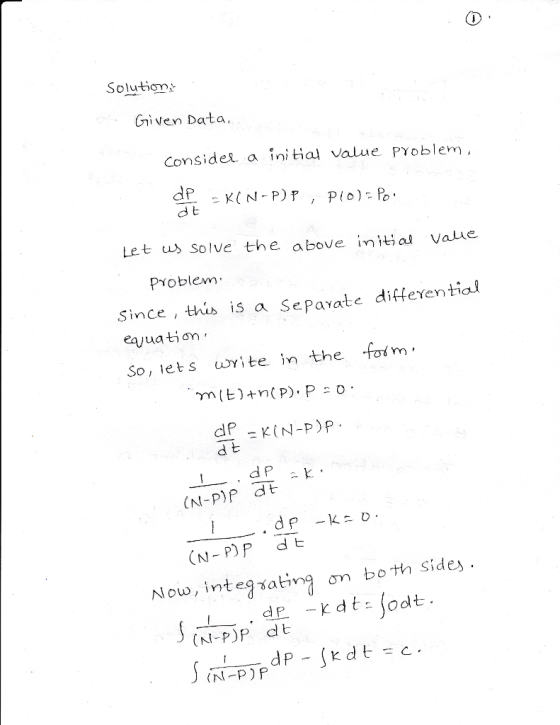
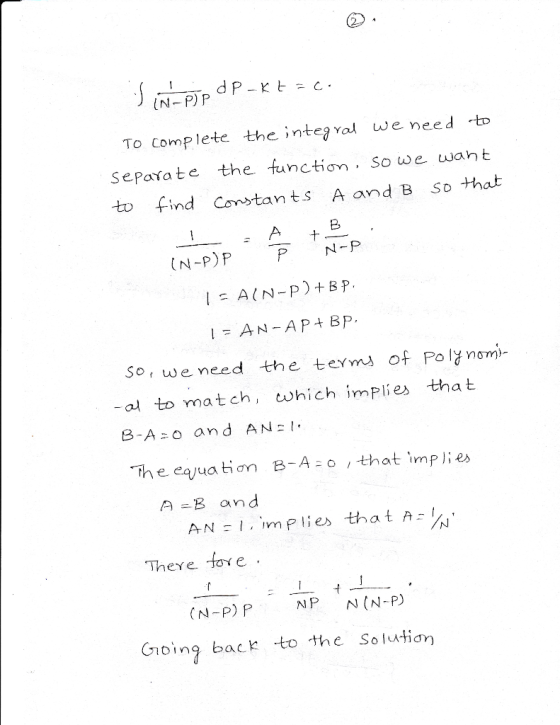
Let P(t) represent the number of people who, at time t, are infected with a certain disease. Let N denote the total number of people in the population. Assume that the spread of the disease can be modeled by the initial value problem:
dP/dt = k(N − P)P, P(0) = P0.
At time t = 0, when 100,000 member of a population of 500,000 are known to be infected, medical authorities intervene with medical treatment. As a consequence of this intervention, the rate factor k is no longer constant but varies with time as k(t) = 2e −t − 1, where time is measured in months and k(t) represents the rate of infection per month per 100,000 people. Initially, as the effects of medical intervention begin to take hold, k(t) remains positive and the disease continues to spread. Eventually, however, the effects of medical treatment cause k(t) to become negative and the number of infected individuals then decreases
Homework Answers


Add Answer to:
Let P(t) represent the number of people who, at time t, are infected with a certain disease. Let ...
2. Suppose the number of people infected with COVID-19 worldwide in thousands can be modeled by...
 2. Suppose the number of people infected with COVID-19 worldwide in thousands can be modeled by P = 10.58e1.017, where t is the time in months, with t = 0 corresponding to the beginning of February. (a) Let t = 1.5 to model predict the amount of people infected as of this week. (b) Predict the infected population in April, May, and June using the model and t = 2,3, and 4. Why is the growth from April to May...
In a laboratory setting, scientists are testing the claim that a certain contagious disease spreads at a rate that is proportional to the number of interactions between those that are infected x(t...
 In a laboratory setting, scientists are testing the claim that a certain contagious disease spreads at a rate that is proportional to the number of interactions between those that are infected x(t) and those that are disease-free y(t). To do this, the scientists begin with a population of 500 mice. Ten of the mice are removed, infected with the contagious disease, and then returned to the rest of the population. 1. Find a mathematical model that estimates the number of...
Question 1. First, we study a model for a disease which spreads quickly through a population....
 Question 1. First, we study a model for a disease which spreads quickly through a population. The rate of new infections at time t is proportional to the number of people who are currently infected at time t, and the number of people who are susceptible at time t. (a) Explain why I(t) satisfies the first-order ODE dI BI(N − 1) dt where ß > 0 is a constant. (b) Find the equilibrium solution(s) of the ODE (in terms of...
Problem 0.1 Let Xt be the number of people who enter a bank by time t...
Problem 0.1 Let Xt be the number of people who enter a bank by time t > 0. Suppose Pr[Xt = k] ... Problem 0.1 Let Xt be the number of people who enter a bank by time t > 0. Suppose Pr[Xt = k] = (tk e−t )/k! , for k = [0, 1, 2, . . . ,] and Pr[Xt = k, Xs = r] = sr *(t − s)k−r *e−t /(r!(k − r)!) , for t >...
Let Qd be the number of units of a commodity demanded by consumers at a given time t and let Qsdenote the number of units of the commodity supplied by producers at a given time t. Let p be the price i...
Let Qd be the number of units of a commodity demanded by consumers at a given time t and let Qsdenote the number of units of the commodity supplied by producers at a given time t. Let p be the price in dollars of the commodity at time t. Suppose the supply and demand functions for a certain commodity in a competitive market are given, in hundreds of units, by Qs = 30 + p + 5 dp/dt Qd =...
Problem 0.1 Let Xt be the number of people who enter a bank by time t...
Problem 0.1 Let Xt be the number of people who enter a bank by time t > 0. Suppose Pr[Xt = k] = (t k e −t )/k! , for k = [0, 1, 2, . . . ,] and Pr[Xt = k, Xs = r] = sr *(t − s)k−r *e−t /(r!(k − r)!) , for t > s > 0, and k ≥ r = 0, 1, 2, . . . . (a) Find Pr[X2 = k |...
Population Growth: Let P(t) be the number of rabbits in the rabbit population. In the simplest...
 Population Growth: Let P(t) be the number of rabbits in the
rabbit population. In the simplest case we can assume the number of
rabbits born at any moment of time is proportional to the number of
rabbits at this moment of time. Mathematically we can write this as
a differential equation:
Here b is the birth rate, i.e. births per time unit per rabbit.
In the model above we ignore deaths and assume resources are
unlimited.
A. Solve the equation...
Population Growth: Let P(t) be the number of rabbits in the
rabbit population. In the simplest case we can assume the number of
rabbits born at any moment of time is proportional to the number of
rabbits at this moment of time. Mathematically we can write this as
a differential equation:
Here b is the birth rate, i.e. births per time unit per rabbit.
In the model above we ignore deaths and assume resources are
unlimited.
A. Solve the equation...
Problem o.1 Let X, be the number of people who enter a bank by time t...
 Problem o.1 Let X, be the number of people who enter a bank by time t > 0. Suppose k! for k- 0,1,2,..., and s (t - s)k-e-t for t>s> 0, and k2r 0,1,2,.... (a) Find Pr[X2 k| X 1 for k 0,1,2,.... (b) Find E2 X1 1 Useful information: Don't eat yellow snow, andeot/k! Problem o.2 Recall the Geometric(p) distribution where X- number of flips of a coin until you get a head (H) with Pr(H) - p. The...
Problem 0.1 Let X be the number of people who enter a bank by time t>0....
 Problem 0.1 Let X be the number of people who enter a bank by time t>0. Suppose ke-t k! for k 0,1,2,., and for t>s > 0, and k-r=0,1,2, . . . . (a) Find Pr(X2 = k | X,-1) for k = 0, 1, 2, . . . . (b) Find E[X2 X1-1 Useful information: Don't eat yellow snow, and et-L=0 tk/k! Problem 0.2 Recall the Geometric(p) distribution where Xnumber of flips of a coin until you get a...
2. Two differential equations modeling problems follow. Do at least one of them (a) i. If...
 2. Two differential equations modeling problems follow. Do at least one of them (a) i. If N is the (fixed, constant) population in among residents can often be modeled as follows: Let x = x(t) be the number of people who have heard caught the disease by time t days. Then the disease spreads via the interactions between those who have the disease, and those who don't. The rate of transmission of the disease is thus proportional to the product...
 2. Suppose the number of people infected with COVID-19 worldwide in thousands can be modeled by P = 10.58e1.017, where t is the time in months, with t = 0 corresponding to the beginning of February. (a) Let t = 1.5 to model predict the amount of people infected as of this week. (b) Predict the infected population in April, May, and June using the model and t = 2,3, and 4. Why is the growth from April to May...
 In a laboratory setting, scientists are testing the claim that a certain contagious disease spreads at a rate that is proportional to the number of interactions between those that are infected x(t) and those that are disease-free y(t). To do this, the scientists begin with a population of 500 mice. Ten of the mice are removed, infected with the contagious disease, and then returned to the rest of the population. 1. Find a mathematical model that estimates the number of...
 Question 1. First, we study a model for a disease which spreads quickly through a population. The rate of new infections at time t is proportional to the number of people who are currently infected at time t, and the number of people who are susceptible at time t. (a) Explain why I(t) satisfies the first-order ODE dI BI(N − 1) dt where ß > 0 is a constant. (b) Find the equilibrium solution(s) of the ODE (in terms of...
 Population Growth: Let P(t) be the number of rabbits in the
rabbit population. In the simplest case we can assume the number of
rabbits born at any moment of time is proportional to the number of
rabbits at this moment of time. Mathematically we can write this as
a differential equation:
Here b is the birth rate, i.e. births per time unit per rabbit.
In the model above we ignore deaths and assume resources are
unlimited.
A. Solve the equation...
Population Growth: Let P(t) be the number of rabbits in the
rabbit population. In the simplest case we can assume the number of
rabbits born at any moment of time is proportional to the number of
rabbits at this moment of time. Mathematically we can write this as
a differential equation:
Here b is the birth rate, i.e. births per time unit per rabbit.
In the model above we ignore deaths and assume resources are
unlimited.
A. Solve the equation...
 Problem o.1 Let X, be the number of people who enter a bank by time t > 0. Suppose k! for k- 0,1,2,..., and s (t - s)k-e-t for t>s> 0, and k2r 0,1,2,.... (a) Find Pr[X2 k| X 1 for k 0,1,2,.... (b) Find E2 X1 1 Useful information: Don't eat yellow snow, andeot/k! Problem o.2 Recall the Geometric(p) distribution where X- number of flips of a coin until you get a head (H) with Pr(H) - p. The...
 Problem 0.1 Let X be the number of people who enter a bank by time t>0. Suppose ke-t k! for k 0,1,2,., and for t>s > 0, and k-r=0,1,2, . . . . (a) Find Pr(X2 = k | X,-1) for k = 0, 1, 2, . . . . (b) Find E[X2 X1-1 Useful information: Don't eat yellow snow, and et-L=0 tk/k! Problem 0.2 Recall the Geometric(p) distribution where Xnumber of flips of a coin until you get a...
 2. Two differential equations modeling problems follow. Do at least one of them (a) i. If N is the (fixed, constant) population in among residents can often be modeled as follows: Let x = x(t) be the number of people who have heard caught the disease by time t days. Then the disease spreads via the interactions between those who have the disease, and those who don't. The rate of transmission of the disease is thus proportional to the product...
Most questions answered within 3 hours.
-
Where is the error in this code sequence?
String s1 = "Hello";
String s2 = "ello";...
asked 11 months ago -
Financial data for Joel de Paris, Inc., for last year
follow:
Joel de Paris, Inc.
Balance...
asked 11 months ago -
Consider this reaction:
Al2(SO4)3 (aq)+ BaCl3
(aq) Al2Cl6 (aq)- +
3BaSO4(s) . What is the...
asked 11 months ago -
Suppose that Savneet is considering increasing her
recent random sample from 20 car rentals to 40...
asked 11 months ago -
Trucks arrive at an unloading terminal at an average rate of 120
per hour.
Trucks arrive...
asked 11 months ago -
Why are methanol and ethanol completely soluble in water while
octanol is not very little soluble....
asked 11 months ago -
A facilities manager at a university reads in a research report
that the mean amount of...
asked 11 months ago -
When the CuSO4 is rehydrated by adding water to the anhydrous
compound, is this an endothermic...
asked 11 months ago -
A ray of sunlight is passing from diamond into crown glass; the
angle of incidence is...
asked 11 months ago -
A block of mass 0.249 kg is placed on top of a light, vertical
spring of...
asked 11 months ago -
how do the kidneys compensate in the presences of acidosis
a) trigger hyperventilate
b) reserve acid...
asked 11 months ago -
Question 501 pts
The rental rate of capital to the firm increases. Which of the
following...
asked 11 months ago