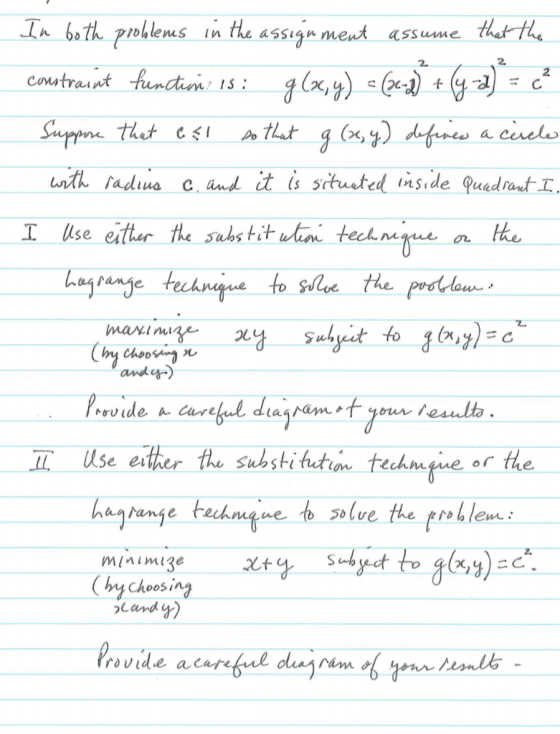
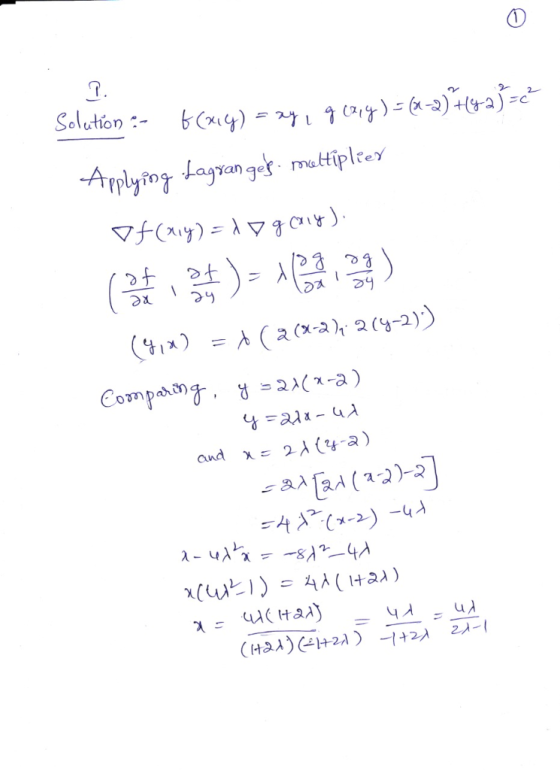
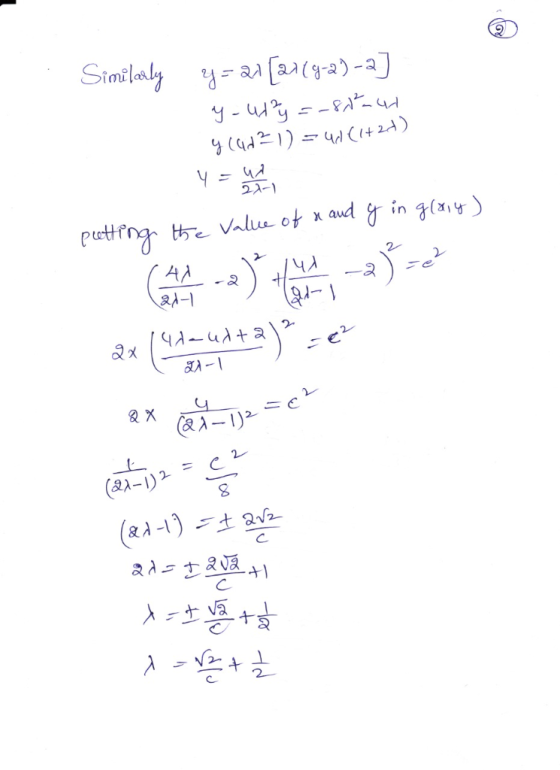
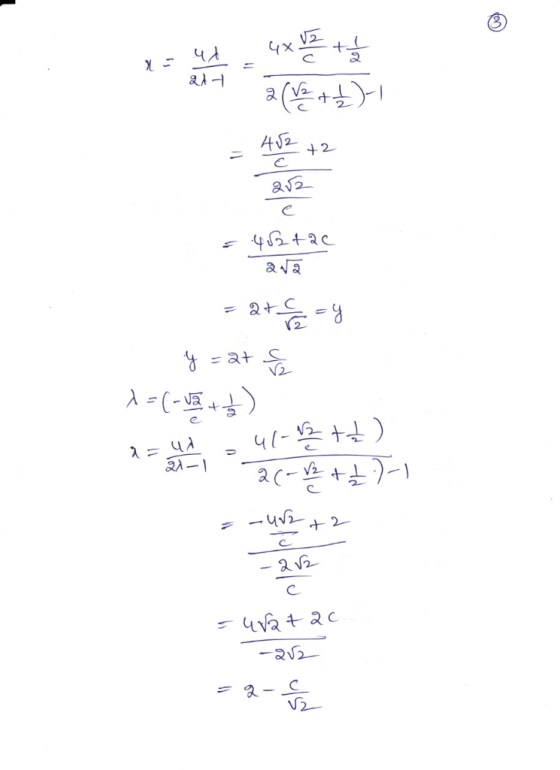
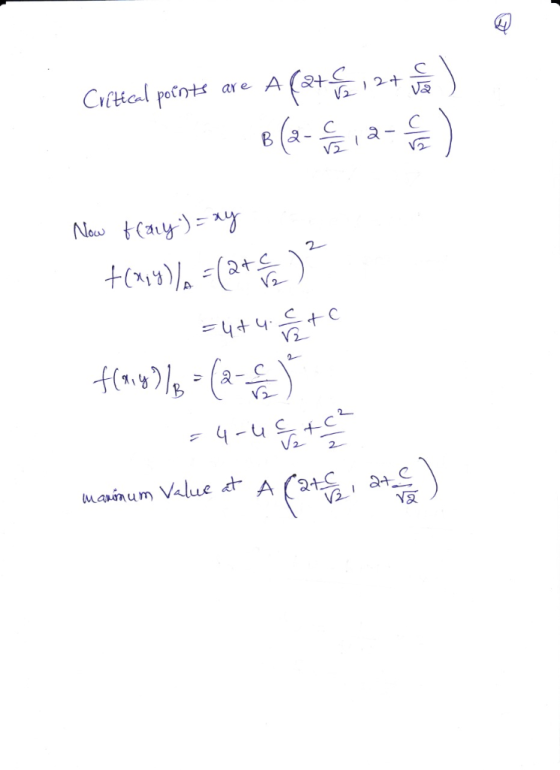
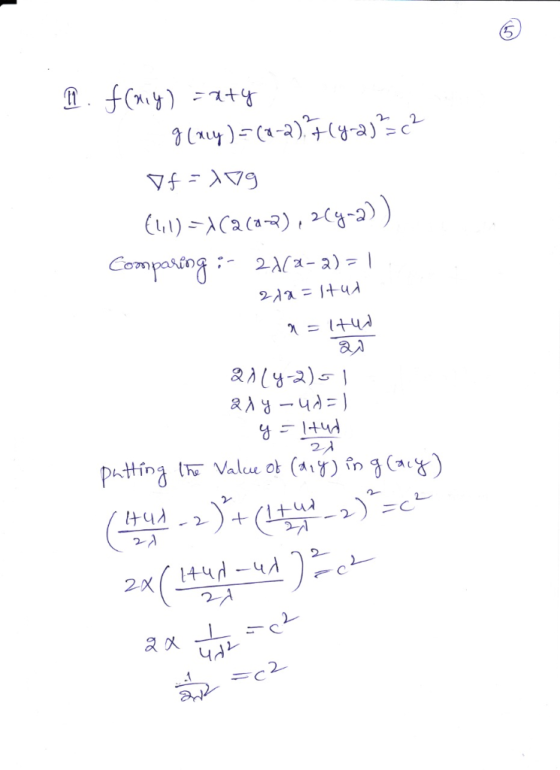
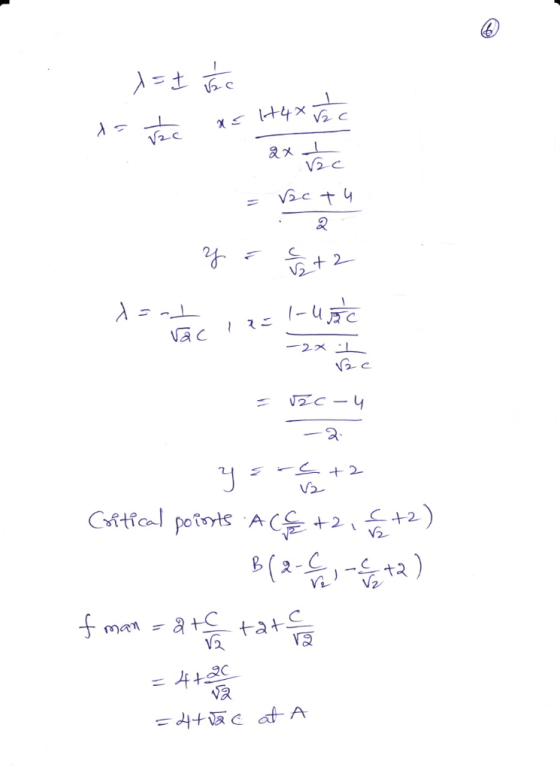
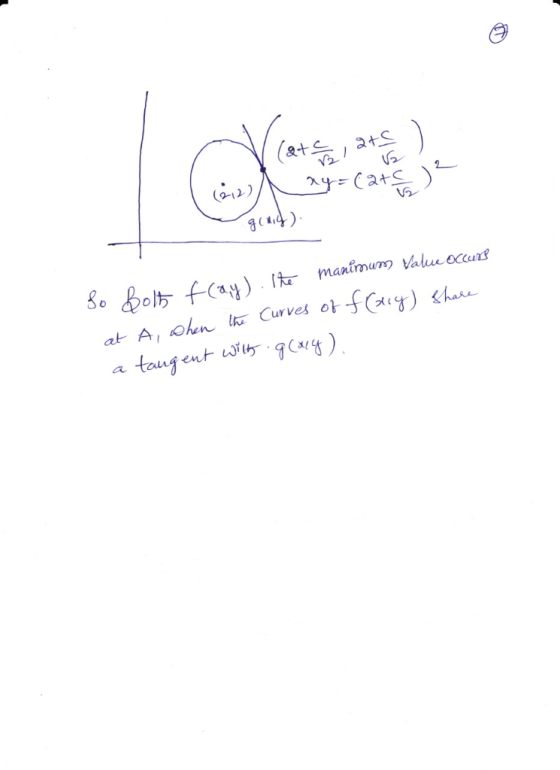
In both problem in the assignment assume that the constraint function is g(x,y)=(x-2)^2+(y-2)^2=c^2
Homework Answers
Add Answer to:
In both problem in the assignment assume that the constraint function is g(x,y)=(x-2)^2+(y-2)^2=c^2
3 Find the minimum and maximum values of the function f(x, y)= x +y subject to the constraint x + y 1250. Use the L...
 3 Find the minimum and maximum values of the function f(x, y)= x +y subject to the constraint x + y 1250. Use the Lagrange Equations. (Use symbolic notation and fractions where needed.) maximum value of the function minimum value of the function cBook Hint
3 Find the minimum and maximum values of the function f(x, y)= x +y subject to the constraint x + y 1250. Use the Lagrange Equations. (Use symbolic notation and fractions where needed.) maximum value...
3 Find the minimum and maximum values of the function f(x, y)= x +y subject to the constraint x + y 1250. Use the Lagrange Equations. (Use symbolic notation and fractions where needed.) maximum value of the function minimum value of the function cBook Hint
3 Find the minimum and maximum values of the function f(x, y)= x +y subject to the constraint x + y 1250. Use the Lagrange Equations. (Use symbolic notation and fractions where needed.) maximum value...
3. Find the minimum and maximum values of the function f (x, y) = x2 + y subject to the constraint x y = 162. Use the L...
 3. Find the minimum and maximum values of the function f (x, y) = x2 + y subject to the constraint x y = 162. Use the Lagrange Equations. (Use symbolic notation and fractions where needed.) maximum value of the function| minimum value of the function
3. Find the minimum and maximum values of the function f (x, y) = x2 + y subject to the constraint x y = 162. Use the Lagrange Equations. (Use symbolic notation and fractions...
3. Find the minimum and maximum values of the function f (x, y) = x2 + y subject to the constraint x y = 162. Use the Lagrange Equations. (Use symbolic notation and fractions where needed.) maximum value of the function| minimum value of the function
3. Find the minimum and maximum values of the function f (x, y) = x2 + y subject to the constraint x y = 162. Use the Lagrange Equations. (Use symbolic notation and fractions...
use Lagrange Multipliers to find absolute max & min values of the function f(x,y) with constraint...
 use Lagrange Multipliers to find absolute max & min values of the function f(x,y) with constraint X. y 2
Use the Lagrange method to find the constrained ends of the function f(x,y)=x+3y that are on...
 Use the Lagrange method to find the constrained ends of the
function f(x,y)=x+3y
that are on the curve x2+y2=10
write your answer from the constrained ends of the form
f(a,b)=c
If there is no restricted maximum or restricted minimum, write
NE
a) Maximum restricted
b) Restricted minimum
Utilice el método de Lagrange para encontrar los extremos restringidos de la función f (2, y) = x + 3y que están sobre la curva z2 + y2 = 10. Escriba su respuesta...
Use the Lagrange method to find the constrained ends of the
function f(x,y)=x+3y
that are on the curve x2+y2=10
write your answer from the constrained ends of the form
f(a,b)=c
If there is no restricted maximum or restricted minimum, write
NE
a) Maximum restricted
b) Restricted minimum
Utilice el método de Lagrange para encontrar los extremos restringidos de la función f (2, y) = x + 3y que están sobre la curva z2 + y2 = 10. Escriba su respuesta...
The goal is to find the minumum and maximum of the function f(x,y)= (1/x)-(1/y) subject to...
 The goal is to find the minumum and maximum of the function
f(x,y)= (1/x)-(1/y) subject to the constraint
g(x,y)=(1/x^2)+(3/y^2)=1
10. (7 points) The goal of this problem is to find the maximum and minimum values of the function (x) subject to the constraint g(x,y) = +3=1. a) Set up a Lagrange multiplier system modeling this problem. (b) Solve the system you set up in part (a). (c) Identify the extrema.
The goal is to find the minumum and maximum of the function
f(x,y)= (1/x)-(1/y) subject to the constraint
g(x,y)=(1/x^2)+(3/y^2)=1
10. (7 points) The goal of this problem is to find the maximum and minimum values of the function (x) subject to the constraint g(x,y) = +3=1. a) Set up a Lagrange multiplier system modeling this problem. (b) Solve the system you set up in part (a). (c) Identify the extrema.
This extreme value problem has a solution with both a maximum value and a minimum value....
 This extreme value problem has a solution with both a maximum
value and a minimum value. Use Lagrange multipliers to find the
extreme values of the function subject to the given constraint.
f(x, y, z) = x2 + y2 +
z2; x4 + y4
+ z4 = 7
Maximum Value:
Minimum Value:
This extreme value problem has a solution with both a maximum value and a minimum value. Use Lagrange multipliers to find the extreme values of the function subject to...
This extreme value problem has a solution with both a maximum
value and a minimum value. Use Lagrange multipliers to find the
extreme values of the function subject to the given constraint.
f(x, y, z) = x2 + y2 +
z2; x4 + y4
+ z4 = 7
Maximum Value:
Minimum Value:
This extreme value problem has a solution with both a maximum value and a minimum value. Use Lagrange multipliers to find the extreme values of the function subject to...
Problem 5. Find saddle points of f(x,y)y sin(a/3). 82+88y6 a local Problem 6. At what point is the function f(x, y) minimum? Problem 7. Use Lagrange multipliers to find the maximum and the minimu...
 Problem 5. Find saddle points of f(x,y)y sin(a/3). 82+88y6 a local Problem 6. At what point is the function f(x, y) minimum? Problem 7. Use Lagrange multipliers to find the maximum and the minimum of f(x, y) -yz on the sphere centered at the origin and of radius 3 in R3
Problem 5. Find saddle points of f(x,y)y sin(a/3). 82+88y6 a local Problem 6. At what point is the function f(x, y) minimum? Problem 7. Use Lagrange multipliers to find...
Problem 5. Find saddle points of f(x,y)y sin(a/3). 82+88y6 a local Problem 6. At what point is the function f(x, y) minimum? Problem 7. Use Lagrange multipliers to find the maximum and the minimum of f(x, y) -yz on the sphere centered at the origin and of radius 3 in R3
Problem 5. Find saddle points of f(x,y)y sin(a/3). 82+88y6 a local Problem 6. At what point is the function f(x, y) minimum? Problem 7. Use Lagrange multipliers to find...
7) Given f(x,y)= x^2+y^2+2, subject to the constraint g(x,y)=x^2+xy+y^2-4=0, write the system of equations which must...
7) Given f(x,y)= x^2+y^2+2, subject to the constraint g(x,y)=x^2+xy+y^2-4=0, write the system of equations which must be solved to optimize f using Lagrange Multipliers.
Problem 2 Expenditure Function: E = x + 2y Utility Constraint: 75 = Vx+ Vy (a)...
 Problem 2 Expenditure Function: E = x + 2y Utility Constraint: 75 = Vx+ Vy (a) Write the Lagrangian function for this problem (b) Solve for the optimal values of x and y (Note that you DON'T have to use the Lagrangian from A)
1. Provide both 3) Minimize the function f(x,y)-x+y jon the line x -y - the location (x.y Solve the problem in the following two different ways and verify that they give the same results. a) Using La...
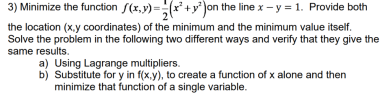 1. Provide both 3) Minimize the function f(x,y)-x+y jon the line x -y - the location (x.y Solve the problem in the following two different ways and verify that they give the same results. a) Using Lagrange multipliers. b) Substitute for y in f(x.y), to create a function of x alone and then minimize that function of a single variable.
1. Provide both 3) Minimize the function f(x,y)-x+y jon the line x -y - the location (x.y Solve the problem...
1. Provide both 3) Minimize the function f(x,y)-x+y jon the line x -y - the location (x.y Solve the problem in the following two different ways and verify that they give the same results. a) Using Lagrange multipliers. b) Substitute for y in f(x.y), to create a function of x alone and then minimize that function of a single variable.
1. Provide both 3) Minimize the function f(x,y)-x+y jon the line x -y - the location (x.y Solve the problem...
 3 Find the minimum and maximum values of the function f(x, y)= x +y subject to the constraint x + y 1250. Use the Lagrange Equations. (Use symbolic notation and fractions where needed.) maximum value of the function minimum value of the function cBook Hint
3 Find the minimum and maximum values of the function f(x, y)= x +y subject to the constraint x + y 1250. Use the Lagrange Equations. (Use symbolic notation and fractions where needed.) maximum value...
3 Find the minimum and maximum values of the function f(x, y)= x +y subject to the constraint x + y 1250. Use the Lagrange Equations. (Use symbolic notation and fractions where needed.) maximum value of the function minimum value of the function cBook Hint
3 Find the minimum and maximum values of the function f(x, y)= x +y subject to the constraint x + y 1250. Use the Lagrange Equations. (Use symbolic notation and fractions where needed.) maximum value...
 3. Find the minimum and maximum values of the function f (x, y) = x2 + y subject to the constraint x y = 162. Use the Lagrange Equations. (Use symbolic notation and fractions where needed.) maximum value of the function| minimum value of the function
3. Find the minimum and maximum values of the function f (x, y) = x2 + y subject to the constraint x y = 162. Use the Lagrange Equations. (Use symbolic notation and fractions...
3. Find the minimum and maximum values of the function f (x, y) = x2 + y subject to the constraint x y = 162. Use the Lagrange Equations. (Use symbolic notation and fractions where needed.) maximum value of the function| minimum value of the function
3. Find the minimum and maximum values of the function f (x, y) = x2 + y subject to the constraint x y = 162. Use the Lagrange Equations. (Use symbolic notation and fractions...
 use Lagrange Multipliers to find absolute max & min values of the function f(x,y) with constraint X. y 2
 Use the Lagrange method to find the constrained ends of the
function f(x,y)=x+3y
that are on the curve x2+y2=10
write your answer from the constrained ends of the form
f(a,b)=c
If there is no restricted maximum or restricted minimum, write
NE
a) Maximum restricted
b) Restricted minimum
Utilice el método de Lagrange para encontrar los extremos restringidos de la función f (2, y) = x + 3y que están sobre la curva z2 + y2 = 10. Escriba su respuesta...
Use the Lagrange method to find the constrained ends of the
function f(x,y)=x+3y
that are on the curve x2+y2=10
write your answer from the constrained ends of the form
f(a,b)=c
If there is no restricted maximum or restricted minimum, write
NE
a) Maximum restricted
b) Restricted minimum
Utilice el método de Lagrange para encontrar los extremos restringidos de la función f (2, y) = x + 3y que están sobre la curva z2 + y2 = 10. Escriba su respuesta...
 The goal is to find the minumum and maximum of the function
f(x,y)= (1/x)-(1/y) subject to the constraint
g(x,y)=(1/x^2)+(3/y^2)=1
10. (7 points) The goal of this problem is to find the maximum and minimum values of the function (x) subject to the constraint g(x,y) = +3=1. a) Set up a Lagrange multiplier system modeling this problem. (b) Solve the system you set up in part (a). (c) Identify the extrema.
The goal is to find the minumum and maximum of the function
f(x,y)= (1/x)-(1/y) subject to the constraint
g(x,y)=(1/x^2)+(3/y^2)=1
10. (7 points) The goal of this problem is to find the maximum and minimum values of the function (x) subject to the constraint g(x,y) = +3=1. a) Set up a Lagrange multiplier system modeling this problem. (b) Solve the system you set up in part (a). (c) Identify the extrema.
 This extreme value problem has a solution with both a maximum
value and a minimum value. Use Lagrange multipliers to find the
extreme values of the function subject to the given constraint.
f(x, y, z) = x2 + y2 +
z2; x4 + y4
+ z4 = 7
Maximum Value:
Minimum Value:
This extreme value problem has a solution with both a maximum value and a minimum value. Use Lagrange multipliers to find the extreme values of the function subject to...
This extreme value problem has a solution with both a maximum
value and a minimum value. Use Lagrange multipliers to find the
extreme values of the function subject to the given constraint.
f(x, y, z) = x2 + y2 +
z2; x4 + y4
+ z4 = 7
Maximum Value:
Minimum Value:
This extreme value problem has a solution with both a maximum value and a minimum value. Use Lagrange multipliers to find the extreme values of the function subject to...
 Problem 5. Find saddle points of f(x,y)y sin(a/3). 82+88y6 a local Problem 6. At what point is the function f(x, y) minimum? Problem 7. Use Lagrange multipliers to find the maximum and the minimum of f(x, y) -yz on the sphere centered at the origin and of radius 3 in R3
Problem 5. Find saddle points of f(x,y)y sin(a/3). 82+88y6 a local Problem 6. At what point is the function f(x, y) minimum? Problem 7. Use Lagrange multipliers to find...
Problem 5. Find saddle points of f(x,y)y sin(a/3). 82+88y6 a local Problem 6. At what point is the function f(x, y) minimum? Problem 7. Use Lagrange multipliers to find the maximum and the minimum of f(x, y) -yz on the sphere centered at the origin and of radius 3 in R3
Problem 5. Find saddle points of f(x,y)y sin(a/3). 82+88y6 a local Problem 6. At what point is the function f(x, y) minimum? Problem 7. Use Lagrange multipliers to find...
 Problem 2 Expenditure Function: E = x + 2y Utility Constraint: 75 = Vx+ Vy (a) Write the Lagrangian function for this problem (b) Solve for the optimal values of x and y (Note that you DON'T have to use the Lagrangian from A)
 1. Provide both 3) Minimize the function f(x,y)-x+y jon the line x -y - the location (x.y Solve the problem in the following two different ways and verify that they give the same results. a) Using Lagrange multipliers. b) Substitute for y in f(x.y), to create a function of x alone and then minimize that function of a single variable.
1. Provide both 3) Minimize the function f(x,y)-x+y jon the line x -y - the location (x.y Solve the problem...
1. Provide both 3) Minimize the function f(x,y)-x+y jon the line x -y - the location (x.y Solve the problem in the following two different ways and verify that they give the same results. a) Using Lagrange multipliers. b) Substitute for y in f(x.y), to create a function of x alone and then minimize that function of a single variable.
1. Provide both 3) Minimize the function f(x,y)-x+y jon the line x -y - the location (x.y Solve the problem...
Most questions answered within 3 hours.
-
Where is the error in this code sequence?
String s1 = "Hello";
String s2 = "ello";...
asked 10 months ago -
Financial data for Joel de Paris, Inc., for last year
follow:
Joel de Paris, Inc.
Balance...
asked 10 months ago -
Consider this reaction:
Al2(SO4)3 (aq)+ BaCl3
(aq) Al2Cl6 (aq)- +
3BaSO4(s) . What is the...
asked 10 months ago -
Suppose that Savneet is considering increasing her
recent random sample from 20 car rentals to 40...
asked 10 months ago -
Trucks arrive at an unloading terminal at an average rate of 120
per hour.
Trucks arrive...
asked 10 months ago -
Why are methanol and ethanol completely soluble in water while
octanol is not very little soluble....
asked 10 months ago -
A facilities manager at a university reads in a research report
that the mean amount of...
asked 10 months ago -
When the CuSO4 is rehydrated by adding water to the anhydrous
compound, is this an endothermic...
asked 10 months ago -
A ray of sunlight is passing from diamond into crown glass; the
angle of incidence is...
asked 10 months ago -
A block of mass 0.249 kg is placed on top of a light, vertical
spring of...
asked 10 months ago -
how do the kidneys compensate in the presences of acidosis
a) trigger hyperventilate
b) reserve acid...
asked 10 months ago -
Question 501 pts
The rental rate of capital to the firm increases. Which of the
following...
asked 10 months ago