
Homework Answers
Add Answer to:
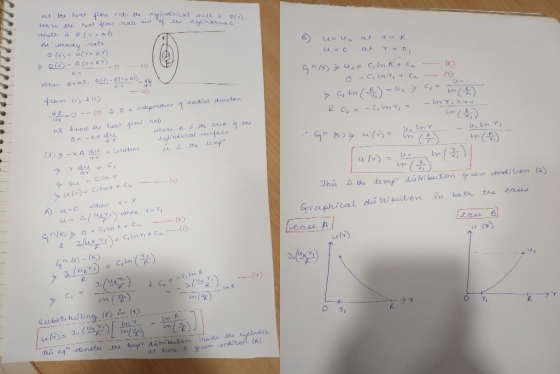
Problem 3 Consider an infinite round cylinder of radius R. Find the distribution of the tem perat...
Problem 3. Consider the following problem which governs the evolution of tem- perature in a bar...
 Problem 3. Consider the following problem which governs the evolution of tem- perature in a bar of length l: du du 0<x<l, t>0, ot =^22+Yºu), og (0, ) = 0, de 10 , 1) = 0, u(x,0) = f(x) = A + 2 cos(") + 3 cos(477), where A, k and y are fixed positve constants. Recall that Neumann boundary con- ditions correspond to no heat flux through the boundaries (i.e. perfect insulation) and the term yều corresponds to internal...
this is a laplace equation in cylinder coordinates: ) 1. (10 points) A solid cylinder of radius a and height h has...
 this is a laplace equation in cylinder coordinates: )
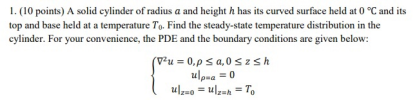
1. (10 points) A solid cylinder of radius a and height h has its curved surface held at 0 °C and its top and base held at a temperature To. Find the steady-state temperature distribution in the cylinder. For your convenience, the PDE and the boundary conditions are given below: lu
1. (10 points) A solid cylinder of radius a and height h has its curved surface held at 0 °C...
this is a laplace equation in cylinder coordinates: )
1. (10 points) A solid cylinder of radius a and height h has its curved surface held at 0 °C and its top and base held at a temperature To. Find the steady-state temperature distribution in the cylinder. For your convenience, the PDE and the boundary conditions are given below: lu
1. (10 points) A solid cylinder of radius a and height h has its curved surface held at 0 °C...
6. Spinning Cylinder A cylinder of radius R and infinite length is made of permanently polarized...
 6. Spinning Cylinder A cylinder of radius R and infinite length is made of permanently polarized dielectric. The polarization vector P is everywhere proportional to the radial vector r, such that P = ar, where a is a positive constant. The cylinder rotates around its axis with an angular velocity w This is a non-relativistic problem where wR< c. a) Find the electric field E at a radius r both inside and outside the cylinder. b) Find the magnetic field...
3. (Cotal: 30 pts) Consider a cylinder of radius R and length L. The thermal "Gonductivity ofthe eyǐnaeris R. The temperature is fixed at the left end at TO and the other end is subject to co...
 3. (Cotal: 30 pts) Consider a cylinder of radius R and length L. The thermal "Gonductivity ofthe eyǐnaeris R. The temperature is fixed at the left end at TO and the other end is subject to convective heat transfer with heat transfer coefficient h and environment temperature of To. The side surface of the cylinder is subject to radiative heat transfer to environment of To. Assume there is no heat generation in the cylinder. (10 pts) starting with energy balance,...
Problem 3: the infinite cylinder An insulating cylinder that is infinitely long has radius R and...
 Problem 3: the infinite cylinder An insulating cylinder that is infinitely long has radius R and a charge per unit length of λ. (Hint: because it is an insulator you should assume that the charge is spread uniformly across its entire volume of the cylinder) a) Use Gauss' Law to calculate the electric field at a point outside of the cylinder as a function of r, the radial distance from the center of the cylinder. (r> R) b) Use Gauss'...
a) Find the solution to the following interior Dirichlet problem with radius R=1 1 PDE Urr...
 a) Find the solution to the following interior Dirichlet problem with radius R=1 1 PDE Urr + Up t 0 0 <r <1 wee p2 r BC u (1,0) = 10 + 3 sin(0) 10 cos(20) 0 <0 < 27 b) Consider the above problem on the unit square (x,y) domain PDE Urr + Uyy = 0 0<x<1 0<y <1 Transform the solution u(r, 0) from "a)" to the solution u(x, y) for "b)" Use the solution u(x,y) to calculate...
10. (21 pts]Find the steady-state temperature distribution in a solid cylinder with radius R and height...
 10. (21 pts]Find the steady-state temperature distribution in a solid cylinder with radius R and height H, if the boundary temperatures are set as 0 on the bottom surface, ugra/R? on the top surface and Uz/H on the curved surface 1 [4 pts) Write the governing equation and boundary conditions 2) [17 pts]Solve the problem
Consider two concentric insulating cylinders of infinite length. The inner cylinder is solid with radius R,...
Consider two concentric insulating cylinders of infinite length. The inner cylinder is solid with radius R, while the outer cylinder is a hollow shell with inner radius a and outer radius b. Both cylinders have the same volume charge density of +ρ. Using Gauss’s Law, find the electric field as a function of r (where r = 0 at the central axis) in the interval a ≤ r < b. Note: Your final equation should be in terms of given...
Consider a particle of mass m in an infinite spherical potential well of radius a For write down the energies and corresponding eigen functions ψ--(r,0.9). (3 pt) a) ne that at t-o the wave fu...
 Consider a particle of mass m in an infinite spherical potential well of radius a For write down the energies and corresponding eigen functions ψ--(r,0.9). (3 pt) a) ne that at t-o the wave function is given by o)-A. Find the normalization constant A function in this basis. Solve for the coeffici You may find useful the integrals in the front of the (6 pt) d) Now consider the finite potential spherical well with V(r)- ing only the radial part...
6. An infinite cylinder of radius R has a uniform charge density of p in its...
 6. An infinite cylinder of radius R has a uniform charge density of p in its interior, and a surface charge density of -pR on its surface. Find the electric field everywhere inside and outside the cylinder. Be clear about both the magnitude and direction of the field.
 Problem 3. Consider the following problem which governs the evolution of tem- perature in a bar of length l: du du 0<x<l, t>0, ot =^22+Yºu), og (0, ) = 0, de 10 , 1) = 0, u(x,0) = f(x) = A + 2 cos(") + 3 cos(477), where A, k and y are fixed positve constants. Recall that Neumann boundary con- ditions correspond to no heat flux through the boundaries (i.e. perfect insulation) and the term yều corresponds to internal...
 this is a laplace equation in cylinder coordinates: )
1. (10 points) A solid cylinder of radius a and height h has its curved surface held at 0 °C and its top and base held at a temperature To. Find the steady-state temperature distribution in the cylinder. For your convenience, the PDE and the boundary conditions are given below: lu
1. (10 points) A solid cylinder of radius a and height h has its curved surface held at 0 °C...
this is a laplace equation in cylinder coordinates: )
1. (10 points) A solid cylinder of radius a and height h has its curved surface held at 0 °C and its top and base held at a temperature To. Find the steady-state temperature distribution in the cylinder. For your convenience, the PDE and the boundary conditions are given below: lu
1. (10 points) A solid cylinder of radius a and height h has its curved surface held at 0 °C...
 6. Spinning Cylinder A cylinder of radius R and infinite length is made of permanently polarized dielectric. The polarization vector P is everywhere proportional to the radial vector r, such that P = ar, where a is a positive constant. The cylinder rotates around its axis with an angular velocity w This is a non-relativistic problem where wR< c. a) Find the electric field E at a radius r both inside and outside the cylinder. b) Find the magnetic field...
 3. (Cotal: 30 pts) Consider a cylinder of radius R and length L. The thermal "Gonductivity ofthe eyǐnaeris R. The temperature is fixed at the left end at TO and the other end is subject to convective heat transfer with heat transfer coefficient h and environment temperature of To. The side surface of the cylinder is subject to radiative heat transfer to environment of To. Assume there is no heat generation in the cylinder. (10 pts) starting with energy balance,...
 Problem 3: the infinite cylinder An insulating cylinder that is infinitely long has radius R and a charge per unit length of λ. (Hint: because it is an insulator you should assume that the charge is spread uniformly across its entire volume of the cylinder) a) Use Gauss' Law to calculate the electric field at a point outside of the cylinder as a function of r, the radial distance from the center of the cylinder. (r> R) b) Use Gauss'...
 a) Find the solution to the following interior Dirichlet problem with radius R=1 1 PDE Urr + Up t 0 0 <r <1 wee p2 r BC u (1,0) = 10 + 3 sin(0) 10 cos(20) 0 <0 < 27 b) Consider the above problem on the unit square (x,y) domain PDE Urr + Uyy = 0 0<x<1 0<y <1 Transform the solution u(r, 0) from "a)" to the solution u(x, y) for "b)" Use the solution u(x,y) to calculate...
 10. (21 pts]Find the steady-state temperature distribution in a solid cylinder with radius R and height H, if the boundary temperatures are set as 0 on the bottom surface, ugra/R? on the top surface and Uz/H on the curved surface 1 [4 pts) Write the governing equation and boundary conditions 2) [17 pts]Solve the problem
 Consider a particle of mass m in an infinite spherical potential well of radius a For write down the energies and corresponding eigen functions ψ--(r,0.9). (3 pt) a) ne that at t-o the wave function is given by o)-A. Find the normalization constant A function in this basis. Solve for the coeffici You may find useful the integrals in the front of the (6 pt) d) Now consider the finite potential spherical well with V(r)- ing only the radial part...
 6. An infinite cylinder of radius R has a uniform charge density of p in its interior, and a surface charge density of -pR on its surface. Find the electric field everywhere inside and outside the cylinder. Be clear about both the magnitude and direction of the field.
Most questions answered within 3 hours.
-
Where is the error in this code sequence?
String s1 = "Hello";
String s2 = "ello";...
asked 10 months ago -
Financial data for Joel de Paris, Inc., for last year
follow:
Joel de Paris, Inc.
Balance...
asked 10 months ago -
Consider this reaction:
Al2(SO4)3 (aq)+ BaCl3
(aq) Al2Cl6 (aq)- +
3BaSO4(s) . What is the...
asked 10 months ago -
Suppose that Savneet is considering increasing her
recent random sample from 20 car rentals to 40...
asked 10 months ago -
Trucks arrive at an unloading terminal at an average rate of 120
per hour.
Trucks arrive...
asked 10 months ago -
Why are methanol and ethanol completely soluble in water while
octanol is not very little soluble....
asked 10 months ago -
A facilities manager at a university reads in a research report
that the mean amount of...
asked 10 months ago -
When the CuSO4 is rehydrated by adding water to the anhydrous
compound, is this an endothermic...
asked 10 months ago -
A ray of sunlight is passing from diamond into crown glass; the
angle of incidence is...
asked 10 months ago -
A block of mass 0.249 kg is placed on top of a light, vertical
spring of...
asked 10 months ago -
how do the kidneys compensate in the presences of acidosis
a) trigger hyperventilate
b) reserve acid...
asked 10 months ago -
Question 501 pts
The rental rate of capital to the firm increases. Which of the
following...
asked 10 months ago