 using floyd’s algorithm find the shortest paths
from b to d and from k to d
using floyd’s algorithm find the shortest paths
from b to d and from k to dHomework Answers


Add Answer to:
Using floyd’s algorithm find the shortest paths from b to d and from k to d
3 Determine shortest paths from node 1 to 5, using Floyd algorithm.
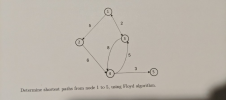 3 Determine shortest paths from node 1 to 5, using Floyd algorithm.
Consider the network shown below. Use Dijkstra's algorithm to find the shortest paths from node a...
 Consider the network shown below. Use Dijkstra's algorithm to find the shortest paths from node a to all other nodes. Enter your answers in the a shortest path answers in the following format: node-node-node. For example, if the ssignment link. Enter the shortest path from a to c is through node b, you would enter the answer as: a-b-c 3 5 6 6
Shortest paths Consider a directed graph with vertices fa, b, c, d, e, f and adjacency...
 Shortest paths Consider a directed graph with vertices fa, b, c, d, e, f and adjacency list representation belovw (with edge weights in parentheses): a: b(4), f(2) e: a(6), b(3), d(7) d: a(6), e(2) e: d(5) f: d(2), e(3) (i) Find three shortest paths from c to e. (ii) Which of these paths could have been found by Dijkstra's shortest path algorithm? (Give a convincing explanation by referring to the main steps of the algorithm.)
2. Apply Dijkstra’s algorithm as discussed in class to solve the single-source shortest-paths problem for the...
 2. Apply Dijkstra’s algorithm as discussed in class to solve the single-source shortest-paths problem for the following graph. Consider node a to be the source. (10 points) a. Show the completed table. b. State the shortest path from A to J and state its length. c. State the shortest path from A to K and state its length. d. State the shortest path from A to L and state its length. 3 5 6 4 3 2 1 2. d...
1. Modify the algorithm for single-source shortest paths to actually store and return the shortest paths...
1. Modify the algorithm for single-source shortest paths to actually store and return the shortest paths rather than just compute the distances.
3. Given the graph G shown, we find the shortest paths from node S using the...
 3. Given the graph G shown, we find the shortest paths from node S using the Bellman-Ford algorithm. How many iterations does it take before the algorithm converges to the solution? 4 A 1 -2 10 S -9 E 1 10 -8 B 2
Find the shortest path algorithm tables (for the graph on the homework sheet) using the (a)...
 Find the shortest path algorithm tables (for the graph on the
homework sheet) using the
(a) Dijkstra algorithm
(b) Ford-Fulkerson algorithm
Label the columns B,C,D from left to right. Node A is the root
node.
Use pointers for only the Ford Fulkerson algorithm as in the
Networks and Grids book.
(c) Let the link number be bandwidth (data rate). Create the
routing table that allows you find paths to the root node that
maximize the bottleneck bandwidth
Uhe
Find the shortest path algorithm tables (for the graph on the
homework sheet) using the
(a) Dijkstra algorithm
(b) Ford-Fulkerson algorithm
Label the columns B,C,D from left to right. Node A is the root
node.
Use pointers for only the Ford Fulkerson algorithm as in the
Networks and Grids book.
(c) Let the link number be bandwidth (data rate). Create the
routing table that allows you find paths to the root node that
maximize the bottleneck bandwidth
Uhe
5. Apply Dijkstra's algorithm as discussed in class to solve the single-source shortest-paths problem for the...
 5. Apply Dijkstra's algorithm as discussed in class to solve the single-source shortest-paths problem for the following graph. Consider node A to be the source. (20 points) a. Show the completed table. b. State the shortest path from A to E and state its length. C. State the shortest path from A to F and state its length. d. State the shortest path from A to G and state its length. A 12 9 B 17 8 7 10 8...
Apply Dijkstra's algorithm as discussed in class to solve the single-source shortest-paths problem for the following...
 Apply Dijkstra's algorithm as discussed in class to solve the single-source shortest-paths problem for the following graph. Consider node A to be the source. (20 points) a. Show the completed table. b. State the shortest path from A to E and state its length. State the shortest path from A to F A 9 and state its length. d. State the shortest path from A to G 17 and state its length. 7 C. 12 B 8 10 D 8...
Question 3 (20%) In this course we elaborated the Dijkstra algorithm for finding the shortest paths...
 Question 3 (20%) In this course we elaborated the Dijkstra algorithm for finding the shortest paths from one vertex to the other vertices in a graph. However, this algorithm has one restriction; It does not work for the graphs that have negative weight edges. For this question you need to search and find an algorithm for finding the shortest paths from one vertex to all the other vertices in a graph with negative weight edges. You need to explain step...
 3 Determine shortest paths from node 1 to 5, using Floyd algorithm.
 Consider the network shown below. Use Dijkstra's algorithm to find the shortest paths from node a to all other nodes. Enter your answers in the a shortest path answers in the following format: node-node-node. For example, if the ssignment link. Enter the shortest path from a to c is through node b, you would enter the answer as: a-b-c 3 5 6 6
 Shortest paths Consider a directed graph with vertices fa, b, c, d, e, f and adjacency list representation belovw (with edge weights in parentheses): a: b(4), f(2) e: a(6), b(3), d(7) d: a(6), e(2) e: d(5) f: d(2), e(3) (i) Find three shortest paths from c to e. (ii) Which of these paths could have been found by Dijkstra's shortest path algorithm? (Give a convincing explanation by referring to the main steps of the algorithm.)
 2. Apply Dijkstra’s algorithm as discussed in class to solve the single-source shortest-paths problem for the following graph. Consider node a to be the source. (10 points) a. Show the completed table. b. State the shortest path from A to J and state its length. c. State the shortest path from A to K and state its length. d. State the shortest path from A to L and state its length. 3 5 6 4 3 2 1 2. d...
 3. Given the graph G shown, we find the shortest paths from node S using the Bellman-Ford algorithm. How many iterations does it take before the algorithm converges to the solution? 4 A 1 -2 10 S -9 E 1 10 -8 B 2
 Find the shortest path algorithm tables (for the graph on the
homework sheet) using the
(a) Dijkstra algorithm
(b) Ford-Fulkerson algorithm
Label the columns B,C,D from left to right. Node A is the root
node.
Use pointers for only the Ford Fulkerson algorithm as in the
Networks and Grids book.
(c) Let the link number be bandwidth (data rate). Create the
routing table that allows you find paths to the root node that
maximize the bottleneck bandwidth
Uhe
Find the shortest path algorithm tables (for the graph on the
homework sheet) using the
(a) Dijkstra algorithm
(b) Ford-Fulkerson algorithm
Label the columns B,C,D from left to right. Node A is the root
node.
Use pointers for only the Ford Fulkerson algorithm as in the
Networks and Grids book.
(c) Let the link number be bandwidth (data rate). Create the
routing table that allows you find paths to the root node that
maximize the bottleneck bandwidth
Uhe
 5. Apply Dijkstra's algorithm as discussed in class to solve the single-source shortest-paths problem for the following graph. Consider node A to be the source. (20 points) a. Show the completed table. b. State the shortest path from A to E and state its length. C. State the shortest path from A to F and state its length. d. State the shortest path from A to G and state its length. A 12 9 B 17 8 7 10 8...
 Apply Dijkstra's algorithm as discussed in class to solve the single-source shortest-paths problem for the following graph. Consider node A to be the source. (20 points) a. Show the completed table. b. State the shortest path from A to E and state its length. State the shortest path from A to F A 9 and state its length. d. State the shortest path from A to G 17 and state its length. 7 C. 12 B 8 10 D 8...
 Question 3 (20%) In this course we elaborated the Dijkstra algorithm for finding the shortest paths from one vertex to the other vertices in a graph. However, this algorithm has one restriction; It does not work for the graphs that have negative weight edges. For this question you need to search and find an algorithm for finding the shortest paths from one vertex to all the other vertices in a graph with negative weight edges. You need to explain step...
Most questions answered within 3 hours.
-
Where is the error in this code sequence?
String s1 = "Hello";
String s2 = "ello";...
asked 11 months ago -
Financial data for Joel de Paris, Inc., for last year
follow:
Joel de Paris, Inc.
Balance...
asked 11 months ago -
Consider this reaction:
Al2(SO4)3 (aq)+ BaCl3
(aq) Al2Cl6 (aq)- +
3BaSO4(s) . What is the...
asked 11 months ago -
Suppose that Savneet is considering increasing her
recent random sample from 20 car rentals to 40...
asked 11 months ago -
Trucks arrive at an unloading terminal at an average rate of 120
per hour.
Trucks arrive...
asked 11 months ago -
Why are methanol and ethanol completely soluble in water while
octanol is not very little soluble....
asked 11 months ago -
A facilities manager at a university reads in a research report
that the mean amount of...
asked 11 months ago -
When the CuSO4 is rehydrated by adding water to the anhydrous
compound, is this an endothermic...
asked 11 months ago -
A ray of sunlight is passing from diamond into crown glass; the
angle of incidence is...
asked 11 months ago -
A block of mass 0.249 kg is placed on top of a light, vertical
spring of...
asked 11 months ago -
how do the kidneys compensate in the presences of acidosis
a) trigger hyperventilate
b) reserve acid...
asked 11 months ago -
Question 501 pts
The rental rate of capital to the firm increases. Which of the
following...
asked 11 months ago