
Homework Answers
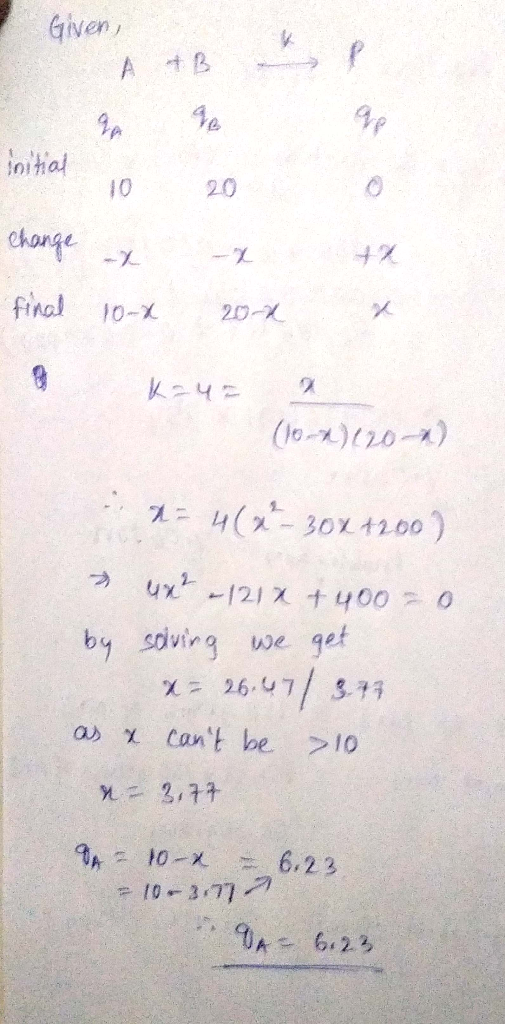
If you still have any doubts regarding above problem please ask in comments
Add Answer to:
1. Consider the reaction given below with qA(0) 10,q (0) 20,,(0) 0, k 4. Solve for qA- ap
Solve this question using the methot used in below example 8.1 DO NOT USE ANY OTHER METHO...
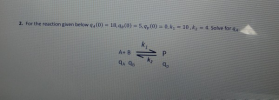 Solve this question using the methot used in below
example 8.1
DO NOT USE ANY OTHER METHOD, ONLY USE THE ONE THAT HAS
BEEN USED IN EXAMPLE 8.1
And please include all the steps
thanks in advance!
2. For the reaction given below qA(O) 18,0)p(0)-0,k 10,k2 4 Solve for qa k2 ap EXAMPLE PROBLEM 8.1 Consider the reaction given in Eq (8.14), with qa(0) -10,4(0) -15, and go(0)-0, K -2 From Eq. (8.14), it is clear that ip---4 and after...
Solve this question using the methot used in below
example 8.1
DO NOT USE ANY OTHER METHOD, ONLY USE THE ONE THAT HAS
BEEN USED IN EXAMPLE 8.1
And please include all the steps
thanks in advance!
2. For the reaction given below qA(O) 18,0)p(0)-0,k 10,k2 4 Solve for qa k2 ap EXAMPLE PROBLEM 8.1 Consider the reaction given in Eq (8.14), with qa(0) -10,4(0) -15, and go(0)-0, K -2 From Eq. (8.14), it is clear that ip---4 and after...
20. Again, consider the (inverse) demand and supply functions, respectively provided by Qa=300-10Pd (or Pd=30-(1/10)Q) and...
 20. Again, consider the (inverse) demand and supply functions, respectively provided by Qa=300-10Pd (or Pd=30-(1/10)Q) and Qs=20Ps (or Ps=(1/20)Qs) that now account for pd and Ps. Now consider t=5 where Pd. Ps=t. a. Graphically illustrate the market, new equilibrium, and economic welfare (i.e. CS, PS, TS, and DWL). b. Numerically solve for pd, ps, and the corresponding Qen. C. Numerically calculate the CS, PS, TS, and DWL.
2. Consider the graph below which illustrates a given firm's AP and MP curves: AP MP...
 2. Consider the graph below which illustrates a given firm's AP and MP curves: AP MP Average and marginal product of labor MP 10 20 40 50 30 Labor a. At what level of output is AVC minimized? Explain your answer. b. When 10 workers are hired, what is the firm's output? c. When 15 workers are hired, what is the firm's AVC if w = 300? d. When 15 workers are hired, what is the firm's SMC if w-300?...
(d) Solve for p and q in terms of a, b, c, d given q-ap+b and...
 (d) Solve for p and q in terms of a, b, c, d given q-ap+b and q cp+d (e) If in the previous problem p stood for price, under what circumstances would the market clearing price (i.e. the p you solved for) be positive? (What are the restrictions on a, b, c,d that would ensure that p is positive?
1. Consider the following generic reaction for which K = 2.54. 3 Z + Q ⇄...
1. Consider the following generic reaction for which K = 2.54. 3 Z + Q ⇄ 2 X What is the value of K for the following reaction? 4 X ⇄ 6 Z + 2 Q A. .394 B. 197 C. 6.45 D. .155 2. Consider the following generic reaction for which K p = 5.51 × 10⁵ at 25°C. 2R (g) + A (g) ⇄ 2Z (g) What is the value of K c for the reaction at the...
2. Solve the below truss for all reactions and member forces - 10 K 1 0'...
 2. Solve the below truss for all reactions and member forces - 10 K 1 0' 10'- 10- 10 20 kip 20 kip 20 kips
Given the below production table: L TP AP MP A 0 0 - - B 1...
Given the below production table: L TP AP MP A 0 0 - - B 1 10 C 2 12 14 D 3 E 11 8 F 48 9.6 4 G 6 H 7 47 6.7 Complete the above table, knowing that the AP maximizes at 3 workers and the TP at 6 workers. Draw in a common diagram the curves of the TP, AP and MP.
03. Consider the boundary value problem 0 Sts1 y(0) & y(1)-1 where k > 0 is a given real paramete...
 03. Consider the boundary value problem 0 Sts1 y(0) & y(1)-1 where k > 0 is a given real parameter a. Verify that y(t) = e-kt (14) is the exact solution of the BVP. b. Use the function mybvp() from the previous problem with h -0.1 and k -10, to solve the BVP by the Finite Difference Method. Plot, on the same axes, the numerical and exact solution. c. Using a log-log plot, graph the maximum error as a function...
Applications of Solutions by Laplace Transform Given L I (0) = 0 for t > 0. Solve for the current...
 1-5 im struggling pls help
Applications of Solutions by Laplace Transform Given L I (0) = 0 for t > 0. Solve for the current I (t) +臘娃q=E(t), w th L-1h,R= 20 ohms, C=0.005 f, E(t) = 150V, q(0)=0and 1. de? Find the charge q(t) in an RC series circuit when q(0)-0 and E(t) = E e-kt, k > 0. Consider both when k 2. and when k = RC. Translations on the t-Axis Using Unit Step Function Find the...
1-5 im struggling pls help
Applications of Solutions by Laplace Transform Given L I (0) = 0 for t > 0. Solve for the current I (t) +臘娃q=E(t), w th L-1h,R= 20 ohms, C=0.005 f, E(t) = 150V, q(0)=0and 1. de? Find the charge q(t) in an RC series circuit when q(0)-0 and E(t) = E e-kt, k > 0. Consider both when k 2. and when k = RC. Translations on the t-Axis Using Unit Step Function Find the...
Consider the graph below of the Gibbs energy versus the extent of reaction, $ , for...
 Consider the graph below of the Gibbs energy versus the extent of reaction, $ , for the following hypothetical reaction at 1 bar and 298 K: R(g) → P(g) X Gibbs energy 0 1 Extent of reaction, The reaction favors the reactant. At X, A,G = Mp – Mr. At X, A,G > 0. At X, Qa < KQ
 Solve this question using the methot used in below
example 8.1
DO NOT USE ANY OTHER METHOD, ONLY USE THE ONE THAT HAS
BEEN USED IN EXAMPLE 8.1
And please include all the steps
thanks in advance!
2. For the reaction given below qA(O) 18,0)p(0)-0,k 10,k2 4 Solve for qa k2 ap EXAMPLE PROBLEM 8.1 Consider the reaction given in Eq (8.14), with qa(0) -10,4(0) -15, and go(0)-0, K -2 From Eq. (8.14), it is clear that ip---4 and after...
Solve this question using the methot used in below
example 8.1
DO NOT USE ANY OTHER METHOD, ONLY USE THE ONE THAT HAS
BEEN USED IN EXAMPLE 8.1
And please include all the steps
thanks in advance!
2. For the reaction given below qA(O) 18,0)p(0)-0,k 10,k2 4 Solve for qa k2 ap EXAMPLE PROBLEM 8.1 Consider the reaction given in Eq (8.14), with qa(0) -10,4(0) -15, and go(0)-0, K -2 From Eq. (8.14), it is clear that ip---4 and after...
 20. Again, consider the (inverse) demand and supply functions, respectively provided by Qa=300-10Pd (or Pd=30-(1/10)Q) and Qs=20Ps (or Ps=(1/20)Qs) that now account for pd and Ps. Now consider t=5 where Pd. Ps=t. a. Graphically illustrate the market, new equilibrium, and economic welfare (i.e. CS, PS, TS, and DWL). b. Numerically solve for pd, ps, and the corresponding Qen. C. Numerically calculate the CS, PS, TS, and DWL.
 2. Consider the graph below which illustrates a given firm's AP and MP curves: AP MP Average and marginal product of labor MP 10 20 40 50 30 Labor a. At what level of output is AVC minimized? Explain your answer. b. When 10 workers are hired, what is the firm's output? c. When 15 workers are hired, what is the firm's AVC if w = 300? d. When 15 workers are hired, what is the firm's SMC if w-300?...
 (d) Solve for p and q in terms of a, b, c, d given q-ap+b and q cp+d (e) If in the previous problem p stood for price, under what circumstances would the market clearing price (i.e. the p you solved for) be positive? (What are the restrictions on a, b, c,d that would ensure that p is positive?
 2. Solve the below truss for all reactions and member forces - 10 K 1 0' 10'- 10- 10 20 kip 20 kip 20 kips
 03. Consider the boundary value problem 0 Sts1 y(0) & y(1)-1 where k > 0 is a given real parameter a. Verify that y(t) = e-kt (14) is the exact solution of the BVP. b. Use the function mybvp() from the previous problem with h -0.1 and k -10, to solve the BVP by the Finite Difference Method. Plot, on the same axes, the numerical and exact solution. c. Using a log-log plot, graph the maximum error as a function...
 1-5 im struggling pls help
Applications of Solutions by Laplace Transform Given L I (0) = 0 for t > 0. Solve for the current I (t) +臘娃q=E(t), w th L-1h,R= 20 ohms, C=0.005 f, E(t) = 150V, q(0)=0and 1. de? Find the charge q(t) in an RC series circuit when q(0)-0 and E(t) = E e-kt, k > 0. Consider both when k 2. and when k = RC. Translations on the t-Axis Using Unit Step Function Find the...
1-5 im struggling pls help
Applications of Solutions by Laplace Transform Given L I (0) = 0 for t > 0. Solve for the current I (t) +臘娃q=E(t), w th L-1h,R= 20 ohms, C=0.005 f, E(t) = 150V, q(0)=0and 1. de? Find the charge q(t) in an RC series circuit when q(0)-0 and E(t) = E e-kt, k > 0. Consider both when k 2. and when k = RC. Translations on the t-Axis Using Unit Step Function Find the...
 Consider the graph below of the Gibbs energy versus the extent of reaction, $ , for the following hypothetical reaction at 1 bar and 298 K: R(g) → P(g) X Gibbs energy 0 1 Extent of reaction, The reaction favors the reactant. At X, A,G = Mp – Mr. At X, A,G > 0. At X, Qa < KQ
Most questions answered within 3 hours.
-
Where is the error in this code sequence?
String s1 = "Hello";
String s2 = "ello";...
asked 11 months ago -
Financial data for Joel de Paris, Inc., for last year
follow:
Joel de Paris, Inc.
Balance...
asked 11 months ago -
Consider this reaction:
Al2(SO4)3 (aq)+ BaCl3
(aq) Al2Cl6 (aq)- +
3BaSO4(s) . What is the...
asked 11 months ago -
Suppose that Savneet is considering increasing her
recent random sample from 20 car rentals to 40...
asked 11 months ago -
Trucks arrive at an unloading terminal at an average rate of 120
per hour.
Trucks arrive...
asked 11 months ago -
Why are methanol and ethanol completely soluble in water while
octanol is not very little soluble....
asked 11 months ago -
A facilities manager at a university reads in a research report
that the mean amount of...
asked 11 months ago -
When the CuSO4 is rehydrated by adding water to the anhydrous
compound, is this an endothermic...
asked 11 months ago -
A ray of sunlight is passing from diamond into crown glass; the
angle of incidence is...
asked 11 months ago -
A block of mass 0.249 kg is placed on top of a light, vertical
spring of...
asked 11 months ago -
how do the kidneys compensate in the presences of acidosis
a) trigger hyperventilate
b) reserve acid...
asked 11 months ago -
Question 501 pts
The rental rate of capital to the firm increases. Which of the
following...
asked 11 months ago