
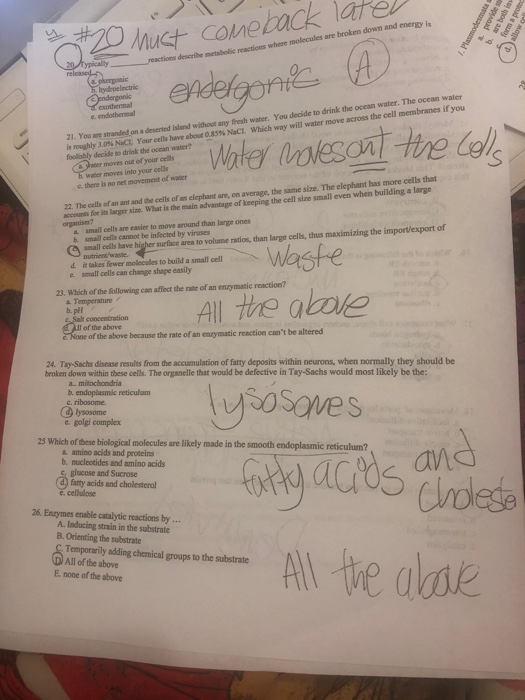
energy is describe metabolic reactions where molecules are broken down and 21. You arg stranded on a deserted island without any fresh water. You decide to drink the ocean water. The occan is roughly 3.0% Naa Your cells have about 085% Nact which way will water move acos te cell mentines if you foolishly decide to drink the ocean water een moves out of your cells water moves into your cells c there is no net movement of water 22. The cells of an ant and the cells of an elephant are, on average, the same size. The elephant has more cells that accounts for its larger size. What is the main advantage of keeping the cell size small even when building a large organisn? small cells are easier to move around than large ones a b. small cells cannot be infected by viruses mall cells have higher surface area to volume ratios, than large cells, thus maximizing the import/export of d it takes fewer molecules to build a small cell e. small cells can change shape easily 23. Which of the following can affect the rate of an enzymatic reaction? All tre atole b. pll of the above e None of the above because the rate of an enzymatic reaction can't be altered 24. Tay-Sachs disease results from the accumulation of fatty deposits within neurons, when normally they should be broken down within these cels. The organelle that would be defective in Tay-Sachs would most likely be the: a.. mitochondria c. ribosome. e. golgi complex 25 Which of these biological molecules are likely made in the smooth endoplasmic reticulum? amino acids and proteins b. nucleotides and amino acids glacose and Sucrose fatty acids and cholesteral e cellulose 26. Enzymes enable catalytic reactions by... A. Inducing strain in the substrate B. Orienting the substrate Temporarily adding chemical groups to the substrate All of the above Е.none ofthe above
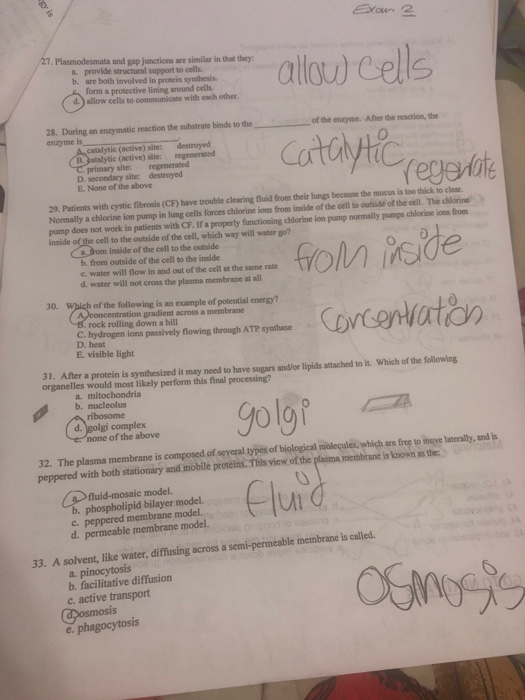
27. Plasmodesmata and gap junctions are similar in that they a provide structural support to cells b. are both involved in protein synthesis form a protective lining around cells d.) allow cells to communicate with esch other 28. During an enzymatic reaction the substrate binds to the enzyme is of the enzyme. After the reaction, the catalytic (active) site: destroyed B atalytie (active) site: regenerated primary site: regenerated D. secondary site: destroyed E. None of the above 29. Patients with cystic fibrosis (CF) have trouble clearing fluid from their lungs because the mucus is too thick to clear. Normally a chlorine ion pump in lung cells forces chlorine ions from inside of the ce'll to outside of the cell. The clorine pump does not work in patients with CF. If a properly functioning chlorine ion pump normally pumps chlorine ions from inside ofthe cell to the outside ofthe cell, which way will water go? rom inside of the cell to the outside b. from outside of the cell to the inside c water will flow in and out of the cell at the same rate d. water will not cross the plasma membrane at all 30. of the following is an example of potential energy? gradient across a membrane rock rolling down a hill C. hydrogen ions passively flowing through ATP synthase D. heat E. visible light 31. After a protein is synthesized it may need to have sugars and/or lipids attached to it. Which of the folilowing organelles would most likely perform this final processing? b. nucleolus olgt ribosome 0 d. golgi complex none of the above 32. The plasma membrane is composed of several types of biological mioleçules, which are free to move lateraily, and is peppered with both stationary and mobile proteins. This view of the plasma meimbrane is known as the: fluid-mosaic model. b. phospholipid bilayer model. c. peppered membrane model. d. permeable membrane model. 33. A solvent, like water, diffusing across a semi-permeable imembrane is called. a. pinocytosis b. facilitative diffusion c. active transport Chosmosis e. phagocytosis
Homework Answers
7. Answer: kinetic energy: potential energy
Plant capture kinetic energy that is light from the sun and store that energy in the potential energy in the chemical bonds of glucose
8. Answer: to maintain the fluidity of the membrane
Cholesterol help the cell to maintain the fluidity against the adverse temperature (cold or hot) beyond the organisms range.
9. Answer: if one and other has nucleus
Nuclear envelope is absent in prokaryotic cells, while it is present in eukaryotic cells. This is distinguishing feature
10. Answer: DNA
Phospholipid, protein and glycocalyx are component of the cell membrane. While DNA is present inside the nucleus. Protein are forming channel in the membrane.
11. Answer: ATP
Mitochondria is also called as power of house of the cell. ATP's are generated in the mitochondria.
12. Answer: lipoprotein
13. Answer: the plasma membrane selectively allows some substances to enter or leave the cell
Selectively permeability means having control on the passing of the substances
20. Answer: exergonic reaction
Exergonic reaction are spontaneous and release energy, which is utilize by the cell.
21. Answer: water moves out of your cells.
When we take the sea water with high salanity than the cell. Then to maintain the osmotic balance, cell looses water to make the internal environment concentrated as external.
22. Answer: c option
Small cell size can handle the concentration gradient effectively
23. Answer: all of the above
24. Answer: lysosome
Hexosaaminidase enzyme is lacking in individual.
Add Answer to:
Energy in the from the sun, and store that enerngy as . Plants are able to captone chemical bonds...
_____membranes proteins are associated with the bilayer through interactions with other membrane component on the surface...
 _____membranes proteins are associated with the bilayer through interactions with other membrane component on the surface of the membrane. Net movement of particles from a region where they are more concentrated to a region where they are law concentrated is called Diffusion of water through a selectively permeable membrane down its own concentration gradient It called A solution with an equivalent concentration of water and hence the tame osmotic pressure as the fluid inside the cell is said to be...
IVOUCI 2 - ine selectively l'ermeable Cell Membrane == Small rapelurer le molecule. TOOO Ch ....
 IVOUCI 2 - ine selectively l'ermeable Cell Membrane == Small rapelurer le molecule. TOOO Ch . Smail surface poliso Inside the cell Membrane spanning protein Carbohydrae chain Glycopied 190911 COIN Toolloool18 .. Outside the cell 7. What two major types of biological molecules compose the majority of the cell membrane in Model 27 - The two major biomoleculo of plasma membrats are lipids and proteins 8. How many different protein molecules are found in Model 22 Cat Two typs of...
. For each of the 3 situations below, use an arrow to indicate the net movement...
. For each of the 3 situations below, use an arrow to indicate the net movement of water into or out of the cell through the semipermeable plasma membrane (i.e. osmosis). (Assume that the sugar molecules cannot pass through the plasma membrane in each case.) 1% sugar (inside a circule) 3% sugar (inside a circule) 1% sugar (inside a circule) 5% sugar 1% sugar 1% sugar 3. In each of the drawings above, indicate if the inside of the cell...
21. The ______ prevents plants cells from bursting when place in a ____ solution. a) centrioles-hypotonic...
21. The ______ prevents plants cells from bursting when place in a ____ solution. a) centrioles-hypotonic b) chloroplasts-hypertonic c) plasma membrane-hypertonic d) vacuole-hypertonic e) cell wall-hypotonic 22. Specialized cells like your own lung cells each lack which of the following organelles which are commonly found in an onion. a) cell membrane b)cell wall c)ribosomes d)nucleolus e) none of the above ______ 23. White blood cells engulf and destroy foreign particles by a process known as phagocytosis which is actually a)...
22-25 and Essay 22. The epidermis a) is classified as pseudostratified columnar epithelium b) allows uncontrolled...
 22-25 and Essay
22. The epidermis a) is classified as pseudostratified columnar epithelium b) allows uncontrolled water loss from the body c) might include keratinocytes, melanocytes, Merkel cells and Langerhans cells d) All the above (a, b and c) are correct 23. Cartilage a) does not contain blood vessels b) is highly negatively charged because of sugars and sulfate groups attached to sugars e) absorbs large amounts of water which acts as a "shock absorber when pressure is applied to...
22-25 and Essay
22. The epidermis a) is classified as pseudostratified columnar epithelium b) allows uncontrolled water loss from the body c) might include keratinocytes, melanocytes, Merkel cells and Langerhans cells d) All the above (a, b and c) are correct 23. Cartilage a) does not contain blood vessels b) is highly negatively charged because of sugars and sulfate groups attached to sugars e) absorbs large amounts of water which acts as a "shock absorber when pressure is applied to...
41. Phospholipids are amphipathic molecules a. True 42. Which of the following structure's protect a plant...
 41. Phospholipids are amphipathic molecules a. True 42. Which of the following structure's protect a plant cell from bursting due to the uptake of excess water? b. False a. Mitochondria b. Plasma membrane c. Chloroplast 43. The opening of d. Cell wall channels is controlled by the binding of a substance to the channel. a. Mechanically-gated c. Voltage-gated b. Ligand-gated d. DNA 44. The concentration of Ca' is in the cell, but outside of the cell. c. Higher .... Lower...
In intestinal epithelial cells, the following conditions exist: a. Na+ concentrations are higher outside of the...
In intestinal epithelial cells, the following conditions exist: a. Na+ concentrations are higher outside of the cell. The Na+ concentration gradient is maintained by the consumption of ATP. b. Amino acid concentration is higher inside the cell. c. Amino acid transporters are membrane proteins that facilitate the transport of amino across the plasma membrane, moving both amino and Na+ into the cell. Based on the facts above, this mechanism is categorized as ______________.
15. Diffusion of water through a differentially permeable membrane is called A. active transport. B. energy....
 15. Diffusion of water through a differentially permeable membrane is called A. active transport. B. energy. C. osmosis. D. All of these answers are true. 16. What happens when an animal cell is placed into a hypertonic solution? A. plasmolysis B. crenation occurs C. it swells D. it is unchanged 17. The point on the enzyme where the enzyme causes the substrate to change is called the A. attachment site. B. active site. C. binding site. D. enzyme-substrate complex 18....
1- The cytoplasmic side of the plasma membrane’s lipid bilayer have high concentrations of (CHOOSE THREE):...
1- The cytoplasmic side of the plasma membrane’s lipid bilayer have high concentrations of (CHOOSE THREE): a. Sphingomyelin b. Phosphatidylethanolamine c. Phosphatidylcholine d. Phosphatidylinositol e. Phosphatidylserine f. Glycolipid 2- Which of the following characteristics DOES NOT keep proteins secured to the plasma membrane? a. Transmembrane domains in the protein b. Glycosylphosphatidylinositol (GPI) anchors c. Fatty acid lipids covalently attached to the protein d. Sugar molecules covalently attached to the protein e. Associations with lipid rafts 3- Which of the following...
A solution is prepared by dissolving aluminum chloride in water and diluting to 500.0 mL. If...
A solution is prepared by dissolving aluminum chloride in water and diluting to 500.0 mL. If this solution contains 44 ppm aluminum ions, the concentration of chloride ions is ppm. A) 11 B) 22 C) 44 D) 88 E) 132 Red-blood cells comprise an outer semi-permeable membrane, and are subject to osmosis. If local solute concentration inside the cells is higher than that outside: A) no net solvent migration will occur B) solvent will migrate from inside the cell to...
 _____membranes proteins are associated with the bilayer through interactions with other membrane component on the surface of the membrane. Net movement of particles from a region where they are more concentrated to a region where they are law concentrated is called Diffusion of water through a selectively permeable membrane down its own concentration gradient It called A solution with an equivalent concentration of water and hence the tame osmotic pressure as the fluid inside the cell is said to be...
 IVOUCI 2 - ine selectively l'ermeable Cell Membrane == Small rapelurer le molecule. TOOO Ch . Smail surface poliso Inside the cell Membrane spanning protein Carbohydrae chain Glycopied 190911 COIN Toolloool18 .. Outside the cell 7. What two major types of biological molecules compose the majority of the cell membrane in Model 27 - The two major biomoleculo of plasma membrats are lipids and proteins 8. How many different protein molecules are found in Model 22 Cat Two typs of...
 22-25 and Essay
22. The epidermis a) is classified as pseudostratified columnar epithelium b) allows uncontrolled water loss from the body c) might include keratinocytes, melanocytes, Merkel cells and Langerhans cells d) All the above (a, b and c) are correct 23. Cartilage a) does not contain blood vessels b) is highly negatively charged because of sugars and sulfate groups attached to sugars e) absorbs large amounts of water which acts as a "shock absorber when pressure is applied to...
22-25 and Essay
22. The epidermis a) is classified as pseudostratified columnar epithelium b) allows uncontrolled water loss from the body c) might include keratinocytes, melanocytes, Merkel cells and Langerhans cells d) All the above (a, b and c) are correct 23. Cartilage a) does not contain blood vessels b) is highly negatively charged because of sugars and sulfate groups attached to sugars e) absorbs large amounts of water which acts as a "shock absorber when pressure is applied to...
 41. Phospholipids are amphipathic molecules a. True 42. Which of the following structure's protect a plant cell from bursting due to the uptake of excess water? b. False a. Mitochondria b. Plasma membrane c. Chloroplast 43. The opening of d. Cell wall channels is controlled by the binding of a substance to the channel. a. Mechanically-gated c. Voltage-gated b. Ligand-gated d. DNA 44. The concentration of Ca' is in the cell, but outside of the cell. c. Higher .... Lower...
 15. Diffusion of water through a differentially permeable membrane is called A. active transport. B. energy. C. osmosis. D. All of these answers are true. 16. What happens when an animal cell is placed into a hypertonic solution? A. plasmolysis B. crenation occurs C. it swells D. it is unchanged 17. The point on the enzyme where the enzyme causes the substrate to change is called the A. attachment site. B. active site. C. binding site. D. enzyme-substrate complex 18....
Most questions answered within 3 hours.
-
Where is the error in this code sequence?
String s1 = "Hello";
String s2 = "ello";...
asked 11 months ago -
Financial data for Joel de Paris, Inc., for last year
follow:
Joel de Paris, Inc.
Balance...
asked 11 months ago -
Consider this reaction:
Al2(SO4)3 (aq)+ BaCl3
(aq) Al2Cl6 (aq)- +
3BaSO4(s) . What is the...
asked 11 months ago -
Suppose that Savneet is considering increasing her
recent random sample from 20 car rentals to 40...
asked 11 months ago -
Trucks arrive at an unloading terminal at an average rate of 120
per hour.
Trucks arrive...
asked 11 months ago -
Why are methanol and ethanol completely soluble in water while
octanol is not very little soluble....
asked 11 months ago -
A facilities manager at a university reads in a research report
that the mean amount of...
asked 11 months ago -
When the CuSO4 is rehydrated by adding water to the anhydrous
compound, is this an endothermic...
asked 11 months ago -
A ray of sunlight is passing from diamond into crown glass; the
angle of incidence is...
asked 11 months ago -
A block of mass 0.249 kg is placed on top of a light, vertical
spring of...
asked 11 months ago -
how do the kidneys compensate in the presences of acidosis
a) trigger hyperventilate
b) reserve acid...
asked 11 months ago -
Question 501 pts
The rental rate of capital to the firm increases. Which of the
following...
asked 11 months ago