- Plot or sketch the magnitude vs. frequency and the phase vs. frequency curves in a linear or log scale.
- Indicate if the circuit is a low pass, high pass, band pass or band reject filter.

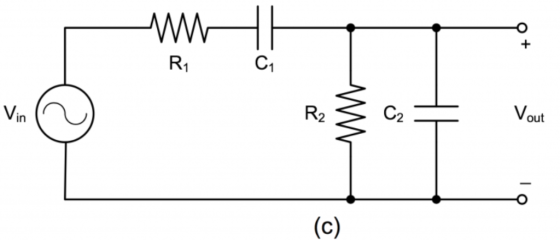
1 C1 R2 C2 Vout in
Homework Answers
The given circuit can be represented in the Laplace domain as follows.
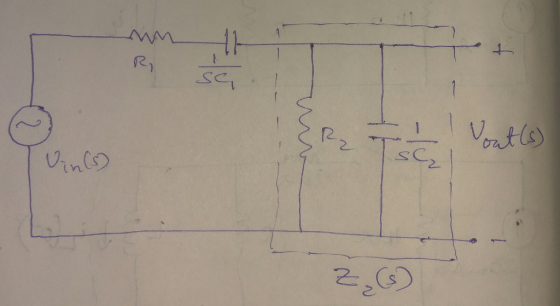
Let 


Then,

Now according the Voltage division principle, the output voltage is


So, the transfer function is given by

Given the circuit elements are

The transfer function is written as


The following MATLAB code is used to generate the frequency response plots.
%values of circuit elements
R1=1*10^3;
R2=10*10^3;
C1=0.01*10^(-6);
C2=0.0056*10^(-6);
%coefficients of numerator
num=[C1*R2 0];
%coefficients of denominator
den=[R1*R2*C2 R1*C1+R2*C2+R2*C1 1];
%plotting the frequency response using the command 'freqs'
freqs(num,den)
The frequency response plot obtained is
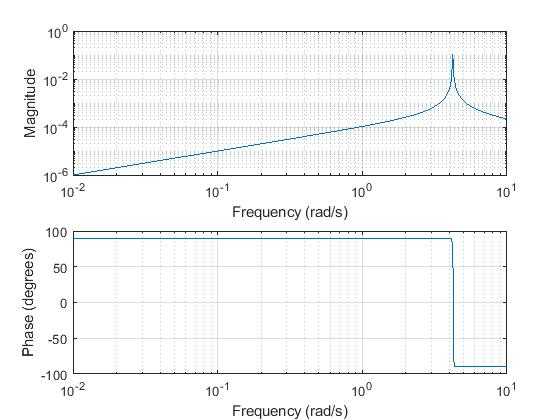
The frequency response plot represents the response of the band-pass filter.
Add Answer to:
Plot or sketch the magnitude vs. frequency and the phase vs. frequency curves in a linear or log ...
A) Design a low-pass filter using the given circuitry with a cut-off value of 1 kHz and plot the ...
 a) Design a low-pass filter using the given circuitry with a cut-off value of 1 kHz and plot the frequency response curve on the given axes 1.0 0.7 0.5 in out 0.0 101 102 103 104 10s Hz b) Design a band-pass filter using the given circuitry with a bandwidth of 500 Hz and a lower cut-off value of 100 Hz, and draw the frequency response curve. Keep all resistors at the same value (i.e. Ri-R-R3-R4). 1.0 0.7 0.5 0.0...
1. The circuit below, which uses one inductor and two identical resistors, (30 pts] can be...
 1. The circuit below, which uses one inductor and two identical resistors, (30 pts] can be described as a filter. Using this circuit: a. Determine the transfer function, H(@) = Vout/Vin. b. Determine the magnitude and phase (in terms of R, L, and o) of the transfer function from part a. Now, assume R = 5022 and L = 2mH c. What is the value of the magnitude as 0 0 d. The value of the magnitude as → e....
Using Matlab, plot the magnitude and phase of the transfer function (vo/vi) vs. frequency range 1-100...
 Using Matlab, plot the magnitude and phase of the transfer
function (vo/vi) vs. frequency range 1-100 kHz. Use log scale for
the frequency axis, dB scale for the magnitude axis, and degrees
for the phase axis. Note dB = 20log10(vo/vi). The 10 stands for
base 10. I need help writing a MATLAB code to output this plot and
also coming up with the vo/vi function itself.
0.1807 H 1402 nF 0.1624 H 1.560nF 1.559 mH
Using Matlab, plot the magnitude and phase of the transfer
function (vo/vi) vs. frequency range 1-100 kHz. Use log scale for
the frequency axis, dB scale for the magnitude axis, and degrees
for the phase axis. Note dB = 20log10(vo/vi). The 10 stands for
base 10. I need help writing a MATLAB code to output this plot and
also coming up with the vo/vi function itself.
0.1807 H 1402 nF 0.1624 H 1.560nF 1.559 mH
3. (a) For each of the RC passive filters shown in Fig. 3, sketch the magnitude...
 3. (a) For each of the RC passive filters shown in Fig. 3, sketch the magnitude in dB and phase as a function of frequency (in Hz), with the frequency on a log scale. Indicate the poles and zeros. For the magnitude plots, indicate the slope (in dB/decade) for each region; for regions that exhibit flat magnitude, indicate the value. Likewise, for regions that exhibit flat phase, indicate the value. (b) Indicate the type of each filter (e.g., lowpass, highpass,...
Please plot on semi-log scale for both magnitude and phase separately B. Sketch the Bode plots...
 Please plot on semi-log scale for both magnitude and phase
separately
B. Sketch the Bode plots for the magnitude and the phase for the transfer function: 10(S + 1) H(S) = S(S + 10)(8 + 100)
Please plot on semi-log scale for both magnitude and phase
separately
B. Sketch the Bode plots for the magnitude and the phase for the transfer function: 10(S + 1) H(S) = S(S + 10)(8 + 100)
Ri vo(t) = 0 Figure 19: Bandpass filter Use Matlab to plot the magnitude and phase...
 Ri vo(t) = 0 Figure 19: Bandpass filter Use Matlab to plot the magnitude and phase of the frequency response. Make sure the frequency range is wide enough to show enough details. Assume R1 = R2 = 1k1, C1 = 7.5nF, and C2 = 2.5uF.
(a) Design a first–order high-pass filter with a cutoff frequency fc = 1.5 kHz and a passband gain |Ao| = 20dB, using a...
(a) Design a first–order high-pass filter with a cutoff frequency fc = 1.5 kHz and a passband gain |Ao| = 20dB, using a capacitor C = 47nF. Include a compensation resistor and determine its value. (b) Sketch the frequency response for the circuit (i.e., magnitude vs. frequency and phase vs. frequency). On the magnitude response plot, indicate the cutoff frequency, bandpass gain, and bandstop rolloff slope. On the phase response plot, indicate the approximate value of the phase angle at...
2. By applying Bode plot approximations, sketch the response of each filter, and hence complete the Table below. Filter Type Order Cut-off Frequency High Passsecond 120kHz Low Pass fourth 2250Hz 400H...
 2. By applying Bode plot approximations, sketch the response of each filter, and hence complete the Table below. Filter Type Order Cut-off Frequency High Passsecond 120kHz Low Pass fourth 2250Hz 400Hz Gain in Stop Band Pass-Band Gain OdB Gain at 15kHz Gain at 18kHz = ? Gain at 50Hz-18dB Gain at 15Hz = ? Gain at 64kHz ? Gain -60dB at 50kH:z 6dB OdB OdB High Pass Band Pass fourth 60Hz, 4kHz 12dB Low Pass sixth 1?
2. By applying...
2. By applying Bode plot approximations, sketch the response of each filter, and hence complete the Table below. Filter Type Order Cut-off Frequency High Passsecond 120kHz Low Pass fourth 2250Hz 400Hz Gain in Stop Band Pass-Band Gain OdB Gain at 15kHz Gain at 18kHz = ? Gain at 50Hz-18dB Gain at 15Hz = ? Gain at 64kHz ? Gain -60dB at 50kH:z 6dB OdB OdB High Pass Band Pass fourth 60Hz, 4kHz 12dB Low Pass sixth 1?
2. By applying...
For each filter mentioned in the following cases, first simulate the circuit using Multisim. You can get a plot of the transfer function that is called the Bode plot. From the right toolbar, select &...
 For each filter mentioned in the following cases, first simulate the circuit using Multisim. You can get a plot of the transfer function that is called the Bode plot. From the right toolbar, select "Bode Plotter". Change initial (I) and final (F frequencies to 1Hz and 200 KHz, respectively. Use a Voltage AC source as the input signal. You do not need to change any parameter from voltage AC source Connect "Bode Plotter" to input and output of your circuit...
TE Question 5 (20 marks) An active filter circuit is shown in Fig. 4. The cut-off frequency of this active filter is...
 TE Question 5 (20 marks) An active filter circuit is shown in Fig. 4. The cut-off frequency of this active filter is 1590Hz. The Input impedance and voltage gain of this filter are 10k0 and -5VN respectively Vout R1 vin R2 C1 Fig. 4 By assuming the operational amplifier, A is ideal, answer the following questions: (a) () State the type of this active fiter. (i) Explain the characteristic of this active filter. [2 marks] 3 marks] (b) 0) Calculate...
 a) Design a low-pass filter using the given circuitry with a cut-off value of 1 kHz and plot the frequency response curve on the given axes 1.0 0.7 0.5 in out 0.0 101 102 103 104 10s Hz b) Design a band-pass filter using the given circuitry with a bandwidth of 500 Hz and a lower cut-off value of 100 Hz, and draw the frequency response curve. Keep all resistors at the same value (i.e. Ri-R-R3-R4). 1.0 0.7 0.5 0.0...
 1. The circuit below, which uses one inductor and two identical resistors, (30 pts] can be described as a filter. Using this circuit: a. Determine the transfer function, H(@) = Vout/Vin. b. Determine the magnitude and phase (in terms of R, L, and o) of the transfer function from part a. Now, assume R = 5022 and L = 2mH c. What is the value of the magnitude as 0 0 d. The value of the magnitude as → e....
 Using Matlab, plot the magnitude and phase of the transfer
function (vo/vi) vs. frequency range 1-100 kHz. Use log scale for
the frequency axis, dB scale for the magnitude axis, and degrees
for the phase axis. Note dB = 20log10(vo/vi). The 10 stands for
base 10. I need help writing a MATLAB code to output this plot and
also coming up with the vo/vi function itself.
0.1807 H 1402 nF 0.1624 H 1.560nF 1.559 mH
Using Matlab, plot the magnitude and phase of the transfer
function (vo/vi) vs. frequency range 1-100 kHz. Use log scale for
the frequency axis, dB scale for the magnitude axis, and degrees
for the phase axis. Note dB = 20log10(vo/vi). The 10 stands for
base 10. I need help writing a MATLAB code to output this plot and
also coming up with the vo/vi function itself.
0.1807 H 1402 nF 0.1624 H 1.560nF 1.559 mH
 3. (a) For each of the RC passive filters shown in Fig. 3, sketch the magnitude in dB and phase as a function of frequency (in Hz), with the frequency on a log scale. Indicate the poles and zeros. For the magnitude plots, indicate the slope (in dB/decade) for each region; for regions that exhibit flat magnitude, indicate the value. Likewise, for regions that exhibit flat phase, indicate the value. (b) Indicate the type of each filter (e.g., lowpass, highpass,...
 Please plot on semi-log scale for both magnitude and phase
separately
B. Sketch the Bode plots for the magnitude and the phase for the transfer function: 10(S + 1) H(S) = S(S + 10)(8 + 100)
Please plot on semi-log scale for both magnitude and phase
separately
B. Sketch the Bode plots for the magnitude and the phase for the transfer function: 10(S + 1) H(S) = S(S + 10)(8 + 100)
 Ri vo(t) = 0 Figure 19: Bandpass filter Use Matlab to plot the magnitude and phase of the frequency response. Make sure the frequency range is wide enough to show enough details. Assume R1 = R2 = 1k1, C1 = 7.5nF, and C2 = 2.5uF.
 2. By applying Bode plot approximations, sketch the response of each filter, and hence complete the Table below. Filter Type Order Cut-off Frequency High Passsecond 120kHz Low Pass fourth 2250Hz 400Hz Gain in Stop Band Pass-Band Gain OdB Gain at 15kHz Gain at 18kHz = ? Gain at 50Hz-18dB Gain at 15Hz = ? Gain at 64kHz ? Gain -60dB at 50kH:z 6dB OdB OdB High Pass Band Pass fourth 60Hz, 4kHz 12dB Low Pass sixth 1?
2. By applying...
2. By applying Bode plot approximations, sketch the response of each filter, and hence complete the Table below. Filter Type Order Cut-off Frequency High Passsecond 120kHz Low Pass fourth 2250Hz 400Hz Gain in Stop Band Pass-Band Gain OdB Gain at 15kHz Gain at 18kHz = ? Gain at 50Hz-18dB Gain at 15Hz = ? Gain at 64kHz ? Gain -60dB at 50kH:z 6dB OdB OdB High Pass Band Pass fourth 60Hz, 4kHz 12dB Low Pass sixth 1?
2. By applying...
 For each filter mentioned in the following cases, first simulate the circuit using Multisim. You can get a plot of the transfer function that is called the Bode plot. From the right toolbar, select "Bode Plotter". Change initial (I) and final (F frequencies to 1Hz and 200 KHz, respectively. Use a Voltage AC source as the input signal. You do not need to change any parameter from voltage AC source Connect "Bode Plotter" to input and output of your circuit...
 TE Question 5 (20 marks) An active filter circuit is shown in Fig. 4. The cut-off frequency of this active filter is 1590Hz. The Input impedance and voltage gain of this filter are 10k0 and -5VN respectively Vout R1 vin R2 C1 Fig. 4 By assuming the operational amplifier, A is ideal, answer the following questions: (a) () State the type of this active fiter. (i) Explain the characteristic of this active filter. [2 marks] 3 marks] (b) 0) Calculate...
Most questions answered within 3 hours.
-
Where is the error in this code sequence?
String s1 = "Hello";
String s2 = "ello";...
asked 10 months ago -
Financial data for Joel de Paris, Inc., for last year
follow:
Joel de Paris, Inc.
Balance...
asked 10 months ago -
Consider this reaction:
Al2(SO4)3 (aq)+ BaCl3
(aq) Al2Cl6 (aq)- +
3BaSO4(s) . What is the...
asked 10 months ago -
Suppose that Savneet is considering increasing her
recent random sample from 20 car rentals to 40...
asked 10 months ago -
Trucks arrive at an unloading terminal at an average rate of 120
per hour.
Trucks arrive...
asked 10 months ago -
Why are methanol and ethanol completely soluble in water while
octanol is not very little soluble....
asked 10 months ago -
A facilities manager at a university reads in a research report
that the mean amount of...
asked 10 months ago -
When the CuSO4 is rehydrated by adding water to the anhydrous
compound, is this an endothermic...
asked 10 months ago -
A ray of sunlight is passing from diamond into crown glass; the
angle of incidence is...
asked 10 months ago -
A block of mass 0.249 kg is placed on top of a light, vertical
spring of...
asked 10 months ago -
how do the kidneys compensate in the presences of acidosis
a) trigger hyperventilate
b) reserve acid...
asked 10 months ago -
Question 501 pts
The rental rate of capital to the firm increases. Which of the
following...
asked 10 months ago