
Figure 1:
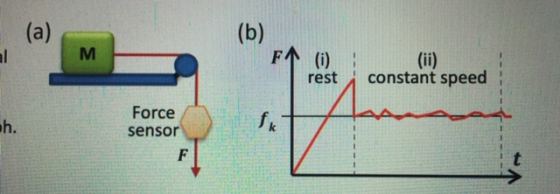
F个 (i) rest constant speed Force sensor h.
Homework Answers

Add Answer to:
1) Please draw the free-body diagram of mass M in Figure 1(a). The diagram should include the pul...
Please answer in details!! include free body diagram!! block of mass m is positioned on the...
 Please answer in details!!
include free body diagram!!
block of mass m is positioned on the frictionless semi-circular surface with radius R as shown. It slides down the surface and undergoes a completely inelastic collision with an identical block which is at rest at the bottom. After the collision, both blocks slide up ramp that makes an angle θ with the horizontal until they come to rest. The coefficient of kinetic friction between the blocks and the ramp is μk....
Please answer in details!!
include free body diagram!!
block of mass m is positioned on the frictionless semi-circular surface with radius R as shown. It slides down the surface and undergoes a completely inelastic collision with an identical block which is at rest at the bottom. After the collision, both blocks slide up ramp that makes an angle θ with the horizontal until they come to rest. The coefficient of kinetic friction between the blocks and the ramp is μk....
62 need help PLEASE DRAW FREE BODY DIAGRAMS!!!!! A boy coasts down a hill on a...
 62 need help PLEASE DRAW FREE BODY DIAGRAMS!!!!!
A boy coasts down a hill on a sled, reaching a level surface at the bottom with a speed of 7.0 m/s. if the coefficient of friction between the sled's runners and the snow is 0.050 and the boy and sled together weigh 600 N, how far does the sled travel on the level surface before coming to rest? A woman at an airport is towing her 20.0-kg suitcase at constant speed...
62 need help PLEASE DRAW FREE BODY DIAGRAMS!!!!!
A boy coasts down a hill on a sled, reaching a level surface at the bottom with a speed of 7.0 m/s. if the coefficient of friction between the sled's runners and the snow is 0.050 and the boy and sled together weigh 600 N, how far does the sled travel on the level surface before coming to rest? A woman at an airport is towing her 20.0-kg suitcase at constant speed...
1) Starting from a free body diagram, algebraically derive mass hanging mass hanging mass of box...
 1) Starting from a free body diagram, algebraically derive mass hanging mass hanging mass of box massof box Pulley box Mass 2) Starting from a free body diagram, algebraically derive equation μ-tan(0) box man pushes a crate massing 50 kg at a constant speed up a ramp inclined at an angle of 30 to the horizontal. The coefficient of kinetic friction between the crate and the ramp is .40. What force must the man exert on the crate?
1. Starting with one of Newton's laws and your free body diagram, derive an expression for...
 1. Starting with one of Newton's laws and your free body
diagram, derive an expression for the normal force exerted on the
block by floor.
- Assess you answer in the following way: If you
let \(\theta\) = 0, what does your
solution predict for the normal force? Does this make physical
sense?
2. Starting with one of Newton's laws and your free body
diagram, derive an expression for the coefficient of kinetic
friction \(\mu_{k}\) between the
block and the...
1. Starting with one of Newton's laws and your free body
diagram, derive an expression for the normal force exerted on the
block by floor.
- Assess you answer in the following way: If you
let \(\theta\) = 0, what does your
solution predict for the normal force? Does this make physical
sense?
2. Starting with one of Newton's laws and your free body
diagram, derive an expression for the coefficient of kinetic
friction \(\mu_{k}\) between the
block and the...
please include a free body diagram starting with this 2) Four forces act on a 3.000...
 please include a free body diagram starting with this
2) Four forces act on a 3.000 kg wooden block, released from rest, on a wooden table: FA=20.0 Nat 222.0, friction, the block's weight, and the normal force from the table. a) Calculate the normal force on the block, assuming the block remains on the table. b) Calculate the magnitude of the maximum static frictional force the table can exert on such a block under any circumstance. 3) For the previous...
please include a free body diagram starting with this
2) Four forces act on a 3.000 kg wooden block, released from rest, on a wooden table: FA=20.0 Nat 222.0, friction, the block's weight, and the normal force from the table. a) Calculate the normal force on the block, assuming the block remains on the table. b) Calculate the magnitude of the maximum static frictional force the table can exert on such a block under any circumstance. 3) For the previous...
Suppose you are holding a box in front of you and away from your body by...
 Suppose you are holding a box in front of you and away from your
body by squeezing the sides, as shown in (Figure 1) .
Part A
Choose the correct free-body diagram showing all of the forces
on the box
What is the force that is holding the box up, the force that is
opposite the weight force?
normal force
kinetic friction force
gravitational force
static friction force
Suppose you are holding a box in front of you and away from your
body by squeezing the sides, as shown in (Figure 1) .
Part A
Choose the correct free-body diagram showing all of the forces
on the box
What is the force that is holding the box up, the force that is
opposite the weight force?
normal force
kinetic friction force
gravitational force
static friction force
Please don't forget to label the free body diagram For charge q_4, draw a free-body diagram...
 Please don't forget to label the free body diagram
For charge q_4, draw a free-body diagram on the figure If this charge is released, what to its in unit vector form? find electric field at q_4 then the force. If all charges released simultaneously. bow would your answer above change?
Please don't forget to label the free body diagram
For charge q_4, draw a free-body diagram on the figure If this charge is released, what to its in unit vector form? find electric field at q_4 then the force. If all charges released simultaneously. bow would your answer above change?
- Draw a "complete" free body diagram for the system. Inclusing coordinates of x & y....
 - Draw a "complete" free body diagram for the system. Inclusing
coordinates of x & y. Label normal force, weight, kinetic
friction, etc
- Create an acceleration equation for M4
- Solve for the accleration of M4 algebraically
- Evaluate your answers if both thetas equal 90 degrees and if
m1, m2, and m3 are in the same height.
Note: kinetic friction ?k1 exists on M1
and ?k2 exists on M2 only
- Draw a "complete" free body diagram for the system. Inclusing
coordinates of x & y. Label normal force, weight, kinetic
friction, etc
- Create an acceleration equation for M4
- Solve for the accleration of M4 algebraically
- Evaluate your answers if both thetas equal 90 degrees and if
m1, m2, and m3 are in the same height.
Note: kinetic friction ?k1 exists on M1
and ?k2 exists on M2 only
330 As shown in the figure, a 25 kg block is being pulled by a force...
 330 As shown in the figure, a 25 kg block is being pulled by a force Fup along a rough incline. The coefficient of kinetic friction between the block and the incline is uk = 0.30. Keep 2 decimal places in all answers. Step 1: Start by drawing a free body diagram of the block, including all the forces exerted on the block. Label the normal force as FN, label the weight as weight. Since the type of the frictional...
Suppose a block of mass m is placed onto a horizontal surface and a horizontal pulling...
Suppose a block of mass m is placed onto a horizontal surface and a horizontal pulling force P is applied to the block. Draw a free-body diagram for the block and apply Newton’s 2nd law to the block. >> Suppose that a horizontal applied force P begins pulling on the block with a steadily increasing force, starting from an applied force of zero. Once static friction is overcome, the applied force is quickly adjusted such that the block moves with...
 Please answer in details!!
include free body diagram!!
block of mass m is positioned on the frictionless semi-circular surface with radius R as shown. It slides down the surface and undergoes a completely inelastic collision with an identical block which is at rest at the bottom. After the collision, both blocks slide up ramp that makes an angle θ with the horizontal until they come to rest. The coefficient of kinetic friction between the blocks and the ramp is μk....
Please answer in details!!
include free body diagram!!
block of mass m is positioned on the frictionless semi-circular surface with radius R as shown. It slides down the surface and undergoes a completely inelastic collision with an identical block which is at rest at the bottom. After the collision, both blocks slide up ramp that makes an angle θ with the horizontal until they come to rest. The coefficient of kinetic friction between the blocks and the ramp is μk....
 62 need help PLEASE DRAW FREE BODY DIAGRAMS!!!!!
A boy coasts down a hill on a sled, reaching a level surface at the bottom with a speed of 7.0 m/s. if the coefficient of friction between the sled's runners and the snow is 0.050 and the boy and sled together weigh 600 N, how far does the sled travel on the level surface before coming to rest? A woman at an airport is towing her 20.0-kg suitcase at constant speed...
62 need help PLEASE DRAW FREE BODY DIAGRAMS!!!!!
A boy coasts down a hill on a sled, reaching a level surface at the bottom with a speed of 7.0 m/s. if the coefficient of friction between the sled's runners and the snow is 0.050 and the boy and sled together weigh 600 N, how far does the sled travel on the level surface before coming to rest? A woman at an airport is towing her 20.0-kg suitcase at constant speed...
 1) Starting from a free body diagram, algebraically derive mass hanging mass hanging mass of box massof box Pulley box Mass 2) Starting from a free body diagram, algebraically derive equation μ-tan(0) box man pushes a crate massing 50 kg at a constant speed up a ramp inclined at an angle of 30 to the horizontal. The coefficient of kinetic friction between the crate and the ramp is .40. What force must the man exert on the crate?
 1. Starting with one of Newton's laws and your free body
diagram, derive an expression for the normal force exerted on the
block by floor.
- Assess you answer in the following way: If you
let \(\theta\) = 0, what does your
solution predict for the normal force? Does this make physical
sense?
2. Starting with one of Newton's laws and your free body
diagram, derive an expression for the coefficient of kinetic
friction \(\mu_{k}\) between the
block and the...
1. Starting with one of Newton's laws and your free body
diagram, derive an expression for the normal force exerted on the
block by floor.
- Assess you answer in the following way: If you
let \(\theta\) = 0, what does your
solution predict for the normal force? Does this make physical
sense?
2. Starting with one of Newton's laws and your free body
diagram, derive an expression for the coefficient of kinetic
friction \(\mu_{k}\) between the
block and the...
 please include a free body diagram starting with this
2) Four forces act on a 3.000 kg wooden block, released from rest, on a wooden table: FA=20.0 Nat 222.0, friction, the block's weight, and the normal force from the table. a) Calculate the normal force on the block, assuming the block remains on the table. b) Calculate the magnitude of the maximum static frictional force the table can exert on such a block under any circumstance. 3) For the previous...
please include a free body diagram starting with this
2) Four forces act on a 3.000 kg wooden block, released from rest, on a wooden table: FA=20.0 Nat 222.0, friction, the block's weight, and the normal force from the table. a) Calculate the normal force on the block, assuming the block remains on the table. b) Calculate the magnitude of the maximum static frictional force the table can exert on such a block under any circumstance. 3) For the previous...
 Suppose you are holding a box in front of you and away from your
body by squeezing the sides, as shown in (Figure 1) .
Part A
Choose the correct free-body diagram showing all of the forces
on the box
What is the force that is holding the box up, the force that is
opposite the weight force?
normal force
kinetic friction force
gravitational force
static friction force
Suppose you are holding a box in front of you and away from your
body by squeezing the sides, as shown in (Figure 1) .
Part A
Choose the correct free-body diagram showing all of the forces
on the box
What is the force that is holding the box up, the force that is
opposite the weight force?
normal force
kinetic friction force
gravitational force
static friction force
 Please don't forget to label the free body diagram
For charge q_4, draw a free-body diagram on the figure If this charge is released, what to its in unit vector form? find electric field at q_4 then the force. If all charges released simultaneously. bow would your answer above change?
Please don't forget to label the free body diagram
For charge q_4, draw a free-body diagram on the figure If this charge is released, what to its in unit vector form? find electric field at q_4 then the force. If all charges released simultaneously. bow would your answer above change?
 - Draw a "complete" free body diagram for the system. Inclusing
coordinates of x & y. Label normal force, weight, kinetic
friction, etc
- Create an acceleration equation for M4
- Solve for the accleration of M4 algebraically
- Evaluate your answers if both thetas equal 90 degrees and if
m1, m2, and m3 are in the same height.
Note: kinetic friction ?k1 exists on M1
and ?k2 exists on M2 only
- Draw a "complete" free body diagram for the system. Inclusing
coordinates of x & y. Label normal force, weight, kinetic
friction, etc
- Create an acceleration equation for M4
- Solve for the accleration of M4 algebraically
- Evaluate your answers if both thetas equal 90 degrees and if
m1, m2, and m3 are in the same height.
Note: kinetic friction ?k1 exists on M1
and ?k2 exists on M2 only
 330 As shown in the figure, a 25 kg block is being pulled by a force Fup along a rough incline. The coefficient of kinetic friction between the block and the incline is uk = 0.30. Keep 2 decimal places in all answers. Step 1: Start by drawing a free body diagram of the block, including all the forces exerted on the block. Label the normal force as FN, label the weight as weight. Since the type of the frictional...
Most questions answered within 3 hours.
-
Where is the error in this code sequence?
String s1 = "Hello";
String s2 = "ello";...
asked 11 months ago -
Financial data for Joel de Paris, Inc., for last year
follow:
Joel de Paris, Inc.
Balance...
asked 11 months ago -
Consider this reaction:
Al2(SO4)3 (aq)+ BaCl3
(aq) Al2Cl6 (aq)- +
3BaSO4(s) . What is the...
asked 11 months ago -
Suppose that Savneet is considering increasing her
recent random sample from 20 car rentals to 40...
asked 11 months ago -
Trucks arrive at an unloading terminal at an average rate of 120
per hour.
Trucks arrive...
asked 11 months ago -
Why are methanol and ethanol completely soluble in water while
octanol is not very little soluble....
asked 11 months ago -
A facilities manager at a university reads in a research report
that the mean amount of...
asked 11 months ago -
When the CuSO4 is rehydrated by adding water to the anhydrous
compound, is this an endothermic...
asked 11 months ago -
A ray of sunlight is passing from diamond into crown glass; the
angle of incidence is...
asked 11 months ago -
A block of mass 0.249 kg is placed on top of a light, vertical
spring of...
asked 11 months ago -
how do the kidneys compensate in the presences of acidosis
a) trigger hyperventilate
b) reserve acid...
asked 11 months ago -
Question 501 pts
The rental rate of capital to the firm increases. Which of the
following...
asked 11 months ago