
I mostly needed help with developing matlab code using the Euler method to create a graph. All the other methods are doable once I have a proper Euler method code to refer to.
Homework Answers
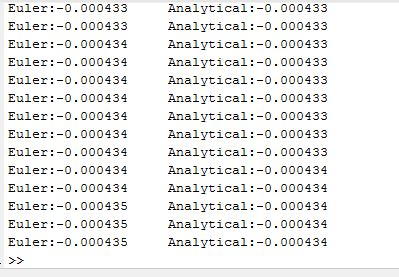
The Euler Method in Matlab For the Second order DE is given below.There are two files one is function file which is contains the euler method. And the another is script file that prepares the differential equation and sets the constants and then feeds the DE into euler function
************************************euler_method.m**********************
function [t,y] = euler_method( deriv_func,t0,dt,t_end,y0
)
%deriv_func is the differential eq.
%t0, t_end are the time range. dt is the increment
%calculate the size of output array
size=ceil((t_end-t0)/dt);
time_range=t0:dt:t_end;
%following line creates array with all elements 0
Y=zeros(size+1,2);
%initialize the Y with initial values
Y(1,:)=y0;
%the below loop solves the differential equation
% y(i+1)=y(i)+h*f(t,y)
for i=1:size
%x will give us column vector with two values
%one for y(1) and another for y(2)
x=deriv_func(time_range(i),Y(i,:));
%below is the euler method formula
Y(i+1,:)=Y(i,:)+dt*x';
end
t=time_range;
y=Y;
end
****************************SecondOrderDE.m************************
clc
clear all;
m=1;
c=0.1;
k=0.01;
initial=[0.2,0];
%Here we convert the Second order
%ODE in to first order by renaming the
%variables. y'=y(2).So differential of y' i.e. y"
% is d(y(2))/dt
%Now d(y(2))/dt = (-k*y(1)-c*y(2))/m.
%That is what we are representing below using Anonymous
function
F= @(t,y)[y(2);(-k*y(1)-c*y(2))/m];
t0=0;
t_end=100;
dt=0.001;
[t,y]=euler_method(F,t0,dt,t_end,initial);
%Following is the Analytical function against which we
compare
%Euler method.
Y=@(t)exp(-0.05.*t).*(0.2.*cos(0.0866025.*t)+0.11547.*sin(0.0866025.*t))
y_analytical=Y(t);
%Now we compare euler with True method
for i=1:length(t)
fprintf('Euler:%f\t\tAnalytical:%f\n',y(i,1),y_analytical(i))
end
%plot (t,y(;,1)) plots displacement vs time
plot(t,y(:,1)), xlabel('time'), ylabel('Displacement'),title('distance-time');

Add Answer to:
I mostly needed help with developing matlab code using the Euler method to create a graph. All th...
Use the Runge Kutta 4th Order (RK-4) Method on the function below to predict the value...
 Use the Runge Kutta 4th Order (RK-4) Method on the function below to predict the value of y(0.1), given t = 0, y(0)-2, and h-01. Report your answer to 3 decimal places. dy/dt = e + 3y Answer: Use the Runge-Kutta 4th Order (RK-4) Method on the function below to predict the value of y(0.2), given y(0.1) from the previous question, and h = 0.1. Report your answer to 3 decimal places. -t dy/dt -e +3y Answer
ME 32200 Programming course (MATLAB) 4. Please finish the following Matlab code for solving the ODE:...
 ME 32200 Programming course (MATLAB)
4. Please finish the following Matlab code for solving the ODE: dy = y(1+1) dt I.C. y(0) = 0 with the multi-step 4th order Milne's Method, and apply 4th order Runge Kutta method to the first 4 points (1 boundary point and the next 3 points). (Hint: 4th order Milne's Method Predictor: 7i+ = Y-3 +h(2f;- fi- +25,-2) Corrector: y = y + + +0. +45j + fi-) Where f; = f(t;,y,) and Fit =...
ME 32200 Programming course (MATLAB)
4. Please finish the following Matlab code for solving the ODE: dy = y(1+1) dt I.C. y(0) = 0 with the multi-step 4th order Milne's Method, and apply 4th order Runge Kutta method to the first 4 points (1 boundary point and the next 3 points). (Hint: 4th order Milne's Method Predictor: 7i+ = Y-3 +h(2f;- fi- +25,-2) Corrector: y = y + + +0. +45j + fi-) Where f; = f(t;,y,) and Fit =...
Hello These are a math problems that need to solve by MATLAB as code Thank you...
 Hello
These are a math problems that need to solve by MATLAB as
code
Thank you !
Initial Value Problem #1: Consider the following first order ODE: dy-p-3 from to 2.2 with y() I (a) Solve with Euler's explicit method using h04. (b) Solve with the midpoint method using h 0.4. (c) Solve with the classical fourth-order Runge-Kutta method using 0.4 analytical solution of the ODE is,·? solution and the numerical solution at the points where the numerical solution is...
Hello
These are a math problems that need to solve by MATLAB as
code
Thank you !
Initial Value Problem #1: Consider the following first order ODE: dy-p-3 from to 2.2 with y() I (a) Solve with Euler's explicit method using h04. (b) Solve with the midpoint method using h 0.4. (c) Solve with the classical fourth-order Runge-Kutta method using 0.4 analytical solution of the ODE is,·? solution and the numerical solution at the points where the numerical solution is...
Please answer with Matlab Programming that can be copied and pasted when doing the Matlab part...
 Please answer with Matlab Programming that can be copied and pasted
when doing the Matlab part
4 part 2
4. Please finish the following Matlab code for solving the ODE: dy 2(1+t) dt I.C. y(0) = 0 with the multi-step 4th order Milne's Method, and apply 4th order Runge Kutta method to the first 4 points (1 boundary point and the next 3 points). (Hint: 4th order Milne's Method Predictor: Jon = Y-3 + H25,- fia+2f1-2) h Corrector: Y:-1 =...
Please answer with Matlab Programming that can be copied and pasted
when doing the Matlab part
4 part 2
4. Please finish the following Matlab code for solving the ODE: dy 2(1+t) dt I.C. y(0) = 0 with the multi-step 4th order Milne's Method, and apply 4th order Runge Kutta method to the first 4 points (1 boundary point and the next 3 points). (Hint: 4th order Milne's Method Predictor: Jon = Y-3 + H25,- fia+2f1-2) h Corrector: Y:-1 =...
9) Using Euler method, solve this with following initial conditions that t = 0 when y = 1, for th...
 9) Using Euler method, solve this with following initial conditions that t = 0 when y = 1, for the range t = 0 to t = 1 with intervals of 0.25 dr + 2x2 +1=0.3 dt 1o) Using second order Taylor Series method, solve with following initial conditions to-0, xo-1 and h-0.24 11) x(1)-2 h-0.02 Solve the following system to find x(1.06) using 2nd, and 3rd and 4th order Runge-Kutta (RK2, RK3 and RK4)method +2x 2 +1-0.3 de sx)-cox(x/2)...
PLEASE HELP! I need to write a MATLAB code for this Euler approximation for finding the...
 PLEASE HELP! I need to write a MATLAB code for this Euler
approximation for finding the velocity of a parachutist at given
time iterations. The answers are provided so you can check to see
if the code works. I need to see it done in actual MATLAB program
so I can understand the coding methodology better.
1.) Euler Method (estimated time 11min) For the second-order drag model (see Eq. (1)), compute the velocity of a free-falling parachutist using Euler's method...
PLEASE HELP! I need to write a MATLAB code for this Euler
approximation for finding the velocity of a parachutist at given
time iterations. The answers are provided so you can check to see
if the code works. I need to see it done in actual MATLAB program
so I can understand the coding methodology better.
1.) Euler Method (estimated time 11min) For the second-order drag model (see Eq. (1)), compute the velocity of a free-falling parachutist using Euler's method...
Using the Runge-Kutta fourth-order method, obtain a solution to dx/dt=f(t,x,y)=xy^3+t^2; dy/dt=g(t,x,y)=ty+x^3 for t= 0 to t= 1 second. The initial conditions are given as x(0)=0, y(0) =1. Use a time...
Using the Runge-Kutta fourth-order method, obtain a solution to dx/dt=f(t,x,y)=xy^3+t^2; dy/dt=g(t,x,y)=ty+x^3 for t= 0 to t= 1 second. The initial conditions are given as x(0)=0, y(0) =1. Use a time increment of 0.2 seconds. Do hand calculations for t = 0.2 sec only.
Can you help me with this problem? This has to be done using Matlab and solving with runge-katta, euler method, and the built in function ode45
 Consider a cylindrical storage tank with surface area A which contains a liquid at depth y:At time t = 0, the tank is empty (y = 0 when t = 0). Liquid is supplied to the tank at a sinusoidal
rate Qin =3Qsin2
(t) and withdrawn from the tank as:
𝑄𝑜𝑢𝑡 = 3(𝑦 − 𝑦𝑜𝑢𝑡)
1.5
if 𝑦 > 𝑦𝑜𝑢𝑡
𝑄𝑜𝑢𝑡 = 0 if 𝑦 ≤ 𝑦𝑜𝑢𝑡 Please note that both 𝑄𝑖𝑛 and 𝑄𝑜𝑢𝑡 have units m3
/h. The mass...
Consider a cylindrical storage tank with surface area A which contains a liquid at depth y:At time t = 0, the tank is empty (y = 0 when t = 0). Liquid is supplied to the tank at a sinusoidal
rate Qin =3Qsin2
(t) and withdrawn from the tank as:
𝑄𝑜𝑢𝑡 = 3(𝑦 − 𝑦𝑜𝑢𝑡)
1.5
if 𝑦 > 𝑦𝑜𝑢𝑡
𝑄𝑜𝑢𝑡 = 0 if 𝑦 ≤ 𝑦𝑜𝑢𝑡 Please note that both 𝑄𝑖𝑛 and 𝑄𝑜𝑢𝑡 have units m3
/h. The mass...
Ordinary Differential Equations (a) Write a Python function implementing the 4'th order Runge-Kutta method. (b) Solve...
 Ordinary Differential Equations (a) Write a Python function implementing the 4'th order Runge-Kutta method. (b) Solve the following amusing variation on a pendulum problem using your routine. A pendulum is suspended from a sliding collar as shown in the diagram below. The system is at rest when an oscillating motion y(t) = Y sin (omega t) is imposed on the collar, starting at t = 0. The differential equation that describes the pendulum motion is given by: d^2 theta/dt^2 =...
where is says use euler2, for that please create a function file for euler method and use that! please help out with t...
 where is says use euler2, for that please create a function
file for euler method and use that! please help out with this!
please! screenahot the outputs and code! thanks!!!
The van der Pol equation is a 2nd-order ODE that describes self-sustaining oscillations in which energy is withdrawn from large oscilations and fed into the small oscillations. This equation typically models electronic circuits containing vacuum tubes. The van der Pol equation is: dy dt where y represents the position coordinate,...
where is says use euler2, for that please create a function
file for euler method and use that! please help out with this!
please! screenahot the outputs and code! thanks!!!
The van der Pol equation is a 2nd-order ODE that describes self-sustaining oscillations in which energy is withdrawn from large oscilations and fed into the small oscillations. This equation typically models electronic circuits containing vacuum tubes. The van der Pol equation is: dy dt where y represents the position coordinate,...
 Use the Runge Kutta 4th Order (RK-4) Method on the function below to predict the value of y(0.1), given t = 0, y(0)-2, and h-01. Report your answer to 3 decimal places. dy/dt = e + 3y Answer: Use the Runge-Kutta 4th Order (RK-4) Method on the function below to predict the value of y(0.2), given y(0.1) from the previous question, and h = 0.1. Report your answer to 3 decimal places. -t dy/dt -e +3y Answer
 ME 32200 Programming course (MATLAB)
4. Please finish the following Matlab code for solving the ODE: dy = y(1+1) dt I.C. y(0) = 0 with the multi-step 4th order Milne's Method, and apply 4th order Runge Kutta method to the first 4 points (1 boundary point and the next 3 points). (Hint: 4th order Milne's Method Predictor: 7i+ = Y-3 +h(2f;- fi- +25,-2) Corrector: y = y + + +0. +45j + fi-) Where f; = f(t;,y,) and Fit =...
ME 32200 Programming course (MATLAB)
4. Please finish the following Matlab code for solving the ODE: dy = y(1+1) dt I.C. y(0) = 0 with the multi-step 4th order Milne's Method, and apply 4th order Runge Kutta method to the first 4 points (1 boundary point and the next 3 points). (Hint: 4th order Milne's Method Predictor: 7i+ = Y-3 +h(2f;- fi- +25,-2) Corrector: y = y + + +0. +45j + fi-) Where f; = f(t;,y,) and Fit =...
 Hello
These are a math problems that need to solve by MATLAB as
code
Thank you !
Initial Value Problem #1: Consider the following first order ODE: dy-p-3 from to 2.2 with y() I (a) Solve with Euler's explicit method using h04. (b) Solve with the midpoint method using h 0.4. (c) Solve with the classical fourth-order Runge-Kutta method using 0.4 analytical solution of the ODE is,·? solution and the numerical solution at the points where the numerical solution is...
Hello
These are a math problems that need to solve by MATLAB as
code
Thank you !
Initial Value Problem #1: Consider the following first order ODE: dy-p-3 from to 2.2 with y() I (a) Solve with Euler's explicit method using h04. (b) Solve with the midpoint method using h 0.4. (c) Solve with the classical fourth-order Runge-Kutta method using 0.4 analytical solution of the ODE is,·? solution and the numerical solution at the points where the numerical solution is...
 Please answer with Matlab Programming that can be copied and pasted
when doing the Matlab part
4 part 2
4. Please finish the following Matlab code for solving the ODE: dy 2(1+t) dt I.C. y(0) = 0 with the multi-step 4th order Milne's Method, and apply 4th order Runge Kutta method to the first 4 points (1 boundary point and the next 3 points). (Hint: 4th order Milne's Method Predictor: Jon = Y-3 + H25,- fia+2f1-2) h Corrector: Y:-1 =...
Please answer with Matlab Programming that can be copied and pasted
when doing the Matlab part
4 part 2
4. Please finish the following Matlab code for solving the ODE: dy 2(1+t) dt I.C. y(0) = 0 with the multi-step 4th order Milne's Method, and apply 4th order Runge Kutta method to the first 4 points (1 boundary point and the next 3 points). (Hint: 4th order Milne's Method Predictor: Jon = Y-3 + H25,- fia+2f1-2) h Corrector: Y:-1 =...
 9) Using Euler method, solve this with following initial conditions that t = 0 when y = 1, for the range t = 0 to t = 1 with intervals of 0.25 dr + 2x2 +1=0.3 dt 1o) Using second order Taylor Series method, solve with following initial conditions to-0, xo-1 and h-0.24 11) x(1)-2 h-0.02 Solve the following system to find x(1.06) using 2nd, and 3rd and 4th order Runge-Kutta (RK2, RK3 and RK4)method +2x 2 +1-0.3 de sx)-cox(x/2)...
 PLEASE HELP! I need to write a MATLAB code for this Euler
approximation for finding the velocity of a parachutist at given
time iterations. The answers are provided so you can check to see
if the code works. I need to see it done in actual MATLAB program
so I can understand the coding methodology better.
1.) Euler Method (estimated time 11min) For the second-order drag model (see Eq. (1)), compute the velocity of a free-falling parachutist using Euler's method...
PLEASE HELP! I need to write a MATLAB code for this Euler
approximation for finding the velocity of a parachutist at given
time iterations. The answers are provided so you can check to see
if the code works. I need to see it done in actual MATLAB program
so I can understand the coding methodology better.
1.) Euler Method (estimated time 11min) For the second-order drag model (see Eq. (1)), compute the velocity of a free-falling parachutist using Euler's method...
 Ordinary Differential Equations (a) Write a Python function implementing the 4'th order Runge-Kutta method. (b) Solve the following amusing variation on a pendulum problem using your routine. A pendulum is suspended from a sliding collar as shown in the diagram below. The system is at rest when an oscillating motion y(t) = Y sin (omega t) is imposed on the collar, starting at t = 0. The differential equation that describes the pendulum motion is given by: d^2 theta/dt^2 =...
 where is says use euler2, for that please create a function
file for euler method and use that! please help out with this!
please! screenahot the outputs and code! thanks!!!
The van der Pol equation is a 2nd-order ODE that describes self-sustaining oscillations in which energy is withdrawn from large oscilations and fed into the small oscillations. This equation typically models electronic circuits containing vacuum tubes. The van der Pol equation is: dy dt where y represents the position coordinate,...
where is says use euler2, for that please create a function
file for euler method and use that! please help out with this!
please! screenahot the outputs and code! thanks!!!
The van der Pol equation is a 2nd-order ODE that describes self-sustaining oscillations in which energy is withdrawn from large oscilations and fed into the small oscillations. This equation typically models electronic circuits containing vacuum tubes. The van der Pol equation is: dy dt where y represents the position coordinate,...
Most questions answered within 3 hours.
-
Where is the error in this code sequence?
String s1 = "Hello";
String s2 = "ello";...
asked 11 months ago -
Financial data for Joel de Paris, Inc., for last year
follow:
Joel de Paris, Inc.
Balance...
asked 11 months ago -
Consider this reaction:
Al2(SO4)3 (aq)+ BaCl3
(aq) Al2Cl6 (aq)- +
3BaSO4(s) . What is the...
asked 11 months ago -
Suppose that Savneet is considering increasing her
recent random sample from 20 car rentals to 40...
asked 11 months ago -
Trucks arrive at an unloading terminal at an average rate of 120
per hour.
Trucks arrive...
asked 11 months ago -
Why are methanol and ethanol completely soluble in water while
octanol is not very little soluble....
asked 11 months ago -
A facilities manager at a university reads in a research report
that the mean amount of...
asked 11 months ago -
When the CuSO4 is rehydrated by adding water to the anhydrous
compound, is this an endothermic...
asked 11 months ago -
A ray of sunlight is passing from diamond into crown glass; the
angle of incidence is...
asked 11 months ago -
A block of mass 0.249 kg is placed on top of a light, vertical
spring of...
asked 11 months ago -
how do the kidneys compensate in the presences of acidosis
a) trigger hyperventilate
b) reserve acid...
asked 11 months ago -
Question 501 pts
The rental rate of capital to the firm increases. Which of the
following...
asked 11 months ago