dictionary adding / removal
Given a variable, unproved_conjectures, that is associated with a dictionary that maps the common names of mathematical conjectures to the years when the conjectures were made, write a statement that deletes the entry for "Fermat's Last Theorem".
Homework Answers
#! /usr/bin/python3
#creating a dictionary for unproved_conjectures
unproved_conjectures = dict()
#creating entry for "Fermat's Last Theorem" in
unproved_conjectures
unproved_conjectures["Fermat's Last Theorem"] = "year: 1637"
#Check if there is an entry for Fermat's Last Theorem, if it
exists then delete that entry
if "Fermat's Last Theorem" in unproved_conjectures:
del unproved_conjectures["Fermat's Last
Theorem"]
print("Entry for Fermat's Last Theorem has been
successfully removed from unproved_conjectures")
else:
print("Entry for Fermat's Last Theorem doesn't
exist")
#Let me know if you need more help, Thank You.
Given a variable, unproved_conjectures, that is associated with a dictionary that maps the common names of...
Given a variable, unproved_conjectures, that is associated with a dictionary that maps the common names of mathematical conjectures to the years when the conjectures were made, write a statement that deletes the entry for "Fermat's Last Theorem". In Python.
For Python 3 MPLS please 1. Given a variable, unproved_conjectures, that is associated with a dictionary...
For Python 3 MPLS please 1. Given a variable, unproved_conjectures, that is associated with a dictionary that maps the common names of mathematical conjectures to the years when the conjectures were made, write a statement that deletes the entry for "Fermat's Last Theorem". 2. Given a dictionary d, create a new dictionary that reverses the keys and values of d. Thus, the keys of d become the values of the new dictionary and the values of d become the keys...
Dictionaries
1)Assume there is a variable, nobel_peace_prizes , that is associated with a dictionary that maps years to winners of the Nobel Peace Prize for that year and assume itis up-to-date through the year 2005. Write a statement that adds an entry that maps the key 2006 to "Muhammad Yunus and Grameen Bank" .2)Given a variable, us_cabinet , that is associated with a dictionary that maps department names to department heads, replace the value "Gonzalez" with "Mukasey" for thekey "Justice Department"3)The...
The variable most_recent_novel is associated with a dictionary that maps the names of novelists to their...
The variable most_recent_novel is associated with a dictionary that maps the names of novelists to their most recently published novels. Write a statement that replaces the value "Harry Potter and the Half-Blood Prince" with the value "Harry Potter and the Deathly Hallows" for the key "J.K. Rawling". In Python
Dictionaries
1)You are given a variable, wwII_battle_winners , that is associated with a dictionary that maps the names of World War II battles to the victors of WWII battles. Writesome code that associates a sorted list of the battle names that appear as keys in this dictionary with the variable battles .2)The inverse of a map is a new map where the values of the original map become the keys of the new map and the keys become the values. For...
(Python) assume the variable dct references a dictionary. Write an if statement that determines whether the...
(Python) assume the variable dct references a dictionary. Write an if statement that determines whether the key 'Jon' exists in the dictionary. If so, assign the value 'Jon' to a key of 'John', and then delete 'Jon' and its associated value.
This script will create a dictionary whose keys are all the directories listed in thePATH system...
This script will create a dictionary whose keys are all the directories listed in thePATH system variable, and whose values are the number of files in each of these directories. The script will also print each directory entry sorted by directory name. The script will use the following five functions to get the required results get_environment_variable_value() get_dirs_from_path() get_file_count() get_file_count_for_dir_list() print_sorted_dictionary() get_environment_variable_value() The header for this function must be This function must accept a shell variable as its only parameter The...
Storing data and adding to data in a dictionary: Experiment with Python dictionaries and their keys()...
Storing data and adding to data in a dictionary: Experiment with Python dictionaries and their keys() member function that returns a list of a dictionary's keys. You can check if a particular key is in a dictionary by using the in test with the keys list. For example, if our dictionary is MyDict = { 1: 'One', 2: 'Two', 3: 'Three' } Then ( 2 in MyDict.keys() ) evaluates to True, indicating that 2 is a valid key for MyDict....
the same problem: We picked the variable name user_dictionary because it will be a dictionary that...
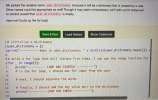 the same problem:
We picked the variable name user_dictionary because it will be a dictionary that is created by a user. Other names could be appropriate as well! Though it may seem unnecessary, we'll add a print statement to remind ourself that user_dictionary is empty. Next we'll build up the for loop! Save & Run Load History Show CodeLens 1 # initialize a dictionary 2 user_dictionary - {} 3 print("--- keys in user_dictionary: " + str(list(user_dictionary.keys()) + 5 # write...
the same problem:
We picked the variable name user_dictionary because it will be a dictionary that is created by a user. Other names could be appropriate as well! Though it may seem unnecessary, we'll add a print statement to remind ourself that user_dictionary is empty. Next we'll build up the for loop! Save & Run Load History Show CodeLens 1 # initialize a dictionary 2 user_dictionary - {} 3 print("--- keys in user_dictionary: " + str(list(user_dictionary.keys()) + 5 # write...
python Function Name: find_me Parameters: a dictionary of strings mapping to strings ( dict ), person1...
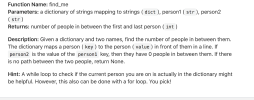 python
Function Name: find_me Parameters: a dictionary of strings mapping to strings ( dict ), person1 ( str), person2 (str) Returns: number of people in between the first and last person ( int ) Description: Given a dictionary and two names, find the number of people in between them. The dictionary maps a person ( key ) to the person ( value ) in front of them in a line. If person2 is the value of the personi key, then...
python
Function Name: find_me Parameters: a dictionary of strings mapping to strings ( dict ), person1 ( str), person2 (str) Returns: number of people in between the first and last person ( int ) Description: Given a dictionary and two names, find the number of people in between them. The dictionary maps a person ( key ) to the person ( value ) in front of them in a line. If person2 is the value of the personi key, then...
 the same problem:
We picked the variable name user_dictionary because it will be a dictionary that is created by a user. Other names could be appropriate as well! Though it may seem unnecessary, we'll add a print statement to remind ourself that user_dictionary is empty. Next we'll build up the for loop! Save & Run Load History Show CodeLens 1 # initialize a dictionary 2 user_dictionary - {} 3 print("--- keys in user_dictionary: " + str(list(user_dictionary.keys()) + 5 # write...
the same problem:
We picked the variable name user_dictionary because it will be a dictionary that is created by a user. Other names could be appropriate as well! Though it may seem unnecessary, we'll add a print statement to remind ourself that user_dictionary is empty. Next we'll build up the for loop! Save & Run Load History Show CodeLens 1 # initialize a dictionary 2 user_dictionary - {} 3 print("--- keys in user_dictionary: " + str(list(user_dictionary.keys()) + 5 # write...
 python
Function Name: find_me Parameters: a dictionary of strings mapping to strings ( dict ), person1 ( str), person2 (str) Returns: number of people in between the first and last person ( int ) Description: Given a dictionary and two names, find the number of people in between them. The dictionary maps a person ( key ) to the person ( value ) in front of them in a line. If person2 is the value of the personi key, then...
python
Function Name: find_me Parameters: a dictionary of strings mapping to strings ( dict ), person1 ( str), person2 (str) Returns: number of people in between the first and last person ( int ) Description: Given a dictionary and two names, find the number of people in between them. The dictionary maps a person ( key ) to the person ( value ) in front of them in a line. If person2 is the value of the personi key, then...
Most questions answered within 3 hours.
-
Where is the error in this code sequence?
String s1 = "Hello";
String s2 = "ello";...
asked 11 months ago -
Financial data for Joel de Paris, Inc., for last year
follow:
Joel de Paris, Inc.
Balance...
asked 11 months ago -
Consider this reaction:
Al2(SO4)3 (aq)+ BaCl3
(aq) Al2Cl6 (aq)- +
3BaSO4(s) . What is the...
asked 11 months ago -
Suppose that Savneet is considering increasing her
recent random sample from 20 car rentals to 40...
asked 11 months ago -
Trucks arrive at an unloading terminal at an average rate of 120
per hour.
Trucks arrive...
asked 11 months ago -
Why are methanol and ethanol completely soluble in water while
octanol is not very little soluble....
asked 11 months ago -
A facilities manager at a university reads in a research report
that the mean amount of...
asked 11 months ago -
When the CuSO4 is rehydrated by adding water to the anhydrous
compound, is this an endothermic...
asked 11 months ago -
A ray of sunlight is passing from diamond into crown glass; the
angle of incidence is...
asked 11 months ago -
A block of mass 0.249 kg is placed on top of a light, vertical
spring of...
asked 11 months ago -
how do the kidneys compensate in the presences of acidosis
a) trigger hyperventilate
b) reserve acid...
asked 11 months ago -
Question 501 pts
The rental rate of capital to the firm increases. Which of the
following...
asked 11 months ago