
 please
help with 2 and 3 asap thank you!
please
help with 2 and 3 asap thank you!gondoic Mond Poly Poly Poly linoleic | CH3(CH2)4(CH-СНСТ CH,CH-CH CHCH,h(CH)OOH -5 very low a-linolenic arachidonie CHy(CH24(CH-CHCH24CH2OH C20H3220 204 CI8H3002 18 3 2. Now, look for trends in the data. Which fatty acids are solid at room temperature (about 25 C)? Which are liquid at room temperature? How does increasing the number of carbons in the hydrocarbon chain affect the melting point? Find a set of fatty acids in the table-as large a set as possible-that shows the trend in melting point with the number of carbons, without being complicated by any other variables. Make a graph to show this trend. What is the formula of the next fatty acid in the series? Use your graph to predict the melting point of this fatty acid. 3. The reason that longer chain molecules have higher boiling points is that longer chain molecules become wrapped around and enmeshed in each other much like the strands of spaghetti 4. How does increasing the number of double bonds in the hydrocarbon chain affect the melting point? Find a set of fatty acids in the table-as large a set as possible-that shows the trend in meltino noint with the number of double honds without heino icated huay ather Focus MacBook Pro
Homework Answers
2) All saturated fatty acids with the number of carbons from C-12 to C-24 are solid at room temperature. And all unsaturated fatty acids are liquid at room temperature.
3) Fatty acids contain long hydrocarbon chain, this hydrocarbon chain is lipophilic in nature. This chain exhibits strong intermolecular van Der Waal forces of attraction. As the attraction between molecules is stronger it requires more energy to separate them thermodynamically. And hence melting point increases with the increase in the number of carbons in the fatty acids.
We will choose saturated fatty acids
to show the trend:
X-axis: number of carbons
Y-axis: melting point
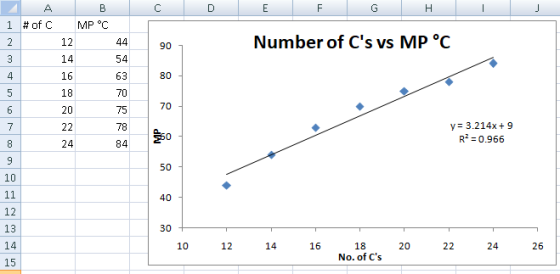
If we take the trend line (best-fit line) equation Y = 3.214*x + 9
where Y = mp, X = number of C's
Next fatty acid is: C24H52O2
To predict the mp of this fatty acid we can use the equation.
Substitute X = 24 and calculate Y = 3.214*24+9 = 86oC
Thus the predicated MP of next fatty acid is 86oC.
Add Answer to:
Colortul Heading 1 Normal Subtitle Selected Chemical and Physical Propotis of Fatty Aeld Condenso...
4. A list of fatty acids is given below. The number of carbons each contains, as...
 4. A list of fatty acids is given below. The number of carbons each contains, as well as the number of double bonds, are listed right after the name. Rank the fatty acids 1-5 from highest melting point to lowest melting point. 1 - highest melting point, 5 - lowest melting point. Palmitic acid (16 carbons, 0 double bonds) Oleic acid (18 carbons, 1 double bond) Linolenic acid (18 carbons, 3 double bonds) Lauric acid (12 carbons, 0 double bonds)...
b) Water "softeners" work via the principle of ion-exchange. The tank ork via the principle of...
 b) Water "softeners" work via the principle of ion-exchange. The tank ork via the principle of ion-exchange. The tank of a water softener is filled with a soluble salt such as sodium chloride. As "hard" water passes through the tank, the . AS "hard" water passes through the tank, the undesirable ions in hard water (e.g., calcium, magnesium, and iron IIT) are exchanged for the more desirable "soft" (m 1) are exchanged for the more desirable "soft" (meaning more soluble)...
26. Melting Points of Lipids The melting points of a series of 18-carbon fatty acids are:...
 26. Melting Points of Lipids The melting points of a series of 18-carbon fatty acids are: stearic acid, 69.6 °C, oleic acid, 13.4 °C; linoleic acid, -5 °C; and linolenic acid, -11 °C. (a) What structural aspect of these 18-carbon fatty acids can be correlated with the melting point? (b) Draw all the possible triacylglycerols that can be constructed from glycerol, palmitic acid, and oleic acid. Rank them in order of increasing melting point. (c) Branched-chain fatty acids are found...
3. Draw line-bond diagrams for linoleic, linolenic and arachidonic acids. TABLE 23.1 Structures of Some Common...
 3. Draw line-bond diagrams for linoleic, linolenic and arachidonic acids. TABLE 23.1 Structures of Some Common Fatty Acids Name No. of carbons Melting point("C) Structure 43.2 53.9 63.1 68.8 76.5 CH3(CH2) 10CO2H CH3(CH2)12CO2H CH3(CH2) 14CO2H CH3(CH2) 16CO2H CH(CH2)18CO2H Saturated Lauric Myristic Palmitic Stearic Arachidic Unsaturated Palmitoleic Oleic Linoleic Linolenic Arachidonic -0.1 13.4 -12 -11 -49.5 (Z)-CH(CH2)-CH-CH(CH2hCO2H (Z)-CH(CH2CH=CH(CH2);CO2H (Z.Z)-CH3(CH2),(CH-CHCH2)2(CH2)CO2H (all Z)-CH3CH2CH=CHCH2)2(CH2).CO2H (all Z)-CH(CH2)-(CH-CHCH2 CH2CH2CO2H 20
I am having trouble is this correct? CH 3a) Provide the definition for a fatty acid...
 I am having trouble is this correct?
CH 3a) Provide the definition for a fatty acid long straight Chain hydrocarbon that has an even number of covers and carboxylic acid at the end, 1) 3b) Draw the structure of the molecule formed when the weak acid shown is ionized in water acid Base Congo 10 Hydronin non но CH3-(CH2)io-COOH + H2O (1) CH3-(CH2) 10-Coo + H30" th (6 pts) 4) A triglyceride is an ester made of glycerol and carboxylic...
I am having trouble is this correct?
CH 3a) Provide the definition for a fatty acid long straight Chain hydrocarbon that has an even number of covers and carboxylic acid at the end, 1) 3b) Draw the structure of the molecule formed when the weak acid shown is ionized in water acid Base Congo 10 Hydronin non но CH3-(CH2)io-COOH + H2O (1) CH3-(CH2) 10-Coo + H30" th (6 pts) 4) A triglyceride is an ester made of glycerol and carboxylic...
Which of the following explanations describes the fatty acid with the highest melting point: 18 carbons...
Which of the following explanations describes the fatty acid with the highest melting point: 18 carbons long, 2 double bonds, both in the cis configuration 18 carbons long and saturated 18 carbons long, 1 double bond, cis configuration 18 carbons long, 1 double bond, trans configuration
In which of the following pairs of fatty acids does the first listed acid have a...
In which of the following pairs of fatty acids does the first listed acid have a higher melting point than the second listed acid? a. 16:2 acid and 16:0 acid b. 21:0 acid and 17:0 acid c. 17:3 acid and 17:0 acid d. 17:3 acid and 20:0 acid Which of the following fatty acids is both monounsaturated and an omega-6 fatty acid? a. CH3–(CH2)18–COOH b. CH3–(CH2)7–CH=CH–(CH2)7–COOH c. CH3–(CH2)4–CH=CH–(CH2)2–(CH2)6–COOH d. CH3–CH2–(CH=CH–CH2)4–(CH2)2–COOH Which of the following types of compounds are expected products...
please help me! :) 16. What is the name of the palmitoleate fatty acid above in omega, o notation? C) -9 A) -7 B) -...
 please help me! :)
16. What is the name of the palmitoleate fatty acid above in omega, o notation? C) -9 A) -7 B) -8 D) -10 Page 3 of 10 First Name Dec 10, 2018 17.Which of the following is NOT a difference between the two fatty acids above, palmitoleate and vaccenate? A) they have a different total number of carbons B) they have a different omega, w notation C) one is cis and the other is trans double...
please help me! :)
16. What is the name of the palmitoleate fatty acid above in omega, o notation? C) -9 A) -7 B) -8 D) -10 Page 3 of 10 First Name Dec 10, 2018 17.Which of the following is NOT a difference between the two fatty acids above, palmitoleate and vaccenate? A) they have a different total number of carbons B) they have a different omega, w notation C) one is cis and the other is trans double...
please assist with 1-5 C=C + H₂ " REACTIONS OF LIPIDS Hydrogenation Consider the following fatty...
 please assist with 1-5
C=C + H₂ " REACTIONS OF LIPIDS Hydrogenation Consider the following fatty acids: tah cha chah aah ooh ooh out Myristica CO 1. Can myristic acid be hydrogenated? 2. Why or why not? 3. Can oleic acid be hydrogenated? 4. Why or why not? 5. When a fatty acid is hydrogenated, will its melting point increase or decrease? Now let's take a closer look at the hydrogenation reaction, this time with fats (not fatty acids): 6....
please assist with 1-5
C=C + H₂ " REACTIONS OF LIPIDS Hydrogenation Consider the following fatty acids: tah cha chah aah ooh ooh out Myristica CO 1. Can myristic acid be hydrogenated? 2. Why or why not? 3. Can oleic acid be hydrogenated? 4. Why or why not? 5. When a fatty acid is hydrogenated, will its melting point increase or decrease? Now let's take a closer look at the hydrogenation reaction, this time with fats (not fatty acids): 6....
Chemistry 1604 In class Lipids Name: Malio Gomez 1. Draw the following two fatty acids and circle the unsaturated fa...
 Chemistry 1604 In class Lipids Name: Malio Gomez 1. Draw the following two fatty acids and circle the unsaturated fatty acid. 18:2412.15 20:0 w Which of the following molecules is NOT a naturally occurring fatty acid? 2. а но" с. Но b. CH3(CH2) CH=CH(CH2) CO2H d. Which of the fatty acids below has the highest melting point? 3. stearic acid но arachidonic acid palmitic acid c. arachidonic acid b. palmitic acid stearic acid a. for for short-term energy storage and...
 4. A list of fatty acids is given below. The number of carbons each contains, as well as the number of double bonds, are listed right after the name. Rank the fatty acids 1-5 from highest melting point to lowest melting point. 1 - highest melting point, 5 - lowest melting point. Palmitic acid (16 carbons, 0 double bonds) Oleic acid (18 carbons, 1 double bond) Linolenic acid (18 carbons, 3 double bonds) Lauric acid (12 carbons, 0 double bonds)...
 b) Water "softeners" work via the principle of ion-exchange. The tank ork via the principle of ion-exchange. The tank of a water softener is filled with a soluble salt such as sodium chloride. As "hard" water passes through the tank, the . AS "hard" water passes through the tank, the undesirable ions in hard water (e.g., calcium, magnesium, and iron IIT) are exchanged for the more desirable "soft" (m 1) are exchanged for the more desirable "soft" (meaning more soluble)...
 26. Melting Points of Lipids The melting points of a series of 18-carbon fatty acids are: stearic acid, 69.6 °C, oleic acid, 13.4 °C; linoleic acid, -5 °C; and linolenic acid, -11 °C. (a) What structural aspect of these 18-carbon fatty acids can be correlated with the melting point? (b) Draw all the possible triacylglycerols that can be constructed from glycerol, palmitic acid, and oleic acid. Rank them in order of increasing melting point. (c) Branched-chain fatty acids are found...
 3. Draw line-bond diagrams for linoleic, linolenic and arachidonic acids. TABLE 23.1 Structures of Some Common Fatty Acids Name No. of carbons Melting point("C) Structure 43.2 53.9 63.1 68.8 76.5 CH3(CH2) 10CO2H CH3(CH2)12CO2H CH3(CH2) 14CO2H CH3(CH2) 16CO2H CH(CH2)18CO2H Saturated Lauric Myristic Palmitic Stearic Arachidic Unsaturated Palmitoleic Oleic Linoleic Linolenic Arachidonic -0.1 13.4 -12 -11 -49.5 (Z)-CH(CH2)-CH-CH(CH2hCO2H (Z)-CH(CH2CH=CH(CH2);CO2H (Z.Z)-CH3(CH2),(CH-CHCH2)2(CH2)CO2H (all Z)-CH3CH2CH=CHCH2)2(CH2).CO2H (all Z)-CH(CH2)-(CH-CHCH2 CH2CH2CO2H 20
 I am having trouble is this correct?
CH 3a) Provide the definition for a fatty acid long straight Chain hydrocarbon that has an even number of covers and carboxylic acid at the end, 1) 3b) Draw the structure of the molecule formed when the weak acid shown is ionized in water acid Base Congo 10 Hydronin non но CH3-(CH2)io-COOH + H2O (1) CH3-(CH2) 10-Coo + H30" th (6 pts) 4) A triglyceride is an ester made of glycerol and carboxylic...
I am having trouble is this correct?
CH 3a) Provide the definition for a fatty acid long straight Chain hydrocarbon that has an even number of covers and carboxylic acid at the end, 1) 3b) Draw the structure of the molecule formed when the weak acid shown is ionized in water acid Base Congo 10 Hydronin non но CH3-(CH2)io-COOH + H2O (1) CH3-(CH2) 10-Coo + H30" th (6 pts) 4) A triglyceride is an ester made of glycerol and carboxylic...
 please help me! :)
16. What is the name of the palmitoleate fatty acid above in omega, o notation? C) -9 A) -7 B) -8 D) -10 Page 3 of 10 First Name Dec 10, 2018 17.Which of the following is NOT a difference between the two fatty acids above, palmitoleate and vaccenate? A) they have a different total number of carbons B) they have a different omega, w notation C) one is cis and the other is trans double...
please help me! :)
16. What is the name of the palmitoleate fatty acid above in omega, o notation? C) -9 A) -7 B) -8 D) -10 Page 3 of 10 First Name Dec 10, 2018 17.Which of the following is NOT a difference between the two fatty acids above, palmitoleate and vaccenate? A) they have a different total number of carbons B) they have a different omega, w notation C) one is cis and the other is trans double...
 please assist with 1-5
C=C + H₂ " REACTIONS OF LIPIDS Hydrogenation Consider the following fatty acids: tah cha chah aah ooh ooh out Myristica CO 1. Can myristic acid be hydrogenated? 2. Why or why not? 3. Can oleic acid be hydrogenated? 4. Why or why not? 5. When a fatty acid is hydrogenated, will its melting point increase or decrease? Now let's take a closer look at the hydrogenation reaction, this time with fats (not fatty acids): 6....
please assist with 1-5
C=C + H₂ " REACTIONS OF LIPIDS Hydrogenation Consider the following fatty acids: tah cha chah aah ooh ooh out Myristica CO 1. Can myristic acid be hydrogenated? 2. Why or why not? 3. Can oleic acid be hydrogenated? 4. Why or why not? 5. When a fatty acid is hydrogenated, will its melting point increase or decrease? Now let's take a closer look at the hydrogenation reaction, this time with fats (not fatty acids): 6....
 Chemistry 1604 In class Lipids Name: Malio Gomez 1. Draw the following two fatty acids and circle the unsaturated fatty acid. 18:2412.15 20:0 w Which of the following molecules is NOT a naturally occurring fatty acid? 2. а но" с. Но b. CH3(CH2) CH=CH(CH2) CO2H d. Which of the fatty acids below has the highest melting point? 3. stearic acid но arachidonic acid palmitic acid c. arachidonic acid b. palmitic acid stearic acid a. for for short-term energy storage and...
Most questions answered within 3 hours.
-
Where is the error in this code sequence?
String s1 = "Hello";
String s2 = "ello";...
asked 10 months ago -
Financial data for Joel de Paris, Inc., for last year
follow:
Joel de Paris, Inc.
Balance...
asked 10 months ago -
Consider this reaction:
Al2(SO4)3 (aq)+ BaCl3
(aq) Al2Cl6 (aq)- +
3BaSO4(s) . What is the...
asked 10 months ago -
Suppose that Savneet is considering increasing her
recent random sample from 20 car rentals to 40...
asked 10 months ago -
Trucks arrive at an unloading terminal at an average rate of 120
per hour.
Trucks arrive...
asked 10 months ago -
Why are methanol and ethanol completely soluble in water while
octanol is not very little soluble....
asked 10 months ago -
A facilities manager at a university reads in a research report
that the mean amount of...
asked 10 months ago -
When the CuSO4 is rehydrated by adding water to the anhydrous
compound, is this an endothermic...
asked 10 months ago -
A ray of sunlight is passing from diamond into crown glass; the
angle of incidence is...
asked 10 months ago -
A block of mass 0.249 kg is placed on top of a light, vertical
spring of...
asked 10 months ago -
how do the kidneys compensate in the presences of acidosis
a) trigger hyperventilate
b) reserve acid...
asked 10 months ago -
Question 501 pts
The rental rate of capital to the firm increases. Which of the
following...
asked 10 months ago