
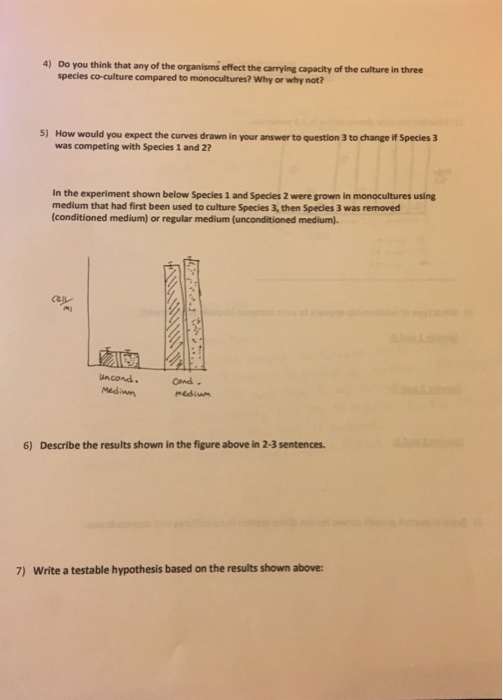
4) Do you think that any of the organisms effect the carrying capacity of the culture in three species co-culture compared to monocultures? Why or why not? How would you expect the curves drawn in your answer to question 3 to change if Species 3 was competing with Species 1 and 2? 5) In the experiment shown below Species 1 and Species 2 were grown in monocultures using medium that had first been used to culture Species 3, then Species 3 was removed (conditioned medium) or regular medium (unconditioned medium). incond. Mediwm Cand mediun 6) Describe the results shown in the figure above in 2-3 sentences 7) Write a testable hypothesis based on the results shown above:
Homework Answers

Ans. 1. The above data represent the interspecies relationship between three species. At first, they are cultured in monoculture and CFU/ml was estimated. Then growth estimation was done for co-culture of two species (f3-f1 and f3-f2) and finally for the culture of three species(f3-f1-f2). By closely analyzing the above data we can correlate the behavioral correlation between species.
Ans.2
Species 1 and 3 --- Commensalism --- Because the growth of species 1 is increased where species 3 unaffected in co-culture
Species 2 and 3 --- Commensalism ---- Because the growth of species 2 is increased where species 3 unaffected in co-culture
Species 1 and 2 --- amensalism ---- Because the growth of species 3 is decreased where species 2 unaffected in co-culture.
Ans.3 The graph shown below is of species grown in monoculture and co-culture.

Ans 4 . Yes species 3 increases the carrying capacity of co-culture as in the presence of species 3 the growth of species 1 and species 2 increase.
Ans5. If the species 3 is in competition which species 1 and 2 It no longer increases the growth but decreases it change it to below mentioned graph

Ans 6.

The result above shows that species 3 has a commensalism behaviour for species 1 and 2, conditioned media obtained from the species 3 increases the growth of species 1 and 2. This may be due to nutritional enrichment of medium by degrading components that can be utilised by species 1 and 2 that they are unable to utilise in monoculture conditions. Result above clearly suggest that condition media of species 3 promotes the growth of the other two species.
Ans 7 All the above data shows that these three species have a inter-species relationship species 3 have a growth promoting effect on species 1 and 2. whereas species 1 decreased the growth of species 2. so it can hypothesis that in a co-culture condition species 2 dominates over species 1 and 3 .
Add Answer to:
1) Describe the data shown below in 2-3 sentences. 2) What type of relationship appears to exist ...
Put the words from 1 to 8 in meaningful sentences. 1- co+ exist 2-in+escapable 3-mis+understand 4-out...
Put the words from 1 to 8 in meaningful sentences. 1- co+ exist 2-in+escapable 3-mis+understand 4-out +grow 5-pre+existing 6-re+adjust 7-sub+conscious 8-un+ involved
please answer each in 2-3 sentences. thank you 1. We have learned that energy can exist...
 please answer each in 2-3 sentences. thank you
1. We have learned that energy can exist in two primary forms: potential energy and kinetic energy a. Which of the two molecules below contains less potential energy? How do you know? (4 points) CH,OH CH OH —0 OH он H-C-H OH OH b. Glucose is high in potential energy. Why does the cell not simply use glucose to power cellular processes? (2 points) c. Explain how the hydrolysis of ATP can...
please answer each in 2-3 sentences. thank you
1. We have learned that energy can exist in two primary forms: potential energy and kinetic energy a. Which of the two molecules below contains less potential energy? How do you know? (4 points) CH,OH CH OH —0 OH он H-C-H OH OH b. Glucose is high in potential energy. Why does the cell not simply use glucose to power cellular processes? (2 points) c. Explain how the hydrolysis of ATP can...
1. Describe in a couple of sentences what the data describes. 2. In one or two sentences, explain...
 1. Describe in a couple of sentences what the data
describes.
2. In one or two sentences, explain how the graphic helped you
to understand the data and describe any conclusions about or
reactions to the data you had.
3. How could you use this in your classroom?
Contrasting social media Democrats to real life Say they don't follow the news much 27% of Democrats on social media 59% of other Democrats As many know (I hope), what we see...
1. Describe in a couple of sentences what the data
describes.
2. In one or two sentences, explain how the graphic helped you
to understand the data and describe any conclusions about or
reactions to the data you had.
3. How could you use this in your classroom?
Contrasting social media Democrats to real life Say they don't follow the news much 27% of Democrats on social media 59% of other Democrats As many know (I hope), what we see...
1.Describe the difference between alpha-, beta-, and gamma-haemolysis? 2.Research the microorganisms listed below. List the full...
1.Describe the difference between alpha-, beta-, and gamma-haemolysis? 2.Research the microorganisms listed below. List the full taxonomy (phylum, class, order, family, genus, species) of each microorganism, and write at least two sentences about a feature/characteristic of each microbe that you find interesting (we are using these strains in experiments in the next laboratory, so linking this feature/characteristic to the laboratory practical will assist your understanding). Streptococcus pneumoniae: Staphylococcus aureus: Escherichia coli: Saccharomyces cerevisiae. 3.What is a microbial cultivation selective medium...
1. What is a corporate culture, and why is it important? Describe the culture at a...
 1. What is a corporate culture, and why is it important? Describe the culture at a business where you have been employed. 2. Mention five specific techniques you can use to improve your written documents. 5. When preparing an oral presentation, what six tasks should you perform? 7. Why are visual aids important? Give at least three examples of different types of visual aids, and explain how you would use each type in a presentation. 8. Based on your own...
1.Describe in a couple of sentences what the data describes. 2. In one or two sentences, explain ...
 1.Describe in a couple of sentences what the data describes.
2. In one or two sentences, explain how the heatmap helped you
to understand the data and describe any conclusions about or
reactions to the data you had.
3. How could you use this in your classroom?
Cuver Seatte singo uko Quebec Ouawa Montreal Port and Minneapolis Wacom Toronto Milwaukee Wyoming Hamilton IowO Chicago Lincole Des Meines Denver Philadelphia Kansas City Kamsas Louisuille virginia Beach Charkotteth Caren nsono Aclanta Dalas...
1.Describe in a couple of sentences what the data describes.
2. In one or two sentences, explain how the heatmap helped you
to understand the data and describe any conclusions about or
reactions to the data you had.
3. How could you use this in your classroom?
Cuver Seatte singo uko Quebec Ouawa Montreal Port and Minneapolis Wacom Toronto Milwaukee Wyoming Hamilton IowO Chicago Lincole Des Meines Denver Philadelphia Kansas City Kamsas Louisuille virginia Beach Charkotteth Caren nsono Aclanta Dalas...
Define: 1. What is Medicare Advantage? 2. What is a benefit period for Medicare? 3. Describe...
 Define: 1. What is Medicare Advantage? 2. What is a benefit period for Medicare? 3. Describe the 80/20 co-payment for Medicare and Medicare Advantage? 4. What is the Plan of Correction? 5. What is a deficiency? 6. What is Nursing Home Compare? 7. Describe the role of the Ombudsman? 8. Define Resident Rights? 9. What are the three therapy categories? 10. Describe Quality of Care?
Lab Report-Carbohydrates 1. Purpose 2. Special Media for Isolating Bacteria (Lab #12) a. Why are dyes...
 Lab Report-Carbohydrates 1. Purpose 2. Special Media for Isolating Bacteria (Lab #12) a. Why are dyes such as phenol red, eosin or methylene blue added to the media? b. How does the bacterium change the media (i.e color of agar or colonies) after incubation? C. In this experiment, which media are selective, and which are differential? d. How did the results observe on the mannitol salt agar and EMB agar correlate to the Gram reaction of the bacteria? e. What...
1. Would you expect early successional species to be r-selected or K-selected? 2. Why? 3. ?What...
 1. Would you expect early
successional species to be r-selected or K-selected?
2. Why?
3. ?What about species that dominate later in succession? Would
you expect them to be r-selected or K-selected?
You cannot see the individual modules in these photos. You may encounter some unitary organisms. Tube-dwelling worms collect particles on a retractable crown of tentacles. The mouth is in the center of the tentacle crown. The animal on the left has a flexible tube (sec arrow on left)...
1. Would you expect early
successional species to be r-selected or K-selected?
2. Why?
3. ?What about species that dominate later in succession? Would
you expect them to be r-selected or K-selected?
You cannot see the individual modules in these photos. You may encounter some unitary organisms. Tube-dwelling worms collect particles on a retractable crown of tentacles. The mouth is in the center of the tentacle crown. The animal on the left has a flexible tube (sec arrow on left)...
You are given a mixed culture of two organisms in a small tube of TSB.
 You are given a mixed culture of two organisms in a small tube of TSB. These two organisms include a Gram-negative strain (your bacterial strain to identify) and a Gram-positive strain (a contaminant). Your first task is to isolate these organisms which will help you identify which Gram-negative strain you are working with. 1) You inoculate two streak plates on TSA media and MacConkey Agar using aseptic technique. For each medium, state whether the medium is selective, differential, or neither and...
 please answer each in 2-3 sentences. thank you
1. We have learned that energy can exist in two primary forms: potential energy and kinetic energy a. Which of the two molecules below contains less potential energy? How do you know? (4 points) CH,OH CH OH —0 OH он H-C-H OH OH b. Glucose is high in potential energy. Why does the cell not simply use glucose to power cellular processes? (2 points) c. Explain how the hydrolysis of ATP can...
please answer each in 2-3 sentences. thank you
1. We have learned that energy can exist in two primary forms: potential energy and kinetic energy a. Which of the two molecules below contains less potential energy? How do you know? (4 points) CH,OH CH OH —0 OH он H-C-H OH OH b. Glucose is high in potential energy. Why does the cell not simply use glucose to power cellular processes? (2 points) c. Explain how the hydrolysis of ATP can...
 1. Describe in a couple of sentences what the data
describes.
2. In one or two sentences, explain how the graphic helped you
to understand the data and describe any conclusions about or
reactions to the data you had.
3. How could you use this in your classroom?
Contrasting social media Democrats to real life Say they don't follow the news much 27% of Democrats on social media 59% of other Democrats As many know (I hope), what we see...
1. Describe in a couple of sentences what the data
describes.
2. In one or two sentences, explain how the graphic helped you
to understand the data and describe any conclusions about or
reactions to the data you had.
3. How could you use this in your classroom?
Contrasting social media Democrats to real life Say they don't follow the news much 27% of Democrats on social media 59% of other Democrats As many know (I hope), what we see...
 1. What is a corporate culture, and why is it important? Describe the culture at a business where you have been employed. 2. Mention five specific techniques you can use to improve your written documents. 5. When preparing an oral presentation, what six tasks should you perform? 7. Why are visual aids important? Give at least three examples of different types of visual aids, and explain how you would use each type in a presentation. 8. Based on your own...
 1.Describe in a couple of sentences what the data describes.
2. In one or two sentences, explain how the heatmap helped you
to understand the data and describe any conclusions about or
reactions to the data you had.
3. How could you use this in your classroom?
Cuver Seatte singo uko Quebec Ouawa Montreal Port and Minneapolis Wacom Toronto Milwaukee Wyoming Hamilton IowO Chicago Lincole Des Meines Denver Philadelphia Kansas City Kamsas Louisuille virginia Beach Charkotteth Caren nsono Aclanta Dalas...
1.Describe in a couple of sentences what the data describes.
2. In one or two sentences, explain how the heatmap helped you
to understand the data and describe any conclusions about or
reactions to the data you had.
3. How could you use this in your classroom?
Cuver Seatte singo uko Quebec Ouawa Montreal Port and Minneapolis Wacom Toronto Milwaukee Wyoming Hamilton IowO Chicago Lincole Des Meines Denver Philadelphia Kansas City Kamsas Louisuille virginia Beach Charkotteth Caren nsono Aclanta Dalas...
 Define: 1. What is Medicare Advantage? 2. What is a benefit period for Medicare? 3. Describe the 80/20 co-payment for Medicare and Medicare Advantage? 4. What is the Plan of Correction? 5. What is a deficiency? 6. What is Nursing Home Compare? 7. Describe the role of the Ombudsman? 8. Define Resident Rights? 9. What are the three therapy categories? 10. Describe Quality of Care?
 Lab Report-Carbohydrates 1. Purpose 2. Special Media for Isolating Bacteria (Lab #12) a. Why are dyes such as phenol red, eosin or methylene blue added to the media? b. How does the bacterium change the media (i.e color of agar or colonies) after incubation? C. In this experiment, which media are selective, and which are differential? d. How did the results observe on the mannitol salt agar and EMB agar correlate to the Gram reaction of the bacteria? e. What...
 1. Would you expect early
successional species to be r-selected or K-selected?
2. Why?
3. ?What about species that dominate later in succession? Would
you expect them to be r-selected or K-selected?
You cannot see the individual modules in these photos. You may encounter some unitary organisms. Tube-dwelling worms collect particles on a retractable crown of tentacles. The mouth is in the center of the tentacle crown. The animal on the left has a flexible tube (sec arrow on left)...
1. Would you expect early
successional species to be r-selected or K-selected?
2. Why?
3. ?What about species that dominate later in succession? Would
you expect them to be r-selected or K-selected?
You cannot see the individual modules in these photos. You may encounter some unitary organisms. Tube-dwelling worms collect particles on a retractable crown of tentacles. The mouth is in the center of the tentacle crown. The animal on the left has a flexible tube (sec arrow on left)...
Most questions answered within 3 hours.
-
Where is the error in this code sequence?
String s1 = "Hello";
String s2 = "ello";...
asked 10 months ago -
Financial data for Joel de Paris, Inc., for last year
follow:
Joel de Paris, Inc.
Balance...
asked 10 months ago -
Consider this reaction:
Al2(SO4)3 (aq)+ BaCl3
(aq) Al2Cl6 (aq)- +
3BaSO4(s) . What is the...
asked 10 months ago -
Suppose that Savneet is considering increasing her
recent random sample from 20 car rentals to 40...
asked 10 months ago -
Trucks arrive at an unloading terminal at an average rate of 120
per hour.
Trucks arrive...
asked 10 months ago -
Why are methanol and ethanol completely soluble in water while
octanol is not very little soluble....
asked 10 months ago -
A facilities manager at a university reads in a research report
that the mean amount of...
asked 10 months ago -
When the CuSO4 is rehydrated by adding water to the anhydrous
compound, is this an endothermic...
asked 10 months ago -
A ray of sunlight is passing from diamond into crown glass; the
angle of incidence is...
asked 10 months ago -
A block of mass 0.249 kg is placed on top of a light, vertical
spring of...
asked 10 months ago -
how do the kidneys compensate in the presences of acidosis
a) trigger hyperventilate
b) reserve acid...
asked 10 months ago -
Question 501 pts
The rental rate of capital to the firm increases. Which of the
following...
asked 10 months ago