
Homework Answers
Add Answer to:
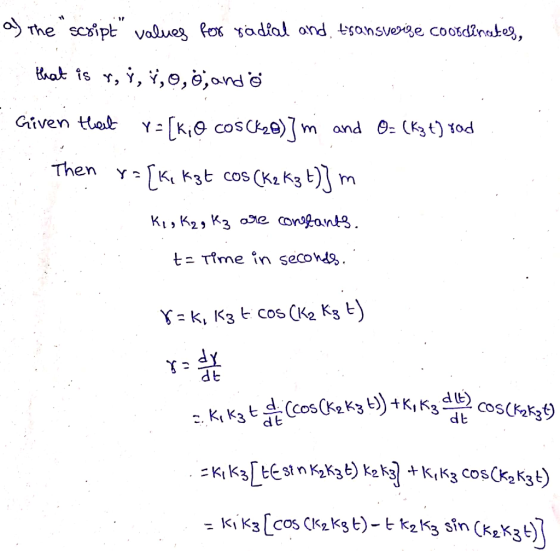
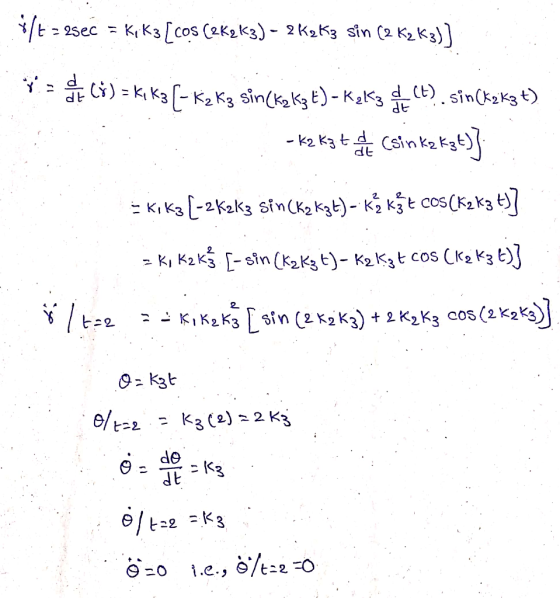
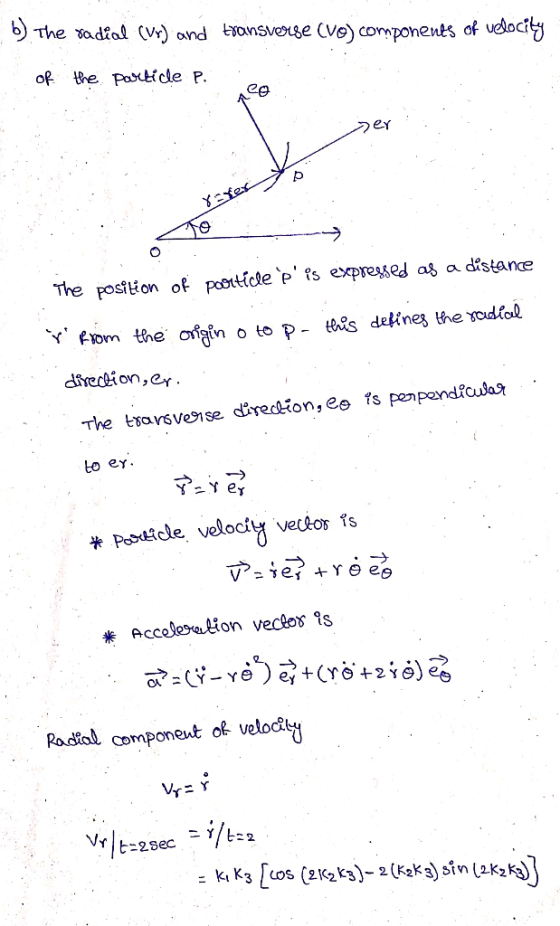
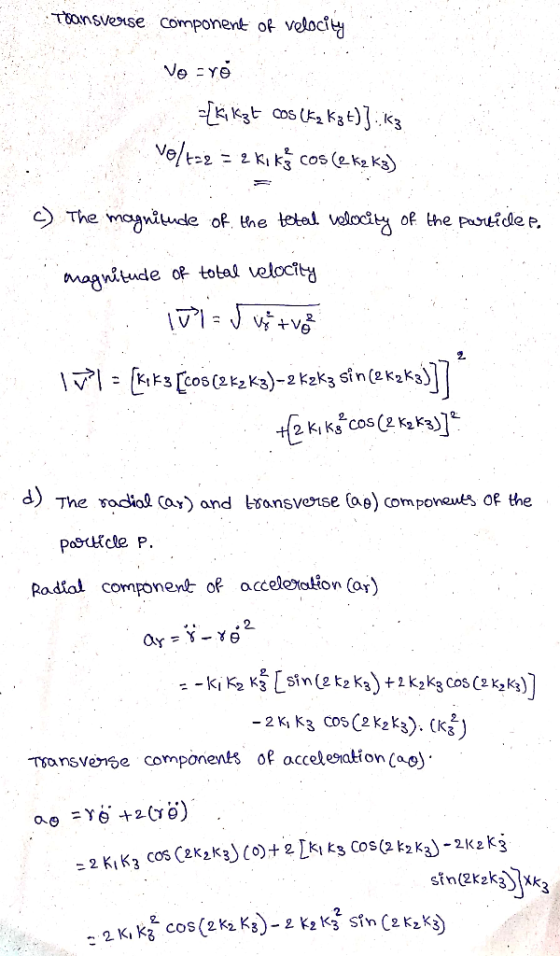
Problem #2 (35 Points) Given The motion of a particle P which coincides with the robot's gripper ...
Last Name: Page Problem #2 (35 Points) Given The motion of a particle P which coincides with the ...
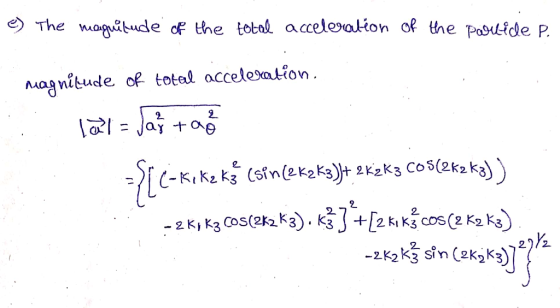
 Last Name: Page Problem #2 (35 Points) Given The motion of a particle P which coincides with the robot's gripper hand at point A is defined by the relations where t is expressed in seconds. Please note that kı, k2, and ks are constants which are greater than zero. For the initial condition, the particle has an angle of 0-0° when-0 sec. So, when t 2 sec, Find: a) The "script" values for radial and transverse coordinates, that is, r,t,i,...
Dynamics Given: The motion of a particle P is defined by the relations r = [kı...
 Dynamics
Given: The motion of a particle P is defined by the relations r = [kı sin(b) m and 0=(k21°) rad, where t is expressed in seconds. Please note that kı, k2, and b are constants which are greater than zero. For the initial condition, the particle has an angle of o=0° when t = 0 sec. So, when 1 = 1 sec, Find: a) The radial (vr) and transverse (ve) components of velocity of the particle P. b) The...
Dynamics
Given: The motion of a particle P is defined by the relations r = [kı sin(b) m and 0=(k21°) rad, where t is expressed in seconds. Please note that kı, k2, and b are constants which are greater than zero. For the initial condition, the particle has an angle of o=0° when t = 0 sec. So, when 1 = 1 sec, Find: a) The radial (vr) and transverse (ve) components of velocity of the particle P. b) The...
dynamic A particle is sliding in a slot on an arm that is rotating about a...
 dynamic
A particle is sliding in a slot on an arm that is rotating about a fixed point. The by r() (3+ cos 2t) inches where t is in seconds. The arm is rotating about the fixed point at a constant rate of 0.3 rad/sec counterclockwise starting at 0 from the horizontal position. (a) Use radial and transverse coordinates to express the velocity and acceleration of the particle when 030 (b) Express the velocity and acceleration of the particle in...
dynamic
A particle is sliding in a slot on an arm that is rotating about a fixed point. The by r() (3+ cos 2t) inches where t is in seconds. The arm is rotating about the fixed point at a constant rate of 0.3 rad/sec counterclockwise starting at 0 from the horizontal position. (a) Use radial and transverse coordinates to express the velocity and acceleration of the particle when 030 (b) Express the velocity and acceleration of the particle in...
2) A particle moves in the x-y plane. Known information about the particle’s motion is given...
2) A particle moves in the x-y plane. Known information about the particle’s motion is given below: ???? = 150?? ft/sec. and at time t = 0, x = 6 ft ?? =5??3+50?? ft a) Derive, as functions of time, the position (x), acceleration (ax), velocity (vy), and acceleration (ay). b) Using your functions, calculate, at time t = 0.25 seconds, the total magnitude of velocity ?? of the particle and the angle ????the velocity vector makes with the x-axis....
Problem H1.B Given: A particle P travels on a path described by the Cartesian coordinates of...
 Problem H1.B Given: A particle P travels on a path described by the Cartesian coordinates of y ca(b - ) where and y have the units of meters.The -component of velocity, i, for P is constamt. Find: For this problem (a) Make a sketch of the path of P over the range of 0 <b. (b) Determine the Cartesian components of the velocity and acceleration of P at 0. Add sketch of the velocity and acceleration vectors for P to...
2. The velocity components of a particle are given as vr = 2 + 2 mm/s...
 2. The velocity components of a particle are given as vr = 2 + 2 mm/s and vy-2sm@t) mm/s. The initial conditions of position are (t = 0) = r(t = 0) = 0, At t = 1 s: (a) Find the components of the position and acceleration vectors in the Cartesian coordinates (b) Determine the velocity and acceleration components in the Polar coordinates (c) Draw vector diagrams to demonstrate that the same velocity and acceleration vectors are obtained for...
2. A particle moves in the x-y plane. Its coordinates are given as functions of time...
 2. A particle moves in the x-y plane. Its coordinates are given as functions of time t(2 0) b x(t)-R(at-sina)t), )Sketch the trajectory of the particle. This is the trajectory of a point on the rim of a wheel y(t)-R(1-cosω t), where R and ω are constants. (a) (3 that is rolling at a constant speed on a horizontal surface. The curve traced out by such a point as it moves through space is called a cycloid. (b) (5 Find...
Problem #1 (35 Points) Given The velocity of a particle as it moves along a straight...
 Problem #1 (35 Points) Given The velocity of a particle as it moves along a straight line is given by v (-12+36t-6t2) ft/s, where t is in seconds. At the initial condition ( 0), so 2 ft. Find a) The acceleration of the particle as a function of time. b) The acceleration of the particle when -6 seconds. c) The position of the particle as a function of time. d) The position of the particle when -6 seconds. e) The...
2. General Motion with Unit Vectors and Components An object undergoes the following consecutive displacements: s...
 2.
General Motion with Unit Vectors and Components An object undergoes the following consecutive displacements: s (2i +3j +5k)m,s2 (6i-91+ 2krn, and s,-(10i + 8j-km a) Find the resultant displacement in terms of unit vectors and components. b) State the magnitude of the resultant displacement. 2. Suppose a hiker travels 5 km southwest from their camp. Then, the hiker travels 2 km 75° north of east. a) Find the displacement of the hiker form their camp. b) If the hiker...
2.
General Motion with Unit Vectors and Components An object undergoes the following consecutive displacements: s (2i +3j +5k)m,s2 (6i-91+ 2krn, and s,-(10i + 8j-km a) Find the resultant displacement in terms of unit vectors and components. b) State the magnitude of the resultant displacement. 2. Suppose a hiker travels 5 km southwest from their camp. Then, the hiker travels 2 km 75° north of east. a) Find the displacement of the hiker form their camp. b) If the hiker...
Student Name 1. A particle confined to motion along the x axis moves with constant acceleration...
 Student Name 1. A particle confined to motion along the x axis moves with constant acceleration fromx = 2.0 m to x 8.0 m during a 2.5-s time interval. The velocity of the particle at x - 8.0 m is 2.8 m/s. What is the acceleration during this time interval? 2. The polar coordinates of a point are r=5.50 m and Angle 240°. What are the Cartesian coordinates of this point? 3. On occasion, the notation A= [A, O] will...
 Last Name: Page Problem #2 (35 Points) Given The motion of a particle P which coincides with the robot's gripper hand at point A is defined by the relations where t is expressed in seconds. Please note that kı, k2, and ks are constants which are greater than zero. For the initial condition, the particle has an angle of 0-0° when-0 sec. So, when t 2 sec, Find: a) The "script" values for radial and transverse coordinates, that is, r,t,i,...
 Dynamics
Given: The motion of a particle P is defined by the relations r = [kı sin(b) m and 0=(k21°) rad, where t is expressed in seconds. Please note that kı, k2, and b are constants which are greater than zero. For the initial condition, the particle has an angle of o=0° when t = 0 sec. So, when 1 = 1 sec, Find: a) The radial (vr) and transverse (ve) components of velocity of the particle P. b) The...
Dynamics
Given: The motion of a particle P is defined by the relations r = [kı sin(b) m and 0=(k21°) rad, where t is expressed in seconds. Please note that kı, k2, and b are constants which are greater than zero. For the initial condition, the particle has an angle of o=0° when t = 0 sec. So, when 1 = 1 sec, Find: a) The radial (vr) and transverse (ve) components of velocity of the particle P. b) The...
 dynamic
A particle is sliding in a slot on an arm that is rotating about a fixed point. The by r() (3+ cos 2t) inches where t is in seconds. The arm is rotating about the fixed point at a constant rate of 0.3 rad/sec counterclockwise starting at 0 from the horizontal position. (a) Use radial and transverse coordinates to express the velocity and acceleration of the particle when 030 (b) Express the velocity and acceleration of the particle in...
dynamic
A particle is sliding in a slot on an arm that is rotating about a fixed point. The by r() (3+ cos 2t) inches where t is in seconds. The arm is rotating about the fixed point at a constant rate of 0.3 rad/sec counterclockwise starting at 0 from the horizontal position. (a) Use radial and transverse coordinates to express the velocity and acceleration of the particle when 030 (b) Express the velocity and acceleration of the particle in...
 Problem H1.B Given: A particle P travels on a path described by the Cartesian coordinates of y ca(b - ) where and y have the units of meters.The -component of velocity, i, for P is constamt. Find: For this problem (a) Make a sketch of the path of P over the range of 0 <b. (b) Determine the Cartesian components of the velocity and acceleration of P at 0. Add sketch of the velocity and acceleration vectors for P to...
 2. The velocity components of a particle are given as vr = 2 + 2 mm/s and vy-2sm@t) mm/s. The initial conditions of position are (t = 0) = r(t = 0) = 0, At t = 1 s: (a) Find the components of the position and acceleration vectors in the Cartesian coordinates (b) Determine the velocity and acceleration components in the Polar coordinates (c) Draw vector diagrams to demonstrate that the same velocity and acceleration vectors are obtained for...
 2. A particle moves in the x-y plane. Its coordinates are given as functions of time t(2 0) b x(t)-R(at-sina)t), )Sketch the trajectory of the particle. This is the trajectory of a point on the rim of a wheel y(t)-R(1-cosω t), where R and ω are constants. (a) (3 that is rolling at a constant speed on a horizontal surface. The curve traced out by such a point as it moves through space is called a cycloid. (b) (5 Find...
 Problem #1 (35 Points) Given The velocity of a particle as it moves along a straight line is given by v (-12+36t-6t2) ft/s, where t is in seconds. At the initial condition ( 0), so 2 ft. Find a) The acceleration of the particle as a function of time. b) The acceleration of the particle when -6 seconds. c) The position of the particle as a function of time. d) The position of the particle when -6 seconds. e) The...
 2.
General Motion with Unit Vectors and Components An object undergoes the following consecutive displacements: s (2i +3j +5k)m,s2 (6i-91+ 2krn, and s,-(10i + 8j-km a) Find the resultant displacement in terms of unit vectors and components. b) State the magnitude of the resultant displacement. 2. Suppose a hiker travels 5 km southwest from their camp. Then, the hiker travels 2 km 75° north of east. a) Find the displacement of the hiker form their camp. b) If the hiker...
2.
General Motion with Unit Vectors and Components An object undergoes the following consecutive displacements: s (2i +3j +5k)m,s2 (6i-91+ 2krn, and s,-(10i + 8j-km a) Find the resultant displacement in terms of unit vectors and components. b) State the magnitude of the resultant displacement. 2. Suppose a hiker travels 5 km southwest from their camp. Then, the hiker travels 2 km 75° north of east. a) Find the displacement of the hiker form their camp. b) If the hiker...
 Student Name 1. A particle confined to motion along the x axis moves with constant acceleration fromx = 2.0 m to x 8.0 m during a 2.5-s time interval. The velocity of the particle at x - 8.0 m is 2.8 m/s. What is the acceleration during this time interval? 2. The polar coordinates of a point are r=5.50 m and Angle 240°. What are the Cartesian coordinates of this point? 3. On occasion, the notation A= [A, O] will...
Most questions answered within 3 hours.
-
Where is the error in this code sequence?
String s1 = "Hello";
String s2 = "ello";...
asked 11 months ago -
Financial data for Joel de Paris, Inc., for last year
follow:
Joel de Paris, Inc.
Balance...
asked 11 months ago -
Consider this reaction:
Al2(SO4)3 (aq)+ BaCl3
(aq) Al2Cl6 (aq)- +
3BaSO4(s) . What is the...
asked 11 months ago -
Suppose that Savneet is considering increasing her
recent random sample from 20 car rentals to 40...
asked 11 months ago -
Trucks arrive at an unloading terminal at an average rate of 120
per hour.
Trucks arrive...
asked 11 months ago -
Why are methanol and ethanol completely soluble in water while
octanol is not very little soluble....
asked 11 months ago -
A facilities manager at a university reads in a research report
that the mean amount of...
asked 11 months ago -
When the CuSO4 is rehydrated by adding water to the anhydrous
compound, is this an endothermic...
asked 11 months ago -
A ray of sunlight is passing from diamond into crown glass; the
angle of incidence is...
asked 11 months ago -
A block of mass 0.249 kg is placed on top of a light, vertical
spring of...
asked 11 months ago -
how do the kidneys compensate in the presences of acidosis
a) trigger hyperventilate
b) reserve acid...
asked 11 months ago -
Question 501 pts
The rental rate of capital to the firm increases. Which of the
following...
asked 11 months ago