
Homework Answers


Add Answer to:
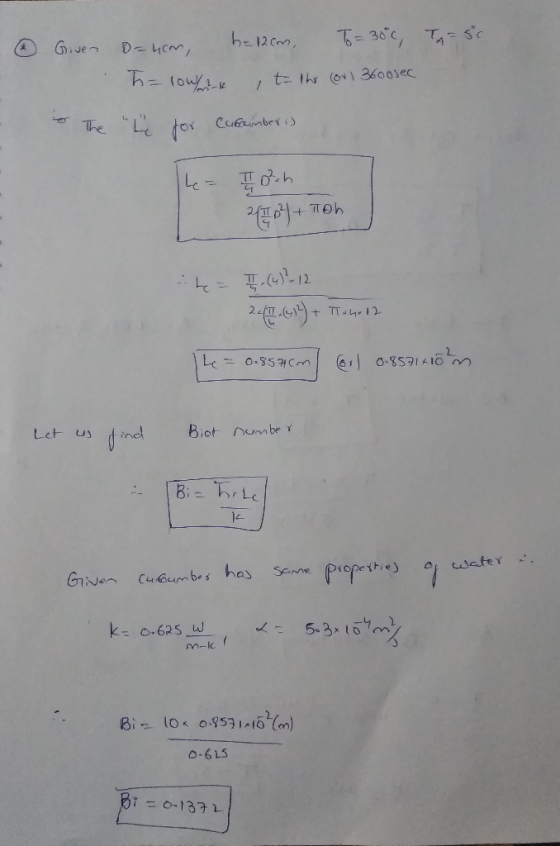
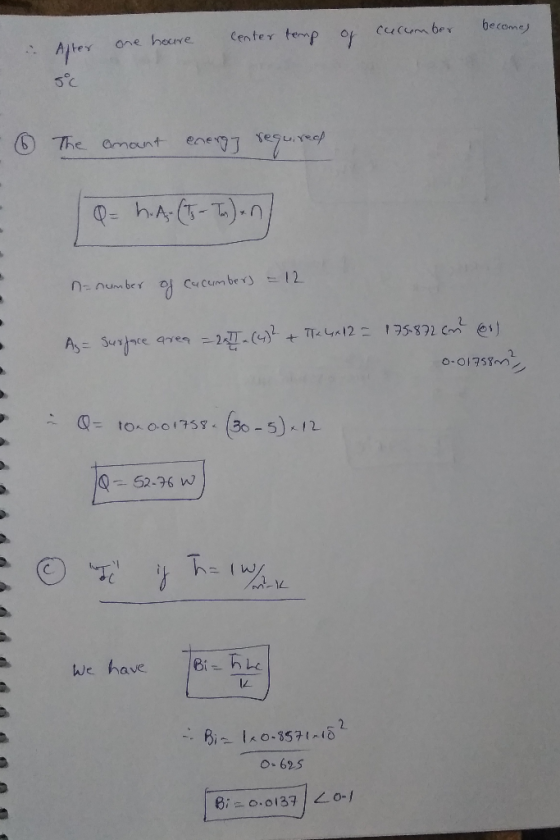
30 points / A taken from a 30 °C environment and laid out in a refrigerator at 5 °C. They have ap...
Problem 3 (30): Steam at Too,1 340 °C flows in a cast iron pipe [k- 80 W/m.°C] whose inner and outer diameter are Di 6 cm and D2 -8 cm, respectively. The pipe is covered with a 4-cm thick glass wool...
 Problem 3 (30): Steam at Too,1 340 °C flows in a cast iron pipe [k- 80 W/m.°C] whose inner and outer diameter are Di 6 cm and D2 -8 cm, respectively. The pipe is covered with a 4-cm thick glass wool insulation [k-0.05 W/ m°C]. Heat is lost to the surroundings at Too,2 - 21°C by natural convection and radiation, with a combined heat transfer coefficient of h- 18 W/m2 °C. Taking the heat transfer coefficient inside the pipe to...
5-111 Consider a refrigerator whose outer dimensions are 1.80 m x 0.8 m × 0.7 m....
 5-111 Consider a refrigerator whose outer dimensions are 1.80 m x 0.8 m × 0.7 m. The walls of the refrigerator are constructed of 3-cm-thick urethane insulation (k = 0.026 W m K and α = 0.36 × 10⁻⁶ m2/s) sandwiched between two layers of sheet metal with negligible thickness. The refrigerated space is maintained at 3°C and the average heat transfer coefficients at the inner and outer surfaces of the wall are 6 W/m2 K and 9 W/m2.K, respectively....
A bare copper cable 2.5 cm in diameter is situated in still air at 15°C. A...
 A bare copper cable 2.5 cm in diameter is situated in still air at 15°C. A current of 800 Amps is passed along the cable. Heat is transferred from the cable to its surroundings by natural convection for which the heat transfer coefficient may be expressed as 2.95025 W/m2 K. Determine whether or not it may be assumed that the temperature across the copper cross section is uniform and what the equilibrium temperature of the cable surface will be. If...
2 ICED WATER IN A SPHERICAL CONTAINER (10 POINTS) Troom = 30°C Iced water O ,...
 2 ICED WATER IN A SPHERICAL CONTAINER (10 POINTS) Troom = 30°C Iced water O , D; = 5 m 1.5 cm T = 0°C A 5-m-internal-diameter spherical tank made of 1.5-cm-thick stainless steel (k = 15 W/( m K )) is used to store iced water at 0°C. The tank is located in a room whose temperature is 30°C. The walls of the room are also at 30°C. Heat transfer between the outer surface of the tank and the...
Problem 1. (30 points) A double-pipe heat exchanger is used to condense steam at 7370 N/m2....
 Problem 1. (30 points) A double-pipe heat exchanger is used to condense steam at 7370 N/m2. Water at an average bulk temperature of 10°C flows at 2.50 m/s through the inner pipe. which is made of copper and has a 2.54-cm ID and a 3.05-cm OD. Steam at its saturation temperature flows in the annulus formed between the outer surface of the inner pipe and an outer pipe of 5.08-cm-ID. The average heat transfer coefficient of the condensing steam is...
Consider a 34 cm thick concrete wall with a thermal conductivity of 0.82 W/m·K. The temperature...
Consider a 34 cm thick concrete wall with a thermal conductivity of 0.82 W/m·K. The temperature of the left surface is held constant at 42°C, whereas the right face is exposed to a flow of 12°C air with a convection heat transfer coefficient of 23 W/m2·K. Neglecting heat transfer by radiation, find the right wall surface temperature and the heat flux through the wall.
265 A person is found dead at 5 p.m. in a room where temperature is 20°C....
 265 A person is found dead at 5 p.m. in a room where temperature is 20°C. The (1 temperature of the body is measured to be 25°C when found, and the heat transfer coefficient is estimated to be 8 W/m2.K. Modelling the human body a 30 cm diameter, 1.70 m long cylinder.calculate actual time in hours) of death of the person. Take thermophysical properties of the body :k = 6.08 * W/m.K, p = 900 kg/m3,C = 4000 J/kg.K إجابت...
2. A separation column at a temperature of 100C is subjected for cooling for a certain...
 2. A separation column at a temperature of 100C is subjected
for cooling for a certain period of time. If the separation column
is 1500 mm high and 18 cm in diameter, and eventually exposed to an
environment temperature of 35C, determine the following with a
neat diagram:
a) Heat Transfer Coefficient (in J/s m2C and kJ/s m2C)
b) Heat transfer Rate (in W and kW)
Assume the properties of air at mean temperature as density
(ρ) = 1.06 kg/m3,...
2. A separation column at a temperature of 100C is subjected
for cooling for a certain period of time. If the separation column
is 1500 mm high and 18 cm in diameter, and eventually exposed to an
environment temperature of 35C, determine the following with a
neat diagram:
a) Heat Transfer Coefficient (in J/s m2C and kJ/s m2C)
b) Heat transfer Rate (in W and kW)
Assume the properties of air at mean temperature as density
(ρ) = 1.06 kg/m3,...
11) Consider a large 5-cm-thick brass plate (k111 W/m-K) in whic uniformly at a rate of 200,000W Im3. One side of th...
 11) Consider a large 5-cm-thick brass plate (k111 W/m-K) in whic uniformly at a rate of 200,000W Im3. One side of the plate is insulated while the other exposed to an environment at 25 C with a heat transfer coefficient of What is the relationship between the maximum plate temperature as W/m2.K. function of the heat transfer coefficient." 1 point
11) Consider a large 5-cm-thick brass plate (k111 W/m-K) in whic uniformly at a rate of 200,000W Im3. One side...
11) Consider a large 5-cm-thick brass plate (k111 W/m-K) in whic uniformly at a rate of 200,000W Im3. One side of the plate is insulated while the other exposed to an environment at 25 C with a heat transfer coefficient of What is the relationship between the maximum plate temperature as W/m2.K. function of the heat transfer coefficient." 1 point
11) Consider a large 5-cm-thick brass plate (k111 W/m-K) in whic uniformly at a rate of 200,000W Im3. One side...
The heat question and would like to have work solution. The answers are (c) 136.6 (d)...
 The heat question and would like to have work solution. The
answers are (c) 136.6 (d) < 2%. thank you.
An long cylindrical vaccuum chamber shown in Figure 1, is used to anneal single titanium rods by maintaining their temperature at 800 °C for an extended period of time. Heat is introduced into the rods internally by induction. The insulation surrounding the chamber has a thicknesss of 50 mm and thermal conductivity of 0.1 W/m.K. The convective heat transfer coefficient...
The heat question and would like to have work solution. The
answers are (c) 136.6 (d) < 2%. thank you.
An long cylindrical vaccuum chamber shown in Figure 1, is used to anneal single titanium rods by maintaining their temperature at 800 °C for an extended period of time. Heat is introduced into the rods internally by induction. The insulation surrounding the chamber has a thicknesss of 50 mm and thermal conductivity of 0.1 W/m.K. The convective heat transfer coefficient...
 Problem 3 (30): Steam at Too,1 340 °C flows in a cast iron pipe [k- 80 W/m.°C] whose inner and outer diameter are Di 6 cm and D2 -8 cm, respectively. The pipe is covered with a 4-cm thick glass wool insulation [k-0.05 W/ m°C]. Heat is lost to the surroundings at Too,2 - 21°C by natural convection and radiation, with a combined heat transfer coefficient of h- 18 W/m2 °C. Taking the heat transfer coefficient inside the pipe to...
 5-111 Consider a refrigerator whose outer dimensions are 1.80 m x 0.8 m × 0.7 m. The walls of the refrigerator are constructed of 3-cm-thick urethane insulation (k = 0.026 W m K and α = 0.36 × 10⁻⁶ m2/s) sandwiched between two layers of sheet metal with negligible thickness. The refrigerated space is maintained at 3°C and the average heat transfer coefficients at the inner and outer surfaces of the wall are 6 W/m2 K and 9 W/m2.K, respectively....
 A bare copper cable 2.5 cm in diameter is situated in still air at 15°C. A current of 800 Amps is passed along the cable. Heat is transferred from the cable to its surroundings by natural convection for which the heat transfer coefficient may be expressed as 2.95025 W/m2 K. Determine whether or not it may be assumed that the temperature across the copper cross section is uniform and what the equilibrium temperature of the cable surface will be. If...
 2 ICED WATER IN A SPHERICAL CONTAINER (10 POINTS) Troom = 30°C Iced water O , D; = 5 m 1.5 cm T = 0°C A 5-m-internal-diameter spherical tank made of 1.5-cm-thick stainless steel (k = 15 W/( m K )) is used to store iced water at 0°C. The tank is located in a room whose temperature is 30°C. The walls of the room are also at 30°C. Heat transfer between the outer surface of the tank and the...
 Problem 1. (30 points) A double-pipe heat exchanger is used to condense steam at 7370 N/m2. Water at an average bulk temperature of 10°C flows at 2.50 m/s through the inner pipe. which is made of copper and has a 2.54-cm ID and a 3.05-cm OD. Steam at its saturation temperature flows in the annulus formed between the outer surface of the inner pipe and an outer pipe of 5.08-cm-ID. The average heat transfer coefficient of the condensing steam is...
 265 A person is found dead at 5 p.m. in a room where temperature is 20°C. The (1 temperature of the body is measured to be 25°C when found, and the heat transfer coefficient is estimated to be 8 W/m2.K. Modelling the human body a 30 cm diameter, 1.70 m long cylinder.calculate actual time in hours) of death of the person. Take thermophysical properties of the body :k = 6.08 * W/m.K, p = 900 kg/m3,C = 4000 J/kg.K إجابت...
 2. A separation column at a temperature of 100C is subjected
for cooling for a certain period of time. If the separation column
is 1500 mm high and 18 cm in diameter, and eventually exposed to an
environment temperature of 35C, determine the following with a
neat diagram:
a) Heat Transfer Coefficient (in J/s m2C and kJ/s m2C)
b) Heat transfer Rate (in W and kW)
Assume the properties of air at mean temperature as density
(ρ) = 1.06 kg/m3,...
2. A separation column at a temperature of 100C is subjected
for cooling for a certain period of time. If the separation column
is 1500 mm high and 18 cm in diameter, and eventually exposed to an
environment temperature of 35C, determine the following with a
neat diagram:
a) Heat Transfer Coefficient (in J/s m2C and kJ/s m2C)
b) Heat transfer Rate (in W and kW)
Assume the properties of air at mean temperature as density
(ρ) = 1.06 kg/m3,...
 11) Consider a large 5-cm-thick brass plate (k111 W/m-K) in whic uniformly at a rate of 200,000W Im3. One side of the plate is insulated while the other exposed to an environment at 25 C with a heat transfer coefficient of What is the relationship between the maximum plate temperature as W/m2.K. function of the heat transfer coefficient." 1 point
11) Consider a large 5-cm-thick brass plate (k111 W/m-K) in whic uniformly at a rate of 200,000W Im3. One side...
11) Consider a large 5-cm-thick brass plate (k111 W/m-K) in whic uniformly at a rate of 200,000W Im3. One side of the plate is insulated while the other exposed to an environment at 25 C with a heat transfer coefficient of What is the relationship between the maximum plate temperature as W/m2.K. function of the heat transfer coefficient." 1 point
11) Consider a large 5-cm-thick brass plate (k111 W/m-K) in whic uniformly at a rate of 200,000W Im3. One side...
 The heat question and would like to have work solution. The
answers are (c) 136.6 (d) < 2%. thank you.
An long cylindrical vaccuum chamber shown in Figure 1, is used to anneal single titanium rods by maintaining their temperature at 800 °C for an extended period of time. Heat is introduced into the rods internally by induction. The insulation surrounding the chamber has a thicknesss of 50 mm and thermal conductivity of 0.1 W/m.K. The convective heat transfer coefficient...
The heat question and would like to have work solution. The
answers are (c) 136.6 (d) < 2%. thank you.
An long cylindrical vaccuum chamber shown in Figure 1, is used to anneal single titanium rods by maintaining their temperature at 800 °C for an extended period of time. Heat is introduced into the rods internally by induction. The insulation surrounding the chamber has a thicknesss of 50 mm and thermal conductivity of 0.1 W/m.K. The convective heat transfer coefficient...
Most questions answered within 3 hours.
-
Where is the error in this code sequence?
String s1 = "Hello";
String s2 = "ello";...
asked 11 months ago -
Financial data for Joel de Paris, Inc., for last year
follow:
Joel de Paris, Inc.
Balance...
asked 11 months ago -
Consider this reaction:
Al2(SO4)3 (aq)+ BaCl3
(aq) Al2Cl6 (aq)- +
3BaSO4(s) . What is the...
asked 11 months ago -
Suppose that Savneet is considering increasing her
recent random sample from 20 car rentals to 40...
asked 11 months ago -
Trucks arrive at an unloading terminal at an average rate of 120
per hour.
Trucks arrive...
asked 11 months ago -
Why are methanol and ethanol completely soluble in water while
octanol is not very little soluble....
asked 11 months ago -
A facilities manager at a university reads in a research report
that the mean amount of...
asked 11 months ago -
When the CuSO4 is rehydrated by adding water to the anhydrous
compound, is this an endothermic...
asked 11 months ago -
A ray of sunlight is passing from diamond into crown glass; the
angle of incidence is...
asked 11 months ago -
A block of mass 0.249 kg is placed on top of a light, vertical
spring of...
asked 11 months ago -
how do the kidneys compensate in the presences of acidosis
a) trigger hyperventilate
b) reserve acid...
asked 11 months ago -
Question 501 pts
The rental rate of capital to the firm increases. Which of the
following...
asked 11 months ago