Navier-Stokes Equation:
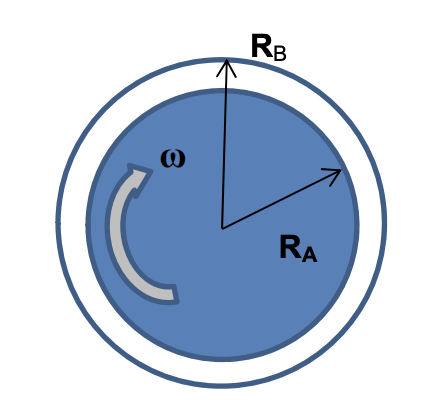
An incompressible Newtonian liquid is confined between two concentric cylinders of infinite length—a solid inner cylinder of radius RA and a hollow outer cylinder of radius RB. The inner cylinder rotates at angular velocity ω and the outer cylinder is stationary. The flow is steady, laminar, and two-dimensional in the r-θ plane. The flow is rotationally symmetric, meaning that nothing is a function of the coordinate θ. The flow is also circular so that ur=0 everywhere.
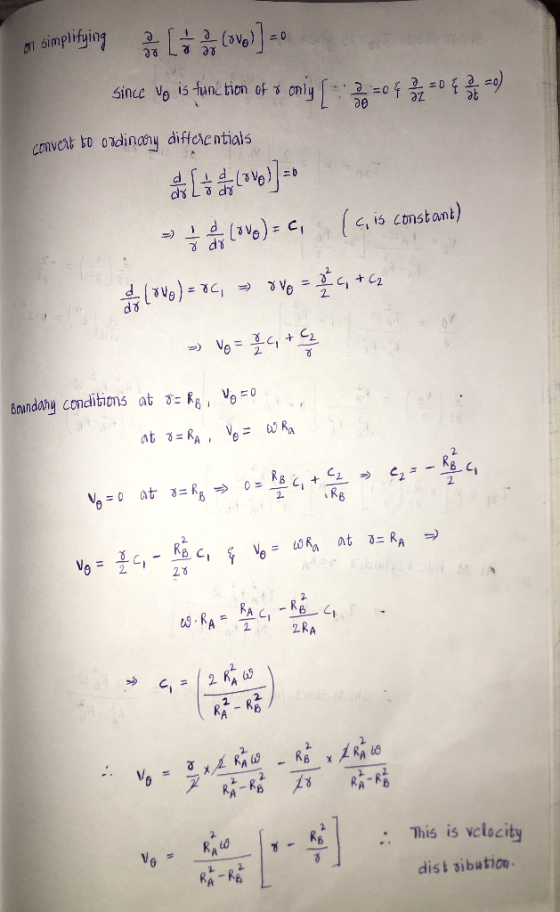
Found Uθ= Ra^2w/(Ra^2-Rb^2)*(r-[Rb^2/r])
a. Derive an expression for the wall shear stress on the inner rotating cylinder.
Homework Answers


Add Answer to:
Navier-Stokes Equation: An incompressible Newtonian liquid is confined between two concentric cy...
An incompressible Newtonian fluid is contained between two long concentric cylinders of radii AR (< 1) and R, as sho...
 An incompressible Newtonian fluid is contained between two long concentric cylinders of radii AR (< 1) and R, as shown in the figure. The inner cylinder rotates with an angular velocity Ω (a) Compute the velocity distribution between the cylinders. End effects caused by (b) Compute the torque required to hold the outer cylinder stationary. (8 Pts)
An incompressible Newtonian fluid is contained between two long concentric cylinders of radii AR (
An incompressible Newtonian fluid is contained between two long concentric cylinders of radii AR (< 1) and R, as shown in the figure. The inner cylinder rotates with an angular velocity Ω (a) Compute the velocity distribution between the cylinders. End effects caused by (b) Compute the torque required to hold the outer cylinder stationary. (8 Pts)
An incompressible Newtonian fluid is contained between two long concentric cylinders of radii AR (
Consider two concentric, infinitely long cylinders. The cylinders are oriented such that the center-line is along the z-axis, and the radii exist in the r-direction. The inner cylinder has a radius o...
 Consider two concentric, infinitely long cylinders. The cylinders are oriented such that the center-line is along the z-axis, and the radii exist in the r-direction. The inner cylinder has a radius of ra and the outer cylinder has a radius rb. The inner cylinder moves in the positive z-direction with a velocity W while the outer cylinder is held stationary. The fluid contained between the cylinders is assumed to be Netwonian, incompressible, isotropic and isothermal. The flow of the fluid...
Consider two concentric, infinitely long cylinders. The cylinders are oriented such that the center-line is along the z-axis, and the radii exist in the r-direction. The inner cylinder has a radius o...
 Consider two concentric, infinitely long cylinders. The cylinders are oriented such that the center-line is along the z-axis, and the radii exist in the r-direction. The inner cylinder has a radius of ra and the outer cylinder has a radius Tb. The inner cylinder rotates with an angular velocity of w whereas the outer cylinder is stationary. There is no pressure gradient applied nor gravity. The fluid contained between the cylinders is assumed to be Netwonian, incompressible, isotropic and isothermal....
Consider two concentric, infinitely long cylinders. The cylinders are oriented such that the center-lines are along...
Consider two concentric, infinitely long cylinders. The cylinders are oriented such that the center-lines are along the z-axis, and the radii exist in the r-direction. The inner cylinder has a radius of r, and the outer cylinder has a radius rb. The inner and outer cylinders are stationary. Gravity exists in the negative z- direction, whereas a constant pressure gradient exists in the positive z-direction. The fluid contained between the cylinders is assumed to be Netwonian, incompressible, isotropic and isothermal....
Q2: A liquid with viscosity μ is confined between two concentric circular surfaces of length L....
 Q2: A liquid with viscosity μ is confined between two concentric circular surfaces of length L. The radii of the inner and outer surfaces are R, and respectively. The outer hollow cylinder is stationary and the inner solid cylinder is moving in the axial direction at velocity U . The axial velocity of the liquid is given as u(r)- Ro, R (In r- In Ro), where r is the radial position. In(R, / R) ener cylinder, moving u (a) Find...
4. Consider the situation of radial flow between two concentric cylinders. The outer cylinder has a...
 4. Consider the situation of radial flow between two concentric cylinders. The outer cylinder has a radius of R and the inner cylinder has a radius KR. Assume flow is only in the radial direction and assume v, = v(r). Use the continuity equation and the relevant momentum balance equations to derive an expression for the pressure difference Pi-Po between the outer and inner cylinders as a function of the volumetric flow rate with L being the length of the...
Fluid is Non-Newtonian. (3) Consider the steady laminar flow between the coaxial cylinders shown below. The...
 Fluid is Non-Newtonian.
(3) Consider the steady laminar flow between the coaxial cylinders shown below. The inner cylinder rotates with angular velocity 2 and the outer cylinder is stationary. The no-slip condition applies at the inner and outer cylinder surfaces and we are considering the cylinders to be very long in the 2-direction hence we may ignore edge effects near the top and bottom surfaces. - R2 Assume that gravity is negligible, v, is zero and that are zero for...
Fluid is Non-Newtonian.
(3) Consider the steady laminar flow between the coaxial cylinders shown below. The inner cylinder rotates with angular velocity 2 and the outer cylinder is stationary. The no-slip condition applies at the inner and outer cylinder surfaces and we are considering the cylinders to be very long in the 2-direction hence we may ignore edge effects near the top and bottom surfaces. - R2 Assume that gravity is negligible, v, is zero and that are zero for...
Tangential laminar flow of a Newtonian fluid with constant density and occurring between two vertical coaxial...
 Tangential laminar flow of a Newtonian fluid with constant density and occurring between two vertical coaxial cylinders in which the outer rotating with an angular velocity of ω and the inner cylinder is fixed a. Write the simplified continuity equation and the simplified momentum balance equations using necessary assumptions and determine the velocity. b. Determine the shear stress distributions for this flow. c. Calculate the necessary torque. outside cylinder rotates 2 inside cylinder Figure: Top view of the coaxial cylinders
Consider two concentric insulating cylinders of infinite length. The inner cylinder is solid with radius R,...
Consider two concentric insulating cylinders of infinite length. The inner cylinder is solid with radius R, while the outer cylinder is a hollow shell with inner radius a and outer radius b. Both cylinders have the same volume charge density of +ρ. Using Gauss’s Law, find the electric field as a function of r (where r = 0 at the central axis) in the interval a ≤ r < b. Note: Your final equation should be in terms of given...
Page 5 Nane: Johnson, Perri NN: 35 1000 omawork 10 10.5 Aoni cous fuid is contained...
 Page 5 Nane: Johnson, Perri NN: 35 1000 omawork 10 10.5 Aoni cous fuid is contained betwen two infinitely vertical, concentric cylinders. The outer cylinder has a radius fixedd rotates with an angular velocity o. The inner cylinder is and has a radius r. The Navier-Stokes equations can be used As utain an exact solution for the velocity distribution in the gap. that the flow in the gap is axisymmetric (neither velocity Fluid nor pressure are functions of angular position...
 An incompressible Newtonian fluid is contained between two long concentric cylinders of radii AR (< 1) and R, as shown in the figure. The inner cylinder rotates with an angular velocity Ω (a) Compute the velocity distribution between the cylinders. End effects caused by (b) Compute the torque required to hold the outer cylinder stationary. (8 Pts)
An incompressible Newtonian fluid is contained between two long concentric cylinders of radii AR (
An incompressible Newtonian fluid is contained between two long concentric cylinders of radii AR (< 1) and R, as shown in the figure. The inner cylinder rotates with an angular velocity Ω (a) Compute the velocity distribution between the cylinders. End effects caused by (b) Compute the torque required to hold the outer cylinder stationary. (8 Pts)
An incompressible Newtonian fluid is contained between two long concentric cylinders of radii AR (
 Consider two concentric, infinitely long cylinders. The cylinders are oriented such that the center-line is along the z-axis, and the radii exist in the r-direction. The inner cylinder has a radius of ra and the outer cylinder has a radius rb. The inner cylinder moves in the positive z-direction with a velocity W while the outer cylinder is held stationary. The fluid contained between the cylinders is assumed to be Netwonian, incompressible, isotropic and isothermal. The flow of the fluid...
 Consider two concentric, infinitely long cylinders. The cylinders are oriented such that the center-line is along the z-axis, and the radii exist in the r-direction. The inner cylinder has a radius of ra and the outer cylinder has a radius Tb. The inner cylinder rotates with an angular velocity of w whereas the outer cylinder is stationary. There is no pressure gradient applied nor gravity. The fluid contained between the cylinders is assumed to be Netwonian, incompressible, isotropic and isothermal....
 Q2: A liquid with viscosity μ is confined between two concentric circular surfaces of length L. The radii of the inner and outer surfaces are R, and respectively. The outer hollow cylinder is stationary and the inner solid cylinder is moving in the axial direction at velocity U . The axial velocity of the liquid is given as u(r)- Ro, R (In r- In Ro), where r is the radial position. In(R, / R) ener cylinder, moving u (a) Find...
 4. Consider the situation of radial flow between two concentric cylinders. The outer cylinder has a radius of R and the inner cylinder has a radius KR. Assume flow is only in the radial direction and assume v, = v(r). Use the continuity equation and the relevant momentum balance equations to derive an expression for the pressure difference Pi-Po between the outer and inner cylinders as a function of the volumetric flow rate with L being the length of the...
 Fluid is Non-Newtonian.
(3) Consider the steady laminar flow between the coaxial cylinders shown below. The inner cylinder rotates with angular velocity 2 and the outer cylinder is stationary. The no-slip condition applies at the inner and outer cylinder surfaces and we are considering the cylinders to be very long in the 2-direction hence we may ignore edge effects near the top and bottom surfaces. - R2 Assume that gravity is negligible, v, is zero and that are zero for...
Fluid is Non-Newtonian.
(3) Consider the steady laminar flow between the coaxial cylinders shown below. The inner cylinder rotates with angular velocity 2 and the outer cylinder is stationary. The no-slip condition applies at the inner and outer cylinder surfaces and we are considering the cylinders to be very long in the 2-direction hence we may ignore edge effects near the top and bottom surfaces. - R2 Assume that gravity is negligible, v, is zero and that are zero for...
 Tangential laminar flow of a Newtonian fluid with constant density and occurring between two vertical coaxial cylinders in which the outer rotating with an angular velocity of ω and the inner cylinder is fixed a. Write the simplified continuity equation and the simplified momentum balance equations using necessary assumptions and determine the velocity. b. Determine the shear stress distributions for this flow. c. Calculate the necessary torque. outside cylinder rotates 2 inside cylinder Figure: Top view of the coaxial cylinders
 Page 5 Nane: Johnson, Perri NN: 35 1000 omawork 10 10.5 Aoni cous fuid is contained betwen two infinitely vertical, concentric cylinders. The outer cylinder has a radius fixedd rotates with an angular velocity o. The inner cylinder is and has a radius r. The Navier-Stokes equations can be used As utain an exact solution for the velocity distribution in the gap. that the flow in the gap is axisymmetric (neither velocity Fluid nor pressure are functions of angular position...
Most questions answered within 3 hours.
-
Where is the error in this code sequence?
String s1 = "Hello";
String s2 = "ello";...
asked 11 months ago -
Financial data for Joel de Paris, Inc., for last year
follow:
Joel de Paris, Inc.
Balance...
asked 11 months ago -
Consider this reaction:
Al2(SO4)3 (aq)+ BaCl3
(aq) Al2Cl6 (aq)- +
3BaSO4(s) . What is the...
asked 11 months ago -
Suppose that Savneet is considering increasing her
recent random sample from 20 car rentals to 40...
asked 11 months ago -
Trucks arrive at an unloading terminal at an average rate of 120
per hour.
Trucks arrive...
asked 11 months ago -
Why are methanol and ethanol completely soluble in water while
octanol is not very little soluble....
asked 11 months ago -
A facilities manager at a university reads in a research report
that the mean amount of...
asked 11 months ago -
When the CuSO4 is rehydrated by adding water to the anhydrous
compound, is this an endothermic...
asked 11 months ago -
A ray of sunlight is passing from diamond into crown glass; the
angle of incidence is...
asked 11 months ago -
A block of mass 0.249 kg is placed on top of a light, vertical
spring of...
asked 11 months ago -
how do the kidneys compensate in the presences of acidosis
a) trigger hyperventilate
b) reserve acid...
asked 11 months ago -
Question 501 pts
The rental rate of capital to the firm increases. Which of the
following...
asked 11 months ago