Please, answer all the parts of the question. The subject is Networking.
Homework Answers

Add Answer to:
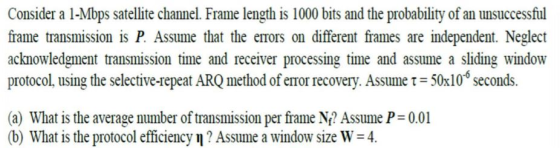
Consider a 1-Mbps satellite channel. Frame length is 1000 bits and the probability of an unsucces...
(a) Assume a Sliding Window with Go-Back N ARQ is being used on a transmission link...
(a) Assume a Sliding Window with Go-Back N ARQ is being used on a transmission link with a 3-bit sequence number. The transmitter has previously sent frames with sequence numbers 0, 1 and 2. Is the transmitter allowed to send a frame with sequence number 3 if the frame with sequence number 2 has not been acknowledged? Explain your answer. (b) Assume a Sliding Window with Go-Back N ARQ is being used on a transmission link with a 3-bit sequence...
Please answer this 2 part question! Please show all work (15 points) The bit stream 1110...
 Please answer this 2 part question! Please show all
work
(15 points) The bit stream 1110 0111 1010 is transmitted using the standard CRC algorithm described in the book. The generator polynomial is r + x + x + 1. Show the actual bit string transmitted. Suppose that the THIRTEENTH (13th) bit from the left in the transmitted message is inverted during transmission. Show that this error is detected on the receiver's end. Show every step in your calculations for...
Please answer this 2 part question! Please show all
work
(15 points) The bit stream 1110 0111 1010 is transmitted using the standard CRC algorithm described in the book. The generator polynomial is r + x + x + 1. Show the actual bit string transmitted. Suppose that the THIRTEENTH (13th) bit from the left in the transmitted message is inverted during transmission. Show that this error is detected on the receiver's end. Show every step in your calculations for...
Find the optimum with random bit errors by taking the derivative and setting it to zero...
 Find the optimum with random bit errors by taking the derivative and setting it to zero for the following protocols: (a) Stop-and-Wait ARQ (b) Go-Back-N ARQ (c) Selective Repeat ARQ (d) Find the optimum frame length for a 1 Mbps channel with 10 ms reaction time, 25-byte frame length ny that maximizes transmission efficiency for a channel overhead, 25-byte ACK frame, and p 104, 10-5, and 10-6.
Sliding window protocol with window size of 7 frames are used between the data link layers of mac...
 please answer the question clearly.
Sliding window protocol with window size of 7 frames are used between the data link layers of machines A and B. Assume that machine B sends an ACK (acknowledgement) for every frame it receives without error, and it sends a NAK (negative acknowledgement) for every frame it receives with error. This corresponds to a receiver window size of 1 frame. Assume also that no frames are lost in the transmission medium. For the scenario shown...
please answer the question clearly.
Sliding window protocol with window size of 7 frames are used between the data link layers of machines A and B. Assume that machine B sends an ACK (acknowledgement) for every frame it receives without error, and it sends a NAK (negative acknowledgement) for every frame it receives with error. This corresponds to a receiver window size of 1 frame. Assume also that no frames are lost in the transmission medium. For the scenario shown...
(a) A data link with a 1 Gigabits/sec capacity is used to transmit packets made up of 1400 bytes of data and 100 bytes of protocol control information. Each packet is acknowledged by a short frame of...
 (a) A data link with a 1 Gigabits/sec capacity is used to transmit packets made up of 1400 bytes of data and 100 bytes of protocol control information. Each packet is acknowledged by a short frame of size 150 bytes. The propagation speed in the transmission medium is 200,000 km/sec. Consider the buffering and processing time in the nodes to be negligible. A node A communicates with a node B, with a distance between nodes A and B of 16...
25. Suppose you are designing a sliding window protocol for a 1-Mbps point-to-point link to the...
 25. Suppose you are designing a sliding window protocol for a 1-Mbps point-to-point link to the stationary satellite evolving around the Earth at an altitude of 3 x 10⁴ km. Assuming that each frame carries 1 KB of data, what is the minimum number of bits you need for the sequence number in the following cases? Assume the speed of light is 3 x 10⁸ m/s. (a) RWS-1 (b) RWS-SWS
Consider a binary communication channel transmitting coded words of n bits each. Assume that the probability...
Consider a binary communication channel transmitting coded words of n bits each. Assume that the probability of successful transmission of a single bit is p (and the probability of an error is q=1-p), and that the code is capable of correcting up to e (where e>= 0) errors. If we assume that the transmission of successive bits is independent, then what is the probability of successful word transmission? Hint: the word is successfully transmitted if there are e or fewer...
In the last module you learned a formula for calculating bit rate, R = b/t, that...
 In the last module you learned a formula for calculating bit rate, R = b/t, that is the number of bits divided by the time. This formula expresses the number of bits that are transmitted over a circuit in a given period of time. In practice, however, we are not only concerned with the number bits transmitted, but also with the number of data bits transmitted over a circuit. The data bits are those that the sender decides to send...
QUESTION 1 "A single router is transmitting packets, each of length L bits, over a single...
QUESTION 1 "A single router is transmitting packets, each of length L bits, over a single link with transmission rate R Mbps to another router at the other end of the link. Suppose that the packet length is L= 12000 bits, and that the link transmission rate along the link to router on the right is R = 1000 Mbps. What is the maximum number of packets per second that can be transmitted by the link (use a whole number)?"...
help with computer network questions 1. What is the difference between circuit switching and packet switching?...
help with computer network questions 1. What is the difference between circuit switching and packet switching? 2. What are the different layers in today’s Internet? Why do we create layers? 3. Suppose there is a 10 Mbps microwave link between a geostationary satellite and its base station on Earth. Every minute the satellite takes a digital photo and sends it to the base station. Assume a propagation speed of 2.4 * 10^8 meters/sec. a. What is the propagation delay of...
 Please answer this 2 part question! Please show all
work
(15 points) The bit stream 1110 0111 1010 is transmitted using the standard CRC algorithm described in the book. The generator polynomial is r + x + x + 1. Show the actual bit string transmitted. Suppose that the THIRTEENTH (13th) bit from the left in the transmitted message is inverted during transmission. Show that this error is detected on the receiver's end. Show every step in your calculations for...
Please answer this 2 part question! Please show all
work
(15 points) The bit stream 1110 0111 1010 is transmitted using the standard CRC algorithm described in the book. The generator polynomial is r + x + x + 1. Show the actual bit string transmitted. Suppose that the THIRTEENTH (13th) bit from the left in the transmitted message is inverted during transmission. Show that this error is detected on the receiver's end. Show every step in your calculations for...
 Find the optimum with random bit errors by taking the derivative and setting it to zero for the following protocols: (a) Stop-and-Wait ARQ (b) Go-Back-N ARQ (c) Selective Repeat ARQ (d) Find the optimum frame length for a 1 Mbps channel with 10 ms reaction time, 25-byte frame length ny that maximizes transmission efficiency for a channel overhead, 25-byte ACK frame, and p 104, 10-5, and 10-6.
 please answer the question clearly.
Sliding window protocol with window size of 7 frames are used between the data link layers of machines A and B. Assume that machine B sends an ACK (acknowledgement) for every frame it receives without error, and it sends a NAK (negative acknowledgement) for every frame it receives with error. This corresponds to a receiver window size of 1 frame. Assume also that no frames are lost in the transmission medium. For the scenario shown...
please answer the question clearly.
Sliding window protocol with window size of 7 frames are used between the data link layers of machines A and B. Assume that machine B sends an ACK (acknowledgement) for every frame it receives without error, and it sends a NAK (negative acknowledgement) for every frame it receives with error. This corresponds to a receiver window size of 1 frame. Assume also that no frames are lost in the transmission medium. For the scenario shown...
 (a) A data link with a 1 Gigabits/sec capacity is used to transmit packets made up of 1400 bytes of data and 100 bytes of protocol control information. Each packet is acknowledged by a short frame of size 150 bytes. The propagation speed in the transmission medium is 200,000 km/sec. Consider the buffering and processing time in the nodes to be negligible. A node A communicates with a node B, with a distance between nodes A and B of 16...
 25. Suppose you are designing a sliding window protocol for a 1-Mbps point-to-point link to the stationary satellite evolving around the Earth at an altitude of 3 x 10⁴ km. Assuming that each frame carries 1 KB of data, what is the minimum number of bits you need for the sequence number in the following cases? Assume the speed of light is 3 x 10⁸ m/s. (a) RWS-1 (b) RWS-SWS
 In the last module you learned a formula for calculating bit rate, R = b/t, that is the number of bits divided by the time. This formula expresses the number of bits that are transmitted over a circuit in a given period of time. In practice, however, we are not only concerned with the number bits transmitted, but also with the number of data bits transmitted over a circuit. The data bits are those that the sender decides to send...
Most questions answered within 3 hours.
-
Where is the error in this code sequence?
String s1 = "Hello";
String s2 = "ello";...
asked 11 months ago -
Financial data for Joel de Paris, Inc., for last year
follow:
Joel de Paris, Inc.
Balance...
asked 11 months ago -
Consider this reaction:
Al2(SO4)3 (aq)+ BaCl3
(aq) Al2Cl6 (aq)- +
3BaSO4(s) . What is the...
asked 11 months ago -
Suppose that Savneet is considering increasing her
recent random sample from 20 car rentals to 40...
asked 11 months ago -
Trucks arrive at an unloading terminal at an average rate of 120
per hour.
Trucks arrive...
asked 11 months ago -
Why are methanol and ethanol completely soluble in water while
octanol is not very little soluble....
asked 11 months ago -
A facilities manager at a university reads in a research report
that the mean amount of...
asked 11 months ago -
When the CuSO4 is rehydrated by adding water to the anhydrous
compound, is this an endothermic...
asked 11 months ago -
A ray of sunlight is passing from diamond into crown glass; the
angle of incidence is...
asked 11 months ago -
A block of mass 0.249 kg is placed on top of a light, vertical
spring of...
asked 11 months ago -
how do the kidneys compensate in the presences of acidosis
a) trigger hyperventilate
b) reserve acid...
asked 11 months ago -
Question 501 pts
The rental rate of capital to the firm increases. Which of the
following...
asked 11 months ago