
Homework Answers
Add Answer to:
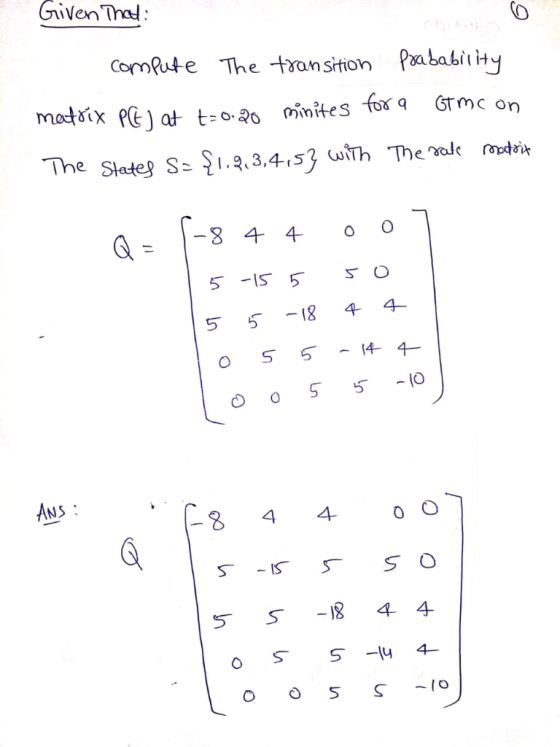
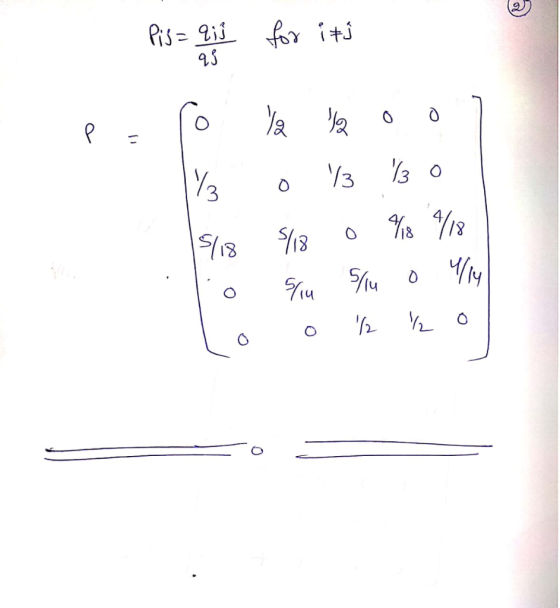
5. Compute the transition probability matrix P(t) at t = 0.20 minutes for a CTMC on the states S ...
2. A Markov chain on states {0, 1, 2, 3, 4, 5} has transition probability matrix...
 2. A Markov chain on states {0, 1, 2, 3, 4, 5} has transition probability matrix 0 0 0 0 0 0 0 0 0 1 0 0 0 0 0 0 0 0 0 0 0 1 Find all classes. Compute the limiting probabilities lim,o P5i for i = 0, 1, 2, 3,4, 5
2. A Markov chain on states {0, 1, 2, 3, 4, 5} has transition probability matrix 0 0 0 0 0 0 0 0 0...
2. A Markov chain on states {0, 1, 2, 3, 4, 5} has transition probability matrix 0 0 0 0 0 0 0 0 0 1 0 0 0 0 0 0 0 0 0 0 0 1 Find all classes. Compute the limiting probabilities lim,o P5i for i = 0, 1, 2, 3,4, 5
2. A Markov chain on states {0, 1, 2, 3, 4, 5} has transition probability matrix 0 0 0 0 0 0 0 0 0...
Let X(n), n 0 be the two-state Markov chain on states (0,1) with transition probability matrix...
 Let X(n), n 0 be the two-state Markov chain on states (0,1) with transition probability matrix probability matrix 「1-5 Find: (a) P(x(1) = olX (0-0, X(2) = 0) (b) P(x(1)メx(2)). Note. (b) is an unconditional joint probability so you will nced t nclude the initi P(X(0-0)-To(0) and P(X(0-1)-n(0).
Suppose that {Xn} is a Markov chain with state space S = {1, 2}, transition matrix...
 Suppose that {Xn} is a Markov chain with state space S = {1, 2},
transition matrix (1/5 4/5 2/5 3/5), and initial distribution P (X0
= 1) = 3/4 and P (X0 = 2) = 1/4. Compute the following:
(a) P(X3 =1|X1 =2)
(b) P(X3 =1|X2 =1,X1 =1,X0 =2)
(c) P(X2 =2)
(d) P(X0 =1,X2 =1)
(15 points) Suppose that {Xn} is a Markov chain with state space S = 1,2), transition matrix and initial distribution P(X0-1-3/4 and P(Xo,-2-1/4. Compute...
Suppose that {Xn} is a Markov chain with state space S = {1, 2},
transition matrix (1/5 4/5 2/5 3/5), and initial distribution P (X0
= 1) = 3/4 and P (X0 = 2) = 1/4. Compute the following:
(a) P(X3 =1|X1 =2)
(b) P(X3 =1|X2 =1,X1 =1,X0 =2)
(c) P(X2 =2)
(d) P(X0 =1,X2 =1)
(15 points) Suppose that {Xn} is a Markov chain with state space S = 1,2), transition matrix and initial distribution P(X0-1-3/4 and P(Xo,-2-1/4. Compute...
0.5 0 0 5. Let P 0.5 0.6 0.3represent the probability transition matrix of a Markov...
 0.5 0 0 5. Let P 0.5 0.6 0.3represent the probability transition matrix of a Markov chain with three 0 0.4 0.7 states (a) Show that the characteristic polynomial of P is given by P-ÀI -X-1.8λ2 +0.95λ-0.15) (b) Verify that λι 1, λ2 = 0.5 and λ3 = 0.3 satisfy the characteristic equation P-λ1-0 (and hence they are the eigenvalues of P) c) Show thatu3u2and u3are three eigenvectors corresponding to the eigenvalues λι, λ2 and λ3, respectively 1/3 (d) Let...
1. Let Xn be a Markov chain with states S = {1, 2} and transition matrix...
 1. Let Xn be a Markov chain with states S = {1, 2} and transition matrix ( 1/2 1/2 p= ( 1/3 2/3 (1) Compute P(X2 = 2|X0 = 1). (2) Compute P(T1 = n|Xo = 1) for n=1 and n > 2. (3) Compute P11 = P(T1 <0|Xo = 1). Is state 1 transient or recurrent? (4) Find the stationary distribution à for the Markov Chain Xn.
(n)," 2 0) be the two-state Markov chain on states (. i} with transition probability matrix...
 (n)," 2 0) be the two-state Markov chain on states (. i} with transition probability matrix 0.7 0.3 0.4 0.6 Find P(X(2) 0 and X(5) X() 0)
Problem 5. A Markov chain Xn, n probability matrix: 0 with states 1, 2, 3 has the following trans...
 Problem 5. A Markov chain Xn, n probability matrix: 0 with states 1, 2, 3 has the following transition 0 1/3 2/3 1/2 0 1/2 If P(o-: 1)-P(Xo-2-1/4, calculate E(%) (use a computer).
Problem 5. A Markov chain Xn, n probability matrix: 0 with states 1, 2, 3 has the following transition 0 1/3 2/3 1/2 0 1/2 If P(o-: 1)-P(Xo-2-1/4, calculate E(%) (use a computer).
Problem 5. A Markov chain Xn, n probability matrix: 0 with states 1, 2, 3 has the following transition 0 1/3 2/3 1/2 0 1/2 If P(o-: 1)-P(Xo-2-1/4, calculate E(%) (use a computer).
P is the (one-step) transition probability matrix of a Markov chain with state space {0, 1, 2, 3,...
 P is the (one-step) transition probability matrix of a Markov chain with state space {0, 1, 2, 3, 4 0.5 0.0 0.5 0.0 0.0 0.25 0.5 0.25 0.0 0.0 P=10.5 0.0 0.5 0.0 0.0 0.0 0.0 0.0 0.5 0.5 0.0 0.0 0.0 0.5 0.5/ (a) Draw a transition diagram. (b) Suppose the chain starts at time 0 in state 2. That is, Xo 2. Find E Xi (c)Suppose the chain starts at time 0 in any of the states with...
PROBLEM 1 (30 points) Given the following matrix of transition probabilities (see the labels of t...
 and please list the actual member states for each class
PROBLEM 1 (30 points) Given the following matrix of transition probabilities (see the labels of the states above and in front of the matrix): 0 (0 0 0 1 P-10 1/2 1/4 1/4 3 1 0 0 0 (a) (6 points) Classify the classes of the Markov chain number of classes: transient class(es): recurrent class(es) of which the absorbing state(s) is (are): (b) (8 points) Determine f1o
PROBLEM 1 (30...
and please list the actual member states for each class
PROBLEM 1 (30 points) Given the following matrix of transition probabilities (see the labels of the states above and in front of the matrix): 0 (0 0 0 1 P-10 1/2 1/4 1/4 3 1 0 0 0 (a) (6 points) Classify the classes of the Markov chain number of classes: transient class(es): recurrent class(es) of which the absorbing state(s) is (are): (b) (8 points) Determine f1o
PROBLEM 1 (30...
(10 points) Consider a Markov chain (Xn)n-0,1,2 probability matrix with state space S ,2,3) and transition...
 (10 points) Consider a Markov chain (Xn)n-0,1,2 probability matrix with state space S ,2,3) and transition 1/5 3/5 1/5 P-0 1/2 1/2 3/10 7/10 0 The initial distribution is given by (1/2,1/6,1/3). Compute (a) P[X2-k for all k- 1,2,3 (b) E[X2] Does the distribution of X2 computed in (a) depend on the initial distribution a? Does the expected value of X2 computed in (b) depend on the nitial distribution a? Give a reason for both of your answers.
 2. A Markov chain on states {0, 1, 2, 3, 4, 5} has transition probability matrix 0 0 0 0 0 0 0 0 0 1 0 0 0 0 0 0 0 0 0 0 0 1 Find all classes. Compute the limiting probabilities lim,o P5i for i = 0, 1, 2, 3,4, 5
2. A Markov chain on states {0, 1, 2, 3, 4, 5} has transition probability matrix 0 0 0 0 0 0 0 0 0...
2. A Markov chain on states {0, 1, 2, 3, 4, 5} has transition probability matrix 0 0 0 0 0 0 0 0 0 1 0 0 0 0 0 0 0 0 0 0 0 1 Find all classes. Compute the limiting probabilities lim,o P5i for i = 0, 1, 2, 3,4, 5
2. A Markov chain on states {0, 1, 2, 3, 4, 5} has transition probability matrix 0 0 0 0 0 0 0 0 0...
 Let X(n), n 0 be the two-state Markov chain on states (0,1) with transition probability matrix probability matrix 「1-5 Find: (a) P(x(1) = olX (0-0, X(2) = 0) (b) P(x(1)メx(2)). Note. (b) is an unconditional joint probability so you will nced t nclude the initi P(X(0-0)-To(0) and P(X(0-1)-n(0).
 Suppose that {Xn} is a Markov chain with state space S = {1, 2},
transition matrix (1/5 4/5 2/5 3/5), and initial distribution P (X0
= 1) = 3/4 and P (X0 = 2) = 1/4. Compute the following:
(a) P(X3 =1|X1 =2)
(b) P(X3 =1|X2 =1,X1 =1,X0 =2)
(c) P(X2 =2)
(d) P(X0 =1,X2 =1)
(15 points) Suppose that {Xn} is a Markov chain with state space S = 1,2), transition matrix and initial distribution P(X0-1-3/4 and P(Xo,-2-1/4. Compute...
Suppose that {Xn} is a Markov chain with state space S = {1, 2},
transition matrix (1/5 4/5 2/5 3/5), and initial distribution P (X0
= 1) = 3/4 and P (X0 = 2) = 1/4. Compute the following:
(a) P(X3 =1|X1 =2)
(b) P(X3 =1|X2 =1,X1 =1,X0 =2)
(c) P(X2 =2)
(d) P(X0 =1,X2 =1)
(15 points) Suppose that {Xn} is a Markov chain with state space S = 1,2), transition matrix and initial distribution P(X0-1-3/4 and P(Xo,-2-1/4. Compute...
 0.5 0 0 5. Let P 0.5 0.6 0.3represent the probability transition matrix of a Markov chain with three 0 0.4 0.7 states (a) Show that the characteristic polynomial of P is given by P-ÀI -X-1.8λ2 +0.95λ-0.15) (b) Verify that λι 1, λ2 = 0.5 and λ3 = 0.3 satisfy the characteristic equation P-λ1-0 (and hence they are the eigenvalues of P) c) Show thatu3u2and u3are three eigenvectors corresponding to the eigenvalues λι, λ2 and λ3, respectively 1/3 (d) Let...
 1. Let Xn be a Markov chain with states S = {1, 2} and transition matrix ( 1/2 1/2 p= ( 1/3 2/3 (1) Compute P(X2 = 2|X0 = 1). (2) Compute P(T1 = n|Xo = 1) for n=1 and n > 2. (3) Compute P11 = P(T1 <0|Xo = 1). Is state 1 transient or recurrent? (4) Find the stationary distribution à for the Markov Chain Xn.
 (n)," 2 0) be the two-state Markov chain on states (. i} with transition probability matrix 0.7 0.3 0.4 0.6 Find P(X(2) 0 and X(5) X() 0)
 Problem 5. A Markov chain Xn, n probability matrix: 0 with states 1, 2, 3 has the following transition 0 1/3 2/3 1/2 0 1/2 If P(o-: 1)-P(Xo-2-1/4, calculate E(%) (use a computer).
Problem 5. A Markov chain Xn, n probability matrix: 0 with states 1, 2, 3 has the following transition 0 1/3 2/3 1/2 0 1/2 If P(o-: 1)-P(Xo-2-1/4, calculate E(%) (use a computer).
Problem 5. A Markov chain Xn, n probability matrix: 0 with states 1, 2, 3 has the following transition 0 1/3 2/3 1/2 0 1/2 If P(o-: 1)-P(Xo-2-1/4, calculate E(%) (use a computer).
 P is the (one-step) transition probability matrix of a Markov chain with state space {0, 1, 2, 3, 4 0.5 0.0 0.5 0.0 0.0 0.25 0.5 0.25 0.0 0.0 P=10.5 0.0 0.5 0.0 0.0 0.0 0.0 0.0 0.5 0.5 0.0 0.0 0.0 0.5 0.5/ (a) Draw a transition diagram. (b) Suppose the chain starts at time 0 in state 2. That is, Xo 2. Find E Xi (c)Suppose the chain starts at time 0 in any of the states with...
 and please list the actual member states for each class
PROBLEM 1 (30 points) Given the following matrix of transition probabilities (see the labels of the states above and in front of the matrix): 0 (0 0 0 1 P-10 1/2 1/4 1/4 3 1 0 0 0 (a) (6 points) Classify the classes of the Markov chain number of classes: transient class(es): recurrent class(es) of which the absorbing state(s) is (are): (b) (8 points) Determine f1o
PROBLEM 1 (30...
and please list the actual member states for each class
PROBLEM 1 (30 points) Given the following matrix of transition probabilities (see the labels of the states above and in front of the matrix): 0 (0 0 0 1 P-10 1/2 1/4 1/4 3 1 0 0 0 (a) (6 points) Classify the classes of the Markov chain number of classes: transient class(es): recurrent class(es) of which the absorbing state(s) is (are): (b) (8 points) Determine f1o
PROBLEM 1 (30...
 (10 points) Consider a Markov chain (Xn)n-0,1,2 probability matrix with state space S ,2,3) and transition 1/5 3/5 1/5 P-0 1/2 1/2 3/10 7/10 0 The initial distribution is given by (1/2,1/6,1/3). Compute (a) P[X2-k for all k- 1,2,3 (b) E[X2] Does the distribution of X2 computed in (a) depend on the initial distribution a? Does the expected value of X2 computed in (b) depend on the nitial distribution a? Give a reason for both of your answers.
Most questions answered within 3 hours.
-
Where is the error in this code sequence?
String s1 = "Hello";
String s2 = "ello";...
asked 11 months ago -
Financial data for Joel de Paris, Inc., for last year
follow:
Joel de Paris, Inc.
Balance...
asked 11 months ago -
Consider this reaction:
Al2(SO4)3 (aq)+ BaCl3
(aq) Al2Cl6 (aq)- +
3BaSO4(s) . What is the...
asked 11 months ago -
Suppose that Savneet is considering increasing her
recent random sample from 20 car rentals to 40...
asked 11 months ago -
Trucks arrive at an unloading terminal at an average rate of 120
per hour.
Trucks arrive...
asked 11 months ago -
Why are methanol and ethanol completely soluble in water while
octanol is not very little soluble....
asked 11 months ago -
A facilities manager at a university reads in a research report
that the mean amount of...
asked 11 months ago -
When the CuSO4 is rehydrated by adding water to the anhydrous
compound, is this an endothermic...
asked 11 months ago -
A ray of sunlight is passing from diamond into crown glass; the
angle of incidence is...
asked 11 months ago -
A block of mass 0.249 kg is placed on top of a light, vertical
spring of...
asked 11 months ago -
how do the kidneys compensate in the presences of acidosis
a) trigger hyperventilate
b) reserve acid...
asked 11 months ago -
Question 501 pts
The rental rate of capital to the firm increases. Which of the
following...
asked 11 months ago