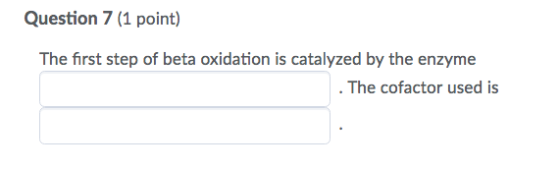
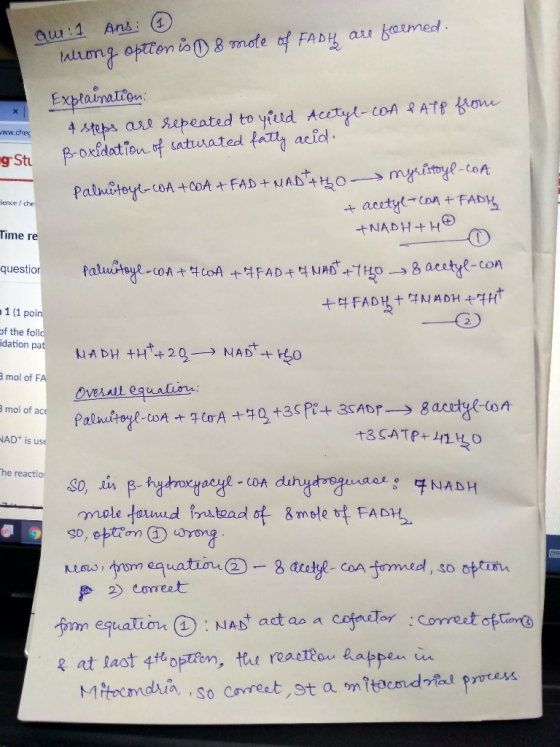
Question 7 (1 point) The first step of beta oxidation is catalyzed by the enzyme . The cofactor used is
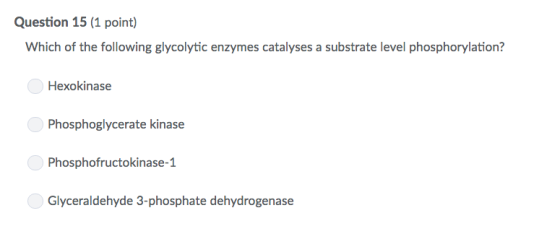
Question 15 (1 point) Which of the following glycolytic enzymes catalyses a substrate level phosphorylation? Hexokinase Phosphoglycerate kinase Phosphofructokinase-1 Glyceraldehyde 3-phosphate dehydrogenase
Homework Answers
Add Answer to:
Question 7 (1 point) The first step of beta oxidation is catalyzed by the enzyme . The cofactor u...
14. Which step of reaction requires inorganic phosphate? What is the enzyme? Which enzyme category does...
 14. Which step of reaction requires inorganic phosphate? What is the enzyme? Which enzyme category does it belong to? 15. Which step of reaction produces H20 as a byproduct? P-0-CH CH - Glyceraldehyde 3-phosphate Dihydroxyacetone phosphate triose phosphate -O-CH2 -CHCH isomerase 2NAD Ilyceraldehyde oxidation and (b) Payoff phase Oxidative conversion of (2) Glyceraldehyde (21 -0-CH -CH glyceraldehyde 3-phosphate 3-phosphate to pyruvate and the coupled 2P IN 6 formation of ATP and NADH 2NAD I 3 phosphate Jl dehydrogenase phosphorylation 2...
Which of the diagrams illustrates the way in which the rate of an enzyme-controlled reaction depends...
 Which of the diagrams illustrates the way in which the rate of an enzyme-controlled reaction depends on substrate concentration? * А B Rate of reaction MÚN Substrate concentration A B D When starch and amylase are mixed in the presence of iodine solution, the blue-black colour rapidly disappears. This is due to the formation of which molecule? * glucose O glycogen sucrose O maltose Which of the following enzyme groups can catalyse oxidation reactions? * O phosphorylases isomerases hydrolases dehydrogenases...
4. Which of the following enzymes catalyzed reactions in glycolysis require(s) ATP as a substrate? A)...
 4. Which of the following enzymes catalyzed reactions in glycolysis require(s) ATP as a substrate? A) Phosphoglycerate mutase E) Pyruvate kinase B) Aldolase F) Phosphofructokinase-1 C) Phosphoglycerate kinase G) Hexokinase D) Glyceraldehyde-3-phosphate dehydrogenase 5. Blood Lactate Levels during Vigorous Exercise The following graph shows the concentrations of lactate in blood plasma before, during, and after a 400 m sprint. Use your knowledge from chapter 14 to explain the causes of the rapid rise in lactate concentration? --Before-- - After Blood...
1. You have given all the enzymes and intermediates in glycolysis. Choose the right enzymes and...
 1. You have given all the enzymes and intermediates in glycolysis. Choose the right enzymes and intermediates and draw the glycolytic pathway. Decorate the diagram by adding ATP, ADP, H", NADH, NAD', P, and H20 where necessary. All the steps are reversible except 1, 3 and 10; draw appropriate arrow. First arrange the reactants in the correct order. Reactants/intermediates: 3-phosphoglycerate glucose Phosphoenolpyruvate dihydroxyacetone phosphate Pyruvate glucose 6-phosphate 1,3-bisphosphoglycerate fructose 6-phosophate 2-phosphoglycerate glyceraldehyde 3-phosphate fructose 1,6-bisphosphate Enzymes: Phosphoglucoisomerase phosphoglycerate kinase phosphoglycerate...
Question 30 (1 point) The enzyme phosphofructokinase is the major regulatory enzyme of glycolysis. What reaction...
 Question 30 (1 point) The enzyme phosphofructokinase is the major regulatory enzyme of glycolysis. What reaction does it catalyze? the phosphorylation of fructose 6- phosphate. the substrate-level phosphorylation reaction whereby phosphoenolpyruvate is converted to pyruvate the isomerization of glucose 6-phosphate to fructose 6-phosphate. the first of the 10 reactions of glycolysis.
Question 30 (1 point) The enzyme phosphofructokinase is the major regulatory enzyme of glycolysis. What reaction...
 Question 30 (1 point) The enzyme phosphofructokinase is the major regulatory enzyme of glycolysis. What reaction does it catalyze? o the phosphorylation of fructose 6-phosphate the substrate-level phosphorylation reaction whereby phosphoenolpyruvate is converted to pyruvate 0 the isomerization of glucose 6-phosphate to fructose 6-phosphate. 0 the first of the 10 reactions of glycolysis. 0
1. When the cell’s ATP supply is depleted, which of the following enzyme’s activity is increased?...
1. When the cell’s ATP supply is depleted, which of the following enzyme’s activity is increased? Hexokinase Pyruvate kinase Glucokinase Phosphofructokinase Explain why this enzyme activity is tied to ATP levels. 2. The pyruvate kinase catalyzed step is not a reversible reaction in glycolysis, how then does gluconeogenesis start from pyruvate? Show the mechanism of the first step of gluconeogenesis. 3. Which of the following cofactors do not form a covalent bond with enzymes' lysine residues? Lipoamide Biotin NADH Pyridoxyl...
4. What is the commited step of glycolysis and how is this enzyme regulated? 5. Glyceraldehyde-3-phophate...
 4. What is the commited step of glycolysis and how is this enzyme regulated? 5. Glyceraldehyde-3-phophate dehydrogenase (GAPDH) is the most important enzyme in glycolysis. a. What two reactions are coupled by GAPDH? b. Draw the structure of the thiohemiacetal intermediate and show the mechanism for generating the acyl thioester intermediate. A+Bred Ared +B For the reaction: AG = Given: ngAE RT In n[Aj{8,al Nernst Equation: AE=A Use the reduction potentials in Table 14-4 to calculate the electromotive force, AE,...
The mechanism of glyceraldehyde 3 phosphate dehydrogenase. In step 1 (Top Left) the sulfur from the cysteine loses its...
 The mechanism of glyceraldehyde 3 phosphate dehydrogenase. In
step 1 (Top Left) the sulfur from the cysteine loses its hydrogen
to the carbonyl carbon of the substrate. I think is wrong and the
hydrogen is stolen by the histidine (nitrogen) using a base
catalyst reaction.
lser Glyceraldehyde 3-phosphate NAD CONH2 H -N + HH Hemithioacetal Oxidation NAD NADH CONH CONH2 Но RN + H -N / H Η Η Hн s NADH NAD Thioester intermediate Thioester intermediate Phosphorylation CONH2 O...
The mechanism of glyceraldehyde 3 phosphate dehydrogenase. In
step 1 (Top Left) the sulfur from the cysteine loses its hydrogen
to the carbonyl carbon of the substrate. I think is wrong and the
hydrogen is stolen by the histidine (nitrogen) using a base
catalyst reaction.
lser Glyceraldehyde 3-phosphate NAD CONH2 H -N + HH Hemithioacetal Oxidation NAD NADH CONH CONH2 Но RN + H -N / H Η Η Hн s NADH NAD Thioester intermediate Thioester intermediate Phosphorylation CONH2 O...
During glycolysis, the addition of a new phosphate group on to a substrate can be catalyzed...
 During glycolysis, the addition of a new phosphate group on to a substrate can be catalyzed by which class(es) of enzymes? Kinase and phosphorylase Kinase and transferase Mutase and Isomerase Phosphorylase and Mutase QUESTION 17 Which of the following factors makes hydrolysis of acetyl coA a favorable process? Enol-keto tautomerization Increased delocalization of the pl-cloud Change of non-aromatic structure to aromatic structure Separation of like charges Substrate Level phosphorylation occurs during glycolysis... step 6, during the formation of 1,3 bisphosphoglycerate...
 14. Which step of reaction requires inorganic phosphate? What is the enzyme? Which enzyme category does it belong to? 15. Which step of reaction produces H20 as a byproduct? P-0-CH CH - Glyceraldehyde 3-phosphate Dihydroxyacetone phosphate triose phosphate -O-CH2 -CHCH isomerase 2NAD Ilyceraldehyde oxidation and (b) Payoff phase Oxidative conversion of (2) Glyceraldehyde (21 -0-CH -CH glyceraldehyde 3-phosphate 3-phosphate to pyruvate and the coupled 2P IN 6 formation of ATP and NADH 2NAD I 3 phosphate Jl dehydrogenase phosphorylation 2...
 Which of the diagrams illustrates the way in which the rate of an enzyme-controlled reaction depends on substrate concentration? * А B Rate of reaction MÚN Substrate concentration A B D When starch and amylase are mixed in the presence of iodine solution, the blue-black colour rapidly disappears. This is due to the formation of which molecule? * glucose O glycogen sucrose O maltose Which of the following enzyme groups can catalyse oxidation reactions? * O phosphorylases isomerases hydrolases dehydrogenases...
 4. Which of the following enzymes catalyzed reactions in glycolysis require(s) ATP as a substrate? A) Phosphoglycerate mutase E) Pyruvate kinase B) Aldolase F) Phosphofructokinase-1 C) Phosphoglycerate kinase G) Hexokinase D) Glyceraldehyde-3-phosphate dehydrogenase 5. Blood Lactate Levels during Vigorous Exercise The following graph shows the concentrations of lactate in blood plasma before, during, and after a 400 m sprint. Use your knowledge from chapter 14 to explain the causes of the rapid rise in lactate concentration? --Before-- - After Blood...
 1. You have given all the enzymes and intermediates in glycolysis. Choose the right enzymes and intermediates and draw the glycolytic pathway. Decorate the diagram by adding ATP, ADP, H", NADH, NAD', P, and H20 where necessary. All the steps are reversible except 1, 3 and 10; draw appropriate arrow. First arrange the reactants in the correct order. Reactants/intermediates: 3-phosphoglycerate glucose Phosphoenolpyruvate dihydroxyacetone phosphate Pyruvate glucose 6-phosphate 1,3-bisphosphoglycerate fructose 6-phosophate 2-phosphoglycerate glyceraldehyde 3-phosphate fructose 1,6-bisphosphate Enzymes: Phosphoglucoisomerase phosphoglycerate kinase phosphoglycerate...
 Question 30 (1 point) The enzyme phosphofructokinase is the major regulatory enzyme of glycolysis. What reaction does it catalyze? the phosphorylation of fructose 6- phosphate. the substrate-level phosphorylation reaction whereby phosphoenolpyruvate is converted to pyruvate the isomerization of glucose 6-phosphate to fructose 6-phosphate. the first of the 10 reactions of glycolysis.
 Question 30 (1 point) The enzyme phosphofructokinase is the major regulatory enzyme of glycolysis. What reaction does it catalyze? o the phosphorylation of fructose 6-phosphate the substrate-level phosphorylation reaction whereby phosphoenolpyruvate is converted to pyruvate 0 the isomerization of glucose 6-phosphate to fructose 6-phosphate. 0 the first of the 10 reactions of glycolysis. 0
 4. What is the commited step of glycolysis and how is this enzyme regulated? 5. Glyceraldehyde-3-phophate dehydrogenase (GAPDH) is the most important enzyme in glycolysis. a. What two reactions are coupled by GAPDH? b. Draw the structure of the thiohemiacetal intermediate and show the mechanism for generating the acyl thioester intermediate. A+Bred Ared +B For the reaction: AG = Given: ngAE RT In n[Aj{8,al Nernst Equation: AE=A Use the reduction potentials in Table 14-4 to calculate the electromotive force, AE,...
 The mechanism of glyceraldehyde 3 phosphate dehydrogenase. In
step 1 (Top Left) the sulfur from the cysteine loses its hydrogen
to the carbonyl carbon of the substrate. I think is wrong and the
hydrogen is stolen by the histidine (nitrogen) using a base
catalyst reaction.
lser Glyceraldehyde 3-phosphate NAD CONH2 H -N + HH Hemithioacetal Oxidation NAD NADH CONH CONH2 Но RN + H -N / H Η Η Hн s NADH NAD Thioester intermediate Thioester intermediate Phosphorylation CONH2 O...
The mechanism of glyceraldehyde 3 phosphate dehydrogenase. In
step 1 (Top Left) the sulfur from the cysteine loses its hydrogen
to the carbonyl carbon of the substrate. I think is wrong and the
hydrogen is stolen by the histidine (nitrogen) using a base
catalyst reaction.
lser Glyceraldehyde 3-phosphate NAD CONH2 H -N + HH Hemithioacetal Oxidation NAD NADH CONH CONH2 Но RN + H -N / H Η Η Hн s NADH NAD Thioester intermediate Thioester intermediate Phosphorylation CONH2 O...
 During glycolysis, the addition of a new phosphate group on to a substrate can be catalyzed by which class(es) of enzymes? Kinase and phosphorylase Kinase and transferase Mutase and Isomerase Phosphorylase and Mutase QUESTION 17 Which of the following factors makes hydrolysis of acetyl coA a favorable process? Enol-keto tautomerization Increased delocalization of the pl-cloud Change of non-aromatic structure to aromatic structure Separation of like charges Substrate Level phosphorylation occurs during glycolysis... step 6, during the formation of 1,3 bisphosphoglycerate...
Most questions answered within 3 hours.
-
Where is the error in this code sequence?
String s1 = "Hello";
String s2 = "ello";...
asked 10 months ago -
Financial data for Joel de Paris, Inc., for last year
follow:
Joel de Paris, Inc.
Balance...
asked 10 months ago -
Consider this reaction:
Al2(SO4)3 (aq)+ BaCl3
(aq) Al2Cl6 (aq)- +
3BaSO4(s) . What is the...
asked 10 months ago -
Suppose that Savneet is considering increasing her
recent random sample from 20 car rentals to 40...
asked 10 months ago -
Trucks arrive at an unloading terminal at an average rate of 120
per hour.
Trucks arrive...
asked 10 months ago -
Why are methanol and ethanol completely soluble in water while
octanol is not very little soluble....
asked 10 months ago -
A facilities manager at a university reads in a research report
that the mean amount of...
asked 10 months ago -
When the CuSO4 is rehydrated by adding water to the anhydrous
compound, is this an endothermic...
asked 10 months ago -
A ray of sunlight is passing from diamond into crown glass; the
angle of incidence is...
asked 10 months ago -
A block of mass 0.249 kg is placed on top of a light, vertical
spring of...
asked 10 months ago -
how do the kidneys compensate in the presences of acidosis
a) trigger hyperventilate
b) reserve acid...
asked 10 months ago -
Question 501 pts
The rental rate of capital to the firm increases. Which of the
following...
asked 10 months ago