
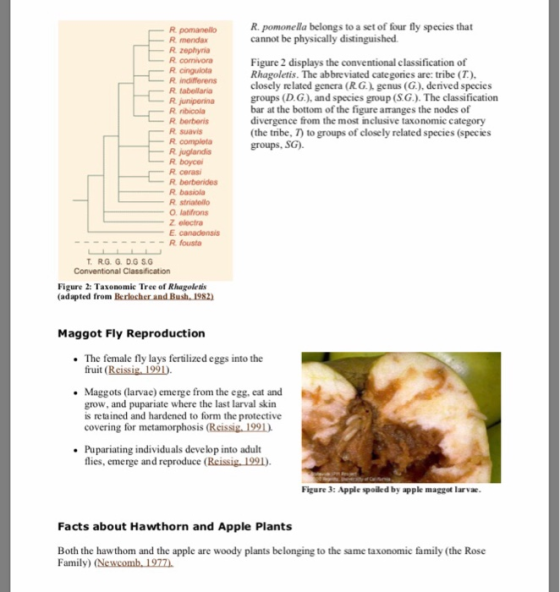

la belongs to a set of four fly species that R. pomonella cannot be physically distinguished. R pomanello R mendax R zephyria R comivora R cingulota Figure 2 displays the conventional classification of Rhagoletis. The abbre viated cate gories are: tribe (T.). closely related genera (R.G.) genus (G), derived species groups (D. G.), and species group (SG.). The classification bar at the bottom of the figure arranges the nodes of divergence from the most inclusive taxonomic category (the tribe, T) to groups of closely related species (species groups, SG). R tabellaria R. juniperina R nibicola R berbenis R suavis R completa R juglandis R. boyce R cerasi R berberides R basiola R striatello O. latifrons Z electra E. canadensis R fousta Figure 2: Taxonomic Tree of Rhagoletis (adapted from Maggot Fly Reproduction The female fly lays fertilized eggs into the fruit (Reissig. 1991). emerge from the egg, eat and Maggots (larvae) grow, and pupariate where the last larval skin is retained and hardened to form the protective covering for metamorphosis (Reissig, 1991) Pupariating individuals develop into adult flies, emerge and reproduce (Reissig 1991). Figure 3: Apple spoiled by apple maggot larvae Facts about Hawthorn and Apple Plants Both the hawthom and the apple are woody plants belonging to the same taxonomic family (the Rose Family)
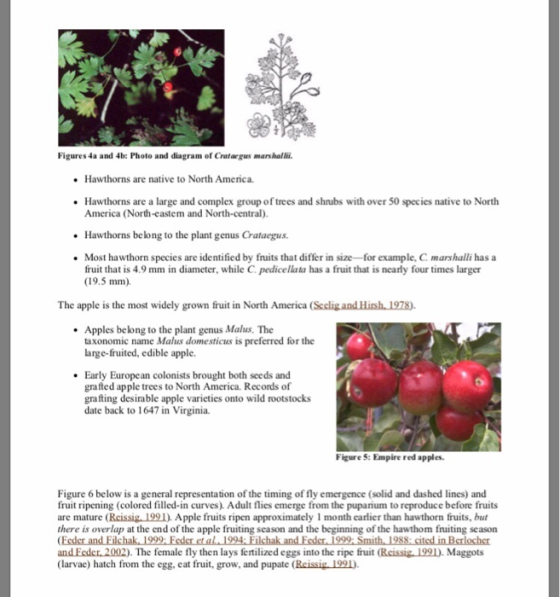
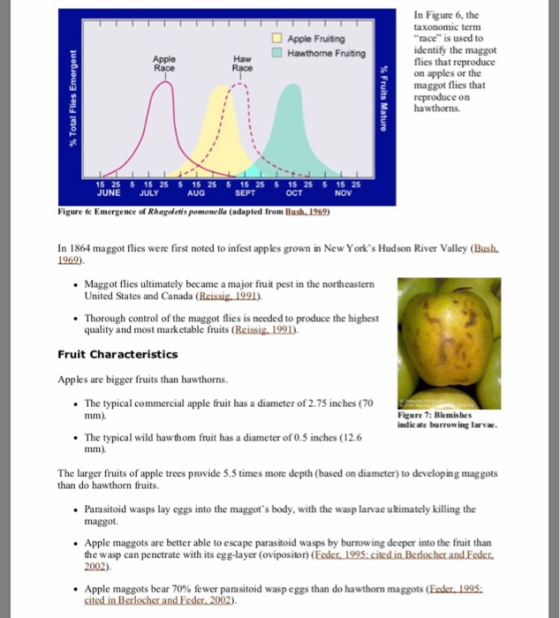
Figures 4a and 4b: Photo and diagram of Cratac gus marshalli. .Hawthorns are native to North America. Hawthorns are a large and complex group of trees and shrubs with over 50 species native to North America (North-eastem and North-central). Hawthorns belong to the plant genus Crataegus. fruit that is 4.9 mm in diameter, while C pedicellata has a fruit that is nearly four times larger .Most hawthorn species are identified by fruits that differ in sizefor example, C marshalli has a (19.5 mm). The apple is the most widely grown fruit in North America (Seelig and Hirsh. 1978). Apples be long to the plant genus Malus. The taxonomic name Malus domesticus is preferred for the large-fruited, edible apple. . Early European colonists brought both seeds and grafted apple trees to North America. Records of grafting desirable apple varieties onto wild rootstocks date back to 1647 in Virginia. Figure 5: Empire red apples Figure 6 below is a general representation of the timing of fly emergence (solid and dashed lines) and fruit ripening (colored filled-in curves). Adult flies emerge from the puparium to reproduce before fruits are mature (Reissig. 1991). Apple fruits ripen approximately 1 month earlier than hawthorn fruits, but there is overlap at the end of the apple fruiting season and the beginning of the hawthom fruiting season and Feder. 2002). The female fly then lays fertilized eggs into the ripe fruit (Reissig, 1991). Maggots (larvae) hatch from the egg, eat fruit, grow, and pupate (Reissig 1991).
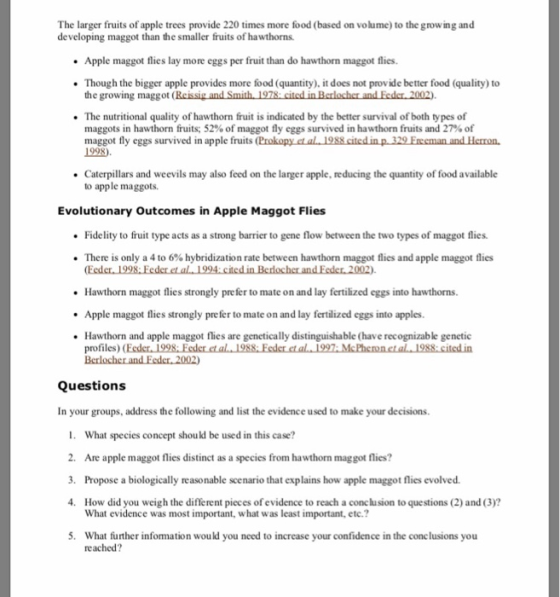
The larger fruits of apple trees provide 220 times more food (based on volume) to the growing and developing maggot than the smaller fruits of hawthorns . Apple maggot flies lay more eggs per fruit than do hawthorn maggot flies. Though the bigger apple provides more food (quantity), it does not provide better food (quality) to The nutritional quality of hawthorn fruit is indicated by the better survival of both types of maggots in hawthorn fruits; 52% of maggot fly eggs survived in hawthorn fruits and 27% of maggot fly eggs survived in apple fruits 1998) Caterpillars and weevils may also feed on the larger apple, reducing the quantity of food available to apple maggots. Evolutionary Outcomes in Apple Maggot Flies Fidelity to fruit type acts as a strong barrier to gene flow between the two types of maggot flies. * There is only a 4 to 6% hybridization rate between hawthorn maggot flies and apple maggot flies Hawthorn maggot flies strongly pre fer to mate on and lay fertilized eggs into hawthorns. Apple maggot flies strongly pre fer to mate on and lay fertilized eggs into apples. Hawthorn and apple maggot flies are genetically distinguishable (have recognizable genetic profiles) ( Questions In your groups, address the following and list the evidence used to make your decisions. I. What species concept should be used in this case? 2. Are apple maggot flies distinct as a species from hawthorn maggot flies? 3. Propose a biologically reasonable scenario that explains how apple maggot flies evolved 4. How did you weigh the different pieces of evidence to reach a conc lusion to questions (2) and (3) What evidence was most important, what was least important, etc.? 5. What further information would you need to increase your confidence in the conclusions you reached?
Questions In your groups, address the following and list the evidence used to make your decisions 1. What species concept should be used in this case? 2 Are apple maggot flies distinct as a species from hawthorn maggot flies? 3. Propose a biologically reasonable scenario that explains how apple maggot flies evolved How did you weigh the different pieces of evidence to reach a conclusion to questions (2) and (3) What evidence was most important, what was least important, ete.? What further infomation would you need to increase your confidence in the conclusions yoru reached?
Homework Answers
q1: These may be regarded as sympatric species since inhabit the same geographic region and continue to evolve.
q2;As per the information given above morphologically the species appear to be indistinguishable but evolutionary they are distinct as they have genetically distinguishable genetic profiles, vary in their mate choices and fidelity to the fruit trees.
q3: Apart from the artice sharing my knowledge with you the divergence has mainly evolved in the flies due to a minuscule change in the connections of two channels in the brain - one for detecting hawthorn odours and the other for apple odours which has led to a major cause for the switch in host fruit. The type of host i.e the trees as per the article determine amount of food , quality of food, brood size etc of the flies which leads to the divergence.
q4: least important was their choice of the host and most important was their choice of mating and the distinguishable genetic profiles.
q5. more information needs on the reproductive behaviour and the mating outcome between the two
Add Answer to:
With all this data i need help answering the questions in the last picture! I need help a...
Most questions answered within 3 hours.
-
Where is the error in this code sequence?
String s1 = "Hello";
String s2 = "ello";...
asked 10 months ago -
Financial data for Joel de Paris, Inc., for last year
follow:
Joel de Paris, Inc.
Balance...
asked 10 months ago -
Consider this reaction:
Al2(SO4)3 (aq)+ BaCl3
(aq) Al2Cl6 (aq)- +
3BaSO4(s) . What is the...
asked 10 months ago -
Suppose that Savneet is considering increasing her
recent random sample from 20 car rentals to 40...
asked 10 months ago -
Trucks arrive at an unloading terminal at an average rate of 120
per hour.
Trucks arrive...
asked 10 months ago -
Why are methanol and ethanol completely soluble in water while
octanol is not very little soluble....
asked 10 months ago -
A facilities manager at a university reads in a research report
that the mean amount of...
asked 10 months ago -
When the CuSO4 is rehydrated by adding water to the anhydrous
compound, is this an endothermic...
asked 10 months ago -
A ray of sunlight is passing from diamond into crown glass; the
angle of incidence is...
asked 10 months ago -
A block of mass 0.249 kg is placed on top of a light, vertical
spring of...
asked 10 months ago -
how do the kidneys compensate in the presences of acidosis
a) trigger hyperventilate
b) reserve acid...
asked 10 months ago -
Question 501 pts
The rental rate of capital to the firm increases. Which of the
following...
asked 10 months ago