
Homework Answers
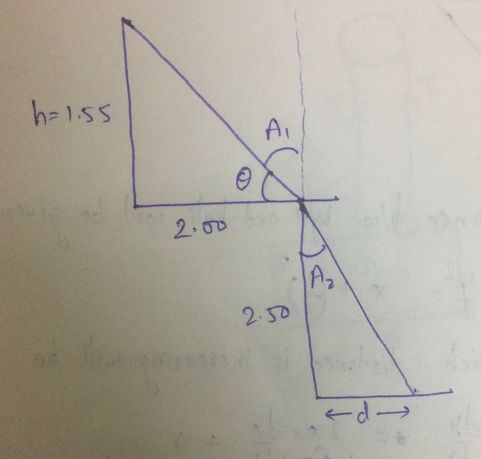
From the figure we can see that Angle 
tan 

So Angle of incident A1 will be
A1 = 90 - 
n1 = refractive index of air = 1.00
n2 = refractive index of water = 1.333
A2 = Angle of refraction = ?
Using Snell's law:
n1*sin A1 = n2*sin A2
A2 = arcsin (n1*sin A1/n2)
A2 = arcsin ((1*sin 52.23deg)/1.333)
A2 = 36.37 deg
Now in lower right-angle triangle
tan A2 = d/2.50
d = 2.50*tan 36.37 deg
d = 1.84 m
Please Upvote.
Add Answer to:
Constants Part A You (height of your eyes above the water, h 1.55 m) are standing 2.00 m from the...
I need help answering this problem. Thanks Constants You (height of your eyes above the water,h.60...
 I
need help answering this problem. Thanks
Constants You (height of your eyes above the water,h.60 m) are standing 2.00 m from the edge of a 2.50-m-deep swimming pool 2.50 m Tap image to zoom . You notice that you can barely see your cell phone, which went missing a few minutes before, on the bottom of the pool. The index of refraction of water at this temperatu Part A re is 1.333 How far from the side of the...
I
need help answering this problem. Thanks
Constants You (height of your eyes above the water,h.60 m) are standing 2.00 m from the edge of a 2.50-m-deep swimming pool 2.50 m Tap image to zoom . You notice that you can barely see your cell phone, which went missing a few minutes before, on the bottom of the pool. The index of refraction of water at this temperatu Part A re is 1.333 How far from the side of the...
You’re standing in waist-deep water with your eyes 0.46 m m above the surface. A fish...
You’re standing in waist-deep water with your eyes 0.46 m m above the surface. A fish is swimming 0.65 m below the surface. Your line of sight to the fish makes a 38 ∘ angle with the water’s surface. How far (horizontally) from you is the fish? Express your answer to two significant figures and include the appropriate units.
You’re standing in waist-deep water with your eyes 0.52 m m above the surface. A fish...
You’re standing in waist-deep water with your eyes 0.52 m m above the surface. A fish is swimming 0.65 m below the surface. Your line of sight to the fish makes a 38 ∘ angle with the water’s surface. Part A How far (horizontally) from you is the fish? Express your answer to two significant figures and include the appropriate units. x x = nothing nothing
You are standing on the edge of a swimming pool and looking directly across at the...
You are standing on the edge of a swimming pool and looking directly across at the opposite side. You notice that the bottom edge of the opposite side of the pool appears to be at an angle of 26.0° below the horizontal. However, when you sit on the pool edge, the bottom edge of the opposite side of the pool appears to be at an angle of only 13.2°below the horizontal. Use these observations to determine the width and depth...
You are standing in a 1.5-m-deep swimming pool at night. The water is very still. You...
You are standing in a 1.5-m-deep swimming pool at night. The water is very still. You hold a laser pointer just above the water's surface and shine it nearly parallel to the surface, but tilted slightly down so that the beam enters the water 3.5mfrom you. How far from you does the beam strike the bottom of the pool? Index of refraction of the water is 1.33.
A person whose eyes are H = 1.55 m above the floor stands 2.20 m in...
A person whose eyes are H = 1.55 m above the floor stands 2.20 m in front of a vertical plane mirror whose bottom edge is 38 cm above the floor (Figure 1) .
A flashlight is held at the edge of a swimming pool at a height h = 2.2 m
A flashlight is held at the edge of a swimming pool at a height h = 2.2 m such that its beam makes an angle of θ = 58 degrees with respect to the water's surface. The pool is d = 1.5 m deep and the index of refraction for air and water are n1=1 and n2 = 1.33, respectively. What is the horizontal distance D, from the edge of the pool to the port on the bottom of the pool...
A flashlight is held at the edge of a swimming pool at a height h = 2.4 m such that its beam makes an angle of θ = 41 degrees with respect to the water's surface
A flashlight is held at the edge of a swimming pool at a height h = 2.4 m such that its beam makes an angle of θ = 41 degrees with respect to the water's surface. The pool is d = 2.25 m deep and the index of refraction for air and water are n1 = 1 and n2 = 1.33, respectively.what is the horizontal distance, D, from the edge of the pool to the point on the bottom of...
It’s nighttime, and you’ve dropped your goggles into a 3.06 m deep swimming pool. If you...
It’s nighttime, and you’ve dropped your goggles into a 3.06 m deep swimming pool. If you hold a laser pointer 0.830 m above the edge of the pool, you can illuminate the goggles if the laser beam enters the water 1.02 m from the edge. How far are the goggles from the edge of the pool?
It's nighttime, and you've dropped your goggles into a 2.8-m-deep swimming pool. If you hold a...
It's nighttime, and you've dropped your goggles into a 2.8-m-deep swimming pool. If you hold a laser pointer 1.0 m above the edge of the pool, you can illuminate the goggles if the laser beam enters the water 2.2 m from the edge. How far are the goggles from the edge of the pool?
 I
need help answering this problem. Thanks
Constants You (height of your eyes above the water,h.60 m) are standing 2.00 m from the edge of a 2.50-m-deep swimming pool 2.50 m Tap image to zoom . You notice that you can barely see your cell phone, which went missing a few minutes before, on the bottom of the pool. The index of refraction of water at this temperatu Part A re is 1.333 How far from the side of the...
I
need help answering this problem. Thanks
Constants You (height of your eyes above the water,h.60 m) are standing 2.00 m from the edge of a 2.50-m-deep swimming pool 2.50 m Tap image to zoom . You notice that you can barely see your cell phone, which went missing a few minutes before, on the bottom of the pool. The index of refraction of water at this temperatu Part A re is 1.333 How far from the side of the...
Most questions answered within 3 hours.
-
Where is the error in this code sequence?
String s1 = "Hello";
String s2 = "ello";...
asked 11 months ago -
Financial data for Joel de Paris, Inc., for last year
follow:
Joel de Paris, Inc.
Balance...
asked 11 months ago -
Consider this reaction:
Al2(SO4)3 (aq)+ BaCl3
(aq) Al2Cl6 (aq)- +
3BaSO4(s) . What is the...
asked 11 months ago -
Suppose that Savneet is considering increasing her
recent random sample from 20 car rentals to 40...
asked 11 months ago -
Trucks arrive at an unloading terminal at an average rate of 120
per hour.
Trucks arrive...
asked 11 months ago -
Why are methanol and ethanol completely soluble in water while
octanol is not very little soluble....
asked 11 months ago -
A facilities manager at a university reads in a research report
that the mean amount of...
asked 11 months ago -
When the CuSO4 is rehydrated by adding water to the anhydrous
compound, is this an endothermic...
asked 11 months ago -
A ray of sunlight is passing from diamond into crown glass; the
angle of incidence is...
asked 11 months ago -
A block of mass 0.249 kg is placed on top of a light, vertical
spring of...
asked 11 months ago -
how do the kidneys compensate in the presences of acidosis
a) trigger hyperventilate
b) reserve acid...
asked 11 months ago -
Question 501 pts
The rental rate of capital to the firm increases. Which of the
following...
asked 11 months ago