
Homework Answers

Add Answer to:
4. Each time a machine is repaired, it remains up and working for an exponentially distributed ti...
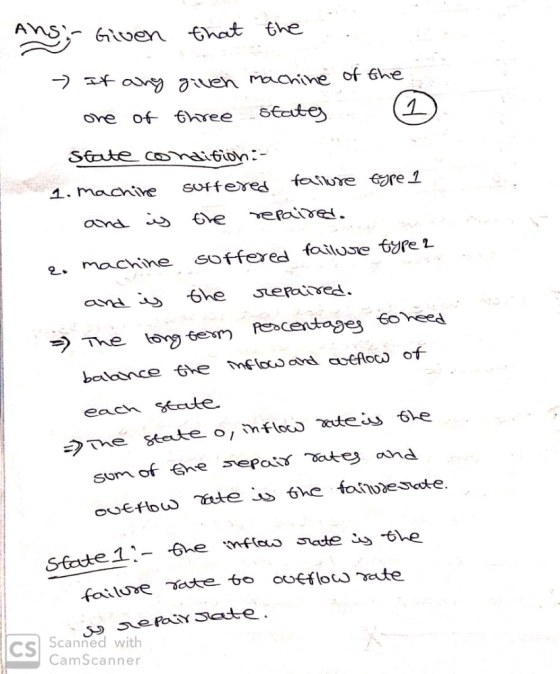
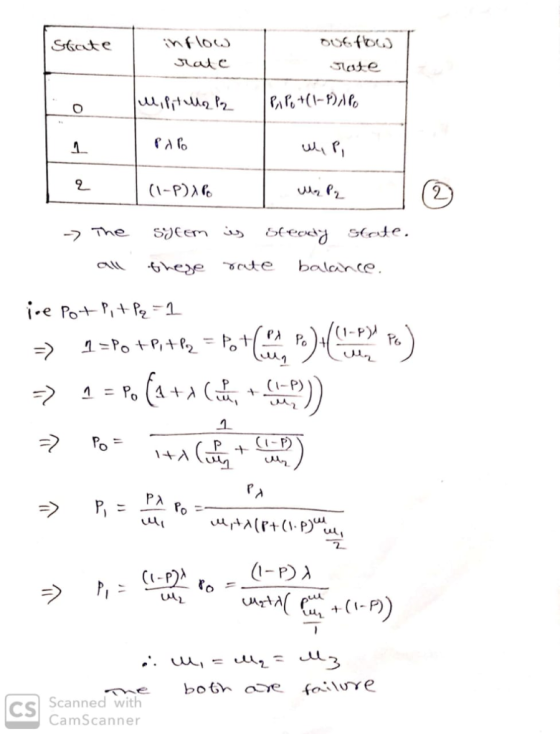
Q3. Each time a machine is repaired it remains "up" for an exponentially distributed time with rate A. It then fails and "down", and its failure is either of two types. If it is a typ...
 Q3. Each time a machine is repaired it remains "up" for an exponentially distributed time with rate A. It then fails and "down", and its failure is either of two types. If it is a type 1 failure, then the time to repair the machine is exponential with rate μ!, if it is a type 2 failure, then the repair time is exponential with rate H2. Each failure is, independently of the time it took the machine to fail, a...
random variable and signal processing
Each time a machine is repaired, it remains up for an exponentially distributed time with rate ?. It then fails, and its failure is either of two types: - Each failure is, independently of the time it took the machine to fail, a type 1 failure with probability ? and a type 2 failure with probability 1 − ?. - If it is a type ? failure, the time to repair the machine is exponential with rate ?? , ?...
Suppose that the time (in hours) required to repair a machine is an exponentially distributed random...
Suppose that the time (in hours) required to repair a machine is an exponentially distributed random variable with parameter λ=0.8, i.e., mean = 1/lambda. What is (a) the probability that a repair takes less than 77 hours?
Suppose d machines are subject to failures and repairs. The failure times are exponentially distributed with...
 Suppose d machines are subject to failures and repairs. The failure times are exponentially distributed with parameter μ, and the repair times are exponentially distributed with parameter λ. Let x(t) denote the number of machines that are in satisfactory order at time t. If there is only one repairman, then under appropriate reasonable assumptions, X(t), t 2 0, is a birth and death process on {O, 1,..., d} with birth rates λχ-λ, 0 x < d, and death rates μΧ_xp,...
A system is subject to two types of failure. When a failure occurs, it is type...
 A system is subject to two types of failure. When a failure occurs, it is type 1 with 40% probability The time from when the system is repaired until a new failure occurs exponentially distributed with mean of 30 days. If the failure is type 1, two different components are repaired by two repairmen in exponentially and independently distributed periods each with a mean of 2 days. If the failure is type 2, one component is repaircd by one repairman...
3. The time in days between breakdowns of a machine is exponentially distributed with λ-02 a....
 3. The time in days between breakdowns of a machine is exponentially distributed with λ-02 a. What is the expected time between machine breakdowns? b. What is the probability that after the machine is repaired, it lasts at least five days before failing again? C. If the machine has performed satisfactorily for seven days, what is the probability that it lasts nine days before breaking down?
. A facility of m identical machines is sharing a single repair person. The time to...
. A facility of m identical machines is sharing a single repair person. The time to repair a failed machine is exponentially distributed with mean 1/λ. A machine, once operational, fails after a time that is exponentially distributed with mean 1/μ. All failure and repair times are independent. (a) Draw state transition diagram (b) Find out expression for the steady-state proportion of time where there is no operational machine.
The average time between failures of a laser machine is exponentially distributed with a mean of...
The average time between failures of a laser machine is exponentially distributed with a mean of 40,000 hours. a) What is the expected time until 4th failure? b) What is the probability that the time to the 5th failure is greater than 80,000 hours?
The time between failures of a laser in a machine, X, is exponentially distributed with a...
 The time between failures of a laser in a machine, X, is exponentially distributed with a mean of 25,000 hours. In other words, 1 a= (failures/hour). 25,000 Exponential Distribution (pdf): f(x) = 1.0-\x, for x > 0. (a) What is the probability that the next failure occurs in 27,000 hours? (b) What is the expected time until the third failure? (c) What is the probability that the time until the third failure exceeds 25,000 hours?
Suppose that the time (in hours) required to repair a machine is an exponentially distributed random variable with parameter λ (lambda) = 0.5
Suppose that the time (in hours) required to repair a machine is an exponentially distributed random variable with parameter λ (lambda) = 0.5.What's the probability that a repair takes less than 5 hours? AND what's the conditional probability that a repair takes at least 11 hours, given that it takes more than 8 hours?
 Q3. Each time a machine is repaired it remains "up" for an exponentially distributed time with rate A. It then fails and "down", and its failure is either of two types. If it is a type 1 failure, then the time to repair the machine is exponential with rate μ!, if it is a type 2 failure, then the repair time is exponential with rate H2. Each failure is, independently of the time it took the machine to fail, a...
 Suppose d machines are subject to failures and repairs. The failure times are exponentially distributed with parameter μ, and the repair times are exponentially distributed with parameter λ. Let x(t) denote the number of machines that are in satisfactory order at time t. If there is only one repairman, then under appropriate reasonable assumptions, X(t), t 2 0, is a birth and death process on {O, 1,..., d} with birth rates λχ-λ, 0 x < d, and death rates μΧ_xp,...
 A system is subject to two types of failure. When a failure occurs, it is type 1 with 40% probability The time from when the system is repaired until a new failure occurs exponentially distributed with mean of 30 days. If the failure is type 1, two different components are repaired by two repairmen in exponentially and independently distributed periods each with a mean of 2 days. If the failure is type 2, one component is repaircd by one repairman...
 3. The time in days between breakdowns of a machine is exponentially distributed with λ-02 a. What is the expected time between machine breakdowns? b. What is the probability that after the machine is repaired, it lasts at least five days before failing again? C. If the machine has performed satisfactorily for seven days, what is the probability that it lasts nine days before breaking down?
 The time between failures of a laser in a machine, X, is exponentially distributed with a mean of 25,000 hours. In other words, 1 a= (failures/hour). 25,000 Exponential Distribution (pdf): f(x) = 1.0-\x, for x > 0. (a) What is the probability that the next failure occurs in 27,000 hours? (b) What is the expected time until the third failure? (c) What is the probability that the time until the third failure exceeds 25,000 hours?
Most questions answered within 3 hours.
-
Where is the error in this code sequence?
String s1 = "Hello";
String s2 = "ello";...
asked 11 months ago -
Financial data for Joel de Paris, Inc., for last year
follow:
Joel de Paris, Inc.
Balance...
asked 11 months ago -
Consider this reaction:
Al2(SO4)3 (aq)+ BaCl3
(aq) Al2Cl6 (aq)- +
3BaSO4(s) . What is the...
asked 11 months ago -
Suppose that Savneet is considering increasing her
recent random sample from 20 car rentals to 40...
asked 11 months ago -
Trucks arrive at an unloading terminal at an average rate of 120
per hour.
Trucks arrive...
asked 11 months ago -
Why are methanol and ethanol completely soluble in water while
octanol is not very little soluble....
asked 11 months ago -
A facilities manager at a university reads in a research report
that the mean amount of...
asked 11 months ago -
When the CuSO4 is rehydrated by adding water to the anhydrous
compound, is this an endothermic...
asked 11 months ago -
A ray of sunlight is passing from diamond into crown glass; the
angle of incidence is...
asked 11 months ago -
A block of mass 0.249 kg is placed on top of a light, vertical
spring of...
asked 11 months ago -
how do the kidneys compensate in the presences of acidosis
a) trigger hyperventilate
b) reserve acid...
asked 11 months ago -
Question 501 pts
The rental rate of capital to the firm increases. Which of the
following...
asked 11 months ago