
Homework Answers
Solution :-
For any given machine, it can have any one of the three states
State Condition
0 Machine works
1 Machine suffered faliure Type I and is being repaired
2 Machine suffered faliure Type II and is being repaired
For long term percentages we need to balance, the inflow and outflow rate for each state.
For state 0, the inflow rate is the sum of the repair rates and the outflow rate is the failure rate.
For State I, the inflow rate is the failure rate and the outflow rate is the repair rate.
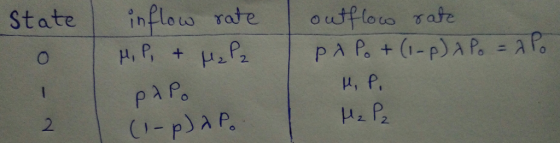
The system is in steady state, if all these rate balance.
We have the additional condition,

Add Answer to:
Q3. Each time a machine is repaired it remains "up" for an exponentially distributed time with rate A. It then fails and "down", and its failure is either of two types. If it is a typ...
4. Each time a machine is repaired, it remains up and working for an exponentially distributed ti...
 4. Each time a machine is repaired, it remains up and working for an exponentially distributed time with rate λ. It then fails, and its failure is either of two types. If it is type 1 failure, then the time to repair the machine is exponentially distributed with mean μ1; if it is a type 1 failure, then the time to repair the machine is exponentially distributed with mean μ2. Each failure is, independently of the time it took the...
random variable and signal processing
Each time a machine is repaired, it remains up for an exponentially distributed time with rate ?. It then fails, and its failure is either of two types: - Each failure is, independently of the time it took the machine to fail, a type 1 failure with probability ? and a type 2 failure with probability 1 − ?. - If it is a type ? failure, the time to repair the machine is exponential with rate ?? , ?...
A system is subject to two types of failure. When a failure occurs, it is type...
 A system is subject to two types of failure. When a failure occurs, it is type 1 with 40% probability The time from when the system is repaired until a new failure occurs exponentially distributed with mean of 30 days. If the failure is type 1, two different components are repaired by two repairmen in exponentially and independently distributed periods each with a mean of 2 days. If the failure is type 2, one component is repaircd by one repairman...
Q3. Commodore 64's computer has three critical parts, each of which is needed for the computer to work. The com...
 Q3. Commodore 64's computer has three critical parts, each of which is needed for the computer to work. The computer runs continuously as long as the three required parts are working. The three parts have mutually independent exponential lifetimes before they fail. The expected lifetime of parts 1, 2 and 3 are 10 weeks, 20 weeks and 30 weeks, respectively. When a part fails, the computer is shut down and an order is made for a new part of that...
3. Consider a fleet of N airplanes. Each airplane breaks down independently at rate μ, and is the...
 3. Consider a fleet of N airplanes. Each airplane breaks down independently at rate μ, and is then sent to the hangar for repair. The repair facility can only repair one airplane at a time and each airplane takes an exponential time of parameter λ to repair of the number of airplanes in service. (b) when N 2, find the smallest value of λ/μ such that the limit probability that all are in service is greater th an 1/2
3....
3. Consider a fleet of N airplanes. Each airplane breaks down independently at rate μ, and is then sent to the hangar for repair. The repair facility can only repair one airplane at a time and each airplane takes an exponential time of parameter λ to repair of the number of airplanes in service. (b) when N 2, find the smallest value of λ/μ such that the limit probability that all are in service is greater th an 1/2
3....
Homework Assignment 3.5 Summer 2018 Question 3: Continuous-time Markov Chains (a) A facility has three that...
 Homework Assignment 3.5 Summer 2018 Question 3: Continuous-time Markov Chains (a) A facility has three that are identical. Each machine fails independently with an exponential distribution with a rate of 1 every day; repairs on any machine are also exponentially distributed with a rate of 1 every 12 hours. Create a continuous-time Markov chain to model this (identify the rates, and the transition probabilities) (b) Now, assume the facility above has three machines, but one of them is of Type...
(1) Consider a "two machine two repairman" problem, where each machine independently breaks down ...
 (1) Consider a "two machine two repairman" problem, where each machine independently breaks down at rate μ (that is after an exponential waiting time with parameter μ) (a) If each repairman repairs a machine at rate λ, calculate the long term proportion of time when both machines are broken. [Hint: calculate the stationary probabilities.] You can also consider 4 marks] (b) Assume that repairman Abel works at rate X, and repairman Bernard works at rate Xb. When there is only...
Consider a machine with the exponential reliability model. Assume that the breakdown rate, lamba, is 1...
Consider a machine with the exponential reliability model. Assume that the breakdown rate, lamba, is 1 and repair rate, mu, is 2. (a) Calculate the probability that the machine is up for more than 10 units of time. (b) Calculate the probability that the machine is down for less than 3 units of time.
Problem 2 There are three machines and two mechanics in a factory. The break time of each machine...
 Problem 2 There are three machines and two mechanics in a factory. The break time of each machine is exponentially distributed with A 1 (per day). The repair time of a broken machine is also exponentially distributed with a mean of 3 hours. (Mechanics work separately) (1). Construct the rate diagram for this queueing system. (be careful about the arrival rate A) (2). Set up the rate balance equations, then solve for pn's. (3). Compute L (4). Compute the actual...
CASE 20 Enron: Not Accounting for the Future* INTRODUCTION Once upon a time, there was a...
 CASE 20 Enron: Not Accounting for the Future* INTRODUCTION Once upon a time, there was a gleaming office tower in Houston, Texas. In front of that gleaming tower was a giant "E" slowly revolving, flashing in the hot Texas sun. But in 2001, the Enron Corporation, which once ranked among the top Fortune 500 companies, would collapse under a mountain of debt that had been concealed through a complex scheme of off-balance-sheet partnerships. Forced to declare bankruptcy, the energy firm...
 4. Each time a machine is repaired, it remains up and working for an exponentially distributed time with rate λ. It then fails, and its failure is either of two types. If it is type 1 failure, then the time to repair the machine is exponentially distributed with mean μ1; if it is a type 1 failure, then the time to repair the machine is exponentially distributed with mean μ2. Each failure is, independently of the time it took the...
 A system is subject to two types of failure. When a failure occurs, it is type 1 with 40% probability The time from when the system is repaired until a new failure occurs exponentially distributed with mean of 30 days. If the failure is type 1, two different components are repaired by two repairmen in exponentially and independently distributed periods each with a mean of 2 days. If the failure is type 2, one component is repaircd by one repairman...
 Q3. Commodore 64's computer has three critical parts, each of which is needed for the computer to work. The computer runs continuously as long as the three required parts are working. The three parts have mutually independent exponential lifetimes before they fail. The expected lifetime of parts 1, 2 and 3 are 10 weeks, 20 weeks and 30 weeks, respectively. When a part fails, the computer is shut down and an order is made for a new part of that...
 3. Consider a fleet of N airplanes. Each airplane breaks down independently at rate μ, and is then sent to the hangar for repair. The repair facility can only repair one airplane at a time and each airplane takes an exponential time of parameter λ to repair of the number of airplanes in service. (b) when N 2, find the smallest value of λ/μ such that the limit probability that all are in service is greater th an 1/2
3....
3. Consider a fleet of N airplanes. Each airplane breaks down independently at rate μ, and is then sent to the hangar for repair. The repair facility can only repair one airplane at a time and each airplane takes an exponential time of parameter λ to repair of the number of airplanes in service. (b) when N 2, find the smallest value of λ/μ such that the limit probability that all are in service is greater th an 1/2
3....
 Homework Assignment 3.5 Summer 2018 Question 3: Continuous-time Markov Chains (a) A facility has three that are identical. Each machine fails independently with an exponential distribution with a rate of 1 every day; repairs on any machine are also exponentially distributed with a rate of 1 every 12 hours. Create a continuous-time Markov chain to model this (identify the rates, and the transition probabilities) (b) Now, assume the facility above has three machines, but one of them is of Type...
 (1) Consider a "two machine two repairman" problem, where each machine independently breaks down at rate μ (that is after an exponential waiting time with parameter μ) (a) If each repairman repairs a machine at rate λ, calculate the long term proportion of time when both machines are broken. [Hint: calculate the stationary probabilities.] You can also consider 4 marks] (b) Assume that repairman Abel works at rate X, and repairman Bernard works at rate Xb. When there is only...
 Problem 2 There are three machines and two mechanics in a factory. The break time of each machine is exponentially distributed with A 1 (per day). The repair time of a broken machine is also exponentially distributed with a mean of 3 hours. (Mechanics work separately) (1). Construct the rate diagram for this queueing system. (be careful about the arrival rate A) (2). Set up the rate balance equations, then solve for pn's. (3). Compute L (4). Compute the actual...
 CASE 20 Enron: Not Accounting for the Future* INTRODUCTION Once upon a time, there was a gleaming office tower in Houston, Texas. In front of that gleaming tower was a giant "E" slowly revolving, flashing in the hot Texas sun. But in 2001, the Enron Corporation, which once ranked among the top Fortune 500 companies, would collapse under a mountain of debt that had been concealed through a complex scheme of off-balance-sheet partnerships. Forced to declare bankruptcy, the energy firm...
Most questions answered within 3 hours.
-
Where is the error in this code sequence?
String s1 = "Hello";
String s2 = "ello";...
asked 10 months ago -
Financial data for Joel de Paris, Inc., for last year
follow:
Joel de Paris, Inc.
Balance...
asked 10 months ago -
Consider this reaction:
Al2(SO4)3 (aq)+ BaCl3
(aq) Al2Cl6 (aq)- +
3BaSO4(s) . What is the...
asked 10 months ago -
Suppose that Savneet is considering increasing her
recent random sample from 20 car rentals to 40...
asked 10 months ago -
Trucks arrive at an unloading terminal at an average rate of 120
per hour.
Trucks arrive...
asked 10 months ago -
Why are methanol and ethanol completely soluble in water while
octanol is not very little soluble....
asked 10 months ago -
A facilities manager at a university reads in a research report
that the mean amount of...
asked 10 months ago -
When the CuSO4 is rehydrated by adding water to the anhydrous
compound, is this an endothermic...
asked 10 months ago -
A ray of sunlight is passing from diamond into crown glass; the
angle of incidence is...
asked 10 months ago -
A block of mass 0.249 kg is placed on top of a light, vertical
spring of...
asked 10 months ago -
how do the kidneys compensate in the presences of acidosis
a) trigger hyperventilate
b) reserve acid...
asked 10 months ago -
Question 501 pts
The rental rate of capital to the firm increases. Which of the
following...
asked 10 months ago