
Homework Answers
According to the crystal field theory,
- it assumes metals and ligands as point charges.
- it assumes neutral Ligand as a dipole.
- according to CFT, Octahedral Complex is formed when metal ion is present in the octahedral void formed by the Ligand.

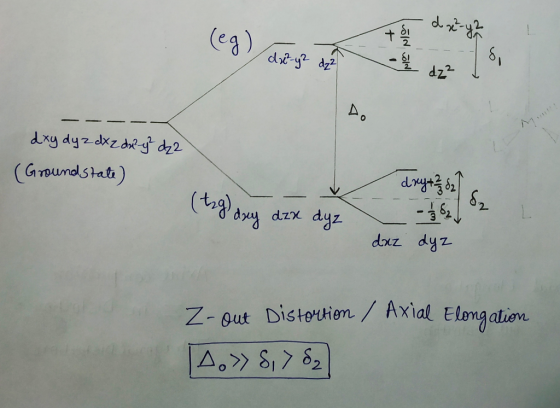
JAHN TALLER DISTORTION- According to it, If any metal posses Electronic degeneracy in Octahedral field then it will try to remove its electronic energy by lowering the overall symmetry of the molecule.
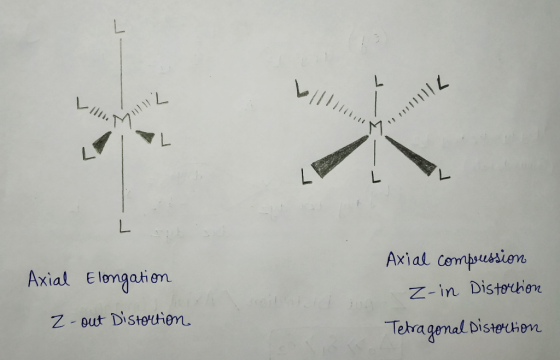
Z- OUT DISTORTION/ AXIAL ELONGATION - the energies of d- Orbitals having Z factor i.e. dxz, dyz, dz2. are lowered and the bonds along Z- axis elongates.
this type of distortion generally occurred with degenerate eg level.
Z-IN DISTORTION / AXIALLY COMPRESSED / TETRAGONALY COMPRESSED - the energies of d- orbitals with Z factor i.e.. dxz, dyz, dz2 , increased and the bond along Z- axis compressed or shortened.

Add Answer to:
Using the crystal field theory approach, draw the d-orbital splitting diagram for octahedral [Cu(...
5. The complex [Cu(CN).]* undergoes tetragonal elongation due to Jahn-Teller distortion Draw the Crystal field splitting...
 5. The complex [Cu(CN).]* undergoes tetragonal elongation due to Jahn-Teller distortion Draw the Crystal field splitting diagram for the complex and fill orbitals with electrons.
2.) Starting with the octahedral (ML6) crystal field splitting pattern below: A.) Draw the d-orbital splitting...
 2.) Starting with the octahedral (ML6) crystal field splitting pattern below: A.) Draw the d-orbital splitting for a tetragonally compressed compound (ML6). This is where the ligands along the z-axis are pushed closer to the metal center, and the ligands along the x and y-axis are pulled further from the metal center (10 marks). B.) Continue this trend until the ligands along the x and y axes are completely removed, and show the d-orbital splitting for the resulting linear complex...
2.) Starting with the octahedral (ML6) crystal field splitting pattern below: A.) Draw the d-orbital splitting...
 2.) Starting with the octahedral (ML6) crystal field splitting pattern below: A.) Draw the d-orbital splitting for a tetragonally compressed compound (ML6). This is where the ligands along the z-axis are pushed closer to the metal center, and the ligands along the x and y-axis are pulled further from the metal center (10 marks). B.) Continue this trend until the ligands along the x and y axes are completely removed, and show the d-orbital splitting for the resulting linear complex...
a) Draw a d orbital electronic configuration of a distorted Cu" octahedral complex: Compression along the...
 a) Draw a d orbital electronic configuration of a distorted Cu" octahedral complex: Compression along the z axis elongation along z axis b) The distortions in Cul complexes are often the consequence of which effect? c) What other metal ions display this effect?
2. a. Draw and show the crystal field splitting of the d orbitals in an octahedral...
 2. a. Draw and show the crystal field splitting of the d orbitals in an octahedral complex, a tetrahedral complex, and in a square planar complex.(clearly label the orbitals) b. Explain the difference in the following crystal field splitting values (1) Co(NH3).]2+ 10200 cm"! : [CO(NH3).]* 22,900 cm (ii) [Cr(H20).]** 17,400 cm. ; [Cr(CN).]3-26,600 cm (iii) [MnF6]?- 22,200 cm-"; [ReF.]?- 27,800 cm- (iv) [Co(NH3).]2+ 10,200 cm '; [Co(NH3)4]2+ 5,900 cm c. Draw and show the filling of 6 d electrons...
-Drawing a crystal field theory energy level diagram Using crystal field theory, draw an electron box...
 -Drawing a crystal field theory energy level diagram Using crystal field theory, draw an electron box energy level diagram for the valence d orbitals on the vanadium atom in a complex. Your diagram should show the relative energy of each orbital, and the number of electrons in each orbital. Note: to make your diagram easier to read, label the d orbitals with just the subscript. For example, label the d.2 orbital with just z energy
1. What is the crystal field stabilisation energy (CFSE) of a d5 metal ion in an...
1. What is the crystal field stabilisation energy (CFSE) of a d5 metal ion in an octahedral ligand field surrounded by weak field ligands? +5Dq -20Dq 0Dq -5Dq -20Dq + P 2. The relative ordering of the d orbital energy levels for a complex such as [Cu(H2O)6]2+ which exhibits tetragonal elongation due to the Jahn-Teller Effect is: Group of answer choices xz = yz = xy < x2-y2 = z2 xy < xz = yz < x2-y2 < z2 xz...
 5. The complex [Cu(CN).]* undergoes tetragonal elongation due to Jahn-Teller distortion Draw the Crystal field splitting diagram for the complex and fill orbitals with electrons.
 2.) Starting with the octahedral (ML6) crystal field splitting pattern below: A.) Draw the d-orbital splitting for a tetragonally compressed compound (ML6). This is where the ligands along the z-axis are pushed closer to the metal center, and the ligands along the x and y-axis are pulled further from the metal center (10 marks). B.) Continue this trend until the ligands along the x and y axes are completely removed, and show the d-orbital splitting for the resulting linear complex...
 2.) Starting with the octahedral (ML6) crystal field splitting pattern below: A.) Draw the d-orbital splitting for a tetragonally compressed compound (ML6). This is where the ligands along the z-axis are pushed closer to the metal center, and the ligands along the x and y-axis are pulled further from the metal center (10 marks). B.) Continue this trend until the ligands along the x and y axes are completely removed, and show the d-orbital splitting for the resulting linear complex...
 a) Draw a d orbital electronic configuration of a distorted Cu" octahedral complex: Compression along the z axis elongation along z axis b) The distortions in Cul complexes are often the consequence of which effect? c) What other metal ions display this effect?
 2. a. Draw and show the crystal field splitting of the d orbitals in an octahedral complex, a tetrahedral complex, and in a square planar complex.(clearly label the orbitals) b. Explain the difference in the following crystal field splitting values (1) Co(NH3).]2+ 10200 cm"! : [CO(NH3).]* 22,900 cm (ii) [Cr(H20).]** 17,400 cm. ; [Cr(CN).]3-26,600 cm (iii) [MnF6]?- 22,200 cm-"; [ReF.]?- 27,800 cm- (iv) [Co(NH3).]2+ 10,200 cm '; [Co(NH3)4]2+ 5,900 cm c. Draw and show the filling of 6 d electrons...
 -Drawing a crystal field theory energy level diagram Using crystal field theory, draw an electron box energy level diagram for the valence d orbitals on the vanadium atom in a complex. Your diagram should show the relative energy of each orbital, and the number of electrons in each orbital. Note: to make your diagram easier to read, label the d orbitals with just the subscript. For example, label the d.2 orbital with just z energy
Most questions answered within 3 hours.
-
Where is the error in this code sequence?
String s1 = "Hello";
String s2 = "ello";...
asked 10 months ago -
Financial data for Joel de Paris, Inc., for last year
follow:
Joel de Paris, Inc.
Balance...
asked 10 months ago -
Consider this reaction:
Al2(SO4)3 (aq)+ BaCl3
(aq) Al2Cl6 (aq)- +
3BaSO4(s) . What is the...
asked 10 months ago -
Suppose that Savneet is considering increasing her
recent random sample from 20 car rentals to 40...
asked 10 months ago -
Trucks arrive at an unloading terminal at an average rate of 120
per hour.
Trucks arrive...
asked 10 months ago -
Why are methanol and ethanol completely soluble in water while
octanol is not very little soluble....
asked 10 months ago -
A facilities manager at a university reads in a research report
that the mean amount of...
asked 10 months ago -
When the CuSO4 is rehydrated by adding water to the anhydrous
compound, is this an endothermic...
asked 10 months ago -
A ray of sunlight is passing from diamond into crown glass; the
angle of incidence is...
asked 10 months ago -
A block of mass 0.249 kg is placed on top of a light, vertical
spring of...
asked 10 months ago -
how do the kidneys compensate in the presences of acidosis
a) trigger hyperventilate
b) reserve acid...
asked 10 months ago -
Question 501 pts
The rental rate of capital to the firm increases. Which of the
following...
asked 10 months ago