
Homework Answers
 hope you understand if not
please upload again
hope you understand if not
please upload again
THANK YOU
Add Answer to:
(1 point) Use RK2 (Heun's method) with h 1/4 to estimate (1) given 0) de2 ESAD. 32 ys уз y4 Find ...
(1 point) Use RK2 (Heun's method) with h 1/6 to estimate y(0.666666666666667) given y: İYa: Find ...
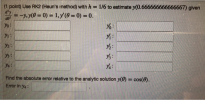 (1 point) Use RK2 (Heun's method) with h 1/6 to estimate y(0.666666666666667) given y: İYa: Find the absolute error relative to the analytic solution y(0) cos(0). Error in y4:
(1 point) Use RK2 (Heun's method) with h 1/6 to estimate y(0.666666666666667) given y: İYa: Find the absolute error relative to the analytic solution y(0) cos(0). Error in y4:
(1 point) Use RK2 (Heun's method) with h 1/6 to estimate y(0.666666666666667) given y: İYa: Find the absolute error relative to the analytic solution y(0) cos(0). Error in y4:
Given the ODE and initial condition 3. y(0) = 1 dt=yi-y Use the explicit predictor-corrector (Heun's)...
 Given the ODE and initial condition 3. y(0) = 1 dt=yi-y Use the explicit predictor-corrector (Heun's) method to manually (i.e. on paper, by hand use Matlab as a calculator, however) integrate this from t -0 to t 1.5 using h 0.5. Describe technique in words and/or equations and fill out the table below with this solution att -[0.0,0.s -you may you i Ss Step 1 Step 2 Step 3 y'(0.0) = y'(0.5) = (0.5)
Suppose that x4 + y4 = 82. (1) Use the method of implicit differentiation to find...
 Suppose that x4 + y4 = 82. (1) Use the method of implicit differentiation to find dy Preview (2) Find the equation of the tangent line at the point (x, y) = (-1, -3). The equation is y = Preview
Problem 1 Use Euler's method with step size h = 0.5 to approximate the solution of the IVP. 2 dy ...
 Problem 1 Use Euler's method with step size h = 0.5 to approximate the solution of the IVP. 2 dy ev dt t 1-t-2, y(1) = 0. Problem 2 Consider the IVP: dy dt (a) Use Euler's method with step size h0.25 to approximate y(0.5) b) Find the exact solution of the IV P c) Find the maximum error in approximating y(0.5) by y2 (d) Calculate the actual absolute error in approximating y(0.5) by /2.
Problem 1 Use Euler's method...
Problem 1 Use Euler's method with step size h = 0.5 to approximate the solution of the IVP. 2 dy ev dt t 1-t-2, y(1) = 0. Problem 2 Consider the IVP: dy dt (a) Use Euler's method with step size h0.25 to approximate y(0.5) b) Find the exact solution of the IV P c) Find the maximum error in approximating y(0.5) by y2 (d) Calculate the actual absolute error in approximating y(0.5) by /2.
Problem 1 Use Euler's method...
1 st s2, y(1)1 The exact solution is given by yo) - = . 1+Int Write a MATLAB code to approximate ...
 1 st s2, y(1)1 The exact solution is given by yo) - = . 1+Int Write a MATLAB code to approximate the solution of the IVP using Midpoint (RK2) and Modified Euler methods when h [0.5 0.1 0.0s 0.01 0.005 0.001]. A) Find the vector w mid and w mod that approximates the solution of the IVP for different values of h. B) Plot the step-size h versus the relative error of both in the same figure using the LOGLOG...
4. (a) (7 points) Use Euler's method with step size h = 0.5 to estimate the...
 4. (a) (7 points) Use Euler's method with step size h = 0.5 to estimate the value at t = 1 of the solution to the initial value problem =t+y and y(0) = 1. dy
choosing C to make P(t) match P(0) at t = 0. Compute the maximum error over 0 ≤ t ≤ 1 for each solution you obtain. How do the errors change with h for the two methods? dP aP (PM-P). With a 1 and...
 choosing C to make P(t) match P(0) at t = 0. Compute the
maximum error
over 0 ≤ t ≤ 1 for each solution you obtain. How do the errors
change with
h for the two methods?
dP aP (PM-P). With a 1 and PM 10, solve this equation with both Euler's method and Heun's method for step sizes h = 10-k for k = 1, 2, 3 for the interval 0 t1. Use the initial value P(O) 1. Given...
choosing C to make P(t) match P(0) at t = 0. Compute the
maximum error
over 0 ≤ t ≤ 1 for each solution you obtain. How do the errors
change with
h for the two methods?
dP aP (PM-P). With a 1 and PM 10, solve this equation with both Euler's method and Heun's method for step sizes h = 10-k for k = 1, 2, 3 for the interval 0 t1. Use the initial value P(O) 1. Given...
step Consider the IVP y = 1 + y?, y(0) = 0 a. Use the Runge-Kutta...
 step Consider the IVP y = 1 + y?, y(0) = 0 a. Use the Runge-Kutta Method with step size 0.1 to approximate y(0.2) b. Find the error between the analytic solution and the approximate solution at each step
Chapter 4, Section 4.4, Additional Question 01 Use the method of variation of parameters to determine the general solution of the given differential equation. y4 +2y y 11sin (t) Use C1, C2, C3, f...
 Chapter 4, Section 4.4, Additional Question 01 Use the method of variation of parameters to determine the general solution of the given differential equation. y4 +2y y 11sin (t) Use C1, C2, C3, for the constants of integration. Enclose arguments of functions in parentheses. For example, sin (2x)
Chapter 4, Section 4.4, Additional Question 01 Use the method of variation of parameters to determine the general solution of the given differential equation. y4 +2y y 11sin (t) Use C1, C2,...
Chapter 4, Section 4.4, Additional Question 01 Use the method of variation of parameters to determine the general solution of the given differential equation. y4 +2y y 11sin (t) Use C1, C2, C3, for the constants of integration. Enclose arguments of functions in parentheses. For example, sin (2x)
Chapter 4, Section 4.4, Additional Question 01 Use the method of variation of parameters to determine the general solution of the given differential equation. y4 +2y y 11sin (t) Use C1, C2,...
A use Euler's method with each of the following step sizes to estimate the value of y 0.4 where y...
 a use Euler's method with each of the following step sizes to estimate the value of y 0.4 where y is the solution of the initial value problem y -y, y 0 3 カー0.4 0.4) (i) y10.4) (in) h= 0.1 b we know that the exact solution of the initial value problem n part a s yー3e ra , as accurately as you can the graph of y e r 4 together with the Euler approximations using the step sizes...
 (1 point) Use RK2 (Heun's method) with h 1/6 to estimate y(0.666666666666667) given y: İYa: Find the absolute error relative to the analytic solution y(0) cos(0). Error in y4:
(1 point) Use RK2 (Heun's method) with h 1/6 to estimate y(0.666666666666667) given y: İYa: Find the absolute error relative to the analytic solution y(0) cos(0). Error in y4:
(1 point) Use RK2 (Heun's method) with h 1/6 to estimate y(0.666666666666667) given y: İYa: Find the absolute error relative to the analytic solution y(0) cos(0). Error in y4:
 Given the ODE and initial condition 3. y(0) = 1 dt=yi-y Use the explicit predictor-corrector (Heun's) method to manually (i.e. on paper, by hand use Matlab as a calculator, however) integrate this from t -0 to t 1.5 using h 0.5. Describe technique in words and/or equations and fill out the table below with this solution att -[0.0,0.s -you may you i Ss Step 1 Step 2 Step 3 y'(0.0) = y'(0.5) = (0.5)
 Suppose that x4 + y4 = 82. (1) Use the method of implicit differentiation to find dy Preview (2) Find the equation of the tangent line at the point (x, y) = (-1, -3). The equation is y = Preview
 Problem 1 Use Euler's method with step size h = 0.5 to approximate the solution of the IVP. 2 dy ev dt t 1-t-2, y(1) = 0. Problem 2 Consider the IVP: dy dt (a) Use Euler's method with step size h0.25 to approximate y(0.5) b) Find the exact solution of the IV P c) Find the maximum error in approximating y(0.5) by y2 (d) Calculate the actual absolute error in approximating y(0.5) by /2.
Problem 1 Use Euler's method...
Problem 1 Use Euler's method with step size h = 0.5 to approximate the solution of the IVP. 2 dy ev dt t 1-t-2, y(1) = 0. Problem 2 Consider the IVP: dy dt (a) Use Euler's method with step size h0.25 to approximate y(0.5) b) Find the exact solution of the IV P c) Find the maximum error in approximating y(0.5) by y2 (d) Calculate the actual absolute error in approximating y(0.5) by /2.
Problem 1 Use Euler's method...
 1 st s2, y(1)1 The exact solution is given by yo) - = . 1+Int Write a MATLAB code to approximate the solution of the IVP using Midpoint (RK2) and Modified Euler methods when h [0.5 0.1 0.0s 0.01 0.005 0.001]. A) Find the vector w mid and w mod that approximates the solution of the IVP for different values of h. B) Plot the step-size h versus the relative error of both in the same figure using the LOGLOG...
 4. (a) (7 points) Use Euler's method with step size h = 0.5 to estimate the value at t = 1 of the solution to the initial value problem =t+y and y(0) = 1. dy
 choosing C to make P(t) match P(0) at t = 0. Compute the
maximum error
over 0 ≤ t ≤ 1 for each solution you obtain. How do the errors
change with
h for the two methods?
dP aP (PM-P). With a 1 and PM 10, solve this equation with both Euler's method and Heun's method for step sizes h = 10-k for k = 1, 2, 3 for the interval 0 t1. Use the initial value P(O) 1. Given...
choosing C to make P(t) match P(0) at t = 0. Compute the
maximum error
over 0 ≤ t ≤ 1 for each solution you obtain. How do the errors
change with
h for the two methods?
dP aP (PM-P). With a 1 and PM 10, solve this equation with both Euler's method and Heun's method for step sizes h = 10-k for k = 1, 2, 3 for the interval 0 t1. Use the initial value P(O) 1. Given...
 step Consider the IVP y = 1 + y?, y(0) = 0 a. Use the Runge-Kutta Method with step size 0.1 to approximate y(0.2) b. Find the error between the analytic solution and the approximate solution at each step
 Chapter 4, Section 4.4, Additional Question 01 Use the method of variation of parameters to determine the general solution of the given differential equation. y4 +2y y 11sin (t) Use C1, C2, C3, for the constants of integration. Enclose arguments of functions in parentheses. For example, sin (2x)
Chapter 4, Section 4.4, Additional Question 01 Use the method of variation of parameters to determine the general solution of the given differential equation. y4 +2y y 11sin (t) Use C1, C2,...
Chapter 4, Section 4.4, Additional Question 01 Use the method of variation of parameters to determine the general solution of the given differential equation. y4 +2y y 11sin (t) Use C1, C2, C3, for the constants of integration. Enclose arguments of functions in parentheses. For example, sin (2x)
Chapter 4, Section 4.4, Additional Question 01 Use the method of variation of parameters to determine the general solution of the given differential equation. y4 +2y y 11sin (t) Use C1, C2,...
 a use Euler's method with each of the following step sizes to estimate the value of y 0.4 where y is the solution of the initial value problem y -y, y 0 3 カー0.4 0.4) (i) y10.4) (in) h= 0.1 b we know that the exact solution of the initial value problem n part a s yー3e ra , as accurately as you can the graph of y e r 4 together with the Euler approximations using the step sizes...
Most questions answered within 3 hours.
-
Where is the error in this code sequence?
String s1 = "Hello";
String s2 = "ello";...
asked 10 months ago -
Financial data for Joel de Paris, Inc., for last year
follow:
Joel de Paris, Inc.
Balance...
asked 10 months ago -
Consider this reaction:
Al2(SO4)3 (aq)+ BaCl3
(aq) Al2Cl6 (aq)- +
3BaSO4(s) . What is the...
asked 10 months ago -
Suppose that Savneet is considering increasing her
recent random sample from 20 car rentals to 40...
asked 10 months ago -
Trucks arrive at an unloading terminal at an average rate of 120
per hour.
Trucks arrive...
asked 10 months ago -
Why are methanol and ethanol completely soluble in water while
octanol is not very little soluble....
asked 10 months ago -
A facilities manager at a university reads in a research report
that the mean amount of...
asked 10 months ago -
When the CuSO4 is rehydrated by adding water to the anhydrous
compound, is this an endothermic...
asked 10 months ago -
A ray of sunlight is passing from diamond into crown glass; the
angle of incidence is...
asked 10 months ago -
A block of mass 0.249 kg is placed on top of a light, vertical
spring of...
asked 10 months ago -
how do the kidneys compensate in the presences of acidosis
a) trigger hyperventilate
b) reserve acid...
asked 10 months ago -
Question 501 pts
The rental rate of capital to the firm increases. Which of the
following...
asked 10 months ago