
Homework Answers

Given


Add Answer to:
4. In a particular series RLC circuit driven by an AC source of a set frequency, the voltage on t...
A series RLC circuit has a 242 Hz resonant frequency, and is driven by an AC...
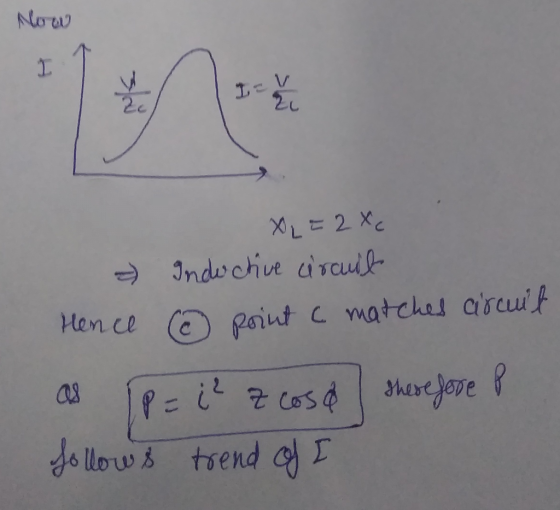
 A series RLC circuit has a 242 Hz resonant frequency, and is
driven by an AC voltage source at 315 Hz. The circuit has a 75.0
resistor and a
66.0 mH inductor. The maximum current is 1.20 A.
a) Find the capacitance in the circuit.
b) Find the maximum voltage of the source.
c) Find the average power of the circuit
d) Find the phase angle .
A series RLC circuit has a 242 Hz resonant frequency, and is
driven by an AC voltage source at 315 Hz. The circuit has a 75.0
resistor and a
66.0 mH inductor. The maximum current is 1.20 A.
a) Find the capacitance in the circuit.
b) Find the maximum voltage of the source.
c) Find the average power of the circuit
d) Find the phase angle .
We have a series RLC circuit with an AC voltage source: The resistance is 100Ohm, the inductance ...
We have a series RLC circuit with an AC voltage source: The resistance is 100Ohm, the inductance is 10mH, the capacitance is 10mF. Select all the right answers. At 60Hz What is true? Question 10 options: The current through the inductor is larger than through the resistor The voltage across the inductor is larger than the voltage across the capacitor The voltage is lagging behind the current at the source The voltage and the current are in phase at the...
The RLC circuit below is being driven by an AC source with a frequency of 47.77...
 The RLC circuit below is being driven by an AC source with a
frequency of 47.77 Hz resulting in a maximum current Imax = 0.25
amps.
24) In this circuit, the voltage
across the capacitor __________ the current through the capacitor
and the voltage across the resistor __________ the current through
the resistor.
leads, lags
leads, leads
lags, leads
lags, lags
lags, is in phase with
is in phase with, leads
Totally unrelated question....
25) A local radio station broadcasts
at the...
The RLC circuit below is being driven by an AC source with a
frequency of 47.77 Hz resulting in a maximum current Imax = 0.25
amps.
24) In this circuit, the voltage
across the capacitor __________ the current through the capacitor
and the voltage across the resistor __________ the current through
the resistor.
leads, lags
leads, leads
lags, leads
lags, lags
lags, is in phase with
is in phase with, leads
Totally unrelated question....
25) A local radio station broadcasts
at the...
An RLC circuit consists of an AC voltage source with a maximum voltage of 131 Volts...
An RLC circuit consists of an AC voltage source with a maximum voltage of 131 Volts connected in series to a resistor, a capacitor, and an inductor. At the resonant frequency, the inductive reactance is 15 Ohms and the total impedance of the circuit is 29 Ohms. What is the average power produced by the battery at 2.7 times the resonant frequency in Watts?
Consider an RLC circuit that is driven by an AC source with an adjustable frequency. Is...
Consider an RLC circuit that is driven by an AC source with an adjustable frequency. Is possible for the maximum voltage drop across the capacitor to exceed the maximum voltage? Please explain with some detail.
A series LRC circuit is driven by an ac source with a voltage amplitude of 36.0...
 A series LRC circuit is driven by an ac source with a voltage amplitude of 36.0 V and a frequency of 60.0 Hz. The resistance is 160 Ohm, the inductance is 0.230 H, and the capacitance is 70.0 mu F. a) Determine the impedance of the circuit. b) Determine the current amplitude. c) Determine the voltage amplitude across (i) the resistor, (ii) the inductor and (iii) the capacitor. d) Sketch the phasor diagram (at t = 0) for the circuit,...
A series RLC circuit is driven by an alternating source at a frequency of 296 Hz...
A series RLC circuit is driven by an alternating source at a frequency of 296 Hz and an emf amplitude of 78.2 V. The resistance is 27.1 Ω, the capacitance is 10.5 µF, and the inductance is 25.5 mH. What is the rms potential difference across (a) the resistor, (b) the capacitor, and (c) the inductor? (d) What is the average rate at which energy is dissipated?
An RLC circuit consists of a resistor, a inductor, and a capacitor connected in series to an AC v...
An RLC circuit consists of a resistor, a inductor, and a capacitor connected in series to an AC voltage source with an RMS voltage of 74 volts. At half the resonant frequency, the phase angle is -25 degrees and the inductive reactance is 47 Ohms. What is the average dissipated power at twice the resonant frequency in Watts?
An RLC circuit is driven by an AC generator. The voltage of the generator is VRMS...
 An RLC circuit is driven by an AC generator. The voltage of the generator is VRMS = 81.4 V. The figure shows the RMS current through the circuit as a function of the driving frequency. 900 800 700 600 500 400 300 200 100 0 100 0 200 300 400 500 600 700 800 900 driving frequency (Hz) What is the resonant frequency of this circuit? Please, notice that the resonance curve passes through a grid intersection point. Tries 0/12...
4) An RLC circuit consists of a resistor, a inductor, and a capacitor connected in series to an A...
4) An RLC circuit consists of a resistor, a inductor, and a capacitor connected in series to an AC voltage source with an RMS voltage of 59 volts. At half the resonant frequency, the phase angle is -35 degrees and the inductive reactance is 46 Ohms. What is the average dissipated power at twice the resonant frequency in Watts?
 A series RLC circuit has a 242 Hz resonant frequency, and is
driven by an AC voltage source at 315 Hz. The circuit has a 75.0
resistor and a
66.0 mH inductor. The maximum current is 1.20 A.
a) Find the capacitance in the circuit.
b) Find the maximum voltage of the source.
c) Find the average power of the circuit
d) Find the phase angle .
A series RLC circuit has a 242 Hz resonant frequency, and is
driven by an AC voltage source at 315 Hz. The circuit has a 75.0
resistor and a
66.0 mH inductor. The maximum current is 1.20 A.
a) Find the capacitance in the circuit.
b) Find the maximum voltage of the source.
c) Find the average power of the circuit
d) Find the phase angle .
 The RLC circuit below is being driven by an AC source with a
frequency of 47.77 Hz resulting in a maximum current Imax = 0.25
amps.
24) In this circuit, the voltage
across the capacitor __________ the current through the capacitor
and the voltage across the resistor __________ the current through
the resistor.
leads, lags
leads, leads
lags, leads
lags, lags
lags, is in phase with
is in phase with, leads
Totally unrelated question....
25) A local radio station broadcasts
at the...
The RLC circuit below is being driven by an AC source with a
frequency of 47.77 Hz resulting in a maximum current Imax = 0.25
amps.
24) In this circuit, the voltage
across the capacitor __________ the current through the capacitor
and the voltage across the resistor __________ the current through
the resistor.
leads, lags
leads, leads
lags, leads
lags, lags
lags, is in phase with
is in phase with, leads
Totally unrelated question....
25) A local radio station broadcasts
at the...
 A series LRC circuit is driven by an ac source with a voltage amplitude of 36.0 V and a frequency of 60.0 Hz. The resistance is 160 Ohm, the inductance is 0.230 H, and the capacitance is 70.0 mu F. a) Determine the impedance of the circuit. b) Determine the current amplitude. c) Determine the voltage amplitude across (i) the resistor, (ii) the inductor and (iii) the capacitor. d) Sketch the phasor diagram (at t = 0) for the circuit,...
 An RLC circuit is driven by an AC generator. The voltage of the generator is VRMS = 81.4 V. The figure shows the RMS current through the circuit as a function of the driving frequency. 900 800 700 600 500 400 300 200 100 0 100 0 200 300 400 500 600 700 800 900 driving frequency (Hz) What is the resonant frequency of this circuit? Please, notice that the resonance curve passes through a grid intersection point. Tries 0/12...
Most questions answered within 3 hours.
-
Where is the error in this code sequence?
String s1 = "Hello";
String s2 = "ello";...
asked 10 months ago -
Financial data for Joel de Paris, Inc., for last year
follow:
Joel de Paris, Inc.
Balance...
asked 10 months ago -
Consider this reaction:
Al2(SO4)3 (aq)+ BaCl3
(aq) Al2Cl6 (aq)- +
3BaSO4(s) . What is the...
asked 10 months ago -
Suppose that Savneet is considering increasing her
recent random sample from 20 car rentals to 40...
asked 10 months ago -
Trucks arrive at an unloading terminal at an average rate of 120
per hour.
Trucks arrive...
asked 10 months ago -
Why are methanol and ethanol completely soluble in water while
octanol is not very little soluble....
asked 10 months ago -
A facilities manager at a university reads in a research report
that the mean amount of...
asked 10 months ago -
When the CuSO4 is rehydrated by adding water to the anhydrous
compound, is this an endothermic...
asked 10 months ago -
A ray of sunlight is passing from diamond into crown glass; the
angle of incidence is...
asked 10 months ago -
A block of mass 0.249 kg is placed on top of a light, vertical
spring of...
asked 10 months ago -
how do the kidneys compensate in the presences of acidosis
a) trigger hyperventilate
b) reserve acid...
asked 10 months ago -
Question 501 pts
The rental rate of capital to the firm increases. Which of the
following...
asked 10 months ago