Consider an analog signal x(t) = 2 cos(2π600t). The signal is sampled at a rate 3000 samples per ...
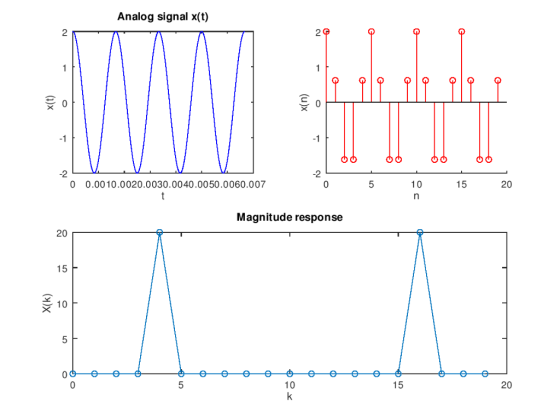
Consider an analog signal x(t) = 2 cos(2π600t). The signal is sampled at a rate 3000 samples per second and 20 samples are saved to memory. Sketch the magnitude of the length 20 DFT of the sampled data. For credit, clearly label axes, and exactly sketch the magnitudes (if you connect points in a line drawing, rather than a “stem” plot, then clearly mark the points themselves).
Homework Answers
%plot analog signal
T=1/600
t=0:T/100:4*T
x=2*cos(2*pi*600*t)
subplot(221)
plot(t,x,'b')
xlabel('t')
ylabel('x(t)')
title('Analog signal x(t)')
%plot sampled signal
N=20
n=0:1:N-1
fs=3000
Ts=1/fs
t=n*Ts
x=2*cos(2*pi*600*t)
subplot(222)
stem(n,x,'r')
xlabel('n')
ylabel('x(n)')
%20 point DFT of sampled signal
Xk=fft(x,N)
k=0:1:N-1
subplot(2,2,[3,4])
plot(k,abs(Xk),'o-')
xlabel('k')
ylabel('X(k)')
title('Magnitude response')
Add Answer to:
Consider an analog signal x(t) = 2 cos(2π600t). The signal is sampled at a rate 3000 samples per ...
Consider a speech signal x() that has the following frequency spectrum: xga) 1 + cos( -/100 a) Se...
 Digital Signal Processing
DFT
Consider a speech signal x() that has the following frequency spectrum: xga) 1 + cos( -/100 a) Select appropriate values of N and T that will help us carry out DFT-based spectral analysis of this signal x401@) 800 such that the continuous-time frequencies are sampled no farther than 10 Hz apart. b) Ignore the issue of spectral leakage; under this assumption, provide a closed-form expression for the DFT of the signal using the values selected in...
Digital Signal Processing
DFT
Consider a speech signal x() that has the following frequency spectrum: xga) 1 + cos( -/100 a) Select appropriate values of N and T that will help us carry out DFT-based spectral analysis of this signal x401@) 800 such that the continuous-time frequencies are sampled no farther than 10 Hz apart. b) Ignore the issue of spectral leakage; under this assumption, provide a closed-form expression for the DFT of the signal using the values selected in...
Q1) Given an analog signal X(t) = 3 cos (2π . 2000t) + 2 cos (2π...
Q1) Given an analog signal X(t) = 3 cos (2π . 2000t) + 2 cos (2π . 5500t) sampled at a rate of 10,000 Hz, a. Sketch the spectrum of the sampled signal up to 20 kHz; b. Sketch the recovered analog signal spectrum if an ideal lowpass filter with a cutoff frequency of 4 kHz is used to filter the sampled signal in order to recover the original signal ; c. Determine the frequency/frequencies of aliasing noise . Q2)...
6. Let Xc(r) = cos 2π450t. This signal is sampled with f, = 1 .5kHz: x[n]...
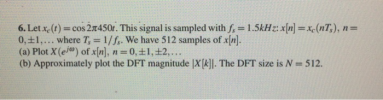 6. Let Xc(r) = cos 2π450t. This signal is sampled with f, = 1 .5kHz: x[n] = xe (nT), n = 0,±1, . . . where T, = 1/f, we have 512 samples of x[n]. (a) Plot X (el") of x[n], n = 0, ± 1 , ±2, . . . (b) Approximately plot the DFT magnitude |x(kl. The DFT size is N = 512.
3. (50 points] Consider the signal (t= cos(27 (100)+]: 1) Let's take samples of x(t) at...
 3. (50 points] Consider the signal (t= cos(27 (100)+]: 1) Let's take samples of x(t) at a sampling rate fs = 180 Hz. Sketch the spectrum X (f) of the sampled signal x (t). Properly label x-axis and y-axis. 2) Now suppose we will use an ideal lowpass filter of gain 1/fs with a cutoff frequency 90 Hz for the sampled signal xs(t). What is the output of the filter x,(t)? 3) Now let's take samples of x(t) at sampling...
Question 1: (Sampling and Aliasing Effeet) (25 Marks) The given analog signal x(t)--sin(16xt)+ sin(11xt)+ sin (5nt), where t is in milliseconds, is sampled at a rate of 12kHz. The resulting sampl...
 Question 1: (Sampling and Aliasing Effeet) (25 Marks) The given analog signal x(t)--sin(16xt)+ sin(11xt)+ sin (5nt), where t is in milliseconds, is sampled at a rate of 12kHz. The resulting samples are immediately reconstructed by an ideal reconstructor. a. Find and sketch the spectrum of x(t) versus Ω. b. Find and sketch the spectrum of the sampled signal versus o. c. Determine the analog signal x (t) at the output of the reconstructor. d. Prove the x(0) and x(t) having...
2.5. Given an analog signal x(t)5cos(2T 2, 5001) + 2cos(2T 4, 5001), for t2 0 sampled...
 2.5. Given an analog signal x(t)5cos(2T 2, 5001) + 2cos(2T 4, 5001), for t2 0 sampled at a rate of 8,000 Hz, a. sketch the spectrum of the sampled signal up to 20 kHz; b. sketch the recovered analog signal spectrum if an ideal lowpass filter with a cutoff frequency of 4 kHz is used to filter the sampled signal in order to recover the original signal; c. determine the frequneuencis f aliasing noise.
4) a. A signal g(t) = 20 cos 50nt.cos 220nt is sampled by a pulse train...
 4) a. A signal g(t) = 20 cos 50nt.cos 220nt is sampled by a pulse train of frequency 250Hz. i. Calculate the Nyquist rate for the signal g(t). (4 Marks) ii. Sketch the spectrum of the resulting sampled signal. (5 Marks) iii. Specify the minimum cutoff frequency of the ideal reconstruction filter so as to recover g(t) from its sampled signal. (3 Mark) b. A signal in the frequency range 350 to 3500Hz is limited to peak to peak swing...
1. Consider a signal of the form (t) = 2 cos(100nt) cos(1507) This signal is first...
 1. Consider a signal of the form (t) = 2 cos(100nt) cos(1507) This signal is first sampled at the rate of 80 samples per second and the result was processed with an ideal reconstruction filter, again assuming that sampling rate was 80 samples per second. What is the signal that results after the reconstruction? Show enough details in your answer to demonstrate that you understand the theory of sampling and reconstruction from samples. Hint: Write (t) as a sum of...
Plot the signal s(t) = cos(2πt), and then illustrate the resulting samples with the following sampling...
Plot the signal s(t) = cos(2πt), and then illustrate the resulting samples with the following sampling intervals: [30 points] • Ts= 0.5 sec. • Ts= 0.75 sec • Ts =1 sec. (a) For each case, also sketch the reconstructed continuous time signal from the samples using linear interpolation (i.e. connecting samples by straight lines). (b) In which case the sampled signal has aliasing distortion? What is the minimal sampling frequency and the corresponding sampling interval needed to avoid aliasing? 3....
Consider a sampler which samples the continuous-time input signal x(t) at a sampling frequency fs =...
 Consider a sampler which samples the continuous-time input signal x(t) at a sampling frequency fs = 8000 Hz and produces at its output a sampled discrete-time signal x$(t) = x(nTs), where To = 1/fs is the sampling period. If the sampled signal is passed through a unity-gain lowpass filter with cutoff frequency of fs/2, sketch the magnitude spectrum of the resulting signal for the following input signals: (a) x(t) = cos(6000nt). (b) x(t) = cos(12000nt). (c) x(t) = cos(18000nt).
 Digital Signal Processing
DFT
Consider a speech signal x() that has the following frequency spectrum: xga) 1 + cos( -/100 a) Select appropriate values of N and T that will help us carry out DFT-based spectral analysis of this signal x401@) 800 such that the continuous-time frequencies are sampled no farther than 10 Hz apart. b) Ignore the issue of spectral leakage; under this assumption, provide a closed-form expression for the DFT of the signal using the values selected in...
Digital Signal Processing
DFT
Consider a speech signal x() that has the following frequency spectrum: xga) 1 + cos( -/100 a) Select appropriate values of N and T that will help us carry out DFT-based spectral analysis of this signal x401@) 800 such that the continuous-time frequencies are sampled no farther than 10 Hz apart. b) Ignore the issue of spectral leakage; under this assumption, provide a closed-form expression for the DFT of the signal using the values selected in...
 6. Let Xc(r) = cos 2π450t. This signal is sampled with f, = 1 .5kHz: x[n] = xe (nT), n = 0,±1, . . . where T, = 1/f, we have 512 samples of x[n]. (a) Plot X (el") of x[n], n = 0, ± 1 , ±2, . . . (b) Approximately plot the DFT magnitude |x(kl. The DFT size is N = 512.
 3. (50 points] Consider the signal (t= cos(27 (100)+]: 1) Let's take samples of x(t) at a sampling rate fs = 180 Hz. Sketch the spectrum X (f) of the sampled signal x (t). Properly label x-axis and y-axis. 2) Now suppose we will use an ideal lowpass filter of gain 1/fs with a cutoff frequency 90 Hz for the sampled signal xs(t). What is the output of the filter x,(t)? 3) Now let's take samples of x(t) at sampling...
 Question 1: (Sampling and Aliasing Effeet) (25 Marks) The given analog signal x(t)--sin(16xt)+ sin(11xt)+ sin (5nt), where t is in milliseconds, is sampled at a rate of 12kHz. The resulting samples are immediately reconstructed by an ideal reconstructor. a. Find and sketch the spectrum of x(t) versus Ω. b. Find and sketch the spectrum of the sampled signal versus o. c. Determine the analog signal x (t) at the output of the reconstructor. d. Prove the x(0) and x(t) having...
 2.5. Given an analog signal x(t)5cos(2T 2, 5001) + 2cos(2T 4, 5001), for t2 0 sampled at a rate of 8,000 Hz, a. sketch the spectrum of the sampled signal up to 20 kHz; b. sketch the recovered analog signal spectrum if an ideal lowpass filter with a cutoff frequency of 4 kHz is used to filter the sampled signal in order to recover the original signal; c. determine the frequneuencis f aliasing noise.
 4) a. A signal g(t) = 20 cos 50nt.cos 220nt is sampled by a pulse train of frequency 250Hz. i. Calculate the Nyquist rate for the signal g(t). (4 Marks) ii. Sketch the spectrum of the resulting sampled signal. (5 Marks) iii. Specify the minimum cutoff frequency of the ideal reconstruction filter so as to recover g(t) from its sampled signal. (3 Mark) b. A signal in the frequency range 350 to 3500Hz is limited to peak to peak swing...
 1. Consider a signal of the form (t) = 2 cos(100nt) cos(1507) This signal is first sampled at the rate of 80 samples per second and the result was processed with an ideal reconstruction filter, again assuming that sampling rate was 80 samples per second. What is the signal that results after the reconstruction? Show enough details in your answer to demonstrate that you understand the theory of sampling and reconstruction from samples. Hint: Write (t) as a sum of...
 Consider a sampler which samples the continuous-time input signal x(t) at a sampling frequency fs = 8000 Hz and produces at its output a sampled discrete-time signal x$(t) = x(nTs), where To = 1/fs is the sampling period. If the sampled signal is passed through a unity-gain lowpass filter with cutoff frequency of fs/2, sketch the magnitude spectrum of the resulting signal for the following input signals: (a) x(t) = cos(6000nt). (b) x(t) = cos(12000nt). (c) x(t) = cos(18000nt).
Most questions answered within 3 hours.
-
Where is the error in this code sequence?
String s1 = "Hello";
String s2 = "ello";...
asked 10 months ago -
Financial data for Joel de Paris, Inc., for last year
follow:
Joel de Paris, Inc.
Balance...
asked 10 months ago -
Consider this reaction:
Al2(SO4)3 (aq)+ BaCl3
(aq) Al2Cl6 (aq)- +
3BaSO4(s) . What is the...
asked 10 months ago -
Suppose that Savneet is considering increasing her
recent random sample from 20 car rentals to 40...
asked 10 months ago -
Trucks arrive at an unloading terminal at an average rate of 120
per hour.
Trucks arrive...
asked 10 months ago -
Why are methanol and ethanol completely soluble in water while
octanol is not very little soluble....
asked 10 months ago -
A facilities manager at a university reads in a research report
that the mean amount of...
asked 10 months ago -
When the CuSO4 is rehydrated by adding water to the anhydrous
compound, is this an endothermic...
asked 10 months ago -
A ray of sunlight is passing from diamond into crown glass; the
angle of incidence is...
asked 10 months ago -
A block of mass 0.249 kg is placed on top of a light, vertical
spring of...
asked 10 months ago -
how do the kidneys compensate in the presences of acidosis
a) trigger hyperventilate
b) reserve acid...
asked 10 months ago -
Question 501 pts
The rental rate of capital to the firm increases. Which of the
following...
asked 10 months ago