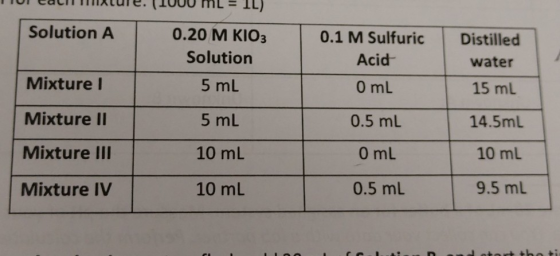
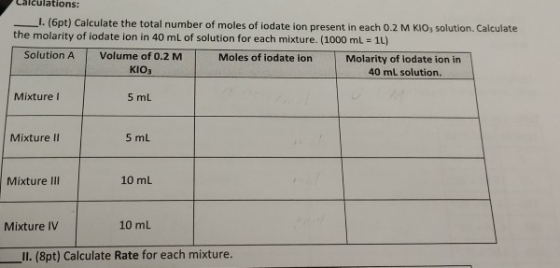
how do I calculate the isolated moles and molarity of the 0.2M KIO3?
Lalculations: I. (6pt) Calculate the total number of moles of iodate ion present in each 0.2 M KlO3 solution. Calculate the molarity of iodate ion in 40 mL of solution for each mixture. (1000 mL = 1L) Solution A Volume of 0.2 M Moles of iodate ion Molarity of iodate ion in 40 ml solution KIO3 Mixture I 5 mL Mixture II 5 mL Mixture III 10 mL Mixture IV 10 mL I1. (8pt) Calculate Rate for each mixture.
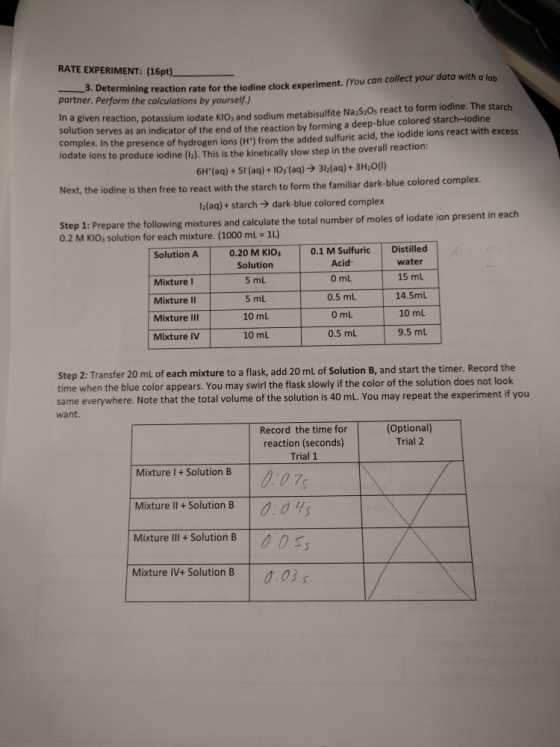
RATE EXPERIMENT: (16pt) - 3. Dete rmining reaction rate for the iodine clock experiment. (You can collect your data with o lab partner. Perform the calculations by yourself.) a given reaction, potassium iodate KIO, and sodium metabisulfite Na S20s react to form iodine. The starch solution serves as an indicator of the end of the reaction by forming a deep-blue colored starch-iodine complex. In the presence of hydrogen ions (H") from the added sulfuric acid, the iodide ions react with excess date ions to produce iodine (12). This is the kinetically slow step in the overall reaction: 6H'(aq) + 51 (aq) + io, (aq/> 312(aq) + 3H20(1) Next, the iodine is then free to react with the starch to form the familiar dark-blue colored complex. l2(aq)+ starch -> dark-blue colored complex Step 1: Prepare the following mixtures and calculate the total number of moles of iodate ion present in each 0.2 M KIO, solution for each mixture. (1000 mL = 1L) 0.1 M Sulfuric Distilled 0.20 M KIO Solution 5 ml Solution A Mixture I Mixture II Mixture Ill Mixture IV Acid 0 mL 0.5 mL 0 mL 0.5 mL water 15 mL 14.5mL 10 mL 9.5 mL 5 mL 10 mL 10 mL Step 2: Transfer 20 mL of each mixture to a flask, add 20 ml of Solution B, and start the timer. Record the time when the blue color appears. You may swirl the flask slowly if the color of the solution does not look same everywhere. Note that the total volume of the solution is 40 mL. You may repeat the experiment if you want. Record the time for reaction (seconds) Trial 1 Optional) Trial 2 Mixture l Solution B Mixture Il + Solution B :015 Mixture III + Solution B | . Mixture IV+ Solution 8 .03
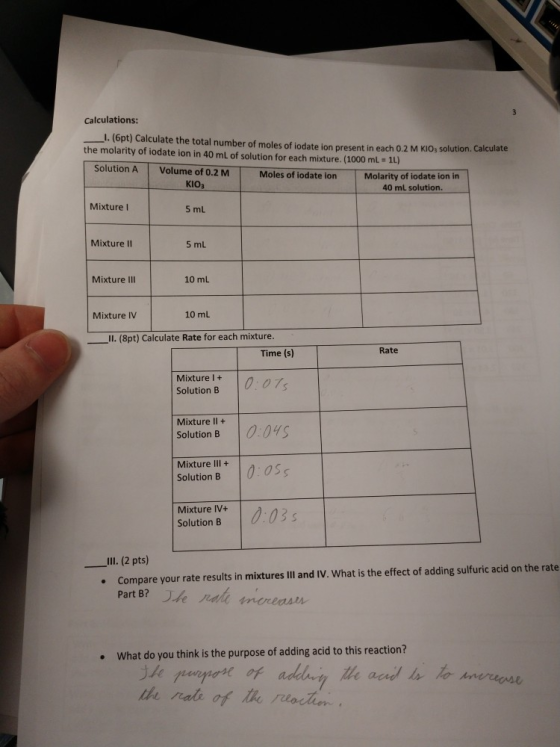
Calculations: . (6pt) Calculate the total number of moles of iodate ion present in each 0.2 M KIOs solution the molarity of iodate ion in 40 mL of solution for each mixture. (1000 ml- i) . Calculate Solution A Volume of 0.2 M Moles of iodate ion Molarity of iodate ion irn KIO3 40 mL solution. Mixture I 5 mL Mixture II 5 mL Mixture 111 10 mL Mixture IV 10 mL 11. (8pt) Calculate Rate for each mixture Time (s) Rate Mixture I + Solution EB Mixture II+ Solution B | Mixture III + Solution B 0:oSs Mixture IV+ Solution B _Ill. (2 pts) Compare your rate results in mixtures Ill nd IV. What is the effect of adding sulfuric acid on the rate What do you think is the purpose of adding acid to this reaction?
Homework Answers
KIO3 (aq) ---> K+ (aq) + IO3 - ( aq)
Hence, no. of moles of KIO3 = no. of moles of K+ = no. of moles of IO3- (iodate ion )
Molarity of KIO3 = 0.2 M
For mixture 1 ,
Volume of KIO3 = 5 ml = 0.005 L
Volume of H2SO4 = 0 ml
No. of moles of IO3- = molarity of KIO3 * volume of KIO3
= 0.2 * 0.005 = 0.001 mol ( answer)
In 40 ml solution , V = 40 ml = 0.040 L
Molarity = no. of moles / volume = 0.001 / 0.040 = 0.025 M ( answer )
For mixture 2,
Volume of 0.2 M KIO3 = 5 ml
Volume of 0.1 M sulphuric acid = 0.5 ml = 0.0005 L
Moles of sulphuric acid = 0.1 * 0.0005 = 0.00005 mol
H2SO4 (aq) ---> 2H+ (aq) + SO4- ( aq)
Hence no. of moles of H+ = 2* 0.00005 = 0.00010 mol
According to the given reaction between acid and KIO3 ,
6 moles of H+ react with 1 mol of IO3- completely
Hence, 0.00010 moles of H+ react with IO3- = 0.00010 / 6 = 0.0000166 moles
Hence no. of moles of IO3- left in solution = 0.001 - 0.0000166 = 0.000983 mol ( answer )
Molarity of 40 ml solution = 0.000983 / 0.040 = 0.02458 M ( answer )
Similarly, for mixture 3
Moles of KIO3 = 0.2 * 0.010 = 0.002 mol
Moles of H2SO4 = 0
Hence, moles of KIO3 = moles of IO3- = 0.002 mol ( answer )
Molarity of 40 ml solution
= 0.002 / 0.040 = 0.05 M ( answer )
Similarly for mixture 4,
Moles of KIO3 = 0.002 mol
Volume of H2SO4 = 0.5 ml
Molarity of H2SO4 = 0.1 M
Moles of H2SO4 = 0.1* 0.0005 = 0.00005 mol
Hence, no. of moles of IO3- reacted =2* 0.00005 / 6 = 0.0000166 mol ( similar to mixture 2 )
Hence moles of IO3- left = 0.002 - 0.0000166 = 0.0019834 mol ( answer )
Molarity of 40 ml solution = 0.0019834 / 0.040 = 0.0495 M ( answer )
I hope it helps. For further clarification please ask in comments.
Add Answer to:
How do I calculate the isolated moles and molarity of the 0.2M KIO3?
1. Calculate the molarity of perchlorate ions in a solution prepared by: mixing 289.9 mL of...
1. Calculate the molarity of perchlorate ions in a solution prepared by: mixing 289.9 mL of 0.596 M potassium perchlorate with 285 mL of 1.25 M calcium perchlorate. 2. Aqueous potassium iodate and potassium iodide react in the presence of dilute hydrochloric acid, as shown below. KIO3(aq) + 5KI(aq) + 6HCl(aq) ⟶ 3I2(aq) + 6KCl(aq) + 3H2O(l) What is the mass of iodine (in mg) formed when 17.7 mL of 0.097 M KIO3 solution reacts with 24.5 mL of 0.02...
3) Use the mole ratios contained in both equation 3 and equation 4 to calculate the...
 3) Use the mole ratios contained in both equation 3 and
equation 4 to calculate the
volume (in mL) of 0.0100 M potassium iodate solution needed to
completely oxidize all
of the ascorbic acid contained in 20.00 mL of 0.0200 M
ascorbic acid solution.
concentration of the titrant can be used along with the mole ratios from the reaction equations to determine the amount of ascorbic acid in the solution Chemical Reactions involved with the redox titration: Equation 1 shows...
3) Use the mole ratios contained in both equation 3 and
equation 4 to calculate the
volume (in mL) of 0.0100 M potassium iodate solution needed to
completely oxidize all
of the ascorbic acid contained in 20.00 mL of 0.0200 M
ascorbic acid solution.
concentration of the titrant can be used along with the mole ratios from the reaction equations to determine the amount of ascorbic acid in the solution Chemical Reactions involved with the redox titration: Equation 1 shows...
Vitamin C in a titration with potassium iodate References Mailings Review View AaBbcode Abccdee AaBbcc No...
 Vitamin C in a titration with potassium iodate
References Mailings Review View AaBbcode Abccdee AaBbcc No Spacing Heading 1 Normal 3. A suitable method for the determination of vitamin C (C.H.O.) is a titration with potassium iodate (KIO). Potassium iodate is used as a titrant and is added to an ascorbic acid solution that contains strong acid and potassium iodide (KI). Potassium iodate reacts with excess potassium iodide, liberating molecular iodine (12): [1] KIO, + 5KI + 6H 31, +6K...
Vitamin C in a titration with potassium iodate
References Mailings Review View AaBbcode Abccdee AaBbcc No Spacing Heading 1 Normal 3. A suitable method for the determination of vitamin C (C.H.O.) is a titration with potassium iodate (KIO). Potassium iodate is used as a titrant and is added to an ascorbic acid solution that contains strong acid and potassium iodide (KI). Potassium iodate reacts with excess potassium iodide, liberating molecular iodine (12): [1] KIO, + 5KI + 6H 31, +6K...
do # 2 first photo Calculate the ongar UUM Calculate the average concentration of the original...
 do # 2
first photo
Calculate the ongar UUM Calculate the average concentration of the original Cu4+ solution Pre-Laboratory Questions 1. Define the term titration. From the chemical equations provided in the introduction, write the overall balanced stoichiometric equation for the volumetric analysis of Cu2+. A 25.00 mL sample of a Cuct solution requires 35.45 mL of 0.2000 M Na S,O2 solution to reach the end point. Calculate the molar concentration of Cuct in the sample. the amount of metallic...
do # 2
first photo
Calculate the ongar UUM Calculate the average concentration of the original Cu4+ solution Pre-Laboratory Questions 1. Define the term titration. From the chemical equations provided in the introduction, write the overall balanced stoichiometric equation for the volumetric analysis of Cu2+. A 25.00 mL sample of a Cuct solution requires 35.45 mL of 0.2000 M Na S,O2 solution to reach the end point. Calculate the molar concentration of Cuct in the sample. the amount of metallic...
Questions 1. Calculate the molarity of a sodium hydroxide (NaOH) solution that is titrated with 0.6887...
 Questions 1. Calculate the molarity of a sodium hydroxide (NaOH) solution that is titrated with 0.6887 g of oxalic acid (Equation 2). The titration requires 15.80 mL of the NaOH solution to reach the end point. Calculate the molarity of a sulfuric acid (H,SO) solution if 30.10 mL of 0.62 10 M NaOH is required to reach the end point when titrated against 10.00 mL of the unknown acid solution. The balanced chemical equation for the reaction is given below....
1) What chemical is the titrant in this experiment? What chemical is the analyte in this experiment? Experi...
 1) What chemical is the titrant in this experiment? What
chemical is the analyte in this
experiment?
Experiment #8: Measuring the Vitamin C Content of Emergen-C™ Objectives: • Students will learn how to use a burette. • Students will learn how to use the iodine starch indicator system to monitor oxidation/reduction reactions. Students will learn how to conduct a titration to determine the amount of analyte in an unknown solution. • Students will learn about ascorbic acid's role as a...
1) What chemical is the titrant in this experiment? What
chemical is the analyte in this
experiment?
Experiment #8: Measuring the Vitamin C Content of Emergen-C™ Objectives: • Students will learn how to use a burette. • Students will learn how to use the iodine starch indicator system to monitor oxidation/reduction reactions. Students will learn how to conduct a titration to determine the amount of analyte in an unknown solution. • Students will learn about ascorbic acid's role as a...
Is the calculated concentration for IO3- in the data table correct, and if not, how do I calculat...
 Is the calculated concentration for IO3-
in the data table correct, and if not, how do I calculate it. Also,
the questions below the data table in the second picture. How are
they calculated?
2. The molar solubility of Cal(IO3)2 in pure water Temperature of the saturated solution of calcium iodate: Volume (or mass) of saturated calcium iodate solution titrated:O -24 °C ted:1 Q mL (or g) Data Trial 1 Trial 2 Trial 3 Volume of Na2S203 titrant Final buret...
Is the calculated concentration for IO3-
in the data table correct, and if not, how do I calculate it. Also,
the questions below the data table in the second picture. How are
they calculated?
2. The molar solubility of Cal(IO3)2 in pure water Temperature of the saturated solution of calcium iodate: Volume (or mass) of saturated calcium iodate solution titrated:O -24 °C ted:1 Q mL (or g) Data Trial 1 Trial 2 Trial 3 Volume of Na2S203 titrant Final buret...
molarity of acid: 0.1435M volume:25ml 1. Use the molar mass and moles of acetic acid to...
 molarity of acid: 0.1435M
volume:25ml
1. Use the molar mass and moles of acetic acid to determine the mass of the acetic acid in the 25.00-ml sample. 2. Calculate the mass/volume percentage (m/v %) by dividing the mass of acetic acid in grams by the volume of the vinegar sample in mL and multiplying by 100. 3. For the reaction of sodium hydroxide solution with a solution of hydrochloric acid: a. Write a balanced molecular equation for the reaction, including...
molarity of acid: 0.1435M
volume:25ml
1. Use the molar mass and moles of acetic acid to determine the mass of the acetic acid in the 25.00-ml sample. 2. Calculate the mass/volume percentage (m/v %) by dividing the mass of acetic acid in grams by the volume of the vinegar sample in mL and multiplying by 100. 3. For the reaction of sodium hydroxide solution with a solution of hydrochloric acid: a. Write a balanced molecular equation for the reaction, including...
Calculate the MOLES of HA (CH3COOH) and MOLES of A- (CH3COO-) present in the solution. Remember,...
 Calculate the MOLES of
HA (CH3COOH) and MOLES of A- (CH3COO-) present in the solution.
Remember, you started with 50.0 mL of 1.0 M solution for each
• The pKa of CH3COOH
is 4.76. Use this information with the moles of acid and moles of
base to calculate the pH of this solution.
Stockroom Information Name: 1M CH3COOH Volume: 50.000 mL Species (aq) Molarity 0.00417456 1M CH3COOH 50.000 mL @ 25.0°C H+ OH 2.41858e-12 0.995825 CH3COOH CH3COO 0.00417456 Temperature: 25.00°C...
Calculate the MOLES of
HA (CH3COOH) and MOLES of A- (CH3COO-) present in the solution.
Remember, you started with 50.0 mL of 1.0 M solution for each
• The pKa of CH3COOH
is 4.76. Use this information with the moles of acid and moles of
base to calculate the pH of this solution.
Stockroom Information Name: 1M CH3COOH Volume: 50.000 mL Species (aq) Molarity 0.00417456 1M CH3COOH 50.000 mL @ 25.0°C H+ OH 2.41858e-12 0.995825 CH3COOH CH3COO 0.00417456 Temperature: 25.00°C...
doing experiment about standardization of 0.0025M sodium thiosulphate solution, can someone tell me how this formula...
 doing experiment about standardization of 0.0025M
sodium thiosulphate solution,
can someone tell me how this formula (calculating exact conc of
Na2S2o3) (at the bottom) comes ?
Data: (10 marks) Part 1: Standardization of 0.0025M sodium thiosulphate solution No. of drops of 0.0025 M sodium thiosulphate solution Solution Trial 1 Trial 2 Trial 3 Average 1 mL of potassium iodate solution + 0.2 mL 3 M HCI + 1 mL D.I. water + 3 drops of starch 2) 22 121.67 N...
doing experiment about standardization of 0.0025M
sodium thiosulphate solution,
can someone tell me how this formula (calculating exact conc of
Na2S2o3) (at the bottom) comes ?
Data: (10 marks) Part 1: Standardization of 0.0025M sodium thiosulphate solution No. of drops of 0.0025 M sodium thiosulphate solution Solution Trial 1 Trial 2 Trial 3 Average 1 mL of potassium iodate solution + 0.2 mL 3 M HCI + 1 mL D.I. water + 3 drops of starch 2) 22 121.67 N...
 3) Use the mole ratios contained in both equation 3 and
equation 4 to calculate the
volume (in mL) of 0.0100 M potassium iodate solution needed to
completely oxidize all
of the ascorbic acid contained in 20.00 mL of 0.0200 M
ascorbic acid solution.
concentration of the titrant can be used along with the mole ratios from the reaction equations to determine the amount of ascorbic acid in the solution Chemical Reactions involved with the redox titration: Equation 1 shows...
3) Use the mole ratios contained in both equation 3 and
equation 4 to calculate the
volume (in mL) of 0.0100 M potassium iodate solution needed to
completely oxidize all
of the ascorbic acid contained in 20.00 mL of 0.0200 M
ascorbic acid solution.
concentration of the titrant can be used along with the mole ratios from the reaction equations to determine the amount of ascorbic acid in the solution Chemical Reactions involved with the redox titration: Equation 1 shows...
 Vitamin C in a titration with potassium iodate
References Mailings Review View AaBbcode Abccdee AaBbcc No Spacing Heading 1 Normal 3. A suitable method for the determination of vitamin C (C.H.O.) is a titration with potassium iodate (KIO). Potassium iodate is used as a titrant and is added to an ascorbic acid solution that contains strong acid and potassium iodide (KI). Potassium iodate reacts with excess potassium iodide, liberating molecular iodine (12): [1] KIO, + 5KI + 6H 31, +6K...
Vitamin C in a titration with potassium iodate
References Mailings Review View AaBbcode Abccdee AaBbcc No Spacing Heading 1 Normal 3. A suitable method for the determination of vitamin C (C.H.O.) is a titration with potassium iodate (KIO). Potassium iodate is used as a titrant and is added to an ascorbic acid solution that contains strong acid and potassium iodide (KI). Potassium iodate reacts with excess potassium iodide, liberating molecular iodine (12): [1] KIO, + 5KI + 6H 31, +6K...
 do # 2
first photo
Calculate the ongar UUM Calculate the average concentration of the original Cu4+ solution Pre-Laboratory Questions 1. Define the term titration. From the chemical equations provided in the introduction, write the overall balanced stoichiometric equation for the volumetric analysis of Cu2+. A 25.00 mL sample of a Cuct solution requires 35.45 mL of 0.2000 M Na S,O2 solution to reach the end point. Calculate the molar concentration of Cuct in the sample. the amount of metallic...
do # 2
first photo
Calculate the ongar UUM Calculate the average concentration of the original Cu4+ solution Pre-Laboratory Questions 1. Define the term titration. From the chemical equations provided in the introduction, write the overall balanced stoichiometric equation for the volumetric analysis of Cu2+. A 25.00 mL sample of a Cuct solution requires 35.45 mL of 0.2000 M Na S,O2 solution to reach the end point. Calculate the molar concentration of Cuct in the sample. the amount of metallic...
 Questions 1. Calculate the molarity of a sodium hydroxide (NaOH) solution that is titrated with 0.6887 g of oxalic acid (Equation 2). The titration requires 15.80 mL of the NaOH solution to reach the end point. Calculate the molarity of a sulfuric acid (H,SO) solution if 30.10 mL of 0.62 10 M NaOH is required to reach the end point when titrated against 10.00 mL of the unknown acid solution. The balanced chemical equation for the reaction is given below....
 1) What chemical is the titrant in this experiment? What
chemical is the analyte in this
experiment?
Experiment #8: Measuring the Vitamin C Content of Emergen-C™ Objectives: • Students will learn how to use a burette. • Students will learn how to use the iodine starch indicator system to monitor oxidation/reduction reactions. Students will learn how to conduct a titration to determine the amount of analyte in an unknown solution. • Students will learn about ascorbic acid's role as a...
1) What chemical is the titrant in this experiment? What
chemical is the analyte in this
experiment?
Experiment #8: Measuring the Vitamin C Content of Emergen-C™ Objectives: • Students will learn how to use a burette. • Students will learn how to use the iodine starch indicator system to monitor oxidation/reduction reactions. Students will learn how to conduct a titration to determine the amount of analyte in an unknown solution. • Students will learn about ascorbic acid's role as a...
 Is the calculated concentration for IO3-
in the data table correct, and if not, how do I calculate it. Also,
the questions below the data table in the second picture. How are
they calculated?
2. The molar solubility of Cal(IO3)2 in pure water Temperature of the saturated solution of calcium iodate: Volume (or mass) of saturated calcium iodate solution titrated:O -24 °C ted:1 Q mL (or g) Data Trial 1 Trial 2 Trial 3 Volume of Na2S203 titrant Final buret...
Is the calculated concentration for IO3-
in the data table correct, and if not, how do I calculate it. Also,
the questions below the data table in the second picture. How are
they calculated?
2. The molar solubility of Cal(IO3)2 in pure water Temperature of the saturated solution of calcium iodate: Volume (or mass) of saturated calcium iodate solution titrated:O -24 °C ted:1 Q mL (or g) Data Trial 1 Trial 2 Trial 3 Volume of Na2S203 titrant Final buret...
 molarity of acid: 0.1435M
volume:25ml
1. Use the molar mass and moles of acetic acid to determine the mass of the acetic acid in the 25.00-ml sample. 2. Calculate the mass/volume percentage (m/v %) by dividing the mass of acetic acid in grams by the volume of the vinegar sample in mL and multiplying by 100. 3. For the reaction of sodium hydroxide solution with a solution of hydrochloric acid: a. Write a balanced molecular equation for the reaction, including...
molarity of acid: 0.1435M
volume:25ml
1. Use the molar mass and moles of acetic acid to determine the mass of the acetic acid in the 25.00-ml sample. 2. Calculate the mass/volume percentage (m/v %) by dividing the mass of acetic acid in grams by the volume of the vinegar sample in mL and multiplying by 100. 3. For the reaction of sodium hydroxide solution with a solution of hydrochloric acid: a. Write a balanced molecular equation for the reaction, including...
 Calculate the MOLES of
HA (CH3COOH) and MOLES of A- (CH3COO-) present in the solution.
Remember, you started with 50.0 mL of 1.0 M solution for each
• The pKa of CH3COOH
is 4.76. Use this information with the moles of acid and moles of
base to calculate the pH of this solution.
Stockroom Information Name: 1M CH3COOH Volume: 50.000 mL Species (aq) Molarity 0.00417456 1M CH3COOH 50.000 mL @ 25.0°C H+ OH 2.41858e-12 0.995825 CH3COOH CH3COO 0.00417456 Temperature: 25.00°C...
Calculate the MOLES of
HA (CH3COOH) and MOLES of A- (CH3COO-) present in the solution.
Remember, you started with 50.0 mL of 1.0 M solution for each
• The pKa of CH3COOH
is 4.76. Use this information with the moles of acid and moles of
base to calculate the pH of this solution.
Stockroom Information Name: 1M CH3COOH Volume: 50.000 mL Species (aq) Molarity 0.00417456 1M CH3COOH 50.000 mL @ 25.0°C H+ OH 2.41858e-12 0.995825 CH3COOH CH3COO 0.00417456 Temperature: 25.00°C...
 doing experiment about standardization of 0.0025M
sodium thiosulphate solution,
can someone tell me how this formula (calculating exact conc of
Na2S2o3) (at the bottom) comes ?
Data: (10 marks) Part 1: Standardization of 0.0025M sodium thiosulphate solution No. of drops of 0.0025 M sodium thiosulphate solution Solution Trial 1 Trial 2 Trial 3 Average 1 mL of potassium iodate solution + 0.2 mL 3 M HCI + 1 mL D.I. water + 3 drops of starch 2) 22 121.67 N...
doing experiment about standardization of 0.0025M
sodium thiosulphate solution,
can someone tell me how this formula (calculating exact conc of
Na2S2o3) (at the bottom) comes ?
Data: (10 marks) Part 1: Standardization of 0.0025M sodium thiosulphate solution No. of drops of 0.0025 M sodium thiosulphate solution Solution Trial 1 Trial 2 Trial 3 Average 1 mL of potassium iodate solution + 0.2 mL 3 M HCI + 1 mL D.I. water + 3 drops of starch 2) 22 121.67 N...
Most questions answered within 3 hours.
-
Where is the error in this code sequence?
String s1 = "Hello";
String s2 = "ello";...
asked 11 months ago -
Financial data for Joel de Paris, Inc., for last year
follow:
Joel de Paris, Inc.
Balance...
asked 11 months ago -
Consider this reaction:
Al2(SO4)3 (aq)+ BaCl3
(aq) Al2Cl6 (aq)- +
3BaSO4(s) . What is the...
asked 11 months ago -
Suppose that Savneet is considering increasing her
recent random sample from 20 car rentals to 40...
asked 11 months ago -
Trucks arrive at an unloading terminal at an average rate of 120
per hour.
Trucks arrive...
asked 11 months ago -
Why are methanol and ethanol completely soluble in water while
octanol is not very little soluble....
asked 11 months ago -
A facilities manager at a university reads in a research report
that the mean amount of...
asked 11 months ago -
When the CuSO4 is rehydrated by adding water to the anhydrous
compound, is this an endothermic...
asked 11 months ago -
A ray of sunlight is passing from diamond into crown glass; the
angle of incidence is...
asked 11 months ago -
A block of mass 0.249 kg is placed on top of a light, vertical
spring of...
asked 11 months ago -
how do the kidneys compensate in the presences of acidosis
a) trigger hyperventilate
b) reserve acid...
asked 11 months ago -
Question 501 pts
The rental rate of capital to the firm increases. Which of the
following...
asked 11 months ago