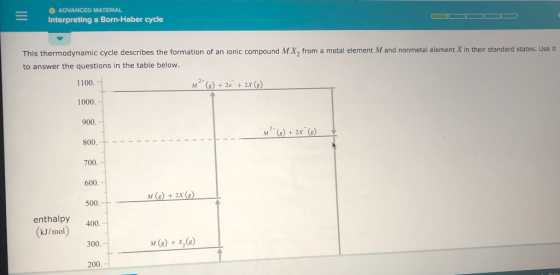
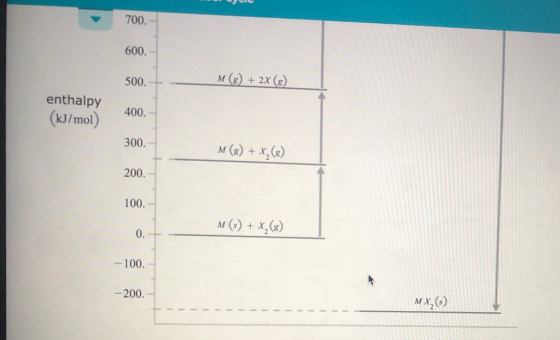
▼ | 700,- 600 M (g) + 2x (g 500 enthalpy 400. 300. м (е) + x, (g) 200 100. м (s) + X2(g) 0. -100. 200. м Х, (s)
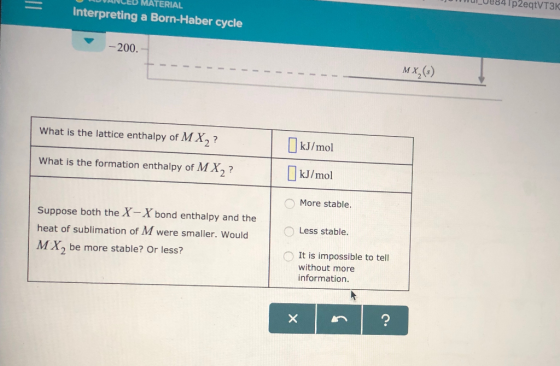
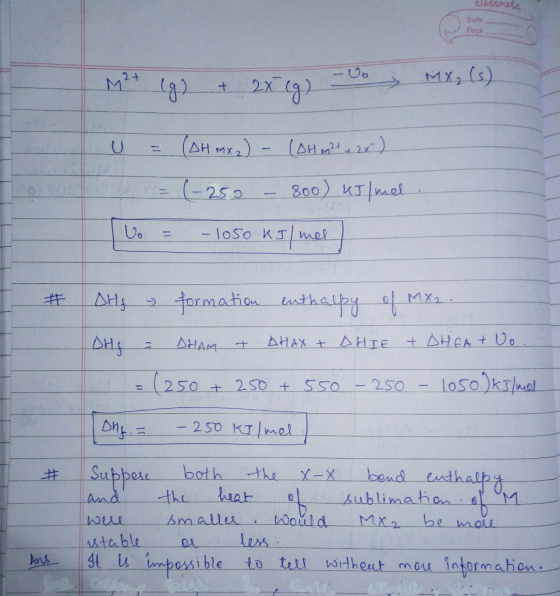
DANCED MATERIAL Interpreting a Born-Haber cycle -200. MX What is the lattice enthalpy of MX2? kJ/mol kJ/mol More stable. What is the formation enthalpy of M X2? Suppose both the X-X bond enthalpy and the heat of sublimation of M were smaller. Would MX2 be more stable? Or less? O Less stable. It is impossible to tell without more information
Homework Answers
Add Answer to:
OADVANCED MATERIAL Interpreting a Born-Haber cycle This thermodynamic cycle describes the formati...
j This thermodynamic cycle describes the formation of an ionic compound M X from a metal...
 j
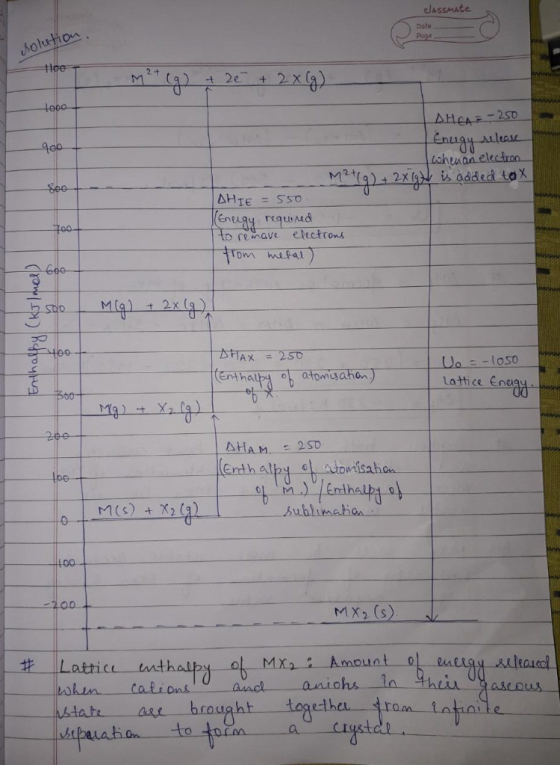
This thermodynamic cycle describes the formation of an ionic compound M X from a metal element M and nonmetal element X in their standard states. Use it to answer the questions in the table below. 900. 2m* () + 2e + x (8) 800. 700. 600. 2M* (x) + x2 (g) 500. 400. 2M (8) + x() enthalpy (kJ/mol 24 (2) + 5x (2) 2M(5) + -,() 1 -100 - 200. M.X(s) What is the lattice enthalpy of M2X...
j
This thermodynamic cycle describes the formation of an ionic compound M X from a metal element M and nonmetal element X in their standard states. Use it to answer the questions in the table below. 900. 2m* () + 2e + x (8) 800. 700. 600. 2M* (x) + x2 (g) 500. 400. 2M (8) + x() enthalpy (kJ/mol 24 (2) + 5x (2) 2M(5) + -,() 1 -100 - 200. M.X(s) What is the lattice enthalpy of M2X...
This thermodynamic cycle describes the formation of an ionic compound MX from a metal element M...
 This thermodynamic cycle describes the formation of an ionic compound MX from a metal element M and nonmetal element X in their standard states. Use it to answer the questions in the table below 900 800 700 600 + X enthalpy 400 300. 200. 100. 0. 100.- kJ/mol M3 What is the lattice enthalpy of MX? 1 kJ/mol What is the enthalpy of formation of MX?kJ/mol Suppose both the heat of sublimation of M and the electron affinity of X...
Question 4 4 pts Use the Born-Haber Cycle to calculate the lattice energy for the formation...
 Question 4 4 pts Use the Born-Haber Cycle to calculate the lattice energy for the formation of X2Y. Input your answer in units of kJ/mole with the correct sign. Process Enthalpy (kJ/mol). X(s)--> X(g) 115 X(g) -->X*(8) + le 499 Y2 (8) --> 2Y (8) 264 -295 Y (8) + 1e.-->Y (8) Y (8) + 1e' --> Y2 () 115 2X(s) +% Y2 (8)--> X2Y(s) -549
Using the Born Haber cycle in the previous question, and the following energies, calculate the standard...
 Using the Born Haber cycle in the previous question, and the following energies, calculate the standard energy of formation for Srl2 Enthalpy of sublimation of Sr(s) = 164 kJ/mol 1st ionization energy of Sr(g) = 549 kJ/mol 2nd ionization energy of Sr(g) - 1064 kJ/mol Enthalpy of sublimation of 12(s) = 62 kJ/mol Bond dissociation energy of 12(g) - 153 kJ/mol 1st electron affinity of l(g) = -295 kJ/mol Lattice energy of Srlz(s) = -1960 kJ/mol *Note: Do not include...
4) Calculate the lattice enthalpy for calcium fluoride using the Born-Haber cycle method, using the provided...
 4) Calculate the lattice enthalpy for calcium fluoride using the Born-Haber cycle method, using the provided table. (Show all your work; 2 points) Enthalpies, AH/(kJ mol) +192 Process Sublimation of Ca(s) Ionization of Ca(g) Dissociation of F2(g) Electron gain by F(g) Formation of CaF (s) +1735 to Ca(ag +157 -328 -1220
1)a. Using the Born Haber cycle, determine the enthalpy for lattice formation of MgO. Mg (s),...
1)a. Using the Born Haber cycle, determine the enthalpy for lattice formation of MgO. Mg (s), ΔHsub = +148 kJ/mol bond dissociation energy for O2 = +499 kJ/mol 1st ionization energy for Mg = +738 kJ/mol 1st electron affinity for O = –141 kJ/mol 2nd ionization energy for Mg = +1450 kJ/mol 2nd electron affinity for O = +844 kJ/mol MgO(s), enthalpy of formation = –602 kJ/mol 1)b. Calculate the lattice formation energy of MgO using the Madelung constant....
Physical Chemistry: Use a Born-Haber cycle to find an experimentally based value for the lattice enthalpy...
 Physical Chemistry:
Use a Born-Haber cycle to find an experimentally based value for the lattice enthalpy of sodium bromide (NaBr(s)). The lattice enthalpy corresponds to the enthalpy change for the process NaBr(s) rightarrow Na^+(g) + Br^-(g) Use the following information in doing this problem. delta H degree_f(Na(g)) = 107.32 kJ/mol delta H degree_IE1(Na(g)) = 495.8 kJ/mol delta H degree_f(Br(g)) = 111.88 kJ/mol delta H degree_EA(Br(g)) = -324.6 kJ/mol delta H degree_f(NaBr(s)) = -361.06 kJ/mol The ionization enthalpy (IE_1) and electron...
Physical Chemistry:
Use a Born-Haber cycle to find an experimentally based value for the lattice enthalpy of sodium bromide (NaBr(s)). The lattice enthalpy corresponds to the enthalpy change for the process NaBr(s) rightarrow Na^+(g) + Br^-(g) Use the following information in doing this problem. delta H degree_f(Na(g)) = 107.32 kJ/mol delta H degree_IE1(Na(g)) = 495.8 kJ/mol delta H degree_f(Br(g)) = 111.88 kJ/mol delta H degree_EA(Br(g)) = -324.6 kJ/mol delta H degree_f(NaBr(s)) = -361.06 kJ/mol The ionization enthalpy (IE_1) and electron...
Born-Fajans-Haber Cycle Suppose a chemist discovers a new metallic element and names it "Xtrinsium" (Xt) Xt...
 Born-Fajans-Haber Cycle Suppose a chemist discovers a new metallic element and names it "Xtrinsium" (Xt) Xt exhibits chemical behaviour similar to an alkaline earth Xt(s) + Cl2(g) → XtCl2(s) Lattice energy for XtCl2 First Ionization energy of Xt Second Ionization energy of Xt Electron affinity of Cl Bond energy of Cl2 Enthalpy of sublimation (atomization) of Xt 2260. kJ/mol 430. kJ/mol 731 kJ/mol -348.7 kJ/mol 239 kJ/mol 170. kJ/mol Use the above data to calculate ΔHof for Xtrinsium chloride.
Using the thermodynamic quantities shown below: construct a Born-Haber cycle for the following reaction: Li(s) +...
 Using the thermodynamic quantities shown below: construct a
Born-Haber cycle for the following reaction: Li(s) + 1/2
F2(g)
LiF(s); calculate the lattice energy of LiF.
Vaporization of Li(s): +159
F2 bond enthalpy: +155
Li ionization energy: +520
F- electron affinity: +328
LiF(s) heat of formation: -616
Using the thermodynamic quantities shown below: construct a
Born-Haber cycle for the following reaction: Li(s) + 1/2
F2(g)
LiF(s); calculate the lattice energy of LiF.
Vaporization of Li(s): +159
F2 bond enthalpy: +155
Li ionization energy: +520
F- electron affinity: +328
LiF(s) heat of formation: -616
7. Use the Born Haber cycle and the given information to determine the net energy change...
 7. Use the Born Haber cycle and the given information to determine the net energy change (in kJ/mol) that takes place in the formation of KF(s) from the elements: Ks) + F2@KFS) Heat of sublimation of K = 89.2 kJ/mol Bond dissociation energy for F2 = 158 kJ/mol Lattice Energy of KF = 821 kJ/mol Eca for F = -328 kJ/mol E; for K = 418.8 kJ/mol
 j
This thermodynamic cycle describes the formation of an ionic compound M X from a metal element M and nonmetal element X in their standard states. Use it to answer the questions in the table below. 900. 2m* () + 2e + x (8) 800. 700. 600. 2M* (x) + x2 (g) 500. 400. 2M (8) + x() enthalpy (kJ/mol 24 (2) + 5x (2) 2M(5) + -,() 1 -100 - 200. M.X(s) What is the lattice enthalpy of M2X...
j
This thermodynamic cycle describes the formation of an ionic compound M X from a metal element M and nonmetal element X in their standard states. Use it to answer the questions in the table below. 900. 2m* () + 2e + x (8) 800. 700. 600. 2M* (x) + x2 (g) 500. 400. 2M (8) + x() enthalpy (kJ/mol 24 (2) + 5x (2) 2M(5) + -,() 1 -100 - 200. M.X(s) What is the lattice enthalpy of M2X...
 This thermodynamic cycle describes the formation of an ionic compound MX from a metal element M and nonmetal element X in their standard states. Use it to answer the questions in the table below 900 800 700 600 + X enthalpy 400 300. 200. 100. 0. 100.- kJ/mol M3 What is the lattice enthalpy of MX? 1 kJ/mol What is the enthalpy of formation of MX?kJ/mol Suppose both the heat of sublimation of M and the electron affinity of X...
 Question 4 4 pts Use the Born-Haber Cycle to calculate the lattice energy for the formation of X2Y. Input your answer in units of kJ/mole with the correct sign. Process Enthalpy (kJ/mol). X(s)--> X(g) 115 X(g) -->X*(8) + le 499 Y2 (8) --> 2Y (8) 264 -295 Y (8) + 1e.-->Y (8) Y (8) + 1e' --> Y2 () 115 2X(s) +% Y2 (8)--> X2Y(s) -549
 Using the Born Haber cycle in the previous question, and the following energies, calculate the standard energy of formation for Srl2 Enthalpy of sublimation of Sr(s) = 164 kJ/mol 1st ionization energy of Sr(g) = 549 kJ/mol 2nd ionization energy of Sr(g) - 1064 kJ/mol Enthalpy of sublimation of 12(s) = 62 kJ/mol Bond dissociation energy of 12(g) - 153 kJ/mol 1st electron affinity of l(g) = -295 kJ/mol Lattice energy of Srlz(s) = -1960 kJ/mol *Note: Do not include...
 4) Calculate the lattice enthalpy for calcium fluoride using the Born-Haber cycle method, using the provided table. (Show all your work; 2 points) Enthalpies, AH/(kJ mol) +192 Process Sublimation of Ca(s) Ionization of Ca(g) Dissociation of F2(g) Electron gain by F(g) Formation of CaF (s) +1735 to Ca(ag +157 -328 -1220
 Physical Chemistry:
Use a Born-Haber cycle to find an experimentally based value for the lattice enthalpy of sodium bromide (NaBr(s)). The lattice enthalpy corresponds to the enthalpy change for the process NaBr(s) rightarrow Na^+(g) + Br^-(g) Use the following information in doing this problem. delta H degree_f(Na(g)) = 107.32 kJ/mol delta H degree_IE1(Na(g)) = 495.8 kJ/mol delta H degree_f(Br(g)) = 111.88 kJ/mol delta H degree_EA(Br(g)) = -324.6 kJ/mol delta H degree_f(NaBr(s)) = -361.06 kJ/mol The ionization enthalpy (IE_1) and electron...
Physical Chemistry:
Use a Born-Haber cycle to find an experimentally based value for the lattice enthalpy of sodium bromide (NaBr(s)). The lattice enthalpy corresponds to the enthalpy change for the process NaBr(s) rightarrow Na^+(g) + Br^-(g) Use the following information in doing this problem. delta H degree_f(Na(g)) = 107.32 kJ/mol delta H degree_IE1(Na(g)) = 495.8 kJ/mol delta H degree_f(Br(g)) = 111.88 kJ/mol delta H degree_EA(Br(g)) = -324.6 kJ/mol delta H degree_f(NaBr(s)) = -361.06 kJ/mol The ionization enthalpy (IE_1) and electron...
 Born-Fajans-Haber Cycle Suppose a chemist discovers a new metallic element and names it "Xtrinsium" (Xt) Xt exhibits chemical behaviour similar to an alkaline earth Xt(s) + Cl2(g) → XtCl2(s) Lattice energy for XtCl2 First Ionization energy of Xt Second Ionization energy of Xt Electron affinity of Cl Bond energy of Cl2 Enthalpy of sublimation (atomization) of Xt 2260. kJ/mol 430. kJ/mol 731 kJ/mol -348.7 kJ/mol 239 kJ/mol 170. kJ/mol Use the above data to calculate ΔHof for Xtrinsium chloride.
 Using the thermodynamic quantities shown below: construct a
Born-Haber cycle for the following reaction: Li(s) + 1/2
F2(g)
LiF(s); calculate the lattice energy of LiF.
Vaporization of Li(s): +159
F2 bond enthalpy: +155
Li ionization energy: +520
F- electron affinity: +328
LiF(s) heat of formation: -616
Using the thermodynamic quantities shown below: construct a
Born-Haber cycle for the following reaction: Li(s) + 1/2
F2(g)
LiF(s); calculate the lattice energy of LiF.
Vaporization of Li(s): +159
F2 bond enthalpy: +155
Li ionization energy: +520
F- electron affinity: +328
LiF(s) heat of formation: -616
 7. Use the Born Haber cycle and the given information to determine the net energy change (in kJ/mol) that takes place in the formation of KF(s) from the elements: Ks) + F2@KFS) Heat of sublimation of K = 89.2 kJ/mol Bond dissociation energy for F2 = 158 kJ/mol Lattice Energy of KF = 821 kJ/mol Eca for F = -328 kJ/mol E; for K = 418.8 kJ/mol
Most questions answered within 3 hours.
-
Where is the error in this code sequence?
String s1 = "Hello";
String s2 = "ello";...
asked 11 months ago -
Financial data for Joel de Paris, Inc., for last year
follow:
Joel de Paris, Inc.
Balance...
asked 11 months ago -
Consider this reaction:
Al2(SO4)3 (aq)+ BaCl3
(aq) Al2Cl6 (aq)- +
3BaSO4(s) . What is the...
asked 11 months ago -
Suppose that Savneet is considering increasing her
recent random sample from 20 car rentals to 40...
asked 11 months ago -
Trucks arrive at an unloading terminal at an average rate of 120
per hour.
Trucks arrive...
asked 11 months ago -
Why are methanol and ethanol completely soluble in water while
octanol is not very little soluble....
asked 11 months ago -
A facilities manager at a university reads in a research report
that the mean amount of...
asked 11 months ago -
When the CuSO4 is rehydrated by adding water to the anhydrous
compound, is this an endothermic...
asked 11 months ago -
A ray of sunlight is passing from diamond into crown glass; the
angle of incidence is...
asked 11 months ago -
A block of mass 0.249 kg is placed on top of a light, vertical
spring of...
asked 11 months ago -
how do the kidneys compensate in the presences of acidosis
a) trigger hyperventilate
b) reserve acid...
asked 11 months ago -
Question 501 pts
The rental rate of capital to the firm increases. Which of the
following...
asked 11 months ago