
Homework Answers
Solution:
Algorithm to construct maximum binary heap:
Step 1 − Create a new node at the end of heap.
Step 2 − Assign new value to the node.
Step 3 − Compare the value of this child node with its parent.
Step 4 − If value of parent is less than child, then swap them.
Step 5 − Repeat step 3 & 4 until Heap property holds.
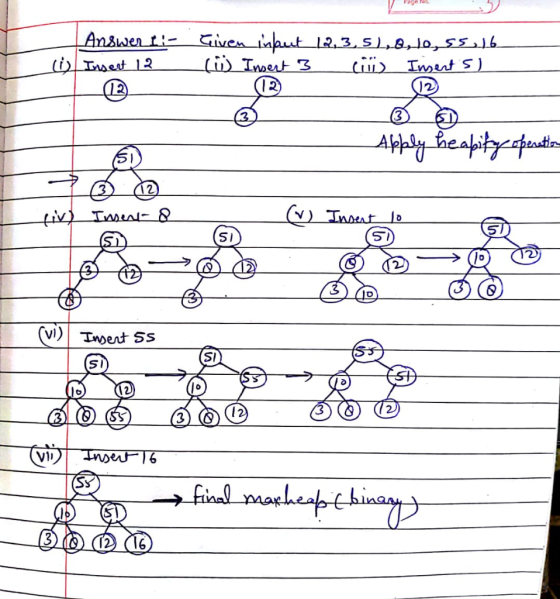
Big-O running time of the algorithm is O(n).
Please give thumbsup, if you like it. Thanks.
Add Answer to:
1. Represent the following input 12,3,51, 8, 10,55, 16 in order to get a maximum binary heap. lus...
In the lectures, we studied binary heaps. A min-Heap can be visualized as a binary tree...
 In the lectures, we studied binary heaps. A min-Heap can be visualized as a binary tree of height with each node having at most two children with the property that value of a node is at most the value of its children. Such heap containing n elements can be represented (stored) as an array with the property Suppose that you would like to construct a & min Heap: each node has at most& children and the value of a node...
ALGORITHM AND DATA STRUCTURES Question Question 1: Convert the following binary tree into a heap using...
ALGORITHM AND DATA STRUCTURES Question Question 1: Convert the following binary tree into a heap using the Heapify algorithm. Draw the diagrams of the tree step by step after every alteration. Question 2: Show the heap that results when the items are inserted into the heap one by one, starting with one that is empty. 7, 3, 8, 1, 4, 20, 11, 33, 45, 23, 6 Question 3. Draw the 2-3-4 tree that results when values are inserted in the...
Trees and Heaps 1. Show that the maximum number of nodes in a binary tree of...
Trees and Heaps 1. Show that the maximum number of nodes in a binary tree of height h is 2h+1 − 1. 2. A full node is a node with two children. Prove that the number of full nodes plus one is equal to the number of leaves in a nonempty binary tree. 3. What is the minimum number of nodes in an AVL tree of height 15? 4. Show the result of inserting 14, 12, 18, 20, 27, 16,...
Convert the array a = [10, 26, 52, 76, 13, 8, 3, 33, 60, 42] into a maximum heap using the linear time heap building algorithm. Show the order of all items after each iteration.
Convert the array a = [10, 26, 52, 76, 13, 8, 3, 33, 60, 42] into a maximum heap using the linear time heap building algorithm. Show the order of all items after each iteration.
In above picture is simple binary tree. Convert this binary tree into "Max Heap" Using below...
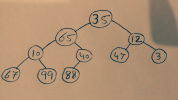 In above picture is simple binary tree. Convert this
binary tree into "Max Heap" Using below mentioned
algorithm.
Perform each step complete dry run. All swaping
occurence show in another step. for example 5 swaping. show 5 steps
and 1 swaping in each step. And mention the algorithm line what
happen what line are execute in this step. algorithm mention
below:-
In swaping algorithm line mentioned what line is
executed. complete dry run. only one swaping in one
step.
9...
In above picture is simple binary tree. Convert this
binary tree into "Max Heap" Using below mentioned
algorithm.
Perform each step complete dry run. All swaping
occurence show in another step. for example 5 swaping. show 5 steps
and 1 swaping in each step. And mention the algorithm line what
happen what line are execute in this step. algorithm mention
below:-
In swaping algorithm line mentioned what line is
executed. complete dry run. only one swaping in one
step.
9...
Finding the second largest number in a maximum binary heap require time complexity of: - O(1)...
Finding the second largest number in a maximum binary heap require time complexity of: - O(1) - O(log(n)) - O(n) - O(nlong(n)) - O(2^n)
Discrete Mathematics Time Complexity Analysis Due: May 9th, 2019 Math 4 6026 Heap Sort Another algorithm for sorting uses a specialized tree structure called a "heap." Specifically, we wi...
 Discrete Mathematics
Time Complexity Analysis Due: May 9th, 2019 Math 4 6026 Heap Sort Another algorithm for sorting uses a specialized tree structure called a "heap." Specifically, we will use a binary heap, which is like a binary tree with hierarchy. Here is an example of a binary heap structure 1. 2. There is a top vertex, called the parent vertex (aka node). The top parent vertex connects to two vertices a level below. These vertices are the "left child"...
Discrete Mathematics
Time Complexity Analysis Due: May 9th, 2019 Math 4 6026 Heap Sort Another algorithm for sorting uses a specialized tree structure called a "heap." Specifically, we will use a binary heap, which is like a binary tree with hierarchy. Here is an example of a binary heap structure 1. 2. There is a top vertex, called the parent vertex (aka node). The top parent vertex connects to two vertices a level below. These vertices are the "left child"...
Question 3. a. Draw the binary min heap represented by the following array: (5 points) 1...
 Question 3. a. Draw the binary min heap represented by the following array: (5 points) 1 2 4 6 7 Value 4 9 12 29 17 14 16 b. Show the result of calling deleteMin twice on the heap you drew in part (a). Show the heap after each deleteMin, and circle the final heap. (5 points) c. Starting with the heap you ended up with in part (b), insert values 11 & 2 in that order. Draw the heap...
QUESTION 16 Show the first pass of sorting the following array-based binary tree max-heap. In other...
 QUESTION 16 Show the first pass of sorting the following array-based binary tree max-heap. In other words, show the first step in sorting, then re-heap the remaining tree into a max-heap. For answers that are not used, put null. You may use scratch paper to draw the trees if you wish. (You will not need all the columns)
Computer Algorithm question 8) Give an algorithm for building a heap in O(n) 9) Prove the...
 Computer Algorithm question
8) Give an algorithm for building a heap in O(n)
9) Prove the algorithm given in 8) runs in O(n) time.
10) What is the asymptotic runtime of an algorithm represented
by the following recurrence equation?
11) Suppose you have the following priority queue implemented as a (max) heap. What will the heap look like when the max node is removed and the heap is readjusted? Assume on each heapify operation the largest child node is selected...
Computer Algorithm question
8) Give an algorithm for building a heap in O(n)
9) Prove the algorithm given in 8) runs in O(n) time.
10) What is the asymptotic runtime of an algorithm represented
by the following recurrence equation?
11) Suppose you have the following priority queue implemented as a (max) heap. What will the heap look like when the max node is removed and the heap is readjusted? Assume on each heapify operation the largest child node is selected...
 In the lectures, we studied binary heaps. A min-Heap can be visualized as a binary tree of height with each node having at most two children with the property that value of a node is at most the value of its children. Such heap containing n elements can be represented (stored) as an array with the property Suppose that you would like to construct a & min Heap: each node has at most& children and the value of a node...
 In above picture is simple binary tree. Convert this
binary tree into "Max Heap" Using below mentioned
algorithm.
Perform each step complete dry run. All swaping
occurence show in another step. for example 5 swaping. show 5 steps
and 1 swaping in each step. And mention the algorithm line what
happen what line are execute in this step. algorithm mention
below:-
In swaping algorithm line mentioned what line is
executed. complete dry run. only one swaping in one
step.
9...
In above picture is simple binary tree. Convert this
binary tree into "Max Heap" Using below mentioned
algorithm.
Perform each step complete dry run. All swaping
occurence show in another step. for example 5 swaping. show 5 steps
and 1 swaping in each step. And mention the algorithm line what
happen what line are execute in this step. algorithm mention
below:-
In swaping algorithm line mentioned what line is
executed. complete dry run. only one swaping in one
step.
9...
 Discrete Mathematics
Time Complexity Analysis Due: May 9th, 2019 Math 4 6026 Heap Sort Another algorithm for sorting uses a specialized tree structure called a "heap." Specifically, we will use a binary heap, which is like a binary tree with hierarchy. Here is an example of a binary heap structure 1. 2. There is a top vertex, called the parent vertex (aka node). The top parent vertex connects to two vertices a level below. These vertices are the "left child"...
Discrete Mathematics
Time Complexity Analysis Due: May 9th, 2019 Math 4 6026 Heap Sort Another algorithm for sorting uses a specialized tree structure called a "heap." Specifically, we will use a binary heap, which is like a binary tree with hierarchy. Here is an example of a binary heap structure 1. 2. There is a top vertex, called the parent vertex (aka node). The top parent vertex connects to two vertices a level below. These vertices are the "left child"...
 Question 3. a. Draw the binary min heap represented by the following array: (5 points) 1 2 4 6 7 Value 4 9 12 29 17 14 16 b. Show the result of calling deleteMin twice on the heap you drew in part (a). Show the heap after each deleteMin, and circle the final heap. (5 points) c. Starting with the heap you ended up with in part (b), insert values 11 & 2 in that order. Draw the heap...
 QUESTION 16 Show the first pass of sorting the following array-based binary tree max-heap. In other words, show the first step in sorting, then re-heap the remaining tree into a max-heap. For answers that are not used, put null. You may use scratch paper to draw the trees if you wish. (You will not need all the columns)
 Computer Algorithm question
8) Give an algorithm for building a heap in O(n)
9) Prove the algorithm given in 8) runs in O(n) time.
10) What is the asymptotic runtime of an algorithm represented
by the following recurrence equation?
11) Suppose you have the following priority queue implemented as a (max) heap. What will the heap look like when the max node is removed and the heap is readjusted? Assume on each heapify operation the largest child node is selected...
Computer Algorithm question
8) Give an algorithm for building a heap in O(n)
9) Prove the algorithm given in 8) runs in O(n) time.
10) What is the asymptotic runtime of an algorithm represented
by the following recurrence equation?
11) Suppose you have the following priority queue implemented as a (max) heap. What will the heap look like when the max node is removed and the heap is readjusted? Assume on each heapify operation the largest child node is selected...
Most questions answered within 3 hours.
-
Where is the error in this code sequence?
String s1 = "Hello";
String s2 = "ello";...
asked 11 months ago -
Financial data for Joel de Paris, Inc., for last year
follow:
Joel de Paris, Inc.
Balance...
asked 11 months ago -
Consider this reaction:
Al2(SO4)3 (aq)+ BaCl3
(aq) Al2Cl6 (aq)- +
3BaSO4(s) . What is the...
asked 11 months ago -
Suppose that Savneet is considering increasing her
recent random sample from 20 car rentals to 40...
asked 11 months ago -
Trucks arrive at an unloading terminal at an average rate of 120
per hour.
Trucks arrive...
asked 11 months ago -
Why are methanol and ethanol completely soluble in water while
octanol is not very little soluble....
asked 11 months ago -
A facilities manager at a university reads in a research report
that the mean amount of...
asked 11 months ago -
When the CuSO4 is rehydrated by adding water to the anhydrous
compound, is this an endothermic...
asked 11 months ago -
A ray of sunlight is passing from diamond into crown glass; the
angle of incidence is...
asked 11 months ago -
A block of mass 0.249 kg is placed on top of a light, vertical
spring of...
asked 11 months ago -
how do the kidneys compensate in the presences of acidosis
a) trigger hyperventilate
b) reserve acid...
asked 11 months ago -
Question 501 pts
The rental rate of capital to the firm increases. Which of the
following...
asked 11 months ago