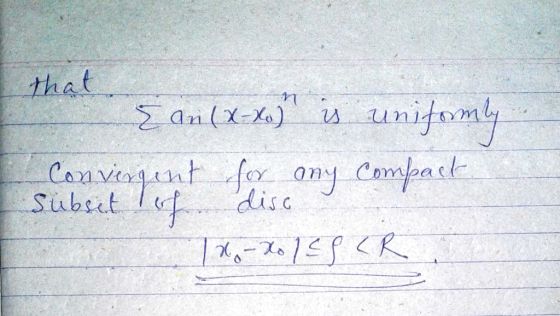
![(4) Let(an}n=o be a sequence in C. Define R-i-lim suplanlì/n. Recall that R e [0,x] o0 is the radius of convergence of the po](http://img.homeworklib.com/images/cedef400-948f-4c43-83bb-821f19475969.png?x-oss-process=image/resize,w_560)
Homework Answers


Add Answer to:
(4) Let(an}n=o be a sequence in C. Define R-i-lim suplanlì/n. Recall that R e [0,x] o0 is the rad...
Let (an) be a sequence such that lim an = 0. Define the sequence (AR) Exercise...
 Let (an) be a sequence such that lim an = 0. Define the sequence (AR) Exercise 21: by A =ļa, and An = zou-a + ax=a + zam for k21. Prove that an converges to some S if and only if Ax converges to S. N=0 k=0 Exercise 22: (Cauchy condensation test) Let (an) be a sequence such that 0 < antı san a) Show n=0 n=1 Hint: Recall the proof of convergence of for p > 1. Ren for...
(10) Suppose that fn : R -> R is a sequence of functions such that for every xo E R there exist a neighborhood N(ro)...
 (10) Suppose that fn : R -> R is a sequence of functions such that for every xo E R there exist a neighborhood N(ro) of xo on which fn converges uniformly. (a) Prove that fn converges uniformly on every compact subset of R
(10) Suppose that fn : R -> R is a sequence of functions such that for every xo E R there exist a neighborhood N(ro) of xo on which fn converges uniformly. (a) Prove that fn...
(10) Suppose that fn : R -> R is a sequence of functions such that for every xo E R there exist a neighborhood N(ro) of xo on which fn converges uniformly. (a) Prove that fn converges uniformly on every compact subset of R
(10) Suppose that fn : R -> R is a sequence of functions such that for every xo E R there exist a neighborhood N(ro) of xo on which fn converges uniformly. (a) Prove that fn...
10. Read through the following "e-free" proof of the uniform convergence of power series. Does it...
 10. Read through the following "e-free" proof of the uniform convergence of power series. Does it depend on limn→oo lan|1/n or lim supn→oo lan! an)1/n? Explain. 1.3 Theorem. For a given power series Σ ak-a)" define the number R, 0 < R < oo, by n-0 lim sup |an| 1/n, then (a) if |z- a < R, the series converges absolutely (b) if lz-a > R, the terms of the series become unbounded and so the (c) if o<r <...
(6) Let (, A,i) be a measure space. Let fn : 0 -» R* be a sequence of measurable functions. Let g, h : O -> R* be a...
 (6) Let (, A,i) be a measure space. Let fn : 0 -» R* be a sequence of measurable functions. Let g, h : O -> R* be a pair of measurable functions such that both are integrable on a set A E A and g(x) < fn(x)<h(x), for all E A and ne N. Prove that / lim sup fn du fn dulim sup fn du lim inf fn du lim inf n o0 A n-oo A noo n00...
2. Let {xn}nEN be a sequence in R converging to x 0. Show that the sequence R. Assume that x 0 an...
 2. Let {xn}nEN be a sequence in R converging to x 0. Show that the sequence R. Assume that x 0 and for each n є N, xn converges to 1. 3. Let A C R". Say that x E Rn is a limit point of A if every open ball around x contains a point y x such that y E A. Let K c Rn be a set such that every infinite subset of K has a limit...
Let (an)nen be a bounded sequence in R. For all n e N define bn =...
 Let (an)nen be a bounded sequence in R. For all n e N define bn = sup{am, On+1, On+2,...}. (You do not have to show that the supremum exists.) (a) Prove that the sequence (bn)nen is a monotone sequence. (b) Prove that the sequence (bn)nen is convergent. (c) Prove or disprove: lim an = lim bre. 100 000
3.) Let ak E R with ak > 0 for all k E N. Suppose Σ㎞iak...
 3.) Let ak E R with ak > 0 for all k E N. Suppose Σ㎞iak converges. Show that Σί1bk (By definition, for a sequence (ck), we say liCkoo if, for all M ER with Hint: Show that there exists (Ni))ไ1 with N > Nj for all j E N, such that bk there exists a sequence (bk)k of real numbers such that lim converges = oo and M >0, there exists N E N such that ck > M...
(3) Let (2,A, /i) be a measure space. Let f : N > R* be a nonnegative measurable function. Define the sequence fn(x)...
 (3) Let (2,A, /i) be a measure space. Let f : N > R* be a nonnegative measurable function. Define the sequence fn(x) = min{f(x), n}, n E N. Prove that for any A E A f du lim fn du A 4 (You must show that the integrals exist.)
(3) Let (2,A, /i) be a measure space. Let f : N > R* be a nonnegative measurable function. Define the sequence fn(x) = min{f(x), n}, n E N. Prove...
(3) Let (2,A, /i) be a measure space. Let f : N > R* be a nonnegative measurable function. Define the sequence fn(x) = min{f(x), n}, n E N. Prove that for any A E A f du lim fn du A 4 (You must show that the integrals exist.)
(3) Let (2,A, /i) be a measure space. Let f : N > R* be a nonnegative measurable function. Define the sequence fn(x) = min{f(x), n}, n E N. Prove...
2. (a) Let 11 = 0 and Zn+1=2r" +1 for all n E N. In +2...
 2. (a) Let 11 = 0 and Zn+1=2r" +1 for all n E N. In +2 i. Find 2, , and ii. Prove that (r converges and find the value of its limit (b) Let a-V2, and define @n+1 = V2+@n for all n 1. Prove that lim an exists and equals 2 Hint: For both parts try to apply the Monotone Convergence Theorem
3. For each n E N let fn : (1, 0) -+ R be given by f/(x) = Find the function f : (1, 0) - R to which {fn} converges poi...
 3. For each n E N let fn : (1, 0) -+ R be given by f/(x) = Find the function f : (1, 0) - R to which {fn} converges pointwise. Prove that the convergence is not uniform
3. For each n E N let fn : (1, 0) -+ R be given by f/(x) = Find the function f : (1, 0) - R to which {fn} converges pointwise. Prove that the convergence is not uniform
3. For each n E N let fn : (1, 0) -+ R be given by f/(x) = Find the function f : (1, 0) - R to which {fn} converges pointwise. Prove that the convergence is not uniform
 Let (an) be a sequence such that lim an = 0. Define the sequence (AR) Exercise 21: by A =ļa, and An = zou-a + ax=a + zam for k21. Prove that an converges to some S if and only if Ax converges to S. N=0 k=0 Exercise 22: (Cauchy condensation test) Let (an) be a sequence such that 0 < antı san a) Show n=0 n=1 Hint: Recall the proof of convergence of for p > 1. Ren for...
 (10) Suppose that fn : R -> R is a sequence of functions such that for every xo E R there exist a neighborhood N(ro) of xo on which fn converges uniformly. (a) Prove that fn converges uniformly on every compact subset of R
(10) Suppose that fn : R -> R is a sequence of functions such that for every xo E R there exist a neighborhood N(ro) of xo on which fn converges uniformly. (a) Prove that fn...
(10) Suppose that fn : R -> R is a sequence of functions such that for every xo E R there exist a neighborhood N(ro) of xo on which fn converges uniformly. (a) Prove that fn converges uniformly on every compact subset of R
(10) Suppose that fn : R -> R is a sequence of functions such that for every xo E R there exist a neighborhood N(ro) of xo on which fn converges uniformly. (a) Prove that fn...
 10. Read through the following "e-free" proof of the uniform convergence of power series. Does it depend on limn→oo lan|1/n or lim supn→oo lan! an)1/n? Explain. 1.3 Theorem. For a given power series Σ ak-a)" define the number R, 0 < R < oo, by n-0 lim sup |an| 1/n, then (a) if |z- a < R, the series converges absolutely (b) if lz-a > R, the terms of the series become unbounded and so the (c) if o<r <...
 (6) Let (, A,i) be a measure space. Let fn : 0 -» R* be a sequence of measurable functions. Let g, h : O -> R* be a pair of measurable functions such that both are integrable on a set A E A and g(x) < fn(x)<h(x), for all E A and ne N. Prove that / lim sup fn du fn dulim sup fn du lim inf fn du lim inf n o0 A n-oo A noo n00...
 2. Let {xn}nEN be a sequence in R converging to x 0. Show that the sequence R. Assume that x 0 and for each n є N, xn converges to 1. 3. Let A C R". Say that x E Rn is a limit point of A if every open ball around x contains a point y x such that y E A. Let K c Rn be a set such that every infinite subset of K has a limit...
 Let (an)nen be a bounded sequence in R. For all n e N define bn = sup{am, On+1, On+2,...}. (You do not have to show that the supremum exists.) (a) Prove that the sequence (bn)nen is a monotone sequence. (b) Prove that the sequence (bn)nen is convergent. (c) Prove or disprove: lim an = lim bre. 100 000
 3.) Let ak E R with ak > 0 for all k E N. Suppose Σ㎞iak converges. Show that Σί1bk (By definition, for a sequence (ck), we say liCkoo if, for all M ER with Hint: Show that there exists (Ni))ไ1 with N > Nj for all j E N, such that bk there exists a sequence (bk)k of real numbers such that lim converges = oo and M >0, there exists N E N such that ck > M...
 (3) Let (2,A, /i) be a measure space. Let f : N > R* be a nonnegative measurable function. Define the sequence fn(x) = min{f(x), n}, n E N. Prove that for any A E A f du lim fn du A 4 (You must show that the integrals exist.)
(3) Let (2,A, /i) be a measure space. Let f : N > R* be a nonnegative measurable function. Define the sequence fn(x) = min{f(x), n}, n E N. Prove...
(3) Let (2,A, /i) be a measure space. Let f : N > R* be a nonnegative measurable function. Define the sequence fn(x) = min{f(x), n}, n E N. Prove that for any A E A f du lim fn du A 4 (You must show that the integrals exist.)
(3) Let (2,A, /i) be a measure space. Let f : N > R* be a nonnegative measurable function. Define the sequence fn(x) = min{f(x), n}, n E N. Prove...
 2. (a) Let 11 = 0 and Zn+1=2r" +1 for all n E N. In +2 i. Find 2, , and ii. Prove that (r converges and find the value of its limit (b) Let a-V2, and define @n+1 = V2+@n for all n 1. Prove that lim an exists and equals 2 Hint: For both parts try to apply the Monotone Convergence Theorem
 3. For each n E N let fn : (1, 0) -+ R be given by f/(x) = Find the function f : (1, 0) - R to which {fn} converges pointwise. Prove that the convergence is not uniform
3. For each n E N let fn : (1, 0) -+ R be given by f/(x) = Find the function f : (1, 0) - R to which {fn} converges pointwise. Prove that the convergence is not uniform
3. For each n E N let fn : (1, 0) -+ R be given by f/(x) = Find the function f : (1, 0) - R to which {fn} converges pointwise. Prove that the convergence is not uniform
Most questions answered within 3 hours.
-
Where is the error in this code sequence?
String s1 = "Hello";
String s2 = "ello";...
asked 10 months ago -
Financial data for Joel de Paris, Inc., for last year
follow:
Joel de Paris, Inc.
Balance...
asked 10 months ago -
Consider this reaction:
Al2(SO4)3 (aq)+ BaCl3
(aq) Al2Cl6 (aq)- +
3BaSO4(s) . What is the...
asked 10 months ago -
Suppose that Savneet is considering increasing her
recent random sample from 20 car rentals to 40...
asked 10 months ago -
Trucks arrive at an unloading terminal at an average rate of 120
per hour.
Trucks arrive...
asked 10 months ago -
Why are methanol and ethanol completely soluble in water while
octanol is not very little soluble....
asked 10 months ago -
A facilities manager at a university reads in a research report
that the mean amount of...
asked 10 months ago -
When the CuSO4 is rehydrated by adding water to the anhydrous
compound, is this an endothermic...
asked 10 months ago -
A ray of sunlight is passing from diamond into crown glass; the
angle of incidence is...
asked 10 months ago -
A block of mass 0.249 kg is placed on top of a light, vertical
spring of...
asked 10 months ago -
how do the kidneys compensate in the presences of acidosis
a) trigger hyperventilate
b) reserve acid...
asked 10 months ago -
Question 501 pts
The rental rate of capital to the firm increases. Which of the
following...
asked 10 months ago