
Homework Answers
Please find the code below::::
def sum_of_products(myList):
mySum = 0
for currentList in myList:
product = 1
for i in currentList:
product *=i
mySum+=product
return mySum
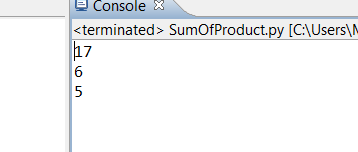
print(sum_of_products([[1,2],[5],[2,5]]))
print(sum_of_products([[2,3]]))
print(sum_of_products([[2],[3]]))

output:
Add Answer to:
0% of final (S1 2019) Write a function called sum_of_products(x), where x is a list of lists of i...
More Practice: Writing Lists& Strings . Write a function average_ evens that takes a list of...
 More Practice: Writing Lists& Strings . Write a function average_ evens that takes a list of numbers as parameters, and adds all the even numbers together and returns their average using a list Example function call: print (average_evens (I-2, -3, 4, 0, 1, 2,3 Outputs: 0 Write a function match that takes two strings as a parameter and returns how many letters the strings have in common. You should treat upper and lower case letters as the same letter ('A,...
Define a function called max_association(), which recieves 2 lists, lst1, which is a list of strings,...
Define a function called max_association(), which recieves 2 lists, lst1, which is a list of strings, and lst2, which is a list of integers. The function must return a list of strings associated to the highest integers in lst1. Assume both lists have the same length As an example, the following code fragment: L1 = ['a','b','c','d','e','f','g','h','i','j'] L2 = [1,2,3,1,3,2,3,1,2,1] result = max_association(L1,L2) print(result) should produce the output: ['c', 'e', 'g']
Define a function called collapse() which takes a list as input. Each element of the list...
Define a function called collapse() which takes a list as input. Each element of the list will either be an integer, or a list of integers. The function should modify the input list by replacing all of the elements which themselves are lists with the sum of their elements. For example: Test Result vals = [1, 2, 3, 4, 5] collapse(vals) print(vals) [1, 2, 3, 4, 5] vals = [1, [2, 3], 4, 5] collapse(vals) print(vals) [1, 5, 4, 5]...
Write a function called avg_max that takes a list of lists (sublists may be empty) and...
 Write a function called avg_max that takes a
list of lists (sublists may be empty) and return the average of the
largest item in each sublist as a float. If a sublist is empty, do
not consider it for the purposes of computing average. You may
assume that everything inside a non-empty sublist is a number. You
may assume that at least one sublist will be non-empty.
Write a function called avg max that takes a list of lists (sublists...
Write a function called avg_max that takes a
list of lists (sublists may be empty) and return the average of the
largest item in each sublist as a float. If a sublist is empty, do
not consider it for the purposes of computing average. You may
assume that everything inside a non-empty sublist is a number. You
may assume that at least one sublist will be non-empty.
Write a function called avg max that takes a list of lists (sublists...
Problem 20 [ 2 points ] Use the Design Recipe to write a function, print_histogram that...
Problem 20 [ 2 points ] Use the Design Recipe to write a function, print_histogram that consumes a list of numbers and prints a histogram graph using asterisks to represent each number in the list. Use one output line per number in the list. You may assume that only integers are passed to this function. Your function should ignore negative values. Include a docstring! Test Result print_histogram([ 0, 2, 4, 1]) ** **** * print_histogram([10, 5, 3, -1, 8]) **********...
1. Make a function make_list_of_lists(n, m) that creates and returns a list of n lists of...
1. Make a function make_list_of_lists(n, m) that creates and returns a list of n lists of size m, where each of the m elements in a sublist are randomly generated integers between 1 and 9. For example, you might obtain l = make_list_of_lists(2,2) >>> print(l) [[1, 4], [5, 7]] Big Hint: You can do this using numpy along the lines of the following code: import numpy >>> l = list(numpy.random.randint(a,b,c)) where you need to sort out what the values of...
Haskell Function program Write a function negateOdds that takes a list of integers and returns a...
Haskell Function program Write a function negateOdds that takes a list of integers and returns a list of integers with all of the odd integers negated. negateOdds :: [Integer] -> [Integer] example: [1,2,3,4,5] should return [-1,2,-3,4,-5]
****python**** Q1. Write a recursive function that returns the sum of all numbers up to and...
 ****python****
Q1.
Write a recursive function that returns the sum of all numbers
up to and including the given value.
This function has to be recursive; you may not use loops!
For example:
Test
Result
print('%d : %d' % (5, sum_up_to(5)))
5 : 15
Q2,
Write a recursive function that counts the number of odd
integers in a given list.
This function has to be recursive; you may not use loops!
For example:
Test
Result
print('%s : %d' % ([2,...
****python****
Q1.
Write a recursive function that returns the sum of all numbers
up to and including the given value.
This function has to be recursive; you may not use loops!
For example:
Test
Result
print('%d : %d' % (5, sum_up_to(5)))
5 : 15
Q2,
Write a recursive function that counts the number of odd
integers in a given list.
This function has to be recursive; you may not use loops!
For example:
Test
Result
print('%s : %d' % ([2,...
Write a function valid_integers(strings) that takes a list of strings as a parameter and returns a...
Write a function valid_integers(strings) that takes a list of strings as a parameter and returns a list of the integers that can be obtained by converting the strings to integers using an expression like int(string). Strings which cannot be converted in this way are ignored. Hint: the statement pass is a statement that does nothing when executed. For example: Test Result strings = ['123', '-39', '+45', 'x', 'COSC121', '123+', '12-3'] print(valid_integers(strings)) [123, -39, 45]
use python 2a. Union (1 points) Make a union function which takes in 2 lists as...
 use python
2a. Union (1 points) Make a union function which takes in 2 lists as parameters and returns a list. It should return a list that contain all elements that are in either list. Your results list should contain no duplicates. For example, if the two lists are [1,5,6,5, 2] and [3,5, 1,9] then the result list is (1,5,6,2,3,9). Note that the list sizes don't have to be equal. Note that the input lists could have duplicates, but your...
use python
2a. Union (1 points) Make a union function which takes in 2 lists as parameters and returns a list. It should return a list that contain all elements that are in either list. Your results list should contain no duplicates. For example, if the two lists are [1,5,6,5, 2] and [3,5, 1,9] then the result list is (1,5,6,2,3,9). Note that the list sizes don't have to be equal. Note that the input lists could have duplicates, but your...
 More Practice: Writing Lists& Strings . Write a function average_ evens that takes a list of numbers as parameters, and adds all the even numbers together and returns their average using a list Example function call: print (average_evens (I-2, -3, 4, 0, 1, 2,3 Outputs: 0 Write a function match that takes two strings as a parameter and returns how many letters the strings have in common. You should treat upper and lower case letters as the same letter ('A,...
 Write a function called avg_max that takes a
list of lists (sublists may be empty) and return the average of the
largest item in each sublist as a float. If a sublist is empty, do
not consider it for the purposes of computing average. You may
assume that everything inside a non-empty sublist is a number. You
may assume that at least one sublist will be non-empty.
Write a function called avg max that takes a list of lists (sublists...
Write a function called avg_max that takes a
list of lists (sublists may be empty) and return the average of the
largest item in each sublist as a float. If a sublist is empty, do
not consider it for the purposes of computing average. You may
assume that everything inside a non-empty sublist is a number. You
may assume that at least one sublist will be non-empty.
Write a function called avg max that takes a list of lists (sublists...
 ****python****
Q1.
Write a recursive function that returns the sum of all numbers
up to and including the given value.
This function has to be recursive; you may not use loops!
For example:
Test
Result
print('%d : %d' % (5, sum_up_to(5)))
5 : 15
Q2,
Write a recursive function that counts the number of odd
integers in a given list.
This function has to be recursive; you may not use loops!
For example:
Test
Result
print('%s : %d' % ([2,...
****python****
Q1.
Write a recursive function that returns the sum of all numbers
up to and including the given value.
This function has to be recursive; you may not use loops!
For example:
Test
Result
print('%d : %d' % (5, sum_up_to(5)))
5 : 15
Q2,
Write a recursive function that counts the number of odd
integers in a given list.
This function has to be recursive; you may not use loops!
For example:
Test
Result
print('%s : %d' % ([2,...
 use python
2a. Union (1 points) Make a union function which takes in 2 lists as parameters and returns a list. It should return a list that contain all elements that are in either list. Your results list should contain no duplicates. For example, if the two lists are [1,5,6,5, 2] and [3,5, 1,9] then the result list is (1,5,6,2,3,9). Note that the list sizes don't have to be equal. Note that the input lists could have duplicates, but your...
use python
2a. Union (1 points) Make a union function which takes in 2 lists as parameters and returns a list. It should return a list that contain all elements that are in either list. Your results list should contain no duplicates. For example, if the two lists are [1,5,6,5, 2] and [3,5, 1,9] then the result list is (1,5,6,2,3,9). Note that the list sizes don't have to be equal. Note that the input lists could have duplicates, but your...
Most questions answered within 3 hours.
-
Where is the error in this code sequence?
String s1 = "Hello";
String s2 = "ello";...
asked 11 months ago -
Financial data for Joel de Paris, Inc., for last year
follow:
Joel de Paris, Inc.
Balance...
asked 11 months ago -
Consider this reaction:
Al2(SO4)3 (aq)+ BaCl3
(aq) Al2Cl6 (aq)- +
3BaSO4(s) . What is the...
asked 11 months ago -
Suppose that Savneet is considering increasing her
recent random sample from 20 car rentals to 40...
asked 11 months ago -
Trucks arrive at an unloading terminal at an average rate of 120
per hour.
Trucks arrive...
asked 11 months ago -
Why are methanol and ethanol completely soluble in water while
octanol is not very little soluble....
asked 11 months ago -
A facilities manager at a university reads in a research report
that the mean amount of...
asked 11 months ago -
When the CuSO4 is rehydrated by adding water to the anhydrous
compound, is this an endothermic...
asked 11 months ago -
A ray of sunlight is passing from diamond into crown glass; the
angle of incidence is...
asked 11 months ago -
A block of mass 0.249 kg is placed on top of a light, vertical
spring of...
asked 11 months ago -
how do the kidneys compensate in the presences of acidosis
a) trigger hyperventilate
b) reserve acid...
asked 11 months ago -
Question 501 pts
The rental rate of capital to the firm increases. Which of the
following...
asked 11 months ago