
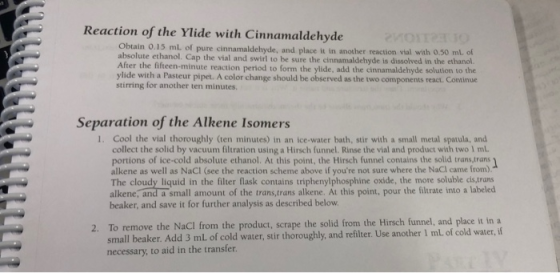
Reaction of the Ylide with Cinnamaldehyde Obtai in 0.15 ml of pure cinnamaldehyde, and place it in another reaction vial with 0.50 mL of absolute ethanol. Cap the vial and swirl to be sure the cinnamaldehyde is dissolved in the ethanol. fter the fifteen-minute reaction period to form the ylide, add the cinnamaldehyde solution to the ylide with a Pasteur pipet. A color change should be observed as the two components react. Continue stirring for another ten minutes. Separation of the Alkene Isomers 1. Cool the vial thoroughly (ten minutes) in an ice-water bath, stir with a small metal spatula, and collect the solid by vacuum filtration using a Hirsch funnel. Rinse the vial and product with two 1 ml portions of ice-cold absolute ethanol. At this point, the Hirsch funnel contains the solid trans,trans alkene as well as NaCI (see the reaction scheme above if you're not sure where the NaCl came from). The cloudy liquid in the filter flask contains triphenylphosphine oxide, the more soluble cis,trans alkene, and a small amount of the trans,trans alkene. At this point, pour the filtrate into a labeled beaker, and save it for further analysis as described below 2. To remove the NaCI from the product, scrape the solid from the Hirsch funnel, and place it in a small beaker. Add 3 ml of cold water, stir thoroughly, and refilter. Use another 1 ml of cold water, i necessary, to aid in the transfer
Homework Answers
Add Answer to:
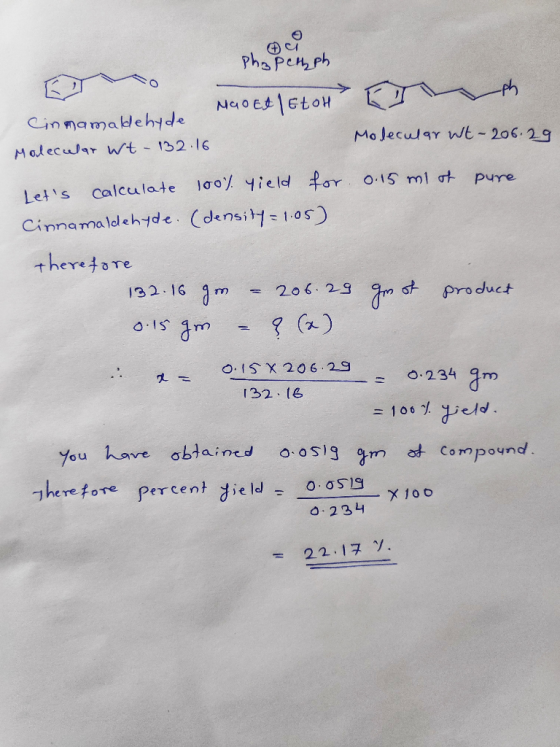
What is the percent yield of the lab procedure below? my final weight of the product is 0.0519 g
what would be the percent yield if the final weight of my product is 0.1357g this...
 what would be the percent yield if the final weight of my product
is 0.1357g this is a green chemistry wittig reaction to produce
1,4-diphenyl-1,3-butadiene from benzyltriphenylphosphonium chloride
and trans- cinnamaledyde using sodium hydroxide as the base
You will be using a Green Chemistry Wittig reaction (NOT Wittig-Horner Emmons reaction) to produce 1,4-diphenyl-1,3-butadiene starting with benzyltriphenylphosphonium chloride and trans- cinnamaledyde using sodium hydroxide as the base. This reaction is considered a "green" reaction, because an aqueous solution will be used...
what would be the percent yield if the final weight of my product
is 0.1357g this is a green chemistry wittig reaction to produce
1,4-diphenyl-1,3-butadiene from benzyltriphenylphosphonium chloride
and trans- cinnamaledyde using sodium hydroxide as the base
You will be using a Green Chemistry Wittig reaction (NOT Wittig-Horner Emmons reaction) to produce 1,4-diphenyl-1,3-butadiene starting with benzyltriphenylphosphonium chloride and trans- cinnamaledyde using sodium hydroxide as the base. This reaction is considered a "green" reaction, because an aqueous solution will be used...
Running the Reaction Add 0.100 g benzil and 0.30 mL 95% ethanol to a 3-mL conical vial. Place a s...
 Determine the theoretical yield and limiting reagent
Running the Reaction Add 0.100 g benzil and 0.30 mL 95% ethanol to a 3-mL conical vial. Place a spin vane in the vial and attach an air condenser. Heat the mixture with an aluminum block (90-100°C) while stirring until the benzil has dissolved (see inset in Tech- nique 6, Figure 6.1A). Using a 9-inch Pasteur pipette, add dropwise 0.25 mL of an aqueous potassium hydroxide solution' downward through the condenser into the...
Determine the theoretical yield and limiting reagent
Running the Reaction Add 0.100 g benzil and 0.30 mL 95% ethanol to a 3-mL conical vial. Place a spin vane in the vial and attach an air condenser. Heat the mixture with an aluminum block (90-100°C) while stirring until the benzil has dissolved (see inset in Tech- nique 6, Figure 6.1A). Using a 9-inch Pasteur pipette, add dropwise 0.25 mL of an aqueous potassium hydroxide solution' downward through the condenser into the...
Why is it important to completely dissolve both the alkene and alkyne before adding the pyridiumium...
Why is it important to completely dissolve both the alkene and alkyne before adding the pyridiumium tribromide to the reaction vial. Why is this important? Hint: the alkene and alkyne do not have the same solubility in acetic acid. this is the experiment, In the fume hood, measure 2.0 mL of glacial acetic acid into your 10 mL microscale reaction vial. Add trans-stilbene (135 mg, 0.75 mmol) and diphenylacetlyene (135 mg, 0.75 mmol). Add a stir bar and place the...
Place 3.0 g of salicylic acid in a 125-ml Erlenmeyer flask. Carefully add, stirring constantly, 6...
 Place 3.0 g of salicylic acid in a 125-ml Erlenmeyer flask. Carefully add, stirring constantly, 6 mL of acetic anhydride, followed by 10 drops of concentrated sulfuric acid. Swirl the contents of the flask so that the reactants are thoroughly mixed. Stopper the flask with a one- hole cork fitted with an inverted Pasteur pipet to prevent condensation of water in the reaction flask during heating on the steam bath. Heat the flask in a boiling-water or steam bath for...
How can the NMP oxalate salt be converted back to NMP? Here is the procedure: PROCEDURES...
How can the NMP oxalate salt be converted back to NMP? Here is the procedure: PROCEDURES Part A: Synthesis of (±)-N,N-dimethyl-3-phenyl-3-(4-trifluoromethylphenoxy)propanamine To the 250-mL round-bottom flask (RBF) containing (±)-3-(dimethylamino)-1-phenylpropanol (product from Lab 6) and a magnetic stir bar, add 4 mL of 4-chlorobenzotrifluoride and 30 mL of dimethylacetamide (DMA). With stirring, add to this mixture 30 mL of 1.0 M potassium tert-butoxide (caustic alkali!) in tert-butyl alcohol using a syringe. Using a simple distillation apparatus, distill the mixture slowly, with...
Find %yield please the product obtained was 0.0870g In the hood, place 100 mu L of...
 Find %yield please the product obtained was 0.0870g
In the hood, place 100 mu L of aniline in a tared 10 times 75 mm (small) test tube. Place the test cube in a small beaker or Erlenmeyer flask to avoid spillage. Stopper the cube with a cork. Now, using a Pasteur pipet, add (with swirling) 0.5 mL of water, followed by three drops of concentrated HCI. Add 10 mg of decolorizing charcoal (we use the pelletized form, called Nonrit^TM) to...
Find %yield please the product obtained was 0.0870g
In the hood, place 100 mu L of aniline in a tared 10 times 75 mm (small) test tube. Place the test cube in a small beaker or Erlenmeyer flask to avoid spillage. Stopper the cube with a cork. Now, using a Pasteur pipet, add (with swirling) 0.5 mL of water, followed by three drops of concentrated HCI. Add 10 mg of decolorizing charcoal (we use the pelletized form, called Nonrit^TM) to...
this is the procedure of melting point experiment ( preparation acetanilid) I want the summarize of...
 this is the procedure of melting point experiment
( preparation acetanilid) I want the summarize of this
procedure
EXPERIMENTAL PROCEDURE Measure 0.100 to 0.125 g of aniline (in dropper bottles near the balances) into a tared reaction tube from the microscale kit and record the weight to the nearest milligram. Add 2 mL of distilled water and 6 to 7 drops (an excess amount, 21 drops =1 mL) of acetic anhydride. Stir the mixture for about 4 minutes untiha solid...
this is the procedure of melting point experiment
( preparation acetanilid) I want the summarize of this
procedure
EXPERIMENTAL PROCEDURE Measure 0.100 to 0.125 g of aniline (in dropper bottles near the balances) into a tared reaction tube from the microscale kit and record the weight to the nearest milligram. Add 2 mL of distilled water and 6 to 7 drops (an excess amount, 21 drops =1 mL) of acetic anhydride. Stir the mixture for about 4 minutes untiha solid...
Find the crude yield and percent yield of trans-4-methoxycinnamic acid Find the crude and percent yield...
 Find the crude yield and percent yield of trans-4-methoxycinnamic
acid
Find the crude and percent yield of ethyl trans-4
methoxycinnamic acid
Synthesis of trans-4-methoxycinnamic acid 0.585 gused To a 25 mL round-bottom flask equipped with a stir bar, add 1 mL of pyridine (Caution! Pyridine is toxic!) followed by 320 mg of 4-methoxybenzaldehyde, 320mg 10. 200ML 585 mg of malonic acid and 33 mg of B-alanine. Clamp the round-bottom flask Ucdi over a stir plate in a sand bath and...
Find the crude yield and percent yield of trans-4-methoxycinnamic
acid
Find the crude and percent yield of ethyl trans-4
methoxycinnamic acid
Synthesis of trans-4-methoxycinnamic acid 0.585 gused To a 25 mL round-bottom flask equipped with a stir bar, add 1 mL of pyridine (Caution! Pyridine is toxic!) followed by 320 mg of 4-methoxybenzaldehyde, 320mg 10. 200ML 585 mg of malonic acid and 33 mg of B-alanine. Clamp the round-bottom flask Ucdi over a stir plate in a sand bath and...
Propose another way of synthesizing NMP from the amino ketone hydrochloride salt starting materia...
 Propose another way of synthesizing NMP from the amino ketone
hydrochloride salt starting material you used.
Part A: Synthesis of (t)-N,N-dimethyl-3-phenyl-3-(4- trifluoromethylphenoxy)propanamine 1. To the 250-mL round-bottom flask (RBF) containing (t)-3-(dimethylamino)-1-phenylpropanol (product from Lab 6) and a magnetic stir bar, add 4 mL of 4- chlorobenzotrifluoride and 30 mL of dimethylacetamide (DMA) 2. With stirring, add to this mixture 30 mL of 1.0 M potassium tert-butoxide (caustic alkali!) in tert-butyl alcohol using a syringe 3. Using a simple distillation apparatus,...
Propose another way of synthesizing NMP from the amino ketone
hydrochloride salt starting material you used.
Part A: Synthesis of (t)-N,N-dimethyl-3-phenyl-3-(4- trifluoromethylphenoxy)propanamine 1. To the 250-mL round-bottom flask (RBF) containing (t)-3-(dimethylamino)-1-phenylpropanol (product from Lab 6) and a magnetic stir bar, add 4 mL of 4- chlorobenzotrifluoride and 30 mL of dimethylacetamide (DMA) 2. With stirring, add to this mixture 30 mL of 1.0 M potassium tert-butoxide (caustic alkali!) in tert-butyl alcohol using a syringe 3. Using a simple distillation apparatus,...
What is the theoretical yield (in grams) and percent yield of your triphenylmethanol product in this...
 What is the theoretical yield (in grams) and percent yield of
your triphenylmethanol product in this experiment?
Assume that you have collected 0.15g of Triphenylmethanol for
the question.
Reaction Set Up ---- ALL glassware NEEDS to be DRY!!! Anhydrous CaCl2 -Drying tube 53 mg Mg turnings Claisen adapter + 2 mL anhydrous ether + 260 ul bromobenzene Air condenser Stir until reaction amber. Heat slowly to reflux for 10 min. Cool the reaction in ice bath for 5 min. Use...
What is the theoretical yield (in grams) and percent yield of
your triphenylmethanol product in this experiment?
Assume that you have collected 0.15g of Triphenylmethanol for
the question.
Reaction Set Up ---- ALL glassware NEEDS to be DRY!!! Anhydrous CaCl2 -Drying tube 53 mg Mg turnings Claisen adapter + 2 mL anhydrous ether + 260 ul bromobenzene Air condenser Stir until reaction amber. Heat slowly to reflux for 10 min. Cool the reaction in ice bath for 5 min. Use...
 what would be the percent yield if the final weight of my product
is 0.1357g this is a green chemistry wittig reaction to produce
1,4-diphenyl-1,3-butadiene from benzyltriphenylphosphonium chloride
and trans- cinnamaledyde using sodium hydroxide as the base
You will be using a Green Chemistry Wittig reaction (NOT Wittig-Horner Emmons reaction) to produce 1,4-diphenyl-1,3-butadiene starting with benzyltriphenylphosphonium chloride and trans- cinnamaledyde using sodium hydroxide as the base. This reaction is considered a "green" reaction, because an aqueous solution will be used...
what would be the percent yield if the final weight of my product
is 0.1357g this is a green chemistry wittig reaction to produce
1,4-diphenyl-1,3-butadiene from benzyltriphenylphosphonium chloride
and trans- cinnamaledyde using sodium hydroxide as the base
You will be using a Green Chemistry Wittig reaction (NOT Wittig-Horner Emmons reaction) to produce 1,4-diphenyl-1,3-butadiene starting with benzyltriphenylphosphonium chloride and trans- cinnamaledyde using sodium hydroxide as the base. This reaction is considered a "green" reaction, because an aqueous solution will be used...
 Determine the theoretical yield and limiting reagent
Running the Reaction Add 0.100 g benzil and 0.30 mL 95% ethanol to a 3-mL conical vial. Place a spin vane in the vial and attach an air condenser. Heat the mixture with an aluminum block (90-100°C) while stirring until the benzil has dissolved (see inset in Tech- nique 6, Figure 6.1A). Using a 9-inch Pasteur pipette, add dropwise 0.25 mL of an aqueous potassium hydroxide solution' downward through the condenser into the...
Determine the theoretical yield and limiting reagent
Running the Reaction Add 0.100 g benzil and 0.30 mL 95% ethanol to a 3-mL conical vial. Place a spin vane in the vial and attach an air condenser. Heat the mixture with an aluminum block (90-100°C) while stirring until the benzil has dissolved (see inset in Tech- nique 6, Figure 6.1A). Using a 9-inch Pasteur pipette, add dropwise 0.25 mL of an aqueous potassium hydroxide solution' downward through the condenser into the...
 Place 3.0 g of salicylic acid in a 125-ml Erlenmeyer flask. Carefully add, stirring constantly, 6 mL of acetic anhydride, followed by 10 drops of concentrated sulfuric acid. Swirl the contents of the flask so that the reactants are thoroughly mixed. Stopper the flask with a one- hole cork fitted with an inverted Pasteur pipet to prevent condensation of water in the reaction flask during heating on the steam bath. Heat the flask in a boiling-water or steam bath for...
 Find %yield please the product obtained was 0.0870g
In the hood, place 100 mu L of aniline in a tared 10 times 75 mm (small) test tube. Place the test cube in a small beaker or Erlenmeyer flask to avoid spillage. Stopper the cube with a cork. Now, using a Pasteur pipet, add (with swirling) 0.5 mL of water, followed by three drops of concentrated HCI. Add 10 mg of decolorizing charcoal (we use the pelletized form, called Nonrit^TM) to...
Find %yield please the product obtained was 0.0870g
In the hood, place 100 mu L of aniline in a tared 10 times 75 mm (small) test tube. Place the test cube in a small beaker or Erlenmeyer flask to avoid spillage. Stopper the cube with a cork. Now, using a Pasteur pipet, add (with swirling) 0.5 mL of water, followed by three drops of concentrated HCI. Add 10 mg of decolorizing charcoal (we use the pelletized form, called Nonrit^TM) to...
 this is the procedure of melting point experiment
( preparation acetanilid) I want the summarize of this
procedure
EXPERIMENTAL PROCEDURE Measure 0.100 to 0.125 g of aniline (in dropper bottles near the balances) into a tared reaction tube from the microscale kit and record the weight to the nearest milligram. Add 2 mL of distilled water and 6 to 7 drops (an excess amount, 21 drops =1 mL) of acetic anhydride. Stir the mixture for about 4 minutes untiha solid...
this is the procedure of melting point experiment
( preparation acetanilid) I want the summarize of this
procedure
EXPERIMENTAL PROCEDURE Measure 0.100 to 0.125 g of aniline (in dropper bottles near the balances) into a tared reaction tube from the microscale kit and record the weight to the nearest milligram. Add 2 mL of distilled water and 6 to 7 drops (an excess amount, 21 drops =1 mL) of acetic anhydride. Stir the mixture for about 4 minutes untiha solid...
 Find the crude yield and percent yield of trans-4-methoxycinnamic
acid
Find the crude and percent yield of ethyl trans-4
methoxycinnamic acid
Synthesis of trans-4-methoxycinnamic acid 0.585 gused To a 25 mL round-bottom flask equipped with a stir bar, add 1 mL of pyridine (Caution! Pyridine is toxic!) followed by 320 mg of 4-methoxybenzaldehyde, 320mg 10. 200ML 585 mg of malonic acid and 33 mg of B-alanine. Clamp the round-bottom flask Ucdi over a stir plate in a sand bath and...
Find the crude yield and percent yield of trans-4-methoxycinnamic
acid
Find the crude and percent yield of ethyl trans-4
methoxycinnamic acid
Synthesis of trans-4-methoxycinnamic acid 0.585 gused To a 25 mL round-bottom flask equipped with a stir bar, add 1 mL of pyridine (Caution! Pyridine is toxic!) followed by 320 mg of 4-methoxybenzaldehyde, 320mg 10. 200ML 585 mg of malonic acid and 33 mg of B-alanine. Clamp the round-bottom flask Ucdi over a stir plate in a sand bath and...
 Propose another way of synthesizing NMP from the amino ketone
hydrochloride salt starting material you used.
Part A: Synthesis of (t)-N,N-dimethyl-3-phenyl-3-(4- trifluoromethylphenoxy)propanamine 1. To the 250-mL round-bottom flask (RBF) containing (t)-3-(dimethylamino)-1-phenylpropanol (product from Lab 6) and a magnetic stir bar, add 4 mL of 4- chlorobenzotrifluoride and 30 mL of dimethylacetamide (DMA) 2. With stirring, add to this mixture 30 mL of 1.0 M potassium tert-butoxide (caustic alkali!) in tert-butyl alcohol using a syringe 3. Using a simple distillation apparatus,...
Propose another way of synthesizing NMP from the amino ketone
hydrochloride salt starting material you used.
Part A: Synthesis of (t)-N,N-dimethyl-3-phenyl-3-(4- trifluoromethylphenoxy)propanamine 1. To the 250-mL round-bottom flask (RBF) containing (t)-3-(dimethylamino)-1-phenylpropanol (product from Lab 6) and a magnetic stir bar, add 4 mL of 4- chlorobenzotrifluoride and 30 mL of dimethylacetamide (DMA) 2. With stirring, add to this mixture 30 mL of 1.0 M potassium tert-butoxide (caustic alkali!) in tert-butyl alcohol using a syringe 3. Using a simple distillation apparatus,...
 What is the theoretical yield (in grams) and percent yield of
your triphenylmethanol product in this experiment?
Assume that you have collected 0.15g of Triphenylmethanol for
the question.
Reaction Set Up ---- ALL glassware NEEDS to be DRY!!! Anhydrous CaCl2 -Drying tube 53 mg Mg turnings Claisen adapter + 2 mL anhydrous ether + 260 ul bromobenzene Air condenser Stir until reaction amber. Heat slowly to reflux for 10 min. Cool the reaction in ice bath for 5 min. Use...
What is the theoretical yield (in grams) and percent yield of
your triphenylmethanol product in this experiment?
Assume that you have collected 0.15g of Triphenylmethanol for
the question.
Reaction Set Up ---- ALL glassware NEEDS to be DRY!!! Anhydrous CaCl2 -Drying tube 53 mg Mg turnings Claisen adapter + 2 mL anhydrous ether + 260 ul bromobenzene Air condenser Stir until reaction amber. Heat slowly to reflux for 10 min. Cool the reaction in ice bath for 5 min. Use...
Most questions answered within 3 hours.
-
Where is the error in this code sequence?
String s1 = "Hello";
String s2 = "ello";...
asked 11 months ago -
Financial data for Joel de Paris, Inc., for last year
follow:
Joel de Paris, Inc.
Balance...
asked 11 months ago -
Consider this reaction:
Al2(SO4)3 (aq)+ BaCl3
(aq) Al2Cl6 (aq)- +
3BaSO4(s) . What is the...
asked 11 months ago -
Suppose that Savneet is considering increasing her
recent random sample from 20 car rentals to 40...
asked 11 months ago -
Trucks arrive at an unloading terminal at an average rate of 120
per hour.
Trucks arrive...
asked 11 months ago -
Why are methanol and ethanol completely soluble in water while
octanol is not very little soluble....
asked 11 months ago -
A facilities manager at a university reads in a research report
that the mean amount of...
asked 11 months ago -
When the CuSO4 is rehydrated by adding water to the anhydrous
compound, is this an endothermic...
asked 11 months ago -
A ray of sunlight is passing from diamond into crown glass; the
angle of incidence is...
asked 11 months ago -
A block of mass 0.249 kg is placed on top of a light, vertical
spring of...
asked 11 months ago -
how do the kidneys compensate in the presences of acidosis
a) trigger hyperventilate
b) reserve acid...
asked 11 months ago -
Question 501 pts
The rental rate of capital to the firm increases. Which of the
following...
asked 11 months ago