
Homework Answers

Please rate it up thanks :)
Add Answer to:
Exercisel: Consider a physical system whose state space, which is three-dimensional is spanned by...
Exercise 1: Consider a physical system whose state space, which is three-dimensional is spanned b...
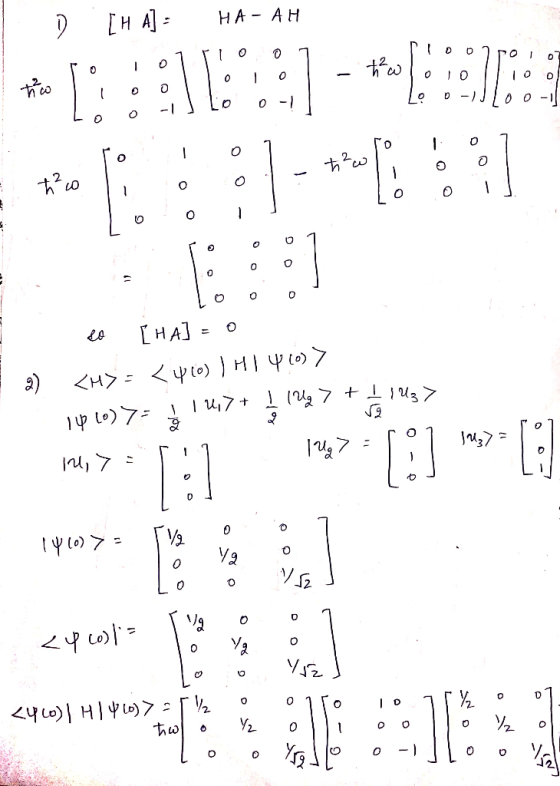
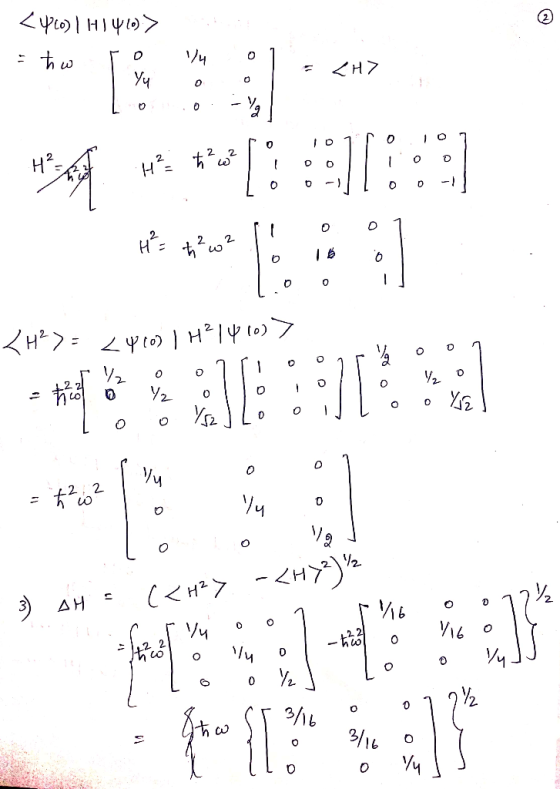
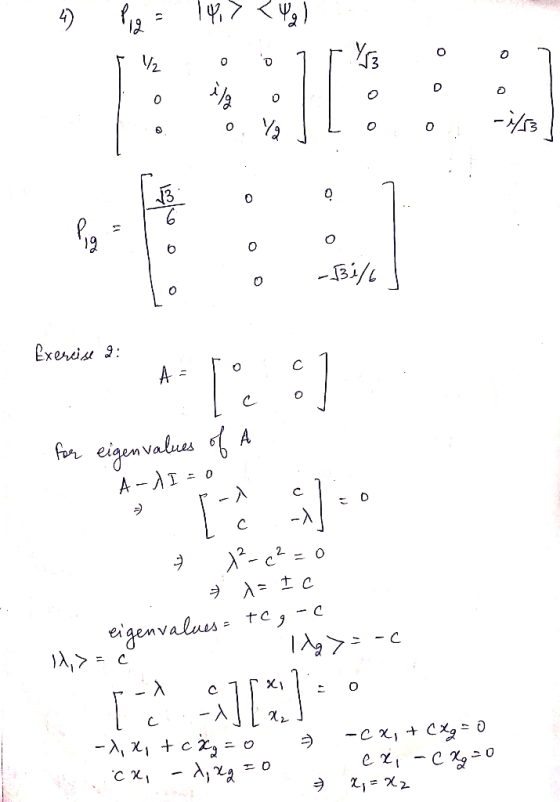
 Exercise 1: Consider a physical system whose state space, which is three-dimensional is spanned by the orthonormal basis formed by three kets |ф11ф2) and IP2). I- In this basis, the Hamiltonian operator H of the system and the observable A are written as: H- ho 0 2 0 A h0 01 where o is real constant And the state ofthe system att-os: ΙΨ(0))siip)+1P2》怡1%) 1- Calculate the commutator [H. A] 2- Determine the energies of the system. 3- Determine the eigen-values...
Q10 The Hamiltonian of a two-state system is given by H E ( i)- I02)(2 |...
 Q10 The Hamiltonian of a two-state system is given by H E ( i)- I02)(2 | -i | ¢1)(2 | +i | ¢2) (¢1 1) where , p2) form a complete and orthonormal basis; E is a real constant having the dimensions of energy (a) Is H Hermitian? Calculate the trace of H (b) Find the matrix representing H in the | øı), | 42) basis and calculate the eigenvalues and the eigenvectors of the matrix. Calculate the trace of...
Consider a two-dimensional state vector space and a basis in this space lay), laz), eigenvectors of...
 Consider a two-dimensional state vector space and a basis in this space lay), laz), eigenvectors of an observable A: Ala) = aja) Alaz) = azlaz) A representation of Hamiltonian operator in this basis is: H = (8 5) Find: -Eigenstates and eigenvalues of H. -If the system is in state |az) at time t=0, What is the state vector of the system at time t? -What is the probability of finding the system in the state |az) at time t?...
Consider a ph<sica stem whose state spuce, which is three -dinensional , is s panned by...
 Consider a ph<sica stem whose state spuce, which is three -dinensional , is s panned by an orthonormal basis 7 l t > , 1 2 > ,'3> ỉ . In this basis- Wo obser vab les A and B re represenfed by th matrice E a -Vt where a, ans b are positive real constants. The syste s in t itia stte nsanlS normali 2atinn Cnnst ant Al lhe observable f is measuredon and tn mazimum Possible Value was...
Problem 8.3 - A New Two-State System Consider a new two-level system with a Hamiltonian given...
 Problem 8.3 - A New Two-State System Consider a new two-level system with a Hamiltonian given by i = Ti 1461 – 12) (2) (3) Also consider an observable represented by the operator Ŝ = * 11/21 - *12/11: It should (hopefully) be clear that 1) and 2) are eigenkets of the Hamiltonian. Let $1) be an eigenket of S corresponding to the smaller eigenvalue of S and let S2) be an eigenket of S corresponding to the larger eigenvalue....
2. Consider a three-dimensional Universe. A vector of this space, starts from the origin of the...
 2. Consider a three-dimensional Universe. A vector of this space, starts from the origin of the coordinate system and has the tip described by the coordinates 1, 0, a) Write the matrix that describes a rotation of this three dimensional vector about the Oz axis by an angle of 45° Both the initial and the final coordinates have the same origin. b) Calculate the projections (of the tip) of this vector along the new axes of coordinates.
Consider a three-level system where the Hamiltonian and observable A are given by the matrix Aˆ...
 Consider a three-level system where the Hamiltonian and
observable A are given by the matrix Aˆ = µ 0 1 0 1 0 1 0 1 0
Hˆ = ¯hω 1 0 0 0 1 0 0 0 1 (a) What are the possible
values obtained in a measurement of A (b) Does a state exist in
which both the results of a measurement of energy E and observable
A can be...
Consider a three-level system where the Hamiltonian and
observable A are given by the matrix Aˆ = µ 0 1 0 1 0 1 0 1 0
Hˆ = ¯hω 1 0 0 0 1 0 0 0 1 (a) What are the possible
values obtained in a measurement of A (b) Does a state exist in
which both the results of a measurement of energy E and observable
A can be...
3) Consider a system whose Hamiltonian H and an operator A are given by the matrices...
 3) Consider a system whose Hamiltonian H and an operator A are given by the matrices 71 H = 60 -1 10 -1 1 0 0 0 -1) A = a 10 4 4 0 10 1 o) 1 0 where εo has the dimensions of energy. a) What are the possible values for the measurement of the energy? (3 marks) b) Suppose that the energy is measured, giving E = - Eo. What values are obtained if we subsequently...
its a complete question there is no additional detail given then this Consider a three-dimensional quantum-mechanical...
 its a complete question there is no additional detail
given then this
Consider a three-dimensional quantum-mechanical system for which the state space has an orthonormal basis {Injm)} consisting of eigenstates of the square and z-component of the total angular momentum operator ), according to j' Injm) = j (+1) 2 In j m) and Jz inj m) = mħ|njm). (The symbol n stands for further quantum numbers, which are unimportant for the present problem.) Let A be a linear operator...
its a complete question there is no additional detail
given then this
Consider a three-dimensional quantum-mechanical system for which the state space has an orthonormal basis {Injm)} consisting of eigenstates of the square and z-component of the total angular momentum operator ), according to j' Injm) = j (+1) 2 In j m) and Jz inj m) = mħ|njm). (The symbol n stands for further quantum numbers, which are unimportant for the present problem.) Let A be a linear operator...
Sur I Nano 2019/20) Qunntum physics exercices 1.1 Linear algebra and formalism Exercice 1.1.1 Basic calculations...
 Sur I Nano 2019/20) Qunntum physics exercices 1.1 Linear algebra and formalism Exercice 1.1.1 Basic calculations We consideran llibert prace Ey of dimension 2 and the two following vectors of En = (17.) and le >= () acting on vectors of Eh 21- We consider also the linear operator = 1+5 1 Calculate the square norms of the two vectors < Hermitian scalar products <ul> and < > 2. Calculate the eigensalues and cigarvectors of A. >, < > and...
 Exercise 1: Consider a physical system whose state space, which is three-dimensional is spanned by the orthonormal basis formed by three kets |ф11ф2) and IP2). I- In this basis, the Hamiltonian operator H of the system and the observable A are written as: H- ho 0 2 0 A h0 01 where o is real constant And the state ofthe system att-os: ΙΨ(0))siip)+1P2》怡1%) 1- Calculate the commutator [H. A] 2- Determine the energies of the system. 3- Determine the eigen-values...
 Q10 The Hamiltonian of a two-state system is given by H E ( i)- I02)(2 | -i | ¢1)(2 | +i | ¢2) (¢1 1) where , p2) form a complete and orthonormal basis; E is a real constant having the dimensions of energy (a) Is H Hermitian? Calculate the trace of H (b) Find the matrix representing H in the | øı), | 42) basis and calculate the eigenvalues and the eigenvectors of the matrix. Calculate the trace of...
 Consider a two-dimensional state vector space and a basis in this space lay), laz), eigenvectors of an observable A: Ala) = aja) Alaz) = azlaz) A representation of Hamiltonian operator in this basis is: H = (8 5) Find: -Eigenstates and eigenvalues of H. -If the system is in state |az) at time t=0, What is the state vector of the system at time t? -What is the probability of finding the system in the state |az) at time t?...
 Consider a ph<sica stem whose state spuce, which is three -dinensional , is s panned by an orthonormal basis 7 l t > , 1 2 > ,'3> ỉ . In this basis- Wo obser vab les A and B re represenfed by th matrice E a -Vt where a, ans b are positive real constants. The syste s in t itia stte nsanlS normali 2atinn Cnnst ant Al lhe observable f is measuredon and tn mazimum Possible Value was...
 Problem 8.3 - A New Two-State System Consider a new two-level system with a Hamiltonian given by i = Ti 1461 – 12) (2) (3) Also consider an observable represented by the operator Ŝ = * 11/21 - *12/11: It should (hopefully) be clear that 1) and 2) are eigenkets of the Hamiltonian. Let $1) be an eigenket of S corresponding to the smaller eigenvalue of S and let S2) be an eigenket of S corresponding to the larger eigenvalue....
 2. Consider a three-dimensional Universe. A vector of this space, starts from the origin of the coordinate system and has the tip described by the coordinates 1, 0, a) Write the matrix that describes a rotation of this three dimensional vector about the Oz axis by an angle of 45° Both the initial and the final coordinates have the same origin. b) Calculate the projections (of the tip) of this vector along the new axes of coordinates.
 Consider a three-level system where the Hamiltonian and
observable A are given by the matrix Aˆ = µ 0 1 0 1 0 1 0 1 0
Hˆ = ¯hω 1 0 0 0 1 0 0 0 1 (a) What are the possible
values obtained in a measurement of A (b) Does a state exist in
which both the results of a measurement of energy E and observable
A can be...
Consider a three-level system where the Hamiltonian and
observable A are given by the matrix Aˆ = µ 0 1 0 1 0 1 0 1 0
Hˆ = ¯hω 1 0 0 0 1 0 0 0 1 (a) What are the possible
values obtained in a measurement of A (b) Does a state exist in
which both the results of a measurement of energy E and observable
A can be...
 3) Consider a system whose Hamiltonian H and an operator A are given by the matrices 71 H = 60 -1 10 -1 1 0 0 0 -1) A = a 10 4 4 0 10 1 o) 1 0 where εo has the dimensions of energy. a) What are the possible values for the measurement of the energy? (3 marks) b) Suppose that the energy is measured, giving E = - Eo. What values are obtained if we subsequently...
 its a complete question there is no additional detail
given then this
Consider a three-dimensional quantum-mechanical system for which the state space has an orthonormal basis {Injm)} consisting of eigenstates of the square and z-component of the total angular momentum operator ), according to j' Injm) = j (+1) 2 In j m) and Jz inj m) = mħ|njm). (The symbol n stands for further quantum numbers, which are unimportant for the present problem.) Let A be a linear operator...
its a complete question there is no additional detail
given then this
Consider a three-dimensional quantum-mechanical system for which the state space has an orthonormal basis {Injm)} consisting of eigenstates of the square and z-component of the total angular momentum operator ), according to j' Injm) = j (+1) 2 In j m) and Jz inj m) = mħ|njm). (The symbol n stands for further quantum numbers, which are unimportant for the present problem.) Let A be a linear operator...
 Sur I Nano 2019/20) Qunntum physics exercices 1.1 Linear algebra and formalism Exercice 1.1.1 Basic calculations We consideran llibert prace Ey of dimension 2 and the two following vectors of En = (17.) and le >= () acting on vectors of Eh 21- We consider also the linear operator = 1+5 1 Calculate the square norms of the two vectors < Hermitian scalar products <ul> and < > 2. Calculate the eigensalues and cigarvectors of A. >, < > and...
Most questions answered within 3 hours.
-
Where is the error in this code sequence?
String s1 = "Hello";
String s2 = "ello";...
asked 11 months ago -
Financial data for Joel de Paris, Inc., for last year
follow:
Joel de Paris, Inc.
Balance...
asked 11 months ago -
Consider this reaction:
Al2(SO4)3 (aq)+ BaCl3
(aq) Al2Cl6 (aq)- +
3BaSO4(s) . What is the...
asked 11 months ago -
Suppose that Savneet is considering increasing her
recent random sample from 20 car rentals to 40...
asked 11 months ago -
Trucks arrive at an unloading terminal at an average rate of 120
per hour.
Trucks arrive...
asked 11 months ago -
Why are methanol and ethanol completely soluble in water while
octanol is not very little soluble....
asked 11 months ago -
A facilities manager at a university reads in a research report
that the mean amount of...
asked 11 months ago -
When the CuSO4 is rehydrated by adding water to the anhydrous
compound, is this an endothermic...
asked 11 months ago -
A ray of sunlight is passing from diamond into crown glass; the
angle of incidence is...
asked 11 months ago -
A block of mass 0.249 kg is placed on top of a light, vertical
spring of...
asked 11 months ago -
how do the kidneys compensate in the presences of acidosis
a) trigger hyperventilate
b) reserve acid...
asked 11 months ago -
Question 501 pts
The rental rate of capital to the firm increases. Which of the
following...
asked 11 months ago