
Homework Answers


Add Answer to:
Using the Quine-McCluskey method, find all minimum product of sums expressions for the following ...
show work Problem 4 For the following function, find the minimum sum-of-products solution, using the Quine-McCluskey method: Ma, b, c, d)-m(1, 3, 4, 5,6, 7, 10, 12, 13) 2,9,15) Problem 4 For...
 show work
Problem 4 For the following function, find the minimum sum-of-products solution, using the Quine-McCluskey method: Ma, b, c, d)-m(1, 3, 4, 5,6, 7, 10, 12, 13) 2,9,15)
Problem 4 For the following function, find the minimum sum-of-products solution, using the Quine-McCluskey method: Ma, b, c, d)-m(1, 3, 4, 5,6, 7, 10, 12, 13) 2,9,15)
show work
Problem 4 For the following function, find the minimum sum-of-products solution, using the Quine-McCluskey method: Ma, b, c, d)-m(1, 3, 4, 5,6, 7, 10, 12, 13) 2,9,15)
Problem 4 For the following function, find the minimum sum-of-products solution, using the Quine-McCluskey method: Ma, b, c, d)-m(1, 3, 4, 5,6, 7, 10, 12, 13) 2,9,15)
Using a prime implicant chart, find all minimum sum-of-products solutions for each of the functions given...
Using a prime implicant chart, find all minimum sum-of-products solutions for each of the functions given in Problem below Q. For each of the following functions, find all of the prime implicants using the Quine- McCluskey method. (a) f(a, b, c, d) = Σ m(0, 3, 4, 5, 7, 9, 11, 13) (b) f(a, b, c, d) = Σ m(2, 4, 5, 6, 9, 10, 11, 12, 13, 15)
2. Find the minimum sum of products and the minimum product of sums for the following...
 2. Find the minimum sum of products and the minimum product of sums for the following function fla, b, c, d) Il M(0, 1, 6, 8, 11, 12). Il D(3, 7, 14, 15)
2.55 Minimize the following functions using the Quine--McCluskey method. (a) f(A,B,C,D) = m(0,2,4,5,7,9,11,12) (b) f(A,B,C,D,E) =...
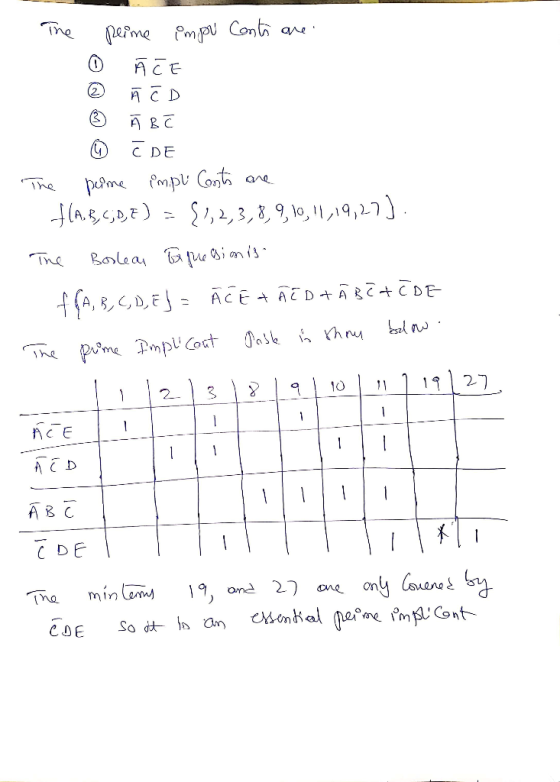
 2.55 Minimize the following functions using the Quine--McCluskey method. (a) f(A,B,C,D) = m(0,2,4,5,7,9,11,12) (b) f(A,B,C,D,E) = m(0,1,2,7,9,11,12,23,27,28) 2.56 Use the Quine-McCluskey method to minimize the following functions with don't cares. (a) f(A,B,C,D) = m(0,6,9,10,13)+d(1,3,8) (b) f(A,B,C,D) = m(1,4,7,10,13)+d(5,14,15) et autorit fiinctione rein the MA techninio 2.55 Minimize the following functions using the Quine--McCluskey method. (a) f(A,B,C,D)= m(0,2,4,5,7,9,11,12) (b) f(A,B,C,D,E)= m(0,1,2,7,9,11,12,23,27,28) 2.56 Use the Quine-McCluskey method to minimize the following functions with don't cares. (a) f(A,B,C,D) = m(0,6,9,10,13)+d(1,3,8) (b) f(A,B,C,D) =...
(a) List all seven product term implicants of F(a, b, c) = Σ m(0, 1, 5,...
(a) List all seven product term implicants of F(a, b, c) = Σ m(0, 1, 5, 7) Which of these implicants are prime? Why is a′c not an implicant? (b) Defne a prime implicant. (c) Why must every term in a minimum sum-of-products expression be a prime implicant? Check your answer using a Karnaugh map. 170 Unit 6 (d) Given that F(A, B, C, D) = Σ m(0, 1, 4, 5, 7, 10, 15), which of the following terms are...
Using the K-Map method, find the optimized "product of sums" expression for the following function: F(W,...
 Using the K-Map method, find the optimized "product of sums" expression for the following function: F(W, X, Y, Z) = II (0, 1, 4, 5, 7, 9, 12, 13, 14, 15)
Using K-maps, obtain the simplified product-of-sums and sum-of-products expressions for the following Boolean functions: a). b)....
 Using K-maps, obtain the simplified product-of-sums and
sum-of-products expressions for the following Boolean
functions:
a).
b).
F(x, y,2)-(3,5,6,7) d(0, 1,2) F(w,x, y, z) (0,1,2,3,7,8, 10)+ d(5,6,11, 15)
Using K-maps, obtain the simplified product-of-sums and
sum-of-products expressions for the following Boolean
functions:
a).
b).
F(x, y,2)-(3,5,6,7) d(0, 1,2) F(w,x, y, z) (0,1,2,3,7,8, 10)+ d(5,6,11, 15)
5.9(a) only please help me with product of sum part only. i already got product of...
 5.9(a) only
please help me with product of sum part only. i already got
product of sum. thank you.
Unit 5 Exercises(1 Protected View Saved to this PC ( ) - puspa gir Mome Insert Draw Design Layout References Mailings Help TED VIEW Be careful-files from the Internet can contain viruses. Unless you need to edit, it's safer to stay in Protected View Review View O Tell me what you want to do Share fnable Editing 5.9 Find the minimum...
5.9(a) only
please help me with product of sum part only. i already got
product of sum. thank you.
Unit 5 Exercises(1 Protected View Saved to this PC ( ) - puspa gir Mome Insert Draw Design Layout References Mailings Help TED VIEW Be careful-files from the Internet can contain viruses. Unless you need to edit, it's safer to stay in Protected View Review View O Tell me what you want to do Share fnable Editing 5.9 Find the minimum...
For each of the following functions, find all the minimum SOP expressions using the Karnaugh map....
For each of the following functions, find all the minimum SOP expressions using the Karnaugh map. f(a,b,c,d) = Σm(0,2,3,4,6,7,8,9,10,11,13,15) (4 solutions) g(a,b,c,d,e)= Σm(0,1,2,4,5,6,10,13,14,18,21,22,24,26,29,30) (1 solution) h(a,b,c,d) = Σm(1,3,4,6,10,12)+Σd(0,7,9,13,15) (3 solutions) f(w,x,y,z) = Σm(0,2,7,8,9,11,13)+Σd(3,10) (2 solutions)
PLEASE WRITE IN C# Problem: Summing up sums. For this question, you’ll understand the importance of...
PLEASE WRITE IN C# Problem: Summing up sums. For this question, you’ll understand the importance of using the results of smaller sets of work. You’re going to create a recursive function that takes in an array of random integers and returns a “sum of sums”. This is best explained through an example. If you have 5 elements in an array, the function should return the sum of elements 0-4, 1-4, 2-4, 3-4, and 4. So, if we had an array...
 show work
Problem 4 For the following function, find the minimum sum-of-products solution, using the Quine-McCluskey method: Ma, b, c, d)-m(1, 3, 4, 5,6, 7, 10, 12, 13) 2,9,15)
Problem 4 For the following function, find the minimum sum-of-products solution, using the Quine-McCluskey method: Ma, b, c, d)-m(1, 3, 4, 5,6, 7, 10, 12, 13) 2,9,15)
show work
Problem 4 For the following function, find the minimum sum-of-products solution, using the Quine-McCluskey method: Ma, b, c, d)-m(1, 3, 4, 5,6, 7, 10, 12, 13) 2,9,15)
Problem 4 For the following function, find the minimum sum-of-products solution, using the Quine-McCluskey method: Ma, b, c, d)-m(1, 3, 4, 5,6, 7, 10, 12, 13) 2,9,15)
 2. Find the minimum sum of products and the minimum product of sums for the following function fla, b, c, d) Il M(0, 1, 6, 8, 11, 12). Il D(3, 7, 14, 15)
 2.55 Minimize the following functions using the Quine--McCluskey method. (a) f(A,B,C,D) = m(0,2,4,5,7,9,11,12) (b) f(A,B,C,D,E) = m(0,1,2,7,9,11,12,23,27,28) 2.56 Use the Quine-McCluskey method to minimize the following functions with don't cares. (a) f(A,B,C,D) = m(0,6,9,10,13)+d(1,3,8) (b) f(A,B,C,D) = m(1,4,7,10,13)+d(5,14,15) et autorit fiinctione rein the MA techninio 2.55 Minimize the following functions using the Quine--McCluskey method. (a) f(A,B,C,D)= m(0,2,4,5,7,9,11,12) (b) f(A,B,C,D,E)= m(0,1,2,7,9,11,12,23,27,28) 2.56 Use the Quine-McCluskey method to minimize the following functions with don't cares. (a) f(A,B,C,D) = m(0,6,9,10,13)+d(1,3,8) (b) f(A,B,C,D) =...
 Using the K-Map method, find the optimized "product of sums" expression for the following function: F(W, X, Y, Z) = II (0, 1, 4, 5, 7, 9, 12, 13, 14, 15)
 Using K-maps, obtain the simplified product-of-sums and
sum-of-products expressions for the following Boolean
functions:
a).
b).
F(x, y,2)-(3,5,6,7) d(0, 1,2) F(w,x, y, z) (0,1,2,3,7,8, 10)+ d(5,6,11, 15)
Using K-maps, obtain the simplified product-of-sums and
sum-of-products expressions for the following Boolean
functions:
a).
b).
F(x, y,2)-(3,5,6,7) d(0, 1,2) F(w,x, y, z) (0,1,2,3,7,8, 10)+ d(5,6,11, 15)
 5.9(a) only
please help me with product of sum part only. i already got
product of sum. thank you.
Unit 5 Exercises(1 Protected View Saved to this PC ( ) - puspa gir Mome Insert Draw Design Layout References Mailings Help TED VIEW Be careful-files from the Internet can contain viruses. Unless you need to edit, it's safer to stay in Protected View Review View O Tell me what you want to do Share fnable Editing 5.9 Find the minimum...
5.9(a) only
please help me with product of sum part only. i already got
product of sum. thank you.
Unit 5 Exercises(1 Protected View Saved to this PC ( ) - puspa gir Mome Insert Draw Design Layout References Mailings Help TED VIEW Be careful-files from the Internet can contain viruses. Unless you need to edit, it's safer to stay in Protected View Review View O Tell me what you want to do Share fnable Editing 5.9 Find the minimum...
Most questions answered within 3 hours.
-
Where is the error in this code sequence?
String s1 = "Hello";
String s2 = "ello";...
asked 10 months ago -
Financial data for Joel de Paris, Inc., for last year
follow:
Joel de Paris, Inc.
Balance...
asked 10 months ago -
Consider this reaction:
Al2(SO4)3 (aq)+ BaCl3
(aq) Al2Cl6 (aq)- +
3BaSO4(s) . What is the...
asked 10 months ago -
Suppose that Savneet is considering increasing her
recent random sample from 20 car rentals to 40...
asked 10 months ago -
Trucks arrive at an unloading terminal at an average rate of 120
per hour.
Trucks arrive...
asked 10 months ago -
Why are methanol and ethanol completely soluble in water while
octanol is not very little soluble....
asked 10 months ago -
A facilities manager at a university reads in a research report
that the mean amount of...
asked 10 months ago -
When the CuSO4 is rehydrated by adding water to the anhydrous
compound, is this an endothermic...
asked 10 months ago -
A ray of sunlight is passing from diamond into crown glass; the
angle of incidence is...
asked 10 months ago -
A block of mass 0.249 kg is placed on top of a light, vertical
spring of...
asked 10 months ago -
how do the kidneys compensate in the presences of acidosis
a) trigger hyperventilate
b) reserve acid...
asked 10 months ago -
Question 501 pts
The rental rate of capital to the firm increases. Which of the
following...
asked 10 months ago