
Homework Answers
Add Answer to:
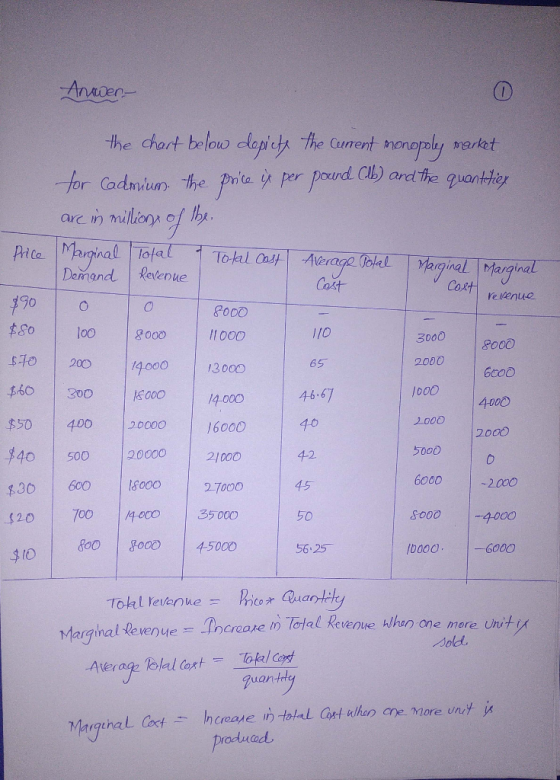
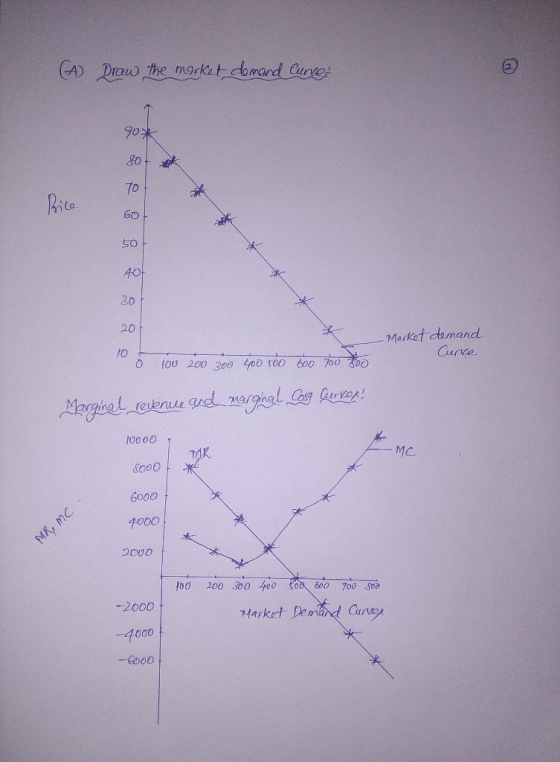
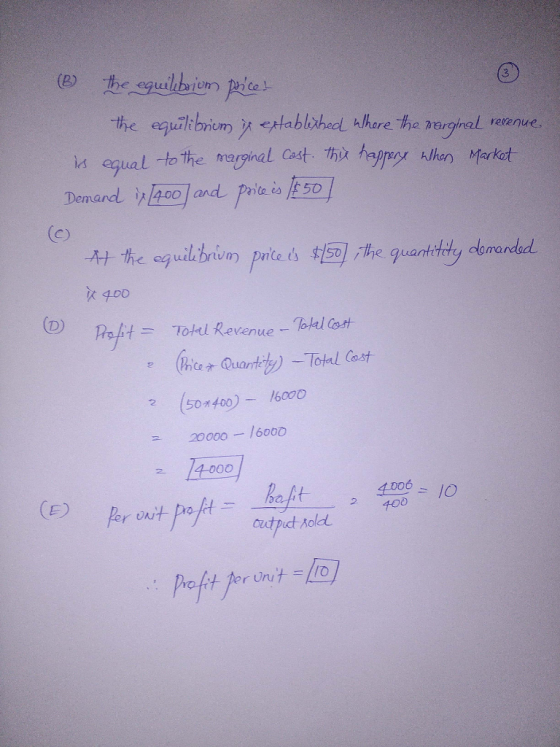
PART II MONOPOLY 10 POINTS The chart below depicts the current monopoly market for cadmium. The p...
Part E-H Assume a profit-maximizing monopolist faces a market demand given by P = (12,000 –...
Part E-H Assume a profit-maximizing monopolist faces a market demand given by P = (12,000 – 90Q)/100 and long run total and marginal cost given by LRTC = 5Q + Q2 + 40 (Note: The answer to this question must be hand-written.): a) Find the equation of the marginal revenue curve corresponding to the market demand curve. b) Find the equation for the marginal cost function. c) Find the profit-maximizing quantity of output for the monopoly and the price the...
4. Monopoly (15 pts) Consider a situation where a monopolist faces the following inverse market demand...
 4. Monopoly (15 pts) Consider a situation where a monopolist faces the following inverse market demand curve p= 100 – 0.54 and the following cost function TC = 89 +92 a) Derive the marginal revenue and marginal cost functions. b) What are the equilibrium price and quantity if this market behaved as if it were perfectly competitive? c) What are the equilibrium price and quantity when the monopolist produces as a monopolist?
Price/Cost ($) 7) Monopoly II (6 points) The marginal costs (MC), average variable costs (AVC), and...
 Price/Cost ($) 7) Monopoly II (6 points) The marginal costs (MC), average variable costs (AVC), and average total costs (ATC) for a monopoly are shown in the figure below. The figure also shows the demand curve (D) and the marginal revenue curve (MR) for this market. 501 ATC AVC a. What is the firm's profit-maximizing level of output? Label this on the graph. b. What price will the monopolist charge for that level of output? Label this on the graph....
Figure 15-6 Price $20+ Marginal Cost 100 150 200 Quantity Marginal Revenue Refer to Figure 15-6. What is the deadweight loss caused by a profit-maximizing monopoly? O O $150 $200 $250 Os300 A monopolist faces market demand given by P - 60 - Q. For this ma
Figure 15-6 Price $20+ Marginal Cost 100 150 200 Quantity Marginal Revenue Refer to Figure 15-6. What is the deadweight loss caused by a profit-maximizing monopoly? O O $150 $200 $250 Os300 A monopolist faces market demand given by P - 60 - Q. For this market, MR = 90 - 2Q and MC - Q. What price will the monopolist charge in order to maximize profits? O $20 O $30 O so Osso In Canada, in the majority of...
Practice Question 4. The inverse demand curve a monopoly faces is p = 30 – Q....
 Practice Question 4. The inverse demand curve a monopoly faces is p = 30 – Q. The firm's total cost function is C(Q) = 0.5Q² and thus marginal cost function is MC(Q) = Q. (a) Determine the monopoly quantity, price and profit, and calculate the CS, PS and social welfare under the monopoly. (b) Determine the socially optimal outcome and calculate the CS, PS and social welfare under the social optimum. (c) Calculate the deadweight loss due to the monopolist...
7. How is monopoly different from perfect competition? 8. What is a barrier to entry? Give...
7. How is monopoly different from perfect competition? 8. What is a barrier to entry? Give some examples. 9. What is a natural monopoly? 11. What is predatory pricing? 14. In what sense is a natural monopoly “natural”? 15. How is the demand curve perceived by a perfectly competitive firm different from the demand curve perceived by a monopolist? 16. How does the demand curve perceived by a monopolist compare with the market demand curve? 17. Is a monopolist a...
Suppose that the local hardware store has a monopoly on screwdrivers. The market demand is given...
Suppose that the local hardware store has a monopoly on screwdrivers. The market demand is given by P = 33 – 0.25Q and the marginal revenue is MR = 33 – 0.5Q. The marginal cost of selling screwdrivers is MC = 1 + 1.5Q. What is the profit-maximizing price the monopolist should charge for the screwdrivers and how many will they sell? Price: $ Quantity: screwdrivers
Problem 3: A market with a monopoly producer has inverse demand P = 120 - 2Q...
 Problem 3: A market with a monopoly producer has inverse demand P = 120 - 2Q (which gives marginal revenue MR = 120 - 4Q). The monopolist has marginal costs are MCQ) = 4Q and no fixed costs. a) What is the monopolist's producer surplus when it charges the profit maximizing uniform price. b) What is the deadweight loss due to monopoly in this market? c) What would the monopolist's producer surplus be if it could engage in first degree...
1. What is a monopoly? Name 2 differences between a monopoly and a perfectly competitive market....
 1. What is a monopoly? Name 2 differences between a monopoly and a perfectly competitive market. 2. What is the profit maximizing condition for a price-setting monopoly? 3. Show that MR follows the notion "same intercept, twice the slope" of demand. 4. Is a monopoly the most socially optimal market? How does a monopoly differ from a perfectly competitive market? Explain and show in a graph. What is the difference in welfare? 5. At what point would a monopoly decide...
3. Monopoly Consider a situation where a monopolist faces the following inverse market demand curve 132...
 3. Monopoly Consider a situation where a monopolist faces the following inverse market demand curve 132 - 2a p and the following cost function TС — 12g + 2q* a) Derive the marginal revenue and marginal cost functions b) What are the equilibrium price and quantity if this market behaved as if it were competitive? c) Calculate the Consumer Surplus, Producer Surplus and Welfare levels under perfect petition d) What are the equilibrium price and quantity when the monopolist produces...
 4. Monopoly (15 pts) Consider a situation where a monopolist faces the following inverse market demand curve p= 100 – 0.54 and the following cost function TC = 89 +92 a) Derive the marginal revenue and marginal cost functions. b) What are the equilibrium price and quantity if this market behaved as if it were perfectly competitive? c) What are the equilibrium price and quantity when the monopolist produces as a monopolist?
 Price/Cost ($) 7) Monopoly II (6 points) The marginal costs (MC), average variable costs (AVC), and average total costs (ATC) for a monopoly are shown in the figure below. The figure also shows the demand curve (D) and the marginal revenue curve (MR) for this market. 501 ATC AVC a. What is the firm's profit-maximizing level of output? Label this on the graph. b. What price will the monopolist charge for that level of output? Label this on the graph....
 Practice Question 4. The inverse demand curve a monopoly faces is p = 30 – Q. The firm's total cost function is C(Q) = 0.5Q² and thus marginal cost function is MC(Q) = Q. (a) Determine the monopoly quantity, price and profit, and calculate the CS, PS and social welfare under the monopoly. (b) Determine the socially optimal outcome and calculate the CS, PS and social welfare under the social optimum. (c) Calculate the deadweight loss due to the monopolist...
 Problem 3: A market with a monopoly producer has inverse demand P = 120 - 2Q (which gives marginal revenue MR = 120 - 4Q). The monopolist has marginal costs are MCQ) = 4Q and no fixed costs. a) What is the monopolist's producer surplus when it charges the profit maximizing uniform price. b) What is the deadweight loss due to monopoly in this market? c) What would the monopolist's producer surplus be if it could engage in first degree...
 1. What is a monopoly? Name 2 differences between a monopoly and a perfectly competitive market. 2. What is the profit maximizing condition for a price-setting monopoly? 3. Show that MR follows the notion "same intercept, twice the slope" of demand. 4. Is a monopoly the most socially optimal market? How does a monopoly differ from a perfectly competitive market? Explain and show in a graph. What is the difference in welfare? 5. At what point would a monopoly decide...
 3. Monopoly Consider a situation where a monopolist faces the following inverse market demand curve 132 - 2a p and the following cost function TС — 12g + 2q* a) Derive the marginal revenue and marginal cost functions b) What are the equilibrium price and quantity if this market behaved as if it were competitive? c) Calculate the Consumer Surplus, Producer Surplus and Welfare levels under perfect petition d) What are the equilibrium price and quantity when the monopolist produces...
Most questions answered within 3 hours.
-
Where is the error in this code sequence?
String s1 = "Hello";
String s2 = "ello";...
asked 10 months ago -
Financial data for Joel de Paris, Inc., for last year
follow:
Joel de Paris, Inc.
Balance...
asked 10 months ago -
Consider this reaction:
Al2(SO4)3 (aq)+ BaCl3
(aq) Al2Cl6 (aq)- +
3BaSO4(s) . What is the...
asked 10 months ago -
Suppose that Savneet is considering increasing her
recent random sample from 20 car rentals to 40...
asked 10 months ago -
Trucks arrive at an unloading terminal at an average rate of 120
per hour.
Trucks arrive...
asked 10 months ago -
Why are methanol and ethanol completely soluble in water while
octanol is not very little soluble....
asked 10 months ago -
A facilities manager at a university reads in a research report
that the mean amount of...
asked 10 months ago -
When the CuSO4 is rehydrated by adding water to the anhydrous
compound, is this an endothermic...
asked 10 months ago -
A ray of sunlight is passing from diamond into crown glass; the
angle of incidence is...
asked 10 months ago -
A block of mass 0.249 kg is placed on top of a light, vertical
spring of...
asked 10 months ago -
how do the kidneys compensate in the presences of acidosis
a) trigger hyperventilate
b) reserve acid...
asked 10 months ago -
Question 501 pts
The rental rate of capital to the firm increases. Which of the
following...
asked 10 months ago