Definition:In the complex numbers, let J denote the set, {x+y√3i :x and y are in Z}. J is an inte...
Definition:In the complex numbers, let J denote the set, {x+y√3i
:x and y are in Z}. J is an integral domain containing Z. If a is
in J, then N(a) is a non-negative member of Z. If a
and b are in J and a|b in J, then N(a)|N(b) in Z. The units of J
are 1, -1
Question:If a and b are in J and ab = 2, then prove one of a and b is a unit. Thus, 2 is prime in J. Show −2 is also prime.
Homework Answers

Then 
As 

If 


So 
Similarly, if 

Thus, 2 and -2 are primes in J
Add Answer to:
Definition:In the complex numbers, let J denote the set, {x+y√3i :x and y are in Z}. J is an inte...
Let R denote the ring of Gaussian integers, i.e., the set of all complex numbers a + bi with a, b...
Let R denote the ring of Gaussian integers, i.e., the set of all complex numbers a + bi with a, b ∈ Z. Define N : R → Z by N(a + bi) = a^2 + b^2. (i) For x,y ∈ R, prove that N(xy) = N(x)N(y). (ii) Use part (i) to prove that 1, −1, i, −i are the only units in R.
Exercise 1.49. The norm of a is the product of a and its complex conjugate: N(a) = aa. Ifa = x +y...
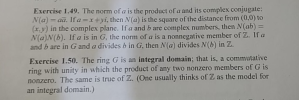 From last part of Q49
Exercise 1.49. The norm of a is the product of a and its complex conjugate: N(a) = aa. Ifa = x +yi, then N(a) is the square of the distance from (0,0) to (x.y) in the complex plane. If a and b are complex numbers, then N(ab)- N(a)N(b). If a is in G, the norm of a is a nonnegative member of Z. If a and b are in G and a divides b in...
From last part of Q49
Exercise 1.49. The norm of a is the product of a and its complex conjugate: N(a) = aa. Ifa = x +yi, then N(a) is the square of the distance from (0,0) to (x.y) in the complex plane. If a and b are complex numbers, then N(ab)- N(a)N(b). If a is in G, the norm of a is a nonnegative member of Z. If a and b are in G and a divides b in...
8. Let A be an integral domain containing elements x, y, and z. Prove the following...
 8. Let A be an integral domain containing elements x, y, and z. Prove the following facts. (a) If z|x and zly, then x/2 + y/2 = (x + y)/2. (b) If 2 x, then y. (x/2) = (y • x)/2. (c) If yız and x[(z/y), then (x • Y)|z, and 2/(x • y) = (z/y)/x.
3. Let {x1, x2,...,xn} be a list of numbers and let ¯ x denote the average...
3. Let {x1, x2,...,xn} be a list of numbers and let ¯ x denote the average of the list. Let a and b be two constants, and for each i such that 1 ≤ i ≤ n, let yi = axi + b. Consider the new list {y1,y2,...,yn}, and let the average of this list be ¯ y. Prove a formula for ¯ y in terms of a, b, and ¯ x. 4. Let n be a positive integer. Consider...
(1) Let P denote the solid bounded by the surface of the hemisphere z -Vl-r-y? and the cone2y2 and let n denote an outw...
 (1) Let P denote the solid bounded by the surface of the hemisphere z -Vl-r-y? and the cone2y2 and let n denote an outwardly directed unit normal vector. Define the vector field F(x, y, z) = yi + zVJ + 21k. (a) Evaluate the surface integral F n dS directly without using Gauss' Divergence Theorem. (b) Evaluate the triple integral Ш div(F) dV directly without using Gauss' Diver- gence Theorem Note: You should obtain the same answer in (a) and...
2.) Let Z the set of integers and two binary operations on it: Z23(x,y) → xTy = xy + 3x +3y +6 e ...
 2.) Let Z the set of integers and two binary operations on it: Z23(x,y) → xTy = xy + 3x +3y +6 e Z i) Show (Z,L,T)is an integral domain ii) Find the set of units U(Z)
2.) Let Z the set of integers and two binary operations on it: Z23(x,y) → xTy = xy + 3x +3y +6 e Z i) Show (Z,L,T)is an integral domain ii) Find the set of units U(Z)
2.) Let Z the set of integers and two binary operations on it: Z23(x,y) → xTy = xy + 3x +3y +6 e Z i) Show (Z,L,T)is an integral domain ii) Find the set of units U(Z)
1. Recall the definition of red, green, blue numbers. Let R denote the set of red numbers. Let G be the set of green num...
1. Recall the definition of red, green, blue numbers. Let R denote the set of red numbers. Let G be the set of green numbers, and let B denote the set of blue numbers. Is R S G S B = Z. Here Z is the set of all intergers. Explain.
Please solve all questions 1. Let 0 : Z/9Z+Z/12Z be the map 6(x + 9Z) =...
 Please solve all questions
1. Let 0 : Z/9Z+Z/12Z be the map 6(x + 9Z) = 4.+ 12Z (a) Prove that o is a ring homomorphism. Note: You must first show that o is well-defined (b) Is o injective? explain (c) Is o surjective? explain 2. In Z, let I = (3) and J = (18). Show that the group I/J is isomorphic to the group Z6 but that the ring I/J is not ring-isomorphic to the ring Z6. 3....
Please solve all questions
1. Let 0 : Z/9Z+Z/12Z be the map 6(x + 9Z) = 4.+ 12Z (a) Prove that o is a ring homomorphism. Note: You must first show that o is well-defined (b) Is o injective? explain (c) Is o surjective? explain 2. In Z, let I = (3) and J = (18). Show that the group I/J is isomorphic to the group Z6 but that the ring I/J is not ring-isomorphic to the ring Z6. 3....
Find the complex numbers w and z which solve the system of equations (-1+i)w + (-2-3i)z...
 Find the complex numbers w and z which solve the system of equations (-1+i)w + (-2-3i)z = -12 - 3i (-2+3i)w +(-1+i)z = 0 +10i (Hint: Check your solution by substituting back in)
5. Let x, y denote real numbers. Consider the statement 3r: (Vy: y(x + 1) ^ 5) Is it true or false? State your answer,...
 5. Let x, y denote real numbers. Consider the statement 3r: (Vy: y(x + 1) ^ 5) Is it true or false? State your answer, "true"" false", and prove it
5. Let x, y denote real numbers. Consider the statement 3r: (Vy: y(x + 1) ^ 5) Is it true or false? State your answer, "true"" false", and prove it
5. Let x, y denote real numbers. Consider the statement 3r: (Vy: y(x + 1) ^ 5) Is it true or false? State your answer, "true"" false", and prove it
 From last part of Q49
Exercise 1.49. The norm of a is the product of a and its complex conjugate: N(a) = aa. Ifa = x +yi, then N(a) is the square of the distance from (0,0) to (x.y) in the complex plane. If a and b are complex numbers, then N(ab)- N(a)N(b). If a is in G, the norm of a is a nonnegative member of Z. If a and b are in G and a divides b in...
From last part of Q49
Exercise 1.49. The norm of a is the product of a and its complex conjugate: N(a) = aa. Ifa = x +yi, then N(a) is the square of the distance from (0,0) to (x.y) in the complex plane. If a and b are complex numbers, then N(ab)- N(a)N(b). If a is in G, the norm of a is a nonnegative member of Z. If a and b are in G and a divides b in...
 8. Let A be an integral domain containing elements x, y, and z. Prove the following facts. (a) If z|x and zly, then x/2 + y/2 = (x + y)/2. (b) If 2 x, then y. (x/2) = (y • x)/2. (c) If yız and x[(z/y), then (x • Y)|z, and 2/(x • y) = (z/y)/x.
 (1) Let P denote the solid bounded by the surface of the hemisphere z -Vl-r-y? and the cone2y2 and let n denote an outwardly directed unit normal vector. Define the vector field F(x, y, z) = yi + zVJ + 21k. (a) Evaluate the surface integral F n dS directly without using Gauss' Divergence Theorem. (b) Evaluate the triple integral Ш div(F) dV directly without using Gauss' Diver- gence Theorem Note: You should obtain the same answer in (a) and...
 2.) Let Z the set of integers and two binary operations on it: Z23(x,y) → xTy = xy + 3x +3y +6 e Z i) Show (Z,L,T)is an integral domain ii) Find the set of units U(Z)
2.) Let Z the set of integers and two binary operations on it: Z23(x,y) → xTy = xy + 3x +3y +6 e Z i) Show (Z,L,T)is an integral domain ii) Find the set of units U(Z)
2.) Let Z the set of integers and two binary operations on it: Z23(x,y) → xTy = xy + 3x +3y +6 e Z i) Show (Z,L,T)is an integral domain ii) Find the set of units U(Z)
 Please solve all questions
1. Let 0 : Z/9Z+Z/12Z be the map 6(x + 9Z) = 4.+ 12Z (a) Prove that o is a ring homomorphism. Note: You must first show that o is well-defined (b) Is o injective? explain (c) Is o surjective? explain 2. In Z, let I = (3) and J = (18). Show that the group I/J is isomorphic to the group Z6 but that the ring I/J is not ring-isomorphic to the ring Z6. 3....
Please solve all questions
1. Let 0 : Z/9Z+Z/12Z be the map 6(x + 9Z) = 4.+ 12Z (a) Prove that o is a ring homomorphism. Note: You must first show that o is well-defined (b) Is o injective? explain (c) Is o surjective? explain 2. In Z, let I = (3) and J = (18). Show that the group I/J is isomorphic to the group Z6 but that the ring I/J is not ring-isomorphic to the ring Z6. 3....
 Find the complex numbers w and z which solve the system of equations (-1+i)w + (-2-3i)z = -12 - 3i (-2+3i)w +(-1+i)z = 0 +10i (Hint: Check your solution by substituting back in)
 5. Let x, y denote real numbers. Consider the statement 3r: (Vy: y(x + 1) ^ 5) Is it true or false? State your answer, "true"" false", and prove it
5. Let x, y denote real numbers. Consider the statement 3r: (Vy: y(x + 1) ^ 5) Is it true or false? State your answer, "true"" false", and prove it
5. Let x, y denote real numbers. Consider the statement 3r: (Vy: y(x + 1) ^ 5) Is it true or false? State your answer, "true"" false", and prove it
Most questions answered within 3 hours.
-
Where is the error in this code sequence?
String s1 = "Hello";
String s2 = "ello";...
asked 10 months ago -
Financial data for Joel de Paris, Inc., for last year
follow:
Joel de Paris, Inc.
Balance...
asked 10 months ago -
Consider this reaction:
Al2(SO4)3 (aq)+ BaCl3
(aq) Al2Cl6 (aq)- +
3BaSO4(s) . What is the...
asked 10 months ago -
Suppose that Savneet is considering increasing her
recent random sample from 20 car rentals to 40...
asked 10 months ago -
Trucks arrive at an unloading terminal at an average rate of 120
per hour.
Trucks arrive...
asked 10 months ago -
Why are methanol and ethanol completely soluble in water while
octanol is not very little soluble....
asked 10 months ago -
A facilities manager at a university reads in a research report
that the mean amount of...
asked 10 months ago -
When the CuSO4 is rehydrated by adding water to the anhydrous
compound, is this an endothermic...
asked 10 months ago -
A ray of sunlight is passing from diamond into crown glass; the
angle of incidence is...
asked 10 months ago -
A block of mass 0.249 kg is placed on top of a light, vertical
spring of...
asked 10 months ago -
how do the kidneys compensate in the presences of acidosis
a) trigger hyperventilate
b) reserve acid...
asked 10 months ago -
Question 501 pts
The rental rate of capital to the firm increases. Which of the
following...
asked 10 months ago