
Homework Answers

Add Answer to:
15. (30 points) Let Y1 < Y2 < Y3 < Y4 be the order statistics of a random sample of size n = 4 fr...
Let Y1<Y2<...<Yn be the order statistics of a random sample of size n from the distribution...
 Let Y1<Y2<...<Yn be the
order statistics of a random sample of size n from the distribution
having p.d.f f(x) = e-y , 0<y<, zero elsewhere. Answer the following
questions.
(a) decide whether Z1 = Y2
and Z2=Y4-Y2 are
stochastically independent or not. (hint. first find the joint
p.d.f. of Y2 and Y4)
(b) show that
Z1 = nY1, Z2=
(n-1)(Y2-Y1),
Z3=(n-2)(Y3-Y2), ....,
Zn=Yn-Yn-1
are stocahstically
independent and that each Zi has the exponential
distribution.(hint use change of variable technique)
Let Y1<Y2<...<Yn be the
order statistics of a random sample of size n from the distribution
having p.d.f f(x) = e-y , 0<y<, zero elsewhere. Answer the following
questions.
(a) decide whether Z1 = Y2
and Z2=Y4-Y2 are
stochastically independent or not. (hint. first find the joint
p.d.f. of Y2 and Y4)
(b) show that
Z1 = nY1, Z2=
(n-1)(Y2-Y1),
Z3=(n-2)(Y3-Y2), ....,
Zn=Yn-Yn-1
are stocahstically
independent and that each Zi has the exponential
distribution.(hint use change of variable technique)
Let Y1< Y2< Y3< Y4< Y5 be the order statistics of n=5 independent observations from the...
Let Y1< Y2< Y3< Y4< Y5 be the order statistics of n=5 independent observations from the exponential distribution with mean= 1. determine P(Y1>1) and find the pdf of Y5
7.46. Let Yi < Y2 Y, be the order statistics of a random sample of size 3 from the distribution with p.d.f. zero...
 7.46. Let Yi < Y2 Y, be the order statistics of a random sample of size 3 from the distribution with p.d.f. zero elsewhere. Find the Joint p.d.f. of Z.-,, Z,-, and Z,- YYY,. The corresponding transformation maps the space 12 Show that z, and z, are joint sufficient statistics for θ1 and θ2.
7.46. Let Yi
7.46. Let Yi < Y2 Y, be the order statistics of a random sample of size 3 from the distribution with p.d.f. zero elsewhere. Find the Joint p.d.f. of Z.-,, Z,-, and Z,- YYY,. The corresponding transformation maps the space 12 Show that z, and z, are joint sufficient statistics for θ1 and θ2.
7.46. Let Yi
Let Y1, Y2, …, Y4 be a random sample from a normal distribution with mean 10...
Let Y1, Y2, …, Y4 be a random sample from a normal distribution with mean 10 years and standard deviation 2.5 years. Find the following probabilities. A. P(Y4 > 14 years) B. P(Y1 + Y2 + Y3 + Y4 < 36 years) C. P{(Y1 < 9 years) and (Y2 < 9 years) and (Y3 < 9 years) and (Y4 < 9 years)} Note: B and C are asking different questions. D. Find E(Y1 +...
Let Y1 N(1,1), Y2 N(2,2), and Y3 N(3,3) be independent random variables. Find a new random...
Let Y1 N(1,1), Y2 N(2,2), and Y3 N(3,3) be independent random variables. Find a new random variable Y4 that is a function of Y1, Y2, and Y3 such that Y4 has a t-distribution with 2 degrees of freedom, and explain why it has that distribution. (To avoid confusion, the parameters in the normal distributions above are the mean and the standard deviation.)
4. I. Let Yǐ < ½ < ⅓ < Ya be the order statistics of a...
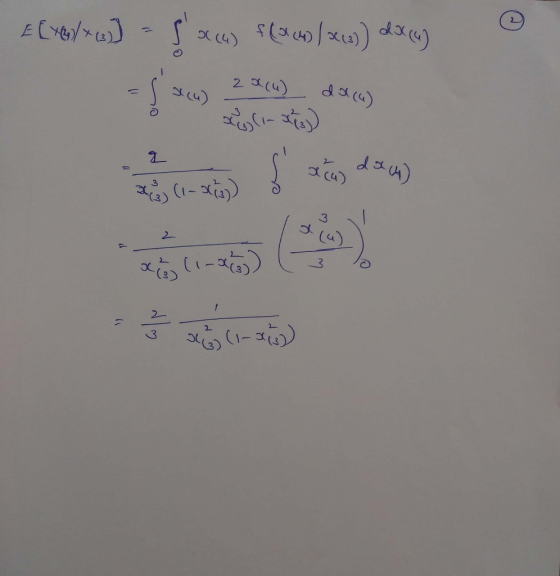
 4. I. Let Yǐ < ½ < ⅓ < Ya be the order statistics of a random sample of size n = 4 from a distribution with pdf f(x) 322, 0<< 1, zero elsewhere. (a) Find the joint pdf of Ys and Ya (b) Find the conditional pdf of Ys, given Y-y (c) Evaluate Evsl (d) Compute the probability that the smallest of the random sample exceeds the median of the distribution
Statistics - Introduction to Probability Please show all work Let Y1 and Y2 be continuous random...
 Statistics - Introduction to Probability
Please show all work
Let Y1 and Y2 be continuous random variables with the joint p.d.f. (probability density function) f(V1, V2) given by Vi + V2 for Os Visl and O SV2 s 1 f(V1, V2) { 0 elsewhere Find the marginal c.d.f. (cumulative distribution function) of a random variable Y1
Statistics - Introduction to Probability
Please show all work
Let Y1 and Y2 be continuous random variables with the joint p.d.f. (probability density function) f(V1, V2) given by Vi + V2 for Os Visl and O SV2 s 1 f(V1, V2) { 0 elsewhere Find the marginal c.d.f. (cumulative distribution function) of a random variable Y1
Let Y1, Y2, and Y3 be independent, N(0, 1)-distributed random variables, and set X1 = Y1...
Let Y1, Y2, and Y3 be independent, N(0, 1)-distributed random variables, and set X1 = Y1 − Y3, X2 = 2Y1 + Y2 − 2Y3, X3 = −2Y1 + 3Y3.Determine the conditional distribution of X2 given that X1 + X3 = x.
Let Y4 be the largest order statistic of a sample of size n = 4 from...
Let Y4 be the largest order statistic of a sample of size n = 4 from a distribution with uniform pdf f(x; θ) = 1/θ, 0 < x < θ, zero elsewhere. If the prior pdf of the parameter g(θ) = 2/θ3, 1 < θ < ∞, zero elsewhere, find the Bayesian estimator δ(Y4) of θ, based upon the sufficient statistic Y4, using the loss function |δ(y4) − θ|.
6.62. Let Yi < Y2 < . . . < Y, be the order statistics of...
 6.62. Let Yi < Y2 < . . . < Y, be the order statistics of a random sample of size n from the distribution having p.df.f(x)-2x/g, 0<x <θ, zero elsewhere (a) If 0 < c < 1, show that Pr (c < Y,/θ < 1)-1-eM (b) If n=5 and if the observed value of Y, is 1.8, find a 99 percent confidence interval for 0.
 Let Y1<Y2<...<Yn be the
order statistics of a random sample of size n from the distribution
having p.d.f f(x) = e-y , 0<y<, zero elsewhere. Answer the following
questions.
(a) decide whether Z1 = Y2
and Z2=Y4-Y2 are
stochastically independent or not. (hint. first find the joint
p.d.f. of Y2 and Y4)
(b) show that
Z1 = nY1, Z2=
(n-1)(Y2-Y1),
Z3=(n-2)(Y3-Y2), ....,
Zn=Yn-Yn-1
are stocahstically
independent and that each Zi has the exponential
distribution.(hint use change of variable technique)
Let Y1<Y2<...<Yn be the
order statistics of a random sample of size n from the distribution
having p.d.f f(x) = e-y , 0<y<, zero elsewhere. Answer the following
questions.
(a) decide whether Z1 = Y2
and Z2=Y4-Y2 are
stochastically independent or not. (hint. first find the joint
p.d.f. of Y2 and Y4)
(b) show that
Z1 = nY1, Z2=
(n-1)(Y2-Y1),
Z3=(n-2)(Y3-Y2), ....,
Zn=Yn-Yn-1
are stocahstically
independent and that each Zi has the exponential
distribution.(hint use change of variable technique)
 7.46. Let Yi < Y2 Y, be the order statistics of a random sample of size 3 from the distribution with p.d.f. zero elsewhere. Find the Joint p.d.f. of Z.-,, Z,-, and Z,- YYY,. The corresponding transformation maps the space 12 Show that z, and z, are joint sufficient statistics for θ1 and θ2.
7.46. Let Yi
7.46. Let Yi < Y2 Y, be the order statistics of a random sample of size 3 from the distribution with p.d.f. zero elsewhere. Find the Joint p.d.f. of Z.-,, Z,-, and Z,- YYY,. The corresponding transformation maps the space 12 Show that z, and z, are joint sufficient statistics for θ1 and θ2.
7.46. Let Yi
 4. I. Let Yǐ < ½ < ⅓ < Ya be the order statistics of a random sample of size n = 4 from a distribution with pdf f(x) 322, 0<< 1, zero elsewhere. (a) Find the joint pdf of Ys and Ya (b) Find the conditional pdf of Ys, given Y-y (c) Evaluate Evsl (d) Compute the probability that the smallest of the random sample exceeds the median of the distribution
 Statistics - Introduction to Probability
Please show all work
Let Y1 and Y2 be continuous random variables with the joint p.d.f. (probability density function) f(V1, V2) given by Vi + V2 for Os Visl and O SV2 s 1 f(V1, V2) { 0 elsewhere Find the marginal c.d.f. (cumulative distribution function) of a random variable Y1
Statistics - Introduction to Probability
Please show all work
Let Y1 and Y2 be continuous random variables with the joint p.d.f. (probability density function) f(V1, V2) given by Vi + V2 for Os Visl and O SV2 s 1 f(V1, V2) { 0 elsewhere Find the marginal c.d.f. (cumulative distribution function) of a random variable Y1
 6.62. Let Yi < Y2 < . . . < Y, be the order statistics of a random sample of size n from the distribution having p.df.f(x)-2x/g, 0<x <θ, zero elsewhere (a) If 0 < c < 1, show that Pr (c < Y,/θ < 1)-1-eM (b) If n=5 and if the observed value of Y, is 1.8, find a 99 percent confidence interval for 0.
Most questions answered within 3 hours.
-
Where is the error in this code sequence?
String s1 = "Hello";
String s2 = "ello";...
asked 11 months ago -
Financial data for Joel de Paris, Inc., for last year
follow:
Joel de Paris, Inc.
Balance...
asked 11 months ago -
Consider this reaction:
Al2(SO4)3 (aq)+ BaCl3
(aq) Al2Cl6 (aq)- +
3BaSO4(s) . What is the...
asked 11 months ago -
Suppose that Savneet is considering increasing her
recent random sample from 20 car rentals to 40...
asked 11 months ago -
Trucks arrive at an unloading terminal at an average rate of 120
per hour.
Trucks arrive...
asked 11 months ago -
Why are methanol and ethanol completely soluble in water while
octanol is not very little soluble....
asked 11 months ago -
A facilities manager at a university reads in a research report
that the mean amount of...
asked 11 months ago -
When the CuSO4 is rehydrated by adding water to the anhydrous
compound, is this an endothermic...
asked 11 months ago -
A ray of sunlight is passing from diamond into crown glass; the
angle of incidence is...
asked 11 months ago -
A block of mass 0.249 kg is placed on top of a light, vertical
spring of...
asked 11 months ago -
how do the kidneys compensate in the presences of acidosis
a) trigger hyperventilate
b) reserve acid...
asked 11 months ago -
Question 501 pts
The rental rate of capital to the firm increases. Which of the
following...
asked 11 months ago