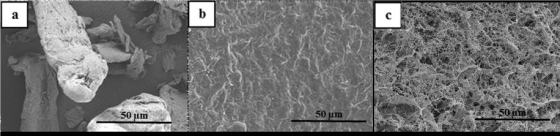
SEM images: (a) purified cellulose microfibers, (b) oven-dried cellulose nanofibers hydrogel (c) freeze dried cellulose nanofiber hydrogel
Discuss the effect of drying (air and freeze drying) on morphology of cellulose nanofiber hydrogels based on scanning electron microscopy (SEM) images.
Homework Answers
Scanning electron microscopy provides information about the surface morphology of the material.
Oven drying: In case of air drying there is considerable loss of water and the surface of the nanofibrils dries up shrinks. The undulations on the surface show that due to loss of water the fibres get unevenly spread.
Freeze drying: In case of freeze dying there is excessive loss of water which is very rapid (sublimation), which results in the stucture break down and formation of porous morphology. Numerous pores are formed with non-uniform diameter. It appears to be more disrupted stucture having amorphous form.
Add Answer to:
SEM images: (a) purified cellulose microfibers, (b) oven-dried cellulose nanofibers hydrogel (c) ...
2)Which of the A)peptidoglycan B)cellulose C)glycogen D)chitin 3 Which of the following is true of fluorescence...
 2)Which of the A)peptidoglycan B)cellulose C)glycogen D)chitin 3 Which of the following is true of fluorescence microscopy? A) Fluorescence microscopy is best at viewing rounded, thicker specimens B) Fluorescent light is emitted throughout the specimen due to fluorescent dyes conjugated to antibodies. C) Fluorescence microscopy is used to view dead specimens only. D) Fluorescence microscopy presents images in three dimensions. E) Fluorescence microscopy is able to overcome problems encountered with using confocal scanning microscopy. 4)While synthesizing a new green pigment,...
 2)Which of the A)peptidoglycan B)cellulose C)glycogen D)chitin 3 Which of the following is true of fluorescence microscopy? A) Fluorescence microscopy is best at viewing rounded, thicker specimens B) Fluorescent light is emitted throughout the specimen due to fluorescent dyes conjugated to antibodies. C) Fluorescence microscopy is used to view dead specimens only. D) Fluorescence microscopy presents images in three dimensions. E) Fluorescence microscopy is able to overcome problems encountered with using confocal scanning microscopy. 4)While synthesizing a new green pigment,...
Most questions answered within 3 hours.
-
Where is the error in this code sequence?
String s1 = "Hello";
String s2 = "ello";...
asked 11 months ago -
Financial data for Joel de Paris, Inc., for last year
follow:
Joel de Paris, Inc.
Balance...
asked 11 months ago -
Consider this reaction:
Al2(SO4)3 (aq)+ BaCl3
(aq) Al2Cl6 (aq)- +
3BaSO4(s) . What is the...
asked 11 months ago -
Suppose that Savneet is considering increasing her
recent random sample from 20 car rentals to 40...
asked 11 months ago -
Trucks arrive at an unloading terminal at an average rate of 120
per hour.
Trucks arrive...
asked 11 months ago -
Why are methanol and ethanol completely soluble in water while
octanol is not very little soluble....
asked 11 months ago -
A facilities manager at a university reads in a research report
that the mean amount of...
asked 11 months ago -
When the CuSO4 is rehydrated by adding water to the anhydrous
compound, is this an endothermic...
asked 11 months ago -
A ray of sunlight is passing from diamond into crown glass; the
angle of incidence is...
asked 11 months ago -
A block of mass 0.249 kg is placed on top of a light, vertical
spring of...
asked 11 months ago -
how do the kidneys compensate in the presences of acidosis
a) trigger hyperventilate
b) reserve acid...
asked 11 months ago -
Question 501 pts
The rental rate of capital to the firm increases. Which of the
following...
asked 11 months ago