
it is MATHEMATICAL PHYSICS PROBLEM kindly help me out in solving this problem :)
Homework Answers
Add Answer to:
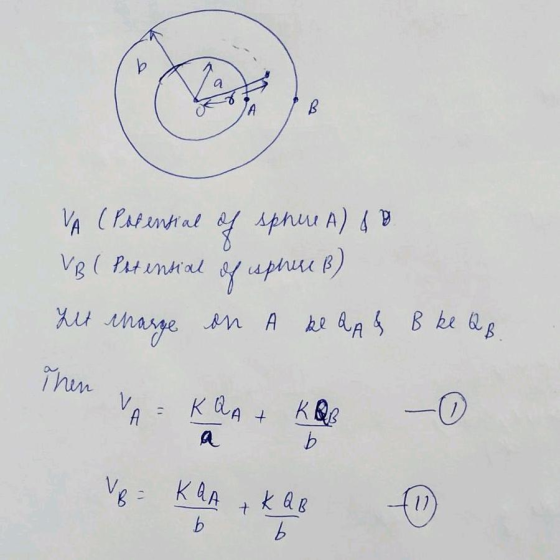
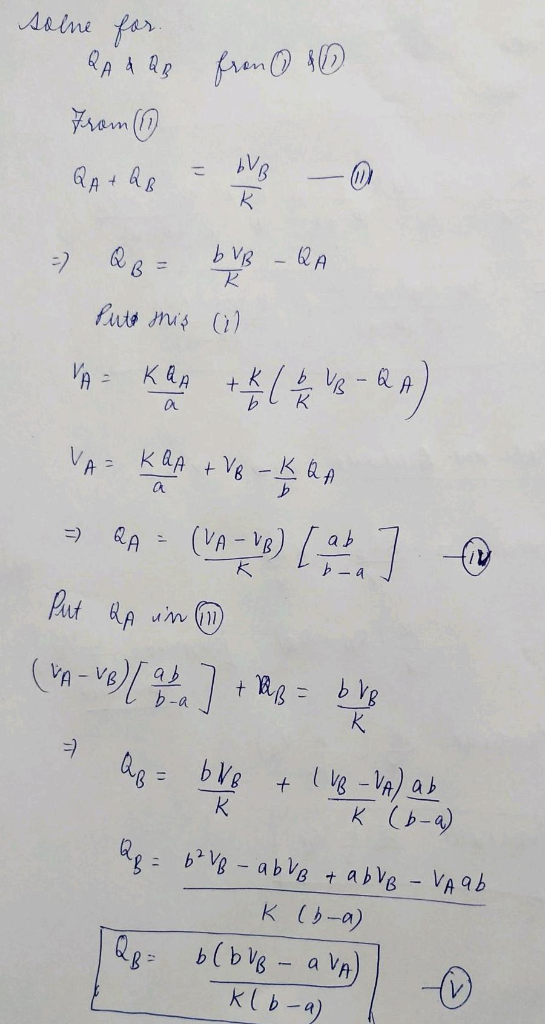
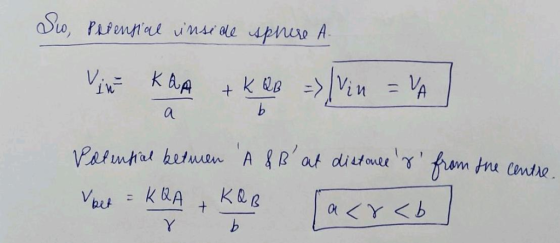
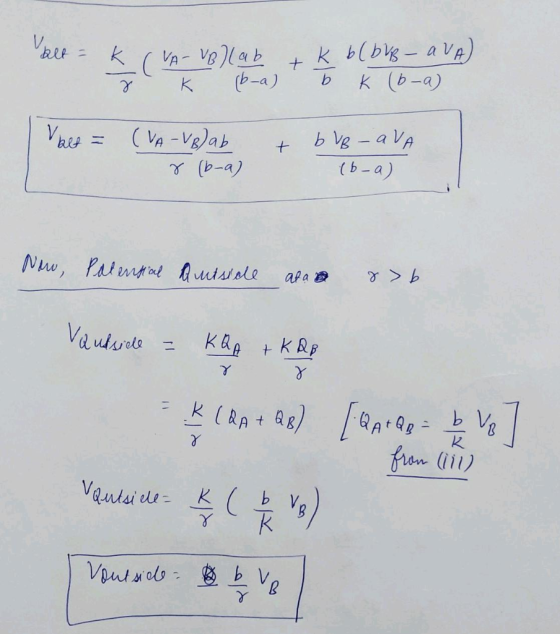
Two concentric conducting spheres of radius a and b are held at potential Va and Vo respectively....
Use Gauss’ Law to solve for the electric field everywhere. Two conducting spheres concentric spheres of...
Use Gauss’ Law to solve for the electric field everywhere. Two conducting spheres concentric spheres of different radii (e.g. r1 and r2). The inner sphere has charge –Q and the outer charge has charge +2Q.
A conducting sphere of radius a, at potential Vo, is surrounded by a thin concentric spherical...
 A conducting sphere of radius a, at potential Vo, is surrounded by a thin concentric spherical shell of radius b, over which someone has glued a surface charge density σ(8)-k cos θ, where k is a constant and θ is the polar spherical coordinate. (a) Find the potential in each region: (i)r > b, and () a<r<b. [5 points] [Hint: start from the general solution of Laplace's equation in spherical coordinates, but allow for different coefficients in the radial part...
Two conducting concentric spheres (shells)have radii R1 = 10 cm and R2 = 20 cm. Both...
Two conducting concentric spheres (shells)have radii R1 = 10 cm and R2 = 20 cm. Both spheres are charged to Q = +20 C. Find: (i) The electric field within the spheres and out of the external sphere. (ii) The potential difference between the spheres. (iii) The electric field profile if the spheres are connected by a thin conducting wire.
Two conducting spheres with radius r1 and r2 and charges q1 and q2, respectively, are connected...
 Two conducting spheres with radius r1 and r2 and charges q1 and q2, respectively, are connected with a conducting wire. The one with more charge will have a higher potential. Select one: True O False Check Two conducting spheres with radius r1 and r2 and charges q1 and q2, respectively. If they are connected with a conducting wire and at equilibrium, they have the same E field value on their surfaces, hence, q/r,2 2/2 Select one: False Check Two conducting...
Consider a geometry of concentric spheres: There is a solid conducting sphere having a radius of...
Consider a geometry of concentric spheres: There is a solid conducting sphere having a radius of a, with a charge of –3q applied to it. There is an insulating spherical shell having an inner radius of b and outer radius of c, with a charge of +2q uniformly distributed throughout its volume. There is a conducting spherical shell having an inner radius of c and outer radius of d, with a charge of +q applied to it. The radii are...
Consider two concentric conducting spheres. The outer sphere is a hollow shell, with an outer radius...
Consider two concentric conducting spheres. The outer sphere is a hollow shell, with an outer radius of a1 = 11.0 cm and a thickness of 0.50 cm. It initially has a charge Q1= -11.0 nC deposited on it. The inner sphere is solid of radius a2 = 5.00 cm, and it has a charge Q2 = +3.00 nC on it. (a) How much charge is on the outer surface of the shell? (b) How much charge is on the inner...
Two concentric conducting spheres of radii a = 5 cm and b = 10 cm have...
Two concentric conducting spheres of radii a = 5 cm and b = 10 cm have a potential difference V = 100 V between them. What is the charge carried by each sphere?
2. (25 points) Two concentric spheres have radii Ri and R2 (R2 > Ri). The potential...
 2. (25 points) Two concentric spheres have radii Ri and R2 (R2 > Ri). The potential everywhere on the surface of the inner sphere is zero. On the surface of the outer sphere the potential is given by V(R2,0-10 cos2 θ, where Vo is a constant and θ is one of the spherical coordinates. What is the potential in the region Ri < R2?
Q#2: Consider two concentric conducting spheres of finite thickness in vacuum. The inner sphere has radii a, a, and car...
 Q#2: Consider two concentric conducting spheres of finite thickness in vacuum. The inner sphere has radii a, a, and carries -q of charge. The outer sphere has radii b,< b, and carries +2q of charge. (a) Calculate the electric field in all regions. Indicate directions (b) Calculate the electric potential in all regions. Indicate signs. (c) Calculate the electrostatic energy of the entire system (d) Calculate the capacitance between the two spheres. (e) What is the electrostatic pressure on each...
Flag question The outer sphere of two concentric conducting spheres of radii 9 cm and 15...
 Flag question The outer sphere of two concentric conducting spheres of radii 9 cm and 15 cm is grounded. Charge q=8 nC is placed on the inner sphere. The outer conductor then contracts from radius 5 cm. Calculate the work done by the electric force.
 A conducting sphere of radius a, at potential Vo, is surrounded by a thin concentric spherical shell of radius b, over which someone has glued a surface charge density σ(8)-k cos θ, where k is a constant and θ is the polar spherical coordinate. (a) Find the potential in each region: (i)r > b, and () a<r<b. [5 points] [Hint: start from the general solution of Laplace's equation in spherical coordinates, but allow for different coefficients in the radial part...
 Two conducting spheres with radius r1 and r2 and charges q1 and q2, respectively, are connected with a conducting wire. The one with more charge will have a higher potential. Select one: True O False Check Two conducting spheres with radius r1 and r2 and charges q1 and q2, respectively. If they are connected with a conducting wire and at equilibrium, they have the same E field value on their surfaces, hence, q/r,2 2/2 Select one: False Check Two conducting...
 2. (25 points) Two concentric spheres have radii Ri and R2 (R2 > Ri). The potential everywhere on the surface of the inner sphere is zero. On the surface of the outer sphere the potential is given by V(R2,0-10 cos2 θ, where Vo is a constant and θ is one of the spherical coordinates. What is the potential in the region Ri < R2?
 Q#2: Consider two concentric conducting spheres of finite thickness in vacuum. The inner sphere has radii a, a, and carries -q of charge. The outer sphere has radii b,< b, and carries +2q of charge. (a) Calculate the electric field in all regions. Indicate directions (b) Calculate the electric potential in all regions. Indicate signs. (c) Calculate the electrostatic energy of the entire system (d) Calculate the capacitance between the two spheres. (e) What is the electrostatic pressure on each...
 Flag question The outer sphere of two concentric conducting spheres of radii 9 cm and 15 cm is grounded. Charge q=8 nC is placed on the inner sphere. The outer conductor then contracts from radius 5 cm. Calculate the work done by the electric force.
Most questions answered within 3 hours.
-
Where is the error in this code sequence?
String s1 = "Hello";
String s2 = "ello";...
asked 11 months ago -
Financial data for Joel de Paris, Inc., for last year
follow:
Joel de Paris, Inc.
Balance...
asked 11 months ago -
Consider this reaction:
Al2(SO4)3 (aq)+ BaCl3
(aq) Al2Cl6 (aq)- +
3BaSO4(s) . What is the...
asked 11 months ago -
Suppose that Savneet is considering increasing her
recent random sample from 20 car rentals to 40...
asked 11 months ago -
Trucks arrive at an unloading terminal at an average rate of 120
per hour.
Trucks arrive...
asked 11 months ago -
Why are methanol and ethanol completely soluble in water while
octanol is not very little soluble....
asked 11 months ago -
A facilities manager at a university reads in a research report
that the mean amount of...
asked 11 months ago -
When the CuSO4 is rehydrated by adding water to the anhydrous
compound, is this an endothermic...
asked 11 months ago -
A ray of sunlight is passing from diamond into crown glass; the
angle of incidence is...
asked 11 months ago -
A block of mass 0.249 kg is placed on top of a light, vertical
spring of...
asked 11 months ago -
how do the kidneys compensate in the presences of acidosis
a) trigger hyperventilate
b) reserve acid...
asked 11 months ago -
Question 501 pts
The rental rate of capital to the firm increases. Which of the
following...
asked 11 months ago