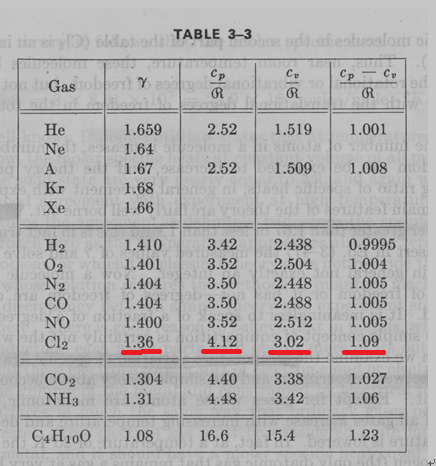
The measured data were at temperatures near room temperature.
For diatomic molecules, I know how to calculate the value of r, Cp/R, Cv/R, (Cp-Cv)/R.
I confused why value of Cl2 has a gap with others diatomic molecules value (r, Cp/R, Cv/R, (Cp-Cv)/R) in experimental.
Thanks!
-------------------------
Are there any information need to give you?
Homework Answers
In general while calculating heat capacity we assume that molucule stays in lowest vibrational energy state because spacing of vibration energy level is large so there will not be any contribution of vibrational degree of freedom in specific heat. However, as per quantum harmonic oscillator approximation, spacing of quantum vibrational energy levels are inversely proportional to reduced mass of atoms in diatomic molecule. Hence, in heavier molecules like chlorine Cl2, energy spacing becomes small and higher vibration energy levels can be occupied even at low temperature. As a result we have to add vibrational degree of freedom as well in case of chlorine specific heat. That is why specific heat of chlorine is higher
================================================
please rate the answer if you like it and write in comment if you have any doubt
Add Answer to:
The measured data were at temperatures near room temperature. For diatomic molecules, I know how ...
(The measured data were at temperature near room temperature.) For monatomic molecules, f=3 (tran...
 (The measured data were at temperature near room
temperature.)
For monatomic molecules, f=3 (translational kinetic energy
degrees of freedom)
so we can get Cv/R=f/2=1.5, Cp/R= (f+2)/2=2.5,
r=(f+2)/2=1.67
The results agree with the experimental observation.
For monatomic molecules, f=7
we can get Cv/R=f/2=3.5, Cp/R= (f+2)/2=4.5, r=(f+2)/2=1.286
The results disagree with the experimental observation.
---------------------------------------
I think that some energy modes (degree of freedom) were not
fully excited at room temperature, if the temperature is high
enough, the experimental value will getting...
(The measured data were at temperature near room
temperature.)
For monatomic molecules, f=3 (translational kinetic energy
degrees of freedom)
so we can get Cv/R=f/2=1.5, Cp/R= (f+2)/2=2.5,
r=(f+2)/2=1.67
The results agree with the experimental observation.
For monatomic molecules, f=7
we can get Cv/R=f/2=3.5, Cp/R= (f+2)/2=4.5, r=(f+2)/2=1.286
The results disagree with the experimental observation.
---------------------------------------
I think that some energy modes (degree of freedom) were not
fully excited at room temperature, if the temperature is high
enough, the experimental value will getting...
 (The measured data were at temperature near room
temperature.)
For monatomic molecules, f=3 (translational kinetic energy
degrees of freedom)
so we can get Cv/R=f/2=1.5, Cp/R= (f+2)/2=2.5,
r=(f+2)/2=1.67
The results agree with the experimental observation.
For monatomic molecules, f=7
we can get Cv/R=f/2=3.5, Cp/R= (f+2)/2=4.5, r=(f+2)/2=1.286
The results disagree with the experimental observation.
---------------------------------------
I think that some energy modes (degree of freedom) were not
fully excited at room temperature, if the temperature is high
enough, the experimental value will getting...
(The measured data were at temperature near room
temperature.)
For monatomic molecules, f=3 (translational kinetic energy
degrees of freedom)
so we can get Cv/R=f/2=1.5, Cp/R= (f+2)/2=2.5,
r=(f+2)/2=1.67
The results agree with the experimental observation.
For monatomic molecules, f=7
we can get Cv/R=f/2=3.5, Cp/R= (f+2)/2=4.5, r=(f+2)/2=1.286
The results disagree with the experimental observation.
---------------------------------------
I think that some energy modes (degree of freedom) were not
fully excited at room temperature, if the temperature is high
enough, the experimental value will getting...
Most questions answered within 3 hours.
-
Where is the error in this code sequence?
String s1 = "Hello";
String s2 = "ello";...
asked 11 months ago -
Financial data for Joel de Paris, Inc., for last year
follow:
Joel de Paris, Inc.
Balance...
asked 11 months ago -
Consider this reaction:
Al2(SO4)3 (aq)+ BaCl3
(aq) Al2Cl6 (aq)- +
3BaSO4(s) . What is the...
asked 11 months ago -
Suppose that Savneet is considering increasing her
recent random sample from 20 car rentals to 40...
asked 11 months ago -
Trucks arrive at an unloading terminal at an average rate of 120
per hour.
Trucks arrive...
asked 11 months ago -
Why are methanol and ethanol completely soluble in water while
octanol is not very little soluble....
asked 11 months ago -
A facilities manager at a university reads in a research report
that the mean amount of...
asked 11 months ago -
When the CuSO4 is rehydrated by adding water to the anhydrous
compound, is this an endothermic...
asked 11 months ago -
A ray of sunlight is passing from diamond into crown glass; the
angle of incidence is...
asked 11 months ago -
A block of mass 0.249 kg is placed on top of a light, vertical
spring of...
asked 11 months ago -
how do the kidneys compensate in the presences of acidosis
a) trigger hyperventilate
b) reserve acid...
asked 11 months ago -
Question 501 pts
The rental rate of capital to the firm increases. Which of the
following...
asked 11 months ago